30 JANUARY 2026
What to See: 11 Exhibitions on War, Color, and Loneliness Worth Visiting in February
Suspilne Kultura offers a selection of Ukrainian art exhibitions that can be visited in February in Kyiv, Lviv, Ivano-Frankivsk, Kharkiv, and Białystok. Some of them opened or were extended at the end of January, but are still open to visitors.
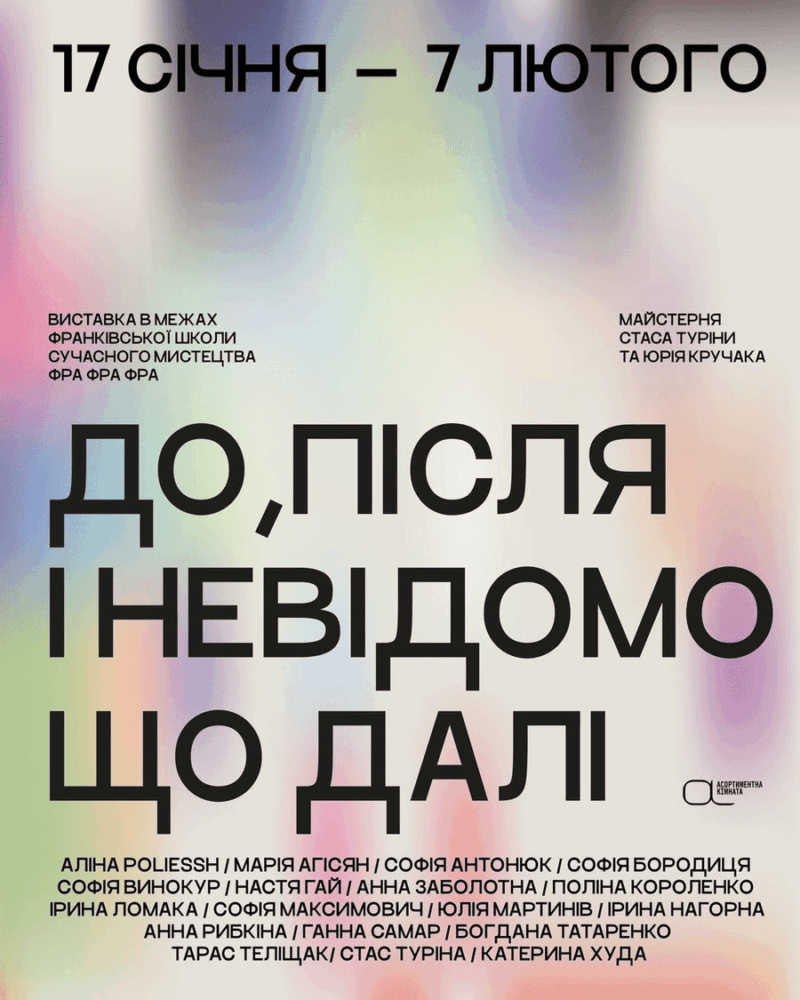
“Before, After, and What Comes Next”
Where: “Asortymentna Kimnata,” 15 Sichovykh Striltsiv Street, Ivano-Frankivsk
When: until 7 February, Thursday–Saturday, 12:00–18:00
Curatorial team: Stas Turina, Yuliia Martyniv, Mariia Ahisiian
The exhibition sums up the three-month course The Fate of Art, which took place at the studio of Stanislav Turina and Yurii Kruchala as part of the Ivano-Frankivsk School of Contemporary Art “Fra fra fra.”
The participants explored the question of artistic practice during wartime — how to continue creating. The exhibition features both new works created specifically for the show and pieces that existed prior to the workshop.
The exhibition brings together the following artists: Alina Poleshko, Mariia Ahisiian, Sofiia Antoniuk, Sofiia Borodytsia, Sofiia Vynokur, Nastia Hai, Anna Zabolotna, Polina Korolenko, Iryna Lomaka, Sofiia Maksymovych, Yuliia Martyniv, Iryna Nahorna, Anna Rybkina, Hanna Samar, Bohdana Tatarenko, Taras Telishchak, Stas Turina, and Kateryna Khuda.
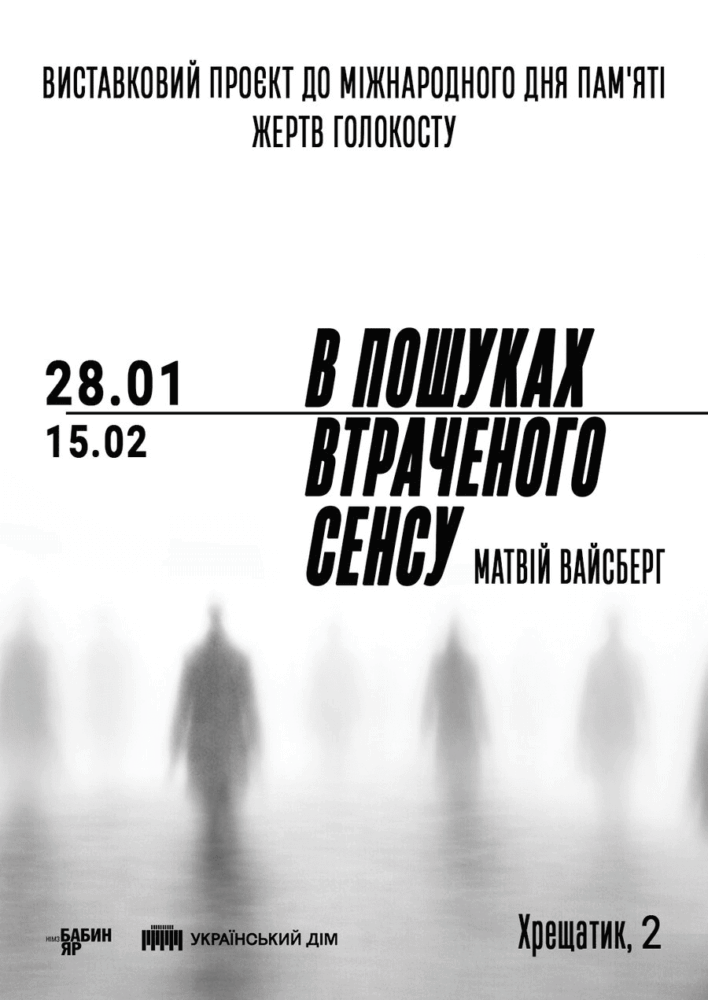
“In Search of Lost Meaning. Matviy Vaisberg”
Where: “Ukrainian House,” 2 Khreshchatyk Street, Kyiv
When: until 15 February 2026, Tuesday–Sunday, 11:00–19:00
Creative team: Roza Tapanova, Mariia Mizina, Mykhailo Alekseienko, Katia Lisova, Mykhailo Kulivnyk
The project is dedicated to International Holocaust Remembrance Day, marked on 27 January, the day of the liberation of prisoners from the Nazi death camp Auschwitz-Birkenau. The exhibition reflects on the memory of this event through texts by public figures, quotes from survivors, archival film materials, the world’s first symphony about the Holocaust written by Dmytro Klebanov, and works by Kyiv-based artist Matviy Vaisberg.
The exhibition brings together more than 200 paintings and graphic works by Matviy Vaisberg, created over the past three decades. These include the series Strange Homes, The Weak Anthropic Principle, Bruegel’s City, Maidan, Road Diary, and The Thin Red Line. The central work of the exhibition is the painting Seven Days, which serves as a metaphor for the search for meaning.
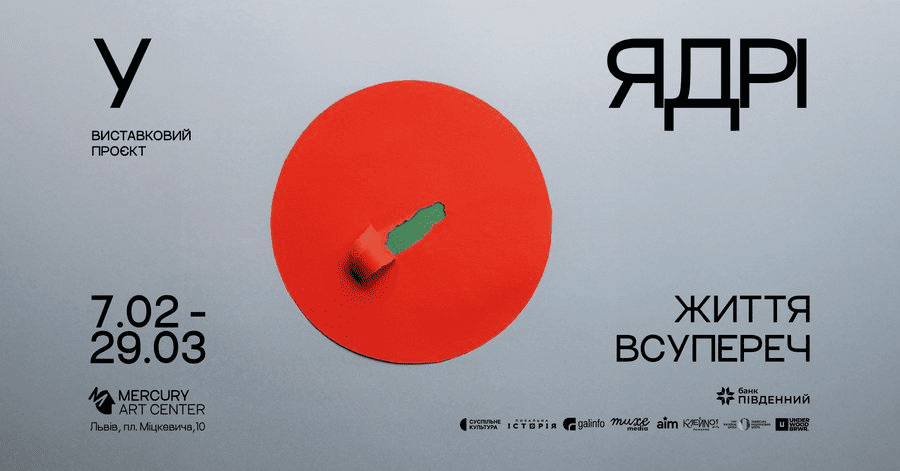
“At the Core”
Where: Mercury Art Center, 10 Adam Mickiewicz Square, Lviv
When: from 7 February to 29 March, Tuesday–Sunday, 12:00–20:00
Curator: Viktoriia Burlaka
As part of the project, works by Ukrainian artists from the time of the Revolution of Dignity to the present day will be presented across various media, including painting, sculpture, graphics, installation, video art, and others.
The exhibition explores how Ukrainians have learned to live in an environment of trauma and, despite this, find the strength to enjoy life, laugh, and love. The organizers believe that hope, memory, and light are what lie at the core.
The exhibition brings together twenty-six artists: Nazar Bilyk, Vlada Ralko, Roman Mykhailov, Daniil Revkovskyi, Andrii Rachynskyi, Kinder Album, Margo Rieznik, Mariia Kulikovska, Ave Libertatemaveamor, Danylo Movchan, Yurii Syvyryn, Tetiana Malinovska, Artem Volokitin, Maryna Taliutto, Alyona Naumenko, Liusia Ivanova, Serhii Kondratiuk, Olha Drozd, Halyna Dudar, Olena Shtepura, Polina Shcherbyna, Valentyna Ivanova, Mila Cheprasova, Anna Lehenka, Anastasiia Hryhorieva, and Liliia Topoliuk.
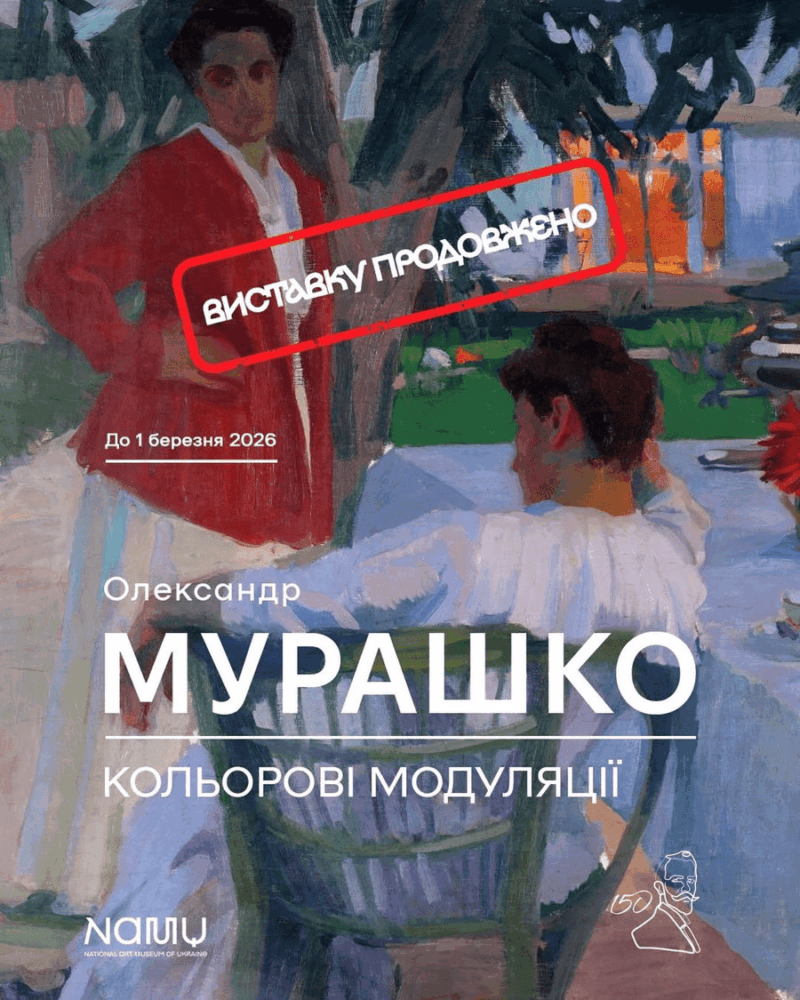
“Oleksandr Murashko. Color Modulations”
Where: National Art Museum of Ukraine (NAMU), 6 Mykhaila Hrushevskoho Street, Kyiv
When: until 1 March, Friday–Sunday, 12:00–18:00
The project is dedicated to the 150th anniversary of Oleksandr Murashko’s birth. The exhibition presents around 50 paintings and graphic works from the museum’s collection, as well as digital versions of archival materials. Priority was given to lesser-known works by the artist, some of which have not been exhibited for more than 20 years.
The project is curated by Maryna Drobotyuk, NAMU’s chief collections curator, and NAMU researcher Lesia Tolstova, with Murashko scholar Daria Dobriian serving as consultant.
“Looking into the Gaps IV”
Where: Jam Factory Art Center, 124 Bohdan Khmelnytskyi Street, Lviv
When: from 21 February to 17 May, Tuesday–Friday, 12:00–20:00; Saturday–Sunday, 11:00–20:00
Curator: Nikita Kadan
The exhibition series Looking into the Gaps was initiated by Nikita Kadan in 2024. It is dedicated to the theme of ruptured connections in the history of Ukrainian art. Previous installments were shown at Voloshyn Gallery in Kyiv, Artsvit Gallery and DCCC in Dnipro, and Art Front Gallery in Tokyo.
The reflections in the current exhibition begin with the theme of the relationship between “we” and “I” in times of war, and move toward loneliness, which has become normalized in the contemporary world.
They speak of an entire chain of lonelinesses: “from loneliness within (an absent or endlessly compulsively rewritten) history, or loneliness within the social contract (constantly betrayed by collective habit), to loneliness in the Ukrainian art field, with its incessant swing between a pull toward institutional care and toward anti-institutional emancipation. Loneliness between art history and the hysteria of artistic life. Ultimately, the connection between loneliness and independence…”
And in the end, they arrive at the shared “we” — an irreducible remainder without which everything would be lost.
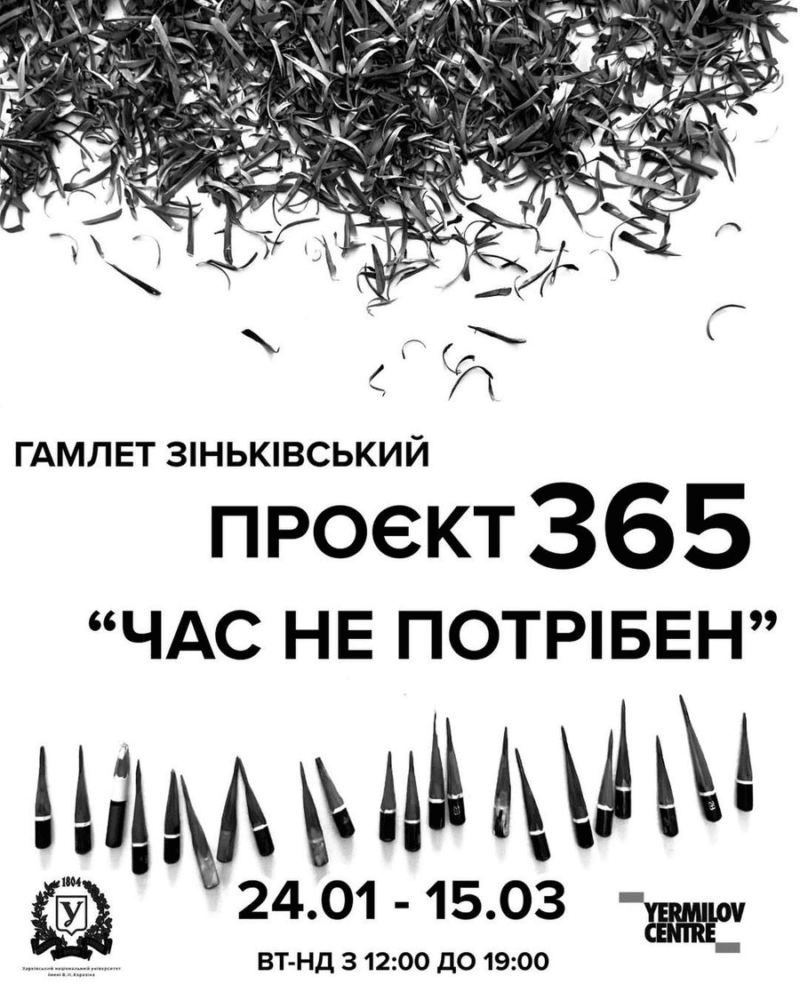
“Time Is Not Needed”
Where: Yermilov Center for Contemporary Art, 4 Maidan Svobody, Kharkiv
When: until 15 March, Tuesday–Sunday, 12:00–19:00
The exhibition continues Hamlet Zinkivskyi’s diary project 365. In it, the artist and illustrator, who primarily works with graphics and street art, explores human experience and inner states in conditions of war and uncertainty.
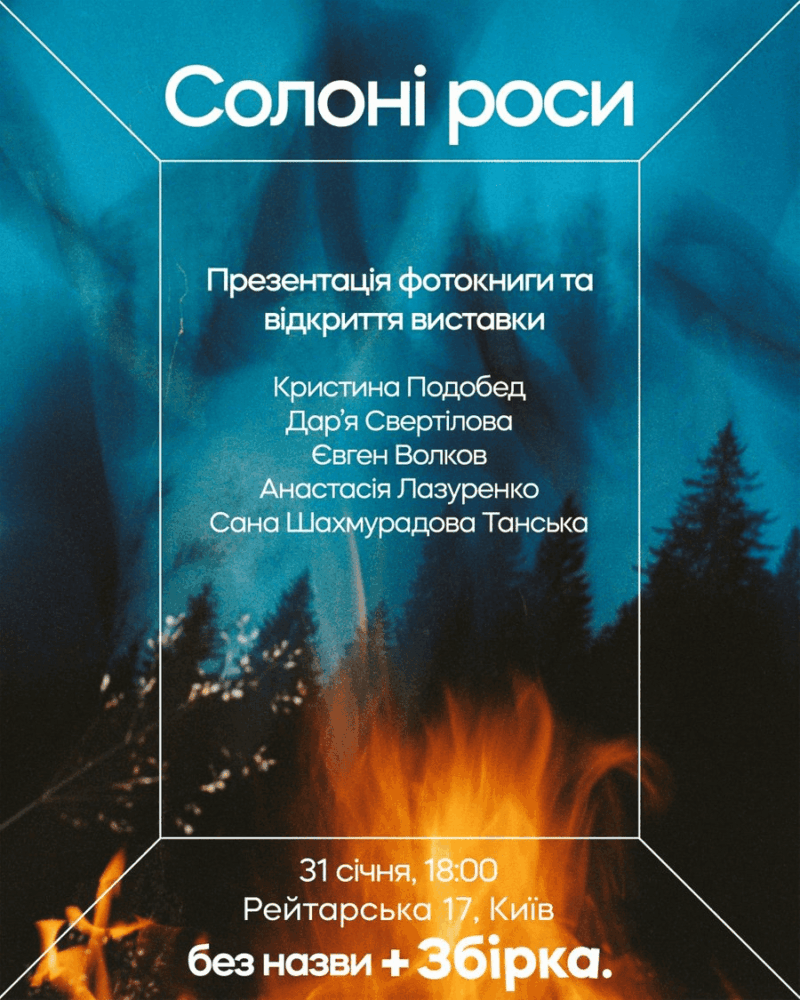
“Salty Dew”
Where: “Bez Nazvy” Gallery, Zbirka Bookstore, 17 Reitarska Street, Kyiv
When: 31 January – 21 February, Monday–Sunday, 11:00–21:00
Salty Dew is an artistic interpretation of Kupala Night rituals, inspired by the tradition of celebrating Ivan Kupala in Ukraine. It is not a reconstruction of the ritual, but a story about memory, the repetition of rituals, the need for magical thinking, and collectively experiencing liminal states.
The project was created in 2019 and has been updated with a photobook, the presentation of which will take place during the exhibition opening.
The exhibition features works by photographers Khrystyna Podobed, Daria Svertilova, Anastasiia Lazurenko, photographer Yevhen Volkov, and artist Sana Shakhmuradova-Tanska.
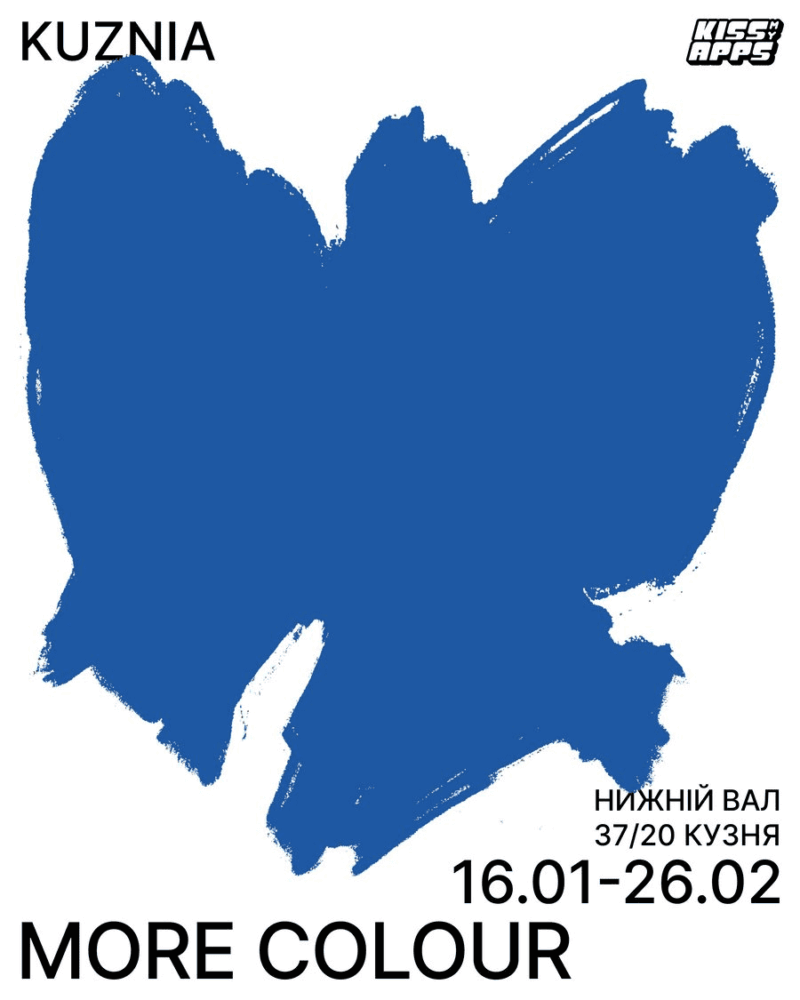
More Colour
Where: Kuznia Gallery, 37/20 Nyzhnii Val Street, Kyiv
When: until 26 February, Monday–Sunday, 9:00–20:00
Curators: Tetiana Tadai, Anastasiia Tereshchenko
The exhibition is dedicated to color as a substance with its own density, sound, and temperature, capable of activating personal memories, as well as color as an autonomous language of experience, memory, and presence.
This theme is explored through the independent practices of Ukrainian artists for whom working with color is central. The project features Anton Saienko, Ivan Oliinyk, Mariia Prysiazhniuk, Artur Muzo, and Yaryna Fedoriv.
Avulsion
Where: Arsenal Gallery in Białystok, 2 Adama Mickiewicza Street, Kyiv
When: until 15 February, Tuesday–Sunday, 10:00–18:00
Curator: Monika Szewczyk
The solo exhibition by Zhanna Kadyrova explores the term “avulsion.” In medicine, it refers to the separation of a bone or soft tissue from its attachment point, or to the intentional surgical removal of a body part. In law, it describes situations where natural processes alter national borders. In industry, it refers to relocation to another region, away from one’s original economic base.
Metaphorically, avulsion refers to separation from one’s environment, culture, or identity through a rejection of traditions and social norms, or the sudden rupture of social ties caused by a crisis.
Kadyrova reflects on how processes beyond our control affect our lives, reshaping territories and structures.
Spilne Art x MYPH Photography Prize
Where: 3.6.9 Space Kyiv, 24 Striletska Street, Kyiv
When: 30 January – 11 February, Wednesday–Sunday, 15:00–19:00
The exhibition features photographs by the three finalists of the MYPH Photography Prize.
The show brings together diverse experiences of living through the full-scale invasion. The photo project by serviceman Oleksii Chariey focuses on military experience. Daria Petrova’s works explore private stories, emotional states, and everyday life on the home front. Mark Chehodaiev’s project reflects on forced emigration through the lens of former tourist infrastructure in Austria.
“Transitional State”
Where: Respublika Sadu Café, 20A Volodymyra Vennychenka Street, Lviv
When: until 10 February, Monday–Sunday, 10:00–21:00
Transitional State is a series of photographs by Kostyantyn, created during the period of the full-scale invasion. His works cover various regions of Ukraine — from Mykolaiv to Kherson and Donetsk — and combine the stories of marines, volunteers, and residents of liberated territories with images of landscapes and cities altered by the war.
These photographs continue Kostyantyn Huzenko’s personal project How We Prepare for War, which he began at the start of the full-scale invasion. The project aimed to show how a person transforms from the decision to mobilize to joining the military, with the first subject being Ukrainian artist Bohdan Bunchak.
Following the photographer’s death on 1 November 2025, Huzenko’s vision remained unfinished. The exhibition Transitional State seeks to bring these works together into a coherent narrative.
Tags: art events color and loneliness culture in February EMPR.media exhibitions guide global art war art