
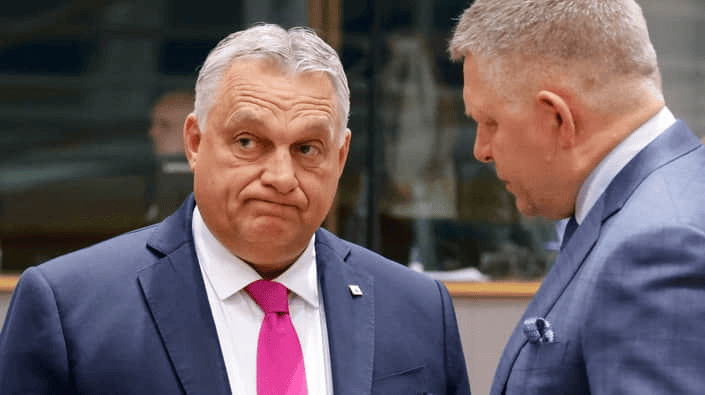
Hungary and Slovakia’s oil blackmail over Druzhba backfires, exposing alternatives to Russian crude, hitting MOL, straining EU ties, and revealing political alignment with Moscow openly.
On February 20, Hungary’s government said it would block the allocation of a €90 billion EU loan to Ukraine until supplies of Russian oil via the Druzhba pipeline are restored.
This is not the first attempt at blackmail: earlier, the Hungarian and Slovak governments threatened to ban exports of petroleum products and electricity to Ukraine. However, these steps clearly did not succeed.
Most importantly, the situation surrounding the Druzhba oil pipeline has debunked all the myths created by Viktor Orban and Robert Fico about the lack of alternatives to Russian oil for Hungary and Slovakia.
Former Slovak economy minister Karel Hirman reflects on the energy situation of Ukraine’s neighbors and on the truth that can no longer be concealed, European Pravda reports.
Following a Russian attack on the western Ukrainian oil hub of Brody and damage to the Druzhba pipeline, the governments of Slovakia and Hungary simultaneously decided to declare a state of emergency in their domestic oil products markets.
This move became a failure for the governments of Robert Fico and Viktor Orban — or, more precisely, a defeat for their policy of alignment with Putin and reliance on Russian energy imports.
After all, neither the closest neighbors (the Czech Republic, Poland, and Austria) nor other EU countries have had to introduce any emergency measures due to the shutdown of Druzhba. These countries long ago “cut themselves off” from such risks by abandoning the purchase of Russian oil.
This also became a strategic failure for the Hungarian company MOL, which owns oil refineries both in Hungary and the Bratislava-based Slovnaft.
Until now, MOL has consistently relied on supplies of Russian oil via the Druzhba pipeline. This approach was the opposite of the one chosen by other refineries in the region and across the European Union as a whole.
The Russian attack on the Druzhba pipeline infrastructure has confirmed the enormous risks of transit through Ukraine during the period of Putin’s aggression.
The current disregard for this risk and the insistence by Hungary and Slovakia on importing specifically Russian oil are causing enormous losses not only for MOL but also for the state budgets of both countries.
Due to the need to declare a state of emergency amid oil shortages, exports of petroleum products to neighboring countries, including Ukraine, also had to be suspended.
This step will not create any serious problems for Ukraine.
The impact on Kyiv will be minimal — petroleum products from Hungary and Slovakia will be replaced by supplies from other sources.
However, this is a blow to MOL: the company is not only suffering major financial losses but also risks losing markets. It now faces a real chance of being replaced by companies from countries that have already abandoned Russian oil and therefore are currently experiencing no problems due to the shutdown of the Druzhba pipeline.
In addition, MOL’s loss of markets is expected to lead to a decline in tax revenues in both Slovakia and Hungary.
At the same time, it is worth paying attention to several “discoveries” that have become obvious in recent days.
First of all, we have received full confirmation of the existence of an alternative route for supplying oil refineries in Hungary and Slovakia — something that Budapest and Bratislava had previously refused to acknowledge, insisting on the lack of any alternative to the Druzhba pipeline.
The Croatian oil terminal on the island of Krk and the Adria pipeline, following modernization in 2015, have sufficient capacity to supply both MOL refineries.
By the way, this fact has repeatedly been publicly confirmed in the past by the company’s top executives themselves.
Likewise, the head of Slovnaft has already announced that the company has purchased tankers with oil from various suppliers, and these supplies will begin arriving by the end of March. Until then, the refinery will operate in a limited mode (which means losses for both MOL and the Slovak state budget), using stocks from the state oil reserves.
Despite all these facts, we once again hear one-sided threats from Fico and Orban directed at Ukraine, as well as criticism of Croatia.
The demands addressed to Croatia to allow, as an exception, the transit of Russian tanker oil look particularly strange.
This is happening in a situation where MOL/Slovnaft itself reports that it has already purchased alternative oil.
Equally strange are the claims that the Adria pipeline allegedly lacks sufficient capacity and that the Croatians are unreliable transit partners — while at the same time asking those very Croatians for an exception to transport Russian oil.
After all, if Fico and Orban were truly right in claiming that Adria does not have enough capacity, then even Russian oil would not be able to pass through it.
Another “discovery” of recent days is that MOL has suddenly begun planning to purchase oil from other suppliers, even though until now Bratislava and Budapest had spoken with one voice, insisting that their refineries were capable of processing only Russian crude.
Developments related to the attack on the hub station in Brody are also noteworthy.
For more than two weeks, both European governments, as well as Kyiv, remained silent about the fact that the attack had damaged the Druzhba pipeline and halted oil transportation through it.
However, Fico and Orban are now suddenly accusing Ukraine of allegedly having already repaired the pipeline but refusing to restart it. Moreover, they are even questioning whether it was in fact damaged by Russian drones and missiles.
Yet Kyiv’s behavior also appears strange.
In addition to the prolonged silence about the damage to the pipeline, it is also being left unmentioned that the shutdown of the Druzhba pipeline halted supplies of Ukrainian oil to MOL refineries in Bratislava and Hungary as well.
These supplies began in late autumn last year at volumes of several tens of thousands of tons per month and were a response to Russian attacks on Ukrainian oil refineries. In this context, the Brody hub plays a key logistical role in these deliveries.
In other words, MOL has now lost not only Russian oil but also Ukrainian supplies, which had begun quite promisingly.
Another question arises: why is Ukraine still transporting Russian oil at all? As a result of Putin’s targeted attacks on the energy grid, Ukraine is facing a critical electricity shortage. Yet electricity is still being used to operate pumps on the oil pipeline.
In this context, the threats directed at Ukraine look even more outrageous and unacceptable.
Statements by Fico and Orban about halting exports of electricity and gas to Ukraine contradict not only basic humanitarian principles but also EU legislation.
Moreover, this concerns exports that are largely carried out by private companies and the energy transit networks of both countries, which earn substantial revenues from them.
Thus, the Slovak and Hungarian leaders are ready to act against the economic interests of their own countries. The statements by both governments are not only anti-Ukrainian, damaging relations with Kyiv — they also negatively affect relations with Croatia and with the EU as a whole.
It is Fico and Orban who are harming their countries’ interests. And all of this is being done solely to please Russia.
Tags: Druzhba pipeline EMPR.media EU politics Hungarian politics Orban and Fico Putin influence Russia energy leverage Slovak politics








![Visitors at the “Thank You With All My Heart” Ukrainian exhibition at the Council of Europe, featuring the Great Amber Heart and powerful war art. :contentReference[oaicite:2]{index=2}](https://empr.media/wp-content/uploads/2026/02/heart-300x171.png)