Social Housing Construction Begins in Bila Tserkva for Mariupol Displaced Residents. On a plot of 11 hectares, 16 buildings will be constructed.
This will provide a thousand apartments for over three thousand people. The first phase is planned to be completed by the end of 2026.
In Bila Tserkva (Kyiv region), a pilot project for building a residential complex of 1,000 apartments for displaced people from Mariupol has been officially launched. This was reported by Korrespondent.net, citing Deputy Prime Minister for Reconstruction and Minister for Communities and Territories Development, Oleksiy Kuleba.
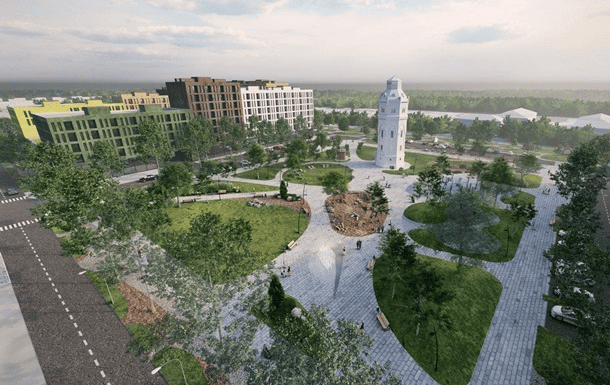
“Today in Bila Tserkva, Kyiv region, we officially launched the construction of municipal housing for families who lost their homes in Mariupol. This is a project we are implementing together with the Mariupol community, the Kyiv Regional Military Administration, businesses, urban planners, and our international partners. On a plot of nearly 11 hectares, 16 buildings will be constructed — providing a thousand apartments for over three thousand people. We plan to complete the first phase by the end of 2026,” he said.
The Deputy Prime Minister added that the neighborhood will be developed as a full-fledged residential area with access to education, healthcare, and services. The plan includes 6-7 story buildings with integrated kindergartens, commercial spaces, and apartments adapted for people with disabilities. The total housing area will exceed 46,000 square meters.
“The project is financed from several sources: the state budget, the budget of the Mariupol community, and support from the European Union.
It combines two key support mechanisms:
- the creation of a municipal rental housing fund, which the community will provide to internally displaced persons on social terms through a transparent allocation system. Apartments will be offered for social rent, below market value, already renovated, furnished, and equipped with household appliances.
- preferential mortgage lending for those who wish to purchase their own housing. This primarily includes families of military personnel, fallen soldiers, veterans, large families, and people with disabilities,” Kuleba noted.
According to TSN, the completed apartments will be transferred to the ownership of the Mariupol community. Rent will amount to no more than 30% of a family’s average income, but not exceeding 4–6 thousand hryvnias per month. Certain categories of internally displaced persons will be able to live rent-free under state programs. Negotiations are also ongoing for international support to scale up the project.
Construction is taking place within the framework of the government initiative “My Home. Ukraine,” which envisions the creation of a state system of affordable housing for socially vulnerable citizens.
“The pilot project for Mariupol residents is being implemented in accordance with government resolution No. 814 by the Mariupol City Council, with the participation of the Ministry of Development, the Kyiv Regional Military Administration, the Bila Tserkva City Council, and with the support of the Metinvest Group,” TSN reports.
The publication adds that construction has already passed the land allocation stage and basic preparatory work.
“Once the financing procedure is approved, permits will be obtained, and active construction will begin. The first phase — eight buildings for over 500 families — is planned to be built using steel frame technology, which will reduce timelines and costs. Metinvest Group has already handed over the documentation for the ‘Steel Dream’ quarter to the state and Mariupol City Council for further use. The company notes that the project allows for expanded use of Ukrainian steel in social construction and contributes to strengthening community resilience,” the authors write, adding that the pilot project is planned to be scaled to regions with the largest number of Mariupol residents — Lviv and Dnipro.
It is recalled that in November, the concept for the Bila Tserkva quarter for displaced persons from Mariupol was approved.
Tags: Bila Tserkva civilian relocation humanitarian aid Mariupol displaced reconstruction 2025 social housing Ukraine resettlement Ukraine war aftermath