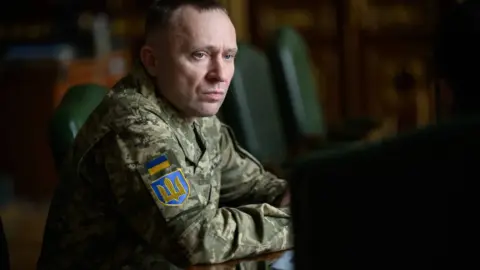
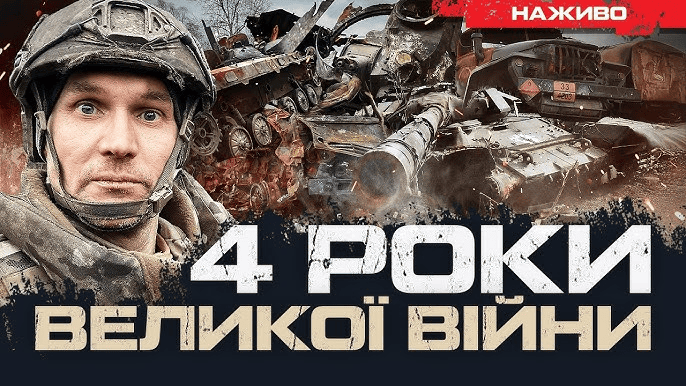
Platoon commander of the 13th “Khartia” Brigade of the National Guard of Ukraine, Yuriy Butusov, provides an analysis of the first days of Russia’s invasion during a live broadcast: the balance of forces, defensive mistakes, and the heroism of Ukrainian troops.
He also outlines the key conclusions drawn from four years of war. This was reported by Censor.NET.
The stream is dedicated to a dramatic, tragic, and heroic chapter in Ukrainian history — and world history as a whole: the fourth anniversary of Russia’s full-scale invasion of Ukraine.
A few words should be said about the situation four years ago, on February 24, 2022. In reality, the situation was critical. We all know this, but after four years it is already possible to draw certain conclusions about the balance of forces. According to Russian sources — and at this point only one Russian source has provided such an assessment over these four years — only one Russian analyst close to the Ministry of Defense of the Russian Federation, Ruslan Pukhov, made public the information that on February 24 Russia launched an offensive against Ukraine with a grouping of approximately 180,000 troops — this refers only to the ground strike force — and another 110,000 were forcibly mobilized in the occupied territories as the so-called L/DPR corps.
That is, the enemy committed only ground forces to the offensive, totaling 290,000 personnel. Overall, the Armed Forces of the Russian Federation, the Russian National Guard, and the mobilized “L/DPR corps” together amounted to at least 1.3 million servicemen.
That is, Russia deployed 320,000 ground forces against Ukraine, with the ability to reinforce them from a total grouping of 1.3 million. Ukraine, in turn, could oppose the enemy with significantly smaller forces.
I carried out calculations of our ground strike groupings that were ready at that time to repel the invasion. It is important to count the actual strength of the troops, because, as I remind you, Ukraine had not begun a general mobilization, and on February 24 we could rely only on those soldiers who were already serving in our defense forces. Thus, the total number of our ground forces did not exceed 90,000 servicemen. Consequently, the enemy had an advantage in the ground component alone of at least three to one.
Yes, the total number of servicemen in the Armed Forces of Ukraine was 210,000, and another 50,000 served in the National Guard of Ukraine. That makes 260,000 in total, plus around 20,000 border guards. However, not all of these troops — just as in the Russian army — were part of combat brigades or battalion tactical groups and could actually be employed in battle. Most personnel were stationed at military bases, facilities, arsenals, support units, rear-area units, as well as in aviation and the Air Force, and so on.
As a result, on the first day of the aggression the enemy had a multiple advantage in forces. This numerical superiority was further reinforced by the enemy’s absolute advantage in situational awareness. At that moment, the Ukrainian army had not been deployed along the border on designated defensive lines; most units simply did not have time to reach them. Deployment in Ukraine began only on February 21, and not even all units were involved. Nevertheless, Ukrainian units were deployed on certain lines where they effectively entered combat straight from the march, without being able to properly organize a defense.
Unfortunately, some units were overstretched. For example, the 58th Infantry Brigade had its subunits stretched along a 150-kilometer front. Other brigades, such as the 59th Brigade near Oleshky in Kherson Oblast, unfortunately were not deployed to their positions at all and were either on the move or in base camps. The enemy knew all of this and acted with complete audacity.
Unfortunately, all the bridges — from Crimea, all five of them, and the four bridges across Chonhar — were captured by the enemy. Only one bridge on the Arabat Spit was partially destroyed. We all know that this was the feat of Vitaliy Skakun. On my channel, there is an investigation by Iryna Storozhenko about this heroic act. In fact, only two of our sailors, on their own initiative, around 11 a.m., removed one explosive-laden trailer and managed to blow up one section of the Henichesk bridge. Unfortunately, the other bridges, six dams, and the four Chonhar bridges were used by the enemy almost without resistance that day.
A similarly tragic situation unfolded in the northern direction, where not a single bridge was destroyed. As a result, the reckless Russian attack on Hostomel, in which the Russian airborne unit — essentially a suicide squad — was reinforced and not eliminated to the last man, succeeded. The enemy reached Hostomel in just one day, covering up to 200 kilometers, because there was no resistance and the bridges were intact. This led to tragic consequences, allowing the enemy to advance very quickly.
The reasons for this were complex: the absence of mobilization, failure to deploy troops on designated defensive lines in time, lack of engineering preparation, and the failure to destroy key engineering structures.
It is shocking that, on the very first day of the war, the enemy managed to capture three bridges near Kherson. This led to extremely tragic consequences. The enemy took the Kakhovka dam in just a few hours, arriving there without a fight in armored personnel carriers the same day. Enemy helicopter-borne troops landed there unhindered and were successful because there was absolutely no guard at the Kakhovka dam. Likewise, the railway bridge near Kherson remained completely unprotected.
Infrastructure, including the famous Antonivskyi Bridge, had to be fought for by our troops because no security had been established. Through the railway bridge, the enemy was able to break through the Kakhovka dam, advance further, and redirect the offensive toward Voznesensk and Mykolaiv.
On the second day of the war, the enemy captured one of the largest cities in southern Ukraine — Melitopol — almost without a fight. By the fifth day, they reached Mariupol from the rear and captured Berdyansk on the third day. This is simply a shocking story. There are still no official assessments; a criminal case is ongoing, of course, with generals being questioned. Generals continue to give testimonies, but even on the fourth anniversary, the State Bureau of Investigation has not disclosed the full details.
All testimonies have long been given — soldiers who tried to blow up the bridges and pressed the detonators that didn’t work, officers, and generals responsible for all of this — all have provided statements. And yet, we know nothing from our official sources about what actually happened on February 24, 2022.
The fact that this information is not being released means that no conclusions are being drawn from it. Perhaps there is no intention to draw them at all. As a result, much of the dramatic situation continues. Unfortunately, without such conclusions, progress is severely limited.
All the more remarkable, in my view, is the real heroism of those Ukrainian soldiers who, despite the overwhelming enemy advantage, fought to the death from the very first minutes of the invasion. According to eyewitness accounts, even when they saw the enemy advancing unhindered over the bridges — crossing the Chonhar bridge, entering checkpoints at full speed—some of our soldiers still engaged in hopeless but heroic combat.
According to testimonies from our prisoners who were at Chonhar, one of our soldiers — whose identity we do not know — fired a grenade launcher and hit one of the Russian combat vehicles crossing Chonhar. I really want to investigate and find out who these people were, who these heroes are, who died at Chonhar — by name. Just imagine: a column moving at full speed, seemingly endless, with no one firing at it, crossing an intact bridge, with no shells or missiles striking it. And in the midst of this, one of our soldiers fired a grenade launcher, even in such hopeless conditions. There are tens of thousands of such heroic acts, which led to the Russian military machine being stopped, destroyed, and defeated.
But many talk about the underestimation of the situation by the Russian leadership. I want to say that, from what I have seen, the Russian invasion was actually fairly well-prepared, with a very clear plan that, in some areas — unfortunately, primarily in the south — succeeded. The enemy did not achieve all its objectives in the south; they were stopped near Zaporizhzhia and Volnovakha, but in the southern region, the Russians managed to reach all their goals, even ahead of schedule. And all of this happened, unfortunately, on the very first day of the war.
The heroes who, later in counterattacks, often hastily, without proper weapons or communication, stopped and defeated this well-prepared, mobilized, and equipped Russian army — an army with absolute air superiority, total naval dominance at the time, massive superiority in combat vehicles and artillery, and at least three times the number of ground forces — what they accomplished is a truly magnificent feat. It is a feat that should be studied, remembered, and recorded in the annals of Ukrainian history for many decades.
The people who entered such battles under those conditions are giants of spirit. Their memory is sacred, and I am grateful that many of these heroes are still alive, with a large number of them continuing the fight. This is what truly makes Ukraine invincible — the strength of such people.
Audience questions
If they hadn’t been allowed to come from Crimea, how do you think the front would have developed?
If all the bridges in the north and south had been blown up in time — on February 23 — then the Russian advance would have stalled at the border. The enemy would have had no chance to reach Hostomel, Irpin, Bucha, or even Moshchun in the north. They would have had no chance to advance toward Brovary through Sumy, nor to break through to Melitopol and Kherson. The numerous dams and bridges in Kherson Oblast severely restricted Russian troop movements.
There is a very important example, still little studied, that I learned from examining Russian sources. On the morning of February 24, Russian units of the 503rd Motorized Rifle Regiment, 19th Motorized Rifle Division, advanced into Ukraine at high speed. Their route through Chonhar was the known Kutaranska dam. On this dam, it is unclear exactly when — possibly back in 2015 — anti-tank explosives were installed. On the morning of February 24, two leading BMP-3 vehicles of the 19th Division crossed the dam, entered Ukrainian territory, and immediately detonated the explosives. Both vehicles and their crews were completely destroyed. I still do not know which Ukrainian sapper carried this out or when, but it was effective. Russian sources note that the regiment’s advance at this location was stopped for a full day. Imagine, no artillery fire, no aviation, no missiles, no shots from our side, not even small arms — and yet the enemy had to spend an entire day clearing the dam. Afterwards, the regiment’s units were redeployed to advance elsewhere.
This is a very serious indicator showing what would have happened if two bridges near Kherson had been blown up. Everything would have remained under Ukrainian control, and we could have maneuvered across these bridges. Melitopol could have had time to prepare its defenses. The enemy simply would not have been able to capture it, bogged down in battles at Chonhar while crossing all these dams and bridges. The terrain there is very difficult — if everything had been destroyed, you could not pass it in a tank or on a BTR. The course of the war would have been different. We would not have had to break through the Russian defensive line in the south head-on in 2023.
We would not have lost Mariupol. We lost two of our best combat brigades, which were encircled a week after the invasion began. Everything would certainly have gone differently. When will this be properly studied and the names of those responsible finally revealed?
Please tell us, have you learned anything new in the military? Share something that you have already managed to do differently.
Friends, I am just a UAV platoon commander at the moment, and I cannot say that we are doing something unique or new that other units haven’t done before. I think what is new is the need to gather people. No matter how much you know about the war — I have known many people in the army since the first days of the war, for many years, since 2014 — but when you form your own unit, when you have to find people, bring in operators, transfer personnel, call friends, work with mobilized soldiers and volunteers every day, and you are personally responsible for specific people, it is a completely different level of engagement, a completely different understanding of the situation.
When you go out as a journalist to film a report, that is one story. But when you go out as a commander responsible for conducting reconnaissance and setting positions, for example near Kupiansk, you work there not to film something, but to complete a specific combat mission. It is a completely different level of motivation, a completely different level of work, and you notice or do not notice entirely different things. So all of this, in this capacity, is new for me.
The new war itself is what it is — it is becoming more technological, more complex in terms of equipment. When I went out to Kupiansk, I want to say that several reconnaissance missions I carried out to set up our positions were, of course, each time something new, because when you face a large number of drones in the air, it is impossible not to be surprised. When the enemy’s kill zone in some directions begins about 10 kilometers from our forward edge, and their drones literally monitor every area, it reaches the point where the drones can see you and you can no longer hide.
Near Kupiansk, when I was moving by the railway station, Russian drones repeatedly spotted me and tried to strike. During one reconnaissance, a hostile FPV drone hit the vehicle I was in, targeting our mechanic-driver. I was sitting right behind him in the vehicle, and I was lucky because the FPV only struck the mount of our mesh on the windshield. If it had hit the mesh itself, I think, unfortunately, the RPG could have penetrated the armor glass. But in this case, we were lucky. The density of threats you feel during each mission is astonishing.
There are now a very large number of drones, and it is impossible to avoid being observed by them 100 percent, no matter how careful you are. This is truly a new factor, which has emerged more noticeably since the second half of 2025 and into 2026, and it is only increasing.
According to the calculations I made, the Russian army had at least a threefold advantage over Ukrainian forces on February 24, 2022. Russian propaganda, by the way, claims that such a large number of people in Ukraine were immediately mobilized, and that someone in the Kremlin underestimated the situation or that intelligence failed to report. I want to say that I counted the Russian mobilization numbers that were officially published in various Russian sources, primarily by the Ministry of Defense of the Russian Federation. These numbers include the officially reported strength of the Russian Armed Forces and other Russian military formations, including mobilized personnel.
From what I have observed throughout the war, Russia maintained a numerical advantage on the front. Even during Ukraine’s first wave of mobilization, Russia still kept its numerical superiority. Perhaps at the very beginning of the war this advantage was about twofold, but it remained nonetheless. Even with the initial wave of Ukrainian mobilization — which I know the figures for and will be publishing soon, showing the number of people who joined the defense forces in February–March — the number of recruits and the queues at military commissariats could not significantly increase Ukraine’s defense forces. There was insufficient equipment, and no time to coordinate and train entirely unorganized units that were being formed from scratch, without command personnel or any backbone structure.
Meanwhile, Russia continued to reinforce and deploy its professional battalions and tactical groups to Ukraine, to establish third battalions in their combat brigades and regiments, by increasing the number of contract soldiers, and through propaganda to encourage volunteers. Later, short-term contracts for volunteers in Russia were introduced, which had a strong effect, followed by the 2022 mobilization in Russia. Calculated overall, throughout 2022, Russian combat forces on the front consistently had numerical superiority. The exhaustion of Russian forces, when numbers were roughly equal, only occurred briefly, around September 2022, when the professional Russian army was worn down to the point that losses exceeded replenishment capacity. This is why Russia was forced to announce mobilization. By the way, the situation today, four years later, is similar.
What is known about Russian losses during this time?
The Russian publication Mediazona released a nominal list of Russian losses over the four years of the war. This list is based only on obituaries in social media and Russian media, and only includes Russian citizens — over 200,000 names. This is a minimal estimate. I believe it is underestimated, roughly 2.5 to 3 times lower than the real number of Russian losses if you count the missing in action — over 100,000.
In Russia, a large number of obituaries are simply not published, and data are not disclosed. The losses of mobilized personnel in the occupied territories are also unknown, where Russia carries out mobilization far more strictly than in Russia itself. Literally hundreds of thousands of men there were mobilized, all able-bodied men. This “cannon fodder” was sent to the front. There is also a significant number of foreign mercenaries, whose numbers are unknown.
Overall, Russian losses amount to many hundreds of thousands of people, and these losses are undoubtedly higher than Ukrainian losses, as Russian sources themselves acknowledge.
Ukrainian losses
According to the Russian portal Lostarmour, which maintains a nominal list based on Ukrainian reports in social media, the enemy recorded about 85,000 Ukrainian defenders killed. I will not give official Ukrainian figures, but the President of Ukraine stated 55,000 killed, which may also be accurate, depending on the methodology. This number refers to those officially recognized as deceased, who may have received posthumous payments. There is also data from obituaries.
Additionally, according to reports, about 85,000 to 90,000 Ukrainian defenders may be missing in action. This comes from statistics published by the Ministry of Internal Affairs on missing personnel. Again, in Ukraine, statistics on missing personnel are not hidden, unlike in Russia. The numbers are frighteningly large.
We can see that the enemy suffers losses of at least a one-to-three ratio, at minimum, for irrecoverable losses. And we know that if we count the number of mobilized personnel in Russia, all contract soldiers called up over these years, it is at least 3.5 million people. Of these, about 700,000 remain in the active combat zone, according to official reports. The 3.5 million is the minimal figure I calculated based on Russian sources: the size of the Russian army, waves of mobilization, contract soldiers, mobilized personnel in the occupied territories under the Russian Armed Forces, the National Guard, and FSB border troops — that is, a large number of forces that were involved. Of these, 700,000 are currently participating on the front in the combat zone.
In addition to the large number of irrecoverable Russian losses, there is of course a significant number of wounded, disabled, and those discharged for medical reasons. The same applies to Ukraine.
This is a terrible war, started by Putin, which leads to horrific casualties for the Ukrainian nation and a war fought to the last Russian soldier. While Putin is consuming Russian lives on an unprecedented industrial scale, Russia is bringing in people from Asia to resettle. In terms of Ukrainian losses, there are also very many wounded, a large number of personnel temporarily out of combat units, those who lose combat readiness, or are discharged for various reasons — such as having a third child, caring for parents, or illness.
Therefore, Ukraine faces a large-scale mobilization, and there are simply not enough people. I am not speaking here about the military aspect, which I have discussed many times; I am now speaking solely about demographic indicators. There are not enough people, and, in my view, a shameful process of “busification” is taking place, but unfortunately, our authorities have found no other way to mobilize people and still do not know how to do it differently.
However, Ukraine’s losses are explained by the fact that, unlike in Russia, a large number of Ukrainian defenders have the option to leave the Armed Forces. In Russia, the only reasons for discharge are disability, loss of limbs, or severe injuries that render a person seriously incapacitated. Even those with serious but non-fatal injuries are still sent into battle by the enemy. Naturally, this different approach to personnel leads to much higher irrecoverable losses in Russia. The estimates we see now suggest at least a one-to-three ratio, possibly one-to-four, because such ruthless consumption of people means that, at any given moment, the Russians have more personnel on the front than we do, since they do not release anyone and people are always sent forward under gunfire.
In our army, the approach to people is, in general, more humane. I will not go into numerous cases of incompetent or harsh decisions, but overall, the treatment of personnel in Ukraine is more humane. This, in turn, is reflected in our losses, even according to the statistics currently published.
Audience questions
What are Russia’s plans for the next five years?
During such a total war, Russia has no five-year plans at all. Right now, it is a total war, a total mobilization of all resources in Russia, and clearly the planning horizon for this war does not exceed one year. Why one year? Both in Ukraine and in Russia, the budget planning for the war is done on a one-year basis. Funds are allocated for one year only. Therefore, when we talk about the prospects of the war, it is currently planned in both Ukraine and Russia for one year.
Over that year, we can see that Putin is trying, at any cost, under the cover of so-called peace negotiations — which he is simply simulating — to achieve his strategic goal: to seize Ukrainian territory by force, fully capture the Donbas, and take control of Zaporizhzhia. If he succeeds and the Russian offensive is not stopped, they will certainly try to go further.
Russia can be stopped, and the Russian army can only be defeated by force. Ukraine has that force even now. Despite all the problems with manpower shortages, I am on the front lines, and I can tell you that wherever personnel are managed well, where attention is given to people, where they are properly trained, and where there is effective leadership, the Ukrainian army and defense forces stop the Russian offensive and destroy the occupiers; they cannot advance anywhere. This happens in areas where all the necessary components for success are present. Unfortunately, such organization, management, logistics, personnel work, and training are not present across all sectors of the front. That is why I have said, and continue to say, that Ukraine’s main problems now, in the fifth year of the war, are responsibility and honesty.
Responsibility for the soldiers, the Ukrainian defenders. And honesty — in reports, in assessing the situation, in drawing conclusions, and in determining whether a practice is effective or not. Our main problem is honesty; everyone knows this, I think all military personnel know it — in reporting. The absence in Ukraine of a key NATO standard, the after-action review, is clear evidence that analysis, conclusions, scaling up of successful practices, and elimination of major shortcomings still do not function properly.
Now, in a high-tech war, advantage comes from management and command decisions, the quality of execution, and the speed of closing the Boyd Loop — the well-known principle I have discussed many times, derived from U.S. Armed Forces management. There are four components of decision-making in which one must anticipate the enemy — four components of the management cycle that commanders at all levels must act ahead of the adversary. This is a major problem for us, it has been, it is, and unfortunately, it will continue to be a problem in the fifth year of the war — a problem that must be addressed.
How can Kherson region be liberated now, with the bridges destroyed and the Kakhovka dam? Is it possible to push the enemy back from the riverbank, and by how much? How can the large Dnipro River be crossed?
This is a very complex technological task, and under conditions of a well-established, dense defense, it is extremely costly. So I don’t think it can be considered a near-term prospect; we need to be realistic while the enemy is still advancing. The enemy can be pushed back from Kherson only within the effective range of our drone operators. There has been an intense battle of drones, electronic warfare systems, and air defense under Kherson for many years. This battle continues, and in it we need to achieve a significant advantage, which we currently do not have to the level required to push the enemy back 20 kilometers. I think 10–15 kilometers from Kherson is realistic. The goal is to establish a kill zone on the opposite bank of the Dnipro, to prevent the enemy from continuing their terrorist attacks and drone strikes.
What’s happening with the foreign legion? Are they planning to disband it or reorganize it?
As far as I know, several foreign legion units were subordinated to a few assault regiments of the Ukrainian Armed Forces. The situation varies. One of the foreign legions, for example, was unhappy with being attached to a particular assault regiment, and public disputes arose. On the other hand, I spoke with soldiers and commanders of a foreign legion unit that was incorporated into the 475th Assault Regiment, CODE 9.2, and there were no problems at all. On the contrary, the people were motivated — they became part of a strong, effective combat team. Where they are treated properly, understood, and given support, it works well.
I think everything always depends on implementation in real life. And in this foreign legion story, there is a positive example. If decisions about reorganization or the creation of new units were actually evaluated — if even one higher-level leader, who writes such directives, tried to coordinate or at least consult the personnel — these issues simply wouldn’t arise. Unfortunately, in our system, decisions are made first, and only afterward are orders issued to someone to manage the scandals — usually not the people who made the management decision in the first place.
So for anyone in the foreign legion, I highly recommend the 475th Regiment under Hero of Ukraine Oleksandr Nastenko. This is a unit where one can fight effectively and with modern standards.
Did you believe four years ago in a full-scale war, or did you expect the invasion to be limited to Donbas?
Honestly, I expected it. I talked about it on broadcasts and in my streams — you can check, I said that the enemy would strike in Donbas and move along the left bank of the Dnipro, attacking from two directions, trying to cross the Dnipro and advance. Why did I think so? I had observed the formations and commented on them. I saw the threat, I spoke about the Russian groupings in the north, near Kyiv, near Chernihiv, and in Crimea.
But in my streams, I repeatedly said that it was hard for me to imagine that the enemy would finish deploying and lock their strike force in Crimea. I was confident that the Ukrainian command, as they had done in 2015, would completely destroy the bridges. This had been discussed so many times over the years. Imagine, every year since 2015, the Southern military grouping conducted exercises for blowing up bridges and dams. Every year.
The last time was just two weeks before the invasion — on February 14, President Volodymyr Zelenskyy attended counter-terrorism exercises in Kherson region. This was also tested. I could not imagine that the bridges would not be destroyed anywhere, that the enemy would manage to clear all of them. Even the bridge to the city of Shchastia in Luhansk region — it was not blown up at all.
I was confident the enemy was preparing and deploying. Our intelligence saw all of this. The head of the Main Intelligence Directorate, Kyrylo Budanov, said that he had warned about the invasion and its timing. On February 23 at 14:00, he informed the country’s leadership that the invasion was inevitable and that the enemy would strike in the morning. Budanov has mentioned this multiple times. He is now the head of the President’s Office, so I’m confident he told the truth. Otherwise, it’s unlikely he would have been appointed there. I hope that is the case.
So everyone knew about the invasion, so all those charges or all the buttons that didn’t work on the bridges — I expected them to be detonated immediately. Not waiting for the enemy to attack, but as soon as they heard the tank engines, the warming of the enemy engines, the aircraft taking off from the airfields, the bridges should have gone up immediately. I was confident that because of this, the enemy would not be able to advance far through the northern forests or via Chonhar in the south. Everything favored this: narrow roads, forests in the north completely blocking maneuver, deep rivers that hadn’t frozen, which vehicles could not cross…
I was confident—the enemy would get stuck right at the border, and on Donbas our army would hold them. Yes, there was a serious risk for the Dnipro — they might advance toward Mariupol, break through Volnovakha. There was a serious threat to Kharkiv region — Izyum, Barvinkove — but the enemy could not achieve any large-scale breakthroughs. Our front in Donbas was strong enough that a rapid breakthrough was impossible. Breakthroughs could be reinforced, we had enough combat-ready troops, I said this. I have many posts and streams where I specifically said that the Russian blitzkrieg would fail, that Russia could not quickly capture Ukraine. I had no doubts about this. You can see my interview with Radio Svoboda on January 30, 2022. I answer all the questions on this topic in detail.
There would be no blitzkrieg. Ukrainian infantry had the advantage over the Russian army and would stop any rapid breakthroughs by Russian columns. But I could not imagine that there would be many areas where the enemy would simply pass through without any fighting. They would just, knowing that it wasn’t mined, openly, simply sit in an APC and travel 150 kilometers in a day. Without resistance. And they would even land troops with helicopters on the Nova Kakhovka dam.
I remember 2014. In March 2014, we had very few combat-ready battalions. So the troops were not sent to Donbas, but several airborne battalions were immediately deployed on alert in Nova Kakhovka. Special forces units were transferred there, including the third regiment, and units of the Airborne Forces. This was because the Nova Kakhovka dam and bridge are among the strategic objects in southern Ukraine, key infrastructure.
I could not imagine that they would simply be handed over to the Russians, that there would be no basic guard with rifles, and that Russian helicopters would calmly, as if on exercises, just fly in and land troops. And all of this would be on camera. I was shocked when I saw that Russia landed troops, and at the landing site on February 24 there was a Belarusian so-called journalist from the publication Minskaya Pravda, who that day posted a video from the Kakhovka, Nova Kakhovka dam. I was shocked, first, that there was no shooting at all and the enemy was landing troops calmly, with APCs approaching, and second, that a Belarusian citizen was present at a strategic object, which, I can guarantee, he was not there by accident. And he was transmitting information not to the editorial office, but to the enemy.
So, honestly, here I will admit, I was wrong in this, I simply did not see any operational prospects in this. Unfortunately, it happened.
So yes, I expected the battles to be in Donbas. I thought the enemy would strike in Luhansk region, try to cut off and encircle our troops there, and encircle Mariupol first. Yes, I really thought the enemy would throw forces from Kharkiv region. And there would be fighting in Crimea, but the enemy would get stuck there. I thought the fighting would be long and difficult, and that they would move out from Chonhar, but it would take a very long time.
…I’m from Nova Kakhovka, we were all in shock.
When did the Russian columns enter the city? From what I saw on video, no later than around 1 p.m. It was just shocking. They simply passed through Chonhar, and everyone went there calmly. Then our pilots, the heroic attack pilots, there is a well-known video of the strike, where our heroes, on two planes, bombed a Russian column of the Russian engineer-sapper regiment that was moving toward Kakhovka. They were probably going to repair the dam, but it was destroyed right on the march. Unfortunately, both of our heroes were killed during that attack. It’s a famous video. The enemy was stopped using these unusual methods.
…The situation in Nova Kakhovka was similar to Enerhodar, at the nuclear power plant. There were no weapons in Enerhodar.
Yes, this was the consequence of Chonhar being surrendered; there were no troops there, and the enemy simply reached Enerhodar. Only there was there a battle, unfortunately short. Because our troops also engaged in combat from the east.
The war will continue. 2026, the fifth year of the war.
People talk about peace negotiations between Russia and the U.S. I see no prospects at all, no willingness on the part of the Russian Federation to make peace. I don’t see any signs. Therefore, I think that war in 2026 is our reality. I believe we need to prepare for war in 2027. And we need to plan and adjust our lives, our personal plans, our vision of life, our place in life, in the world, accordingly. The war could be very long. I personally don’t see any logic in planning beyond a year. We are watching the situation. The enemy is advancing. The enemy wants the entire Donbas. This is a critical issue. Therefore, the battle for the Sloviansk-Kramatorsk area will be fierce. And the enemy will try to seize this line, this key area in Donbas, the gateway to Slobozhanshchyna and central Ukraine, by force.
The enemy will also try to capture Zaporizhzhia. In principle, the offensive will continue along the entire front – in Sumy, Kharkiv, and Dnipropetrovsk regions. But obviously, Donbas and Zaporizhzhia, as territories that the enemy has declared part of the Russian Federation, are a priority. And Putin will spare no Russian; he will send as much cannon fodder there as possible. Their mobilization pace has slowed recently, but Russia is a totalitarian state, and every month they come up with new methods to round up cannon fodder, to force people to sign contracts. In Russia, signing a contract means you cannot leave. Even those with injuries, even those with shrapnel in their bodies, serious wounds or concussions – they are mercilessly sent to meat-grinder assaults. The enemy acts like the NKVD or KGB, a repressive machine, and they will keep throwing Russians into the fight to the last man. Russia has people to settle its lands – Caucasians, Asians. Putin is forcing everyone into the war.
The war will continue, and we must understand that changes are needed. We must draw conclusions and understand what to do next. The war can only be ended by the Ukrainian nation. Simply having finances and weapons will not finish it. It is decided when every commander on the front, every leader, takes responsibility for their sector, reports honestly on the situation, and draws truthful conclusions – both about successes and mistakes, about effective and ineffective actions. This is the main issue. The key issue of 2026.
Drones, weapons – all of this can be purchased. You cannot buy people, and you cannot buy commanders. Raising soldiers, developing fighters, cultivating commanders – this is the responsibility of the state, and of a state that the Ukrainian nation helps influence and support in this process. Quality is the only guarantee to stop the enemy, to force Putin to see the futility of the war, and to compel him toward peace.
Thank you to everyone for the 12 years we Ukrainians have walked together. We have chosen a shared fate, we walk this path together, we fight for our freedom, and for us the Ukrainian nation, the Ukrainian state, Ukrainian freedom – these are not empty words. These are things we are ready to give our lives for. And many of us already have. This day is a day of memory, above all memory of the true Ukrainian heroes who made the impossible possible – what the whole world did not believe in. What was impossible in terms of tactics, strategy, weapons, on the map, on paper, in numbers – became possible in action. It became possible because our heroes went forward with what they had. With rifles, grenades, and sometimes without them – just with bottles of incendiary mixture and their bare hands. This is the day, this is the feat that will live forever.
Thank you for the stream, and glory to Ukraine!