
The play “The Elevator Director” is a living theatrical project created with veterans from the Unbroken rehabilitation center, where participants share their experiences and build the story together on stage.
“Unbroken Theatre” in Lviv is part of the ecosystem of the Unbroken rehabilitation center. And this system is so large that, together with the First Theatre of Lviv, a separate performance was created about it — an 18+ tragicomedy titled “The Elevator Director.”
The co-founder of “Unbroken Theatre” and co-author of the play is contemporary playwright Iryna Harets, while the director is Svitlana Fedieshova, who staged “Penelope” based on a work by Alina Sarnatska (Lesya Ukrainka Theatre in Lviv). First, a reading of the play was held, and now a full production will be presented.
The performance features Ukrainian defenders undergoing rehabilitation, as well as their relatives and the center’s social workers. For example, Denys Monastyrskyi has been undergoing rehabilitation at the center since mid-January, while Taras Yakymovych has been there for almost a year, with two trips home. “I’m practically a local here already,” Taras jokes. Another veteran, Ruslan Prygoda, has already completed his rehabilitation and is participating in the performance while also working at the craft brewery “Khmelnyi Lev,” where he returned after military service.
Ahead of the premiere of the performance on April 3 and 4, Suspilne Culture spoke with the creators of “The Elevator Director” and explains how theatre becomes a tool for recovery rather than therapy.
Hryts from the barbershop and the barista Elf: the Unbroken universe
Playwrights Iryna Harets and Liubov Ilnytska regularly held meetings with veterans at the rehabilitation center, where they wrote texts together. One day in October, as they were approaching Unbroken, they met a serviceman, Hryts. He was very upset because he had received a poor haircut at the center’s barbershop.
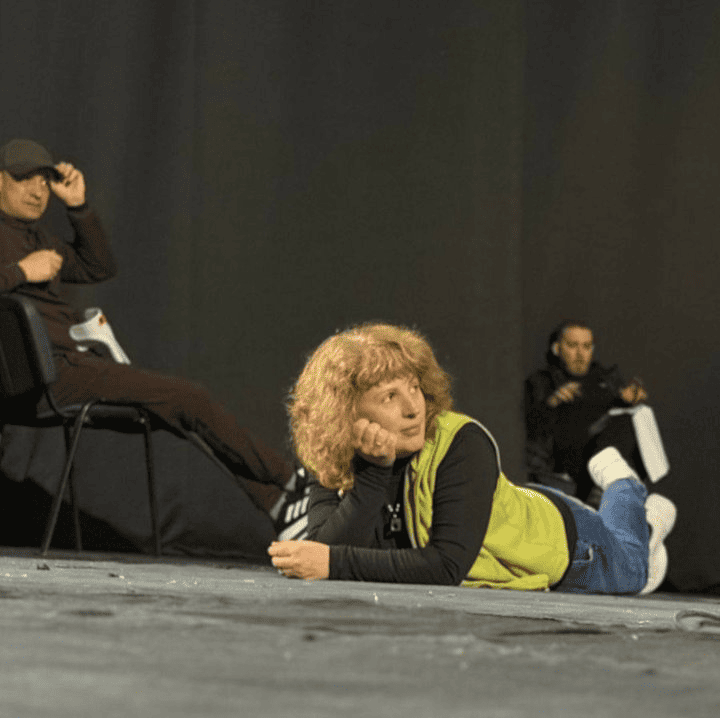
“Hryts asked me if I had scissors and asked me to cut his hair. It was unexpected, because at that time I was a stranger to him. And it was also very chaotic and funny,” recalls Iryna Harets when we ask her about this story — Liubov Ilnytska describes it on social media.
That day at Unbroken, they were set to begin work on a collective comedy text, and this situation also became part of the story. “Gathering around a table with the group, we realized that this is it — Unbroken, with its diverse people, its cafés, barbershop, workshops, and departments that form a small city, and it is an inexhaustible source of material for this comedy,” Ilnytska writes.
This diversity is now brought together in the space of an elevator that “breaks personal boundaries, rocks you like life up and down, offers chance encounters with strange people and experiences, forces you to listen to stories, feel irritation, compassion, and even envy.”
Overall, the story of “Unbroken Theatre” began a year ago: Iryna Harets, who is not only a playwright but also a trained psychologist, joined the project at the invitation of Kateryna Sadova.
“I did not guide the veterans toward writing about trauma — we simply wrote the stories they wanted to tell. But they still wanted to talk about what they had been through. Perhaps not for everyone, but for many, this becomes a tool for recovery,” says Iryna Harets.
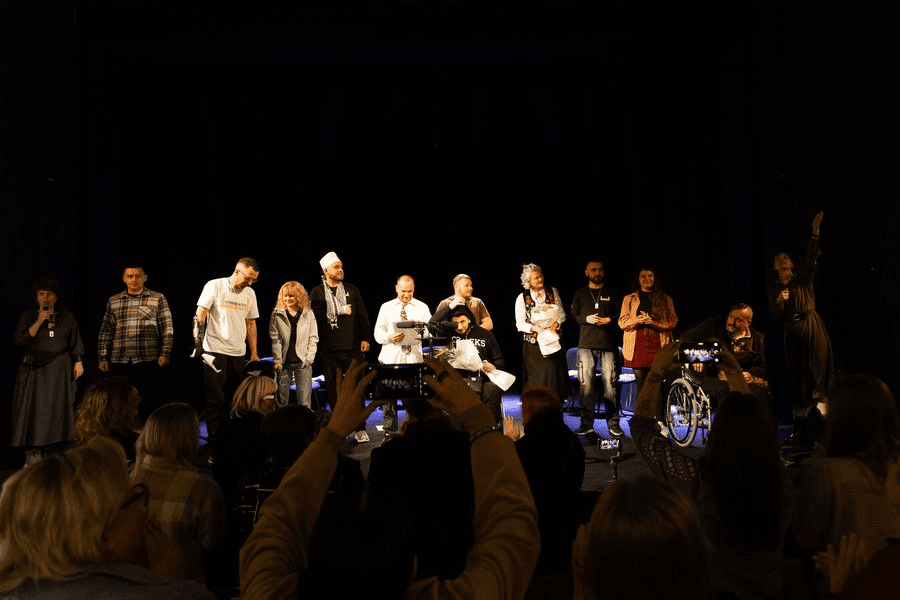
Together with the veterans, she wanted to create a dark comedy that could serve as support in difficult times. During one of the meetings, participants shared stories from life at Unbroken, until one of the future co-authors of the text, Roman Onuchko, said: “Imagine, I once rode an elevator and asked for 25 euros.” He became the prototype of the Elevator Director, who has a business idea — to charge this amount for each floor from everyone who enters the elevator in order to buy an apartment in Lviv and stay in the city.
“When we got talking with Roman, I asked where he was from. He said he was from Shostka and that his house was still intact. I realized he had nowhere to return to, and at that moment the ideas came together into a single text,” says Iryna Harets, who wrote the play based on the stories of Roman Onuchko, Ruslan Pryhoda, and Filip Khvorostyankin.
To write the play, the playwright spent several weeks living at Unbroken, where she visited the rehabilitation department and the prosthetics workshop, spoke with the center’s staff, and even met with the chief physician, who also became a character in the story (played by Taras Yakymovych). The playwright also met Unbroken’s barista, whom the servicemen nicknamed Elf.
“Every other soldier told me stories about Elf — a very young woman working as a barista, even though she doesn’t like coffee. Her ease in communication captivates those who come to her, you simply can’t ignore her,” says Iryna Harets. “If we’ve already spoiled this character (meaning Death), I’ll note that we often ‘beat up’ our own people, even when they are not to blame. And we even get a certain satisfaction from it. This character also becomes someone you want to ‘beat up,’ and I feel that too. Overall, working on this project has been a path of recovery for me, and I have gained great pleasure from it.”
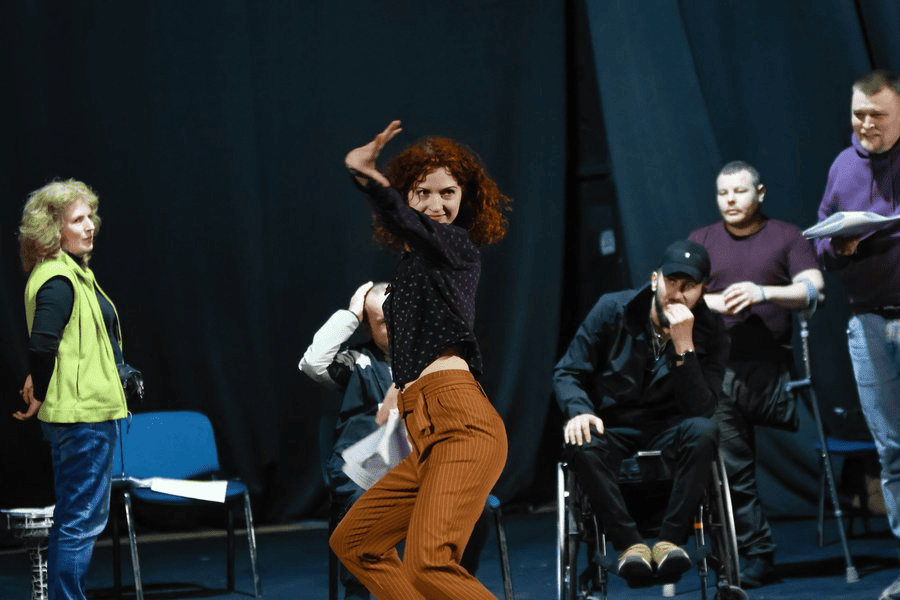
“For me, creativity is an additional and supportive tool, particularly in the rehabilitation of military personnel,” says director Svitlana Fedieshova. “Even though we are creating this project specifically for its participants, I believe it should be a high-quality stage production. I also find joy and love in it myself.”
In the elevator: a vestibule between two train cars
According to the plot, the Elevator Director is looking for a way to settle in Lviv: if not to buy an apartment, then at least to meet a girl with Lviv residency. It is around the Elevator Director that all encounters and conversations revolve. In the elevator, he meets an archetypal grandmother who cannot get used to the term “wheelchair,” as well as civilian patients who are also undergoing treatment at Unbroken — communication with them is not always straightforward. The Elevator Director even encounters Death, who may “get scared and run away if one sees life as an adventure and learns to overcome obstacles with good humor.”
The elevator becomes a symbol of an honest space where different destinies meet, as the playwright explains. So honest, in fact, that the characters sometimes swear, which is why the performance carries an 18+ rating. Swearing becomes part of the living language of the text and the performance.
“In my view, we raised many important questions. It is about loneliness, about the lack of a place to return to, and about the journey — how to find your way back,” says Iryna Harets. “For me, this is like a vestibule between two train cars: when you have moved from one, but have not yet entered the other,” says director Svitlana Fedieshova. “For a return to happen, a set of tools is needed. And the issue of return, as well as the idea of home, takes on different meanings. I believe this is not a problem of veterans — it is something that society must address.”
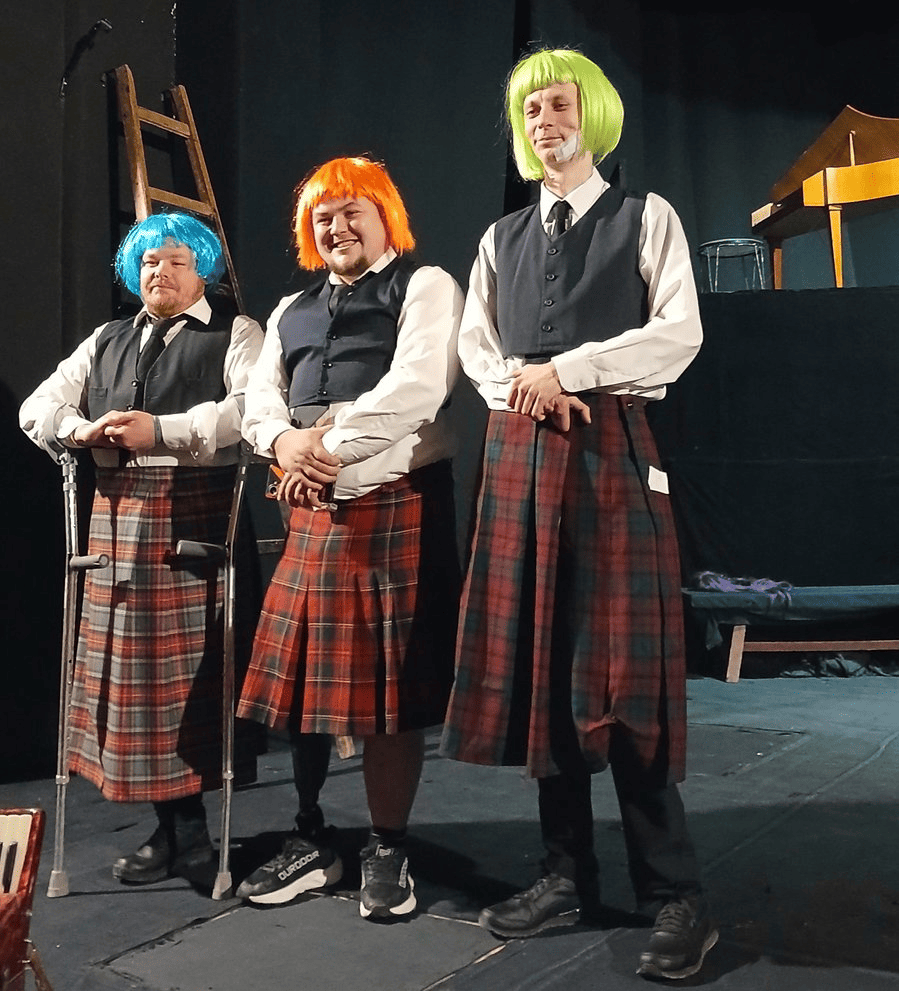
In the scenography, created by artist Bohdan Polishchuk, the illusion of an elevator was developed — one that seems to be moving yet also appears to be paused between floors. The driving forces of the elevator are certain stories and circumstances, as the director explains.
“The world of the performance emerged from the inner dialogues of the main character, the Elevator Director. That is, he sees real characters and projects his own perception onto them. I did not want this to be an everyday story, so it became phantasmagorical: there are moments when it is difficult to tell whether it is reality or a dream,” says Svitlana Fedieshova.
23 Characters: Here Are Those Who Play Several of Them
Denys Monastyrskyi
The director calls Denys Monastyrskyi a “one-man orchestra,” as he performs three roles and still manages to play the harpsichord. In the military, he served as a tank battalion driver-mechanic in the 67th Separate Mechanized Brigade. He was wounded in October 2025 and has been undergoing rehabilitation at Unbroken since mid-January.
“I considered myself a patient of Unbroken even before I arrived here. After spending a month in a ward at a previous hospital, I realized I couldn’t stay there for long and needed to keep moving. A nurse in the surgical department even asked me: ‘What are you doing here, aren’t you from Unbroken?’ It was funny because it felt like I was both here and there,” says Denys Monastyrskyi.
“When you end up in a hospital, you don’t know anyone there. People come into your room and leave. You don’t have a stable environment or connections, and you can’t build them. So theatre became a way not to be alone with my problems,” the veteran admits.
“On stage, people can try on different roles without fear of being misunderstood. That’s why they open up more, and rehabilitation becomes faster, both emotionally and mentally: you don’t fully understand whether you are undergoing treatment or simply living a civilian life. I can live within the walls of a hospital.”
In childhood and adolescence, Denys had experience in amateur theatre, so he says that transforming into different roles is relatively easy for him. At the moment, he doesn’t have a lot of text, but he shares that keeping up with the performance timing is challenging — and that quick costume changes are required.
“I am quite similar to my character Kostya, as if I am playing myself. I also have the roles of the Cleaner and our beloved Nurse who delivers our meals. It all started when I agreed on my own initiative to read these roles. Now it has become so interesting that it’s impossible to stop. I was also asked who can play a musical instrument, and I agreed to that as well,” says Denys Monastyrskyi. Spoiler: in the performance, not only Denys will be singing.
Ruslan Pryhoda
A native of Lviv, Ruslan Pryhoda was wounded abroad while serving in a reconnaissance company of the 41st Separate Mechanized Brigade. He has now become a co-author of the play’s dramaturgy. Within the team, he is jokingly referred to as the assistant director.
“I’m a rather persistent assistant to the director. Maybe less so now, but earlier I often made remarks during rehearsals. I just wanted to make everything as good as possible so we wouldn’t forget anything,” says Ruslan Pryhoda.
While most participants live at the rehabilitation center and are provided with organized transport to rehearsals at the First Theatre, Ruslan has to get there on his own and take time off from work (he works at the craft brewery “Khmelnyi Lev”). However, his employer is understanding and allows him to take time off.
“I am not new to theatre, but I am not a professional either. The reading format was new to me: I had never taken part in something like this before, so I became interested and agreed to participate. Then Ms. Iryna [Harets] also suggested writing a play, which, to be honest, really fascinated me, although I joined this process a little later than the others. We simply brainstormed ideas, which Ms. Iryna wrote down and later structured into a text,” says Ruslan Pryhoda.
He also has an acting role, portraying Kum. “I like this role; it is not far from reality. In general, the roles in this play somehow mysteriously went to the people for whom they are the closest. It seems to me that everyone is playing a role close to real life,” the veteran describes.
He admits that the most difficult parts for him were working on facial expression and physical movement, as well as learning the text — not because of the text itself, but because he has to interact with the Elevator Director in three different scenes on different topics, which can make it easy to mix up the sequence.
“I find it difficult to judge what has changed in me or in my behavior during the work on the performance. But I can see from the outside how the guys on stage are shedding some chains and limitations. For some it is easier, for others more difficult, but in one way or another, everyone becomes freer. It is also noticeable in communication. If before it was just ‘Hi, how are you?’, now we discuss the theme of the performance, theatre in general, and other topics,” says Ruslan Pryhoda.
Taras Yakymovych
“Before I was wounded, I had been to the theatre once or twice. During one performance I fell asleep, another was interesting,” smiles Taras Yakymovych. “I can’t sit still; I need to be doing something, so I signed up for all the activities offered by the center, including sports events. It was the same with theatre: they asked me if I wanted to try, and I agreed. I liked it — it’s an attempt to overcome stage fright, work on diction, and develop acting skills.”
Taras Yakymovych has been a participant in the Russian-Ukrainian war since 2014. After serving for a year, he spent some time as a civilian, working as a general laborer and later as a forensic expert and head of a department at the Volyn Research Forensic Center of the Ministry of Internal Affairs. In 2022, he was mobilized again into the 14th Mechanized Brigade. Later, after a break, he joined the 12th Special Purpose Brigade of the National Guard, “Azov,” where he served as a commander of a “Vampire” UAV unit. He was wounded in January 2025 on the Toretsk direction.
Like all participants, he finds it difficult at times to combine his rehabilitation schedule with rehearsals, as it has to be coordinated with an occupational therapist and a physical therapist. He also had to miss rehearsals for some time because he traveled to Lutsk to compete in archery tournaments.
At the readings, Taras Yakymovych performed three roles: the Chief Physician, a Foreigner, and a Physical Therapist, while in the full version of the performance he plays only the first two.
“I think my personal image corresponds to the Doctor — a strict man who cares about every patient, maintains order and structure so that everything runs smoothly and the guys recover as much as possible. Another role is the Foreign volunteer who helps the military. It can be difficult to work on physicality: I am not naturally very flexible, and all four of my limbs were injured. But it seems I’m managing a little,” says Taras Yakymovych.
Due to the severity of his injuries, the veteran’s recovery at the center has already lasted almost a year, since mid-April 2025 (before that, Taras Yakymovych spent several months in St. Panteleimon Hospital). However, in a few weeks he plans to return to the military. In the future, he dreams of having his own blueberry plantation.
This is a living story, and it can expand
Just days before the premiere, three more participants joined the performance during rehearsals. Director Svitlana Fedieshova explains: “They just came to be with us, to be part of the community. They were interested. When we started singing, they asked if they could join us and stayed.”
This is a living performance, so more veterans will join it over time. “Each person in this story has become close and dear to me; I don’t want to part with anyone. But Taras, for example, will soon leave, and over time others will also leave as their rehabilitation ends. In addition, people may occasionally miss rehearsals due to their rehabilitation process. That’s why we will keep introducing new veterans from the rehabilitation center into the existing story, stage design, and concept,” says the director.
“The story can expand in unexpected ways. I am now being contacted by veterans, not only from Unbroken: they are asking how they can join the theatre and the project. For now, I simply invite them to come and watch the performance. But for us, it is a challenge — to involve everyone who wants to participate,” comments Iryna Harets, who dreams that one day the story of life at Unbroken will become a mini-series.
The play “The Elevator Director” will remain in the repertoire of the First Theatre of Lviv after its premiere.
Tags: Culture Lviv rehabilitation resilience storytelling theater Ukraine veterans war

![Ceremony scene and artwork celebrating the return of the Kazimir Malevich art award for Ukrainian artists after five years.:contentReference[oaicite:2]{index=2}](https://empr.media/wp-content/uploads/2025/08/malevych-480x270.png)
![Contemporary Ukrainian war art installation and mixed-media pieces reflecting displacement, trauma, memory and resilience on the fourth invasion anniversary. :contentReference[oaicite:2]{index=2}](https://empr.media/wp-content/uploads/2026/02/art-480x270.png)