
Constant missile and drone strikes on rear cities are forcing Ukrainian engineers to look for non-standard solutions to protect people and equipment. At the intersection of the defense sector and the construction industry, a technology has emerged designed to neutralize the main threat from broken glass and blast waves.
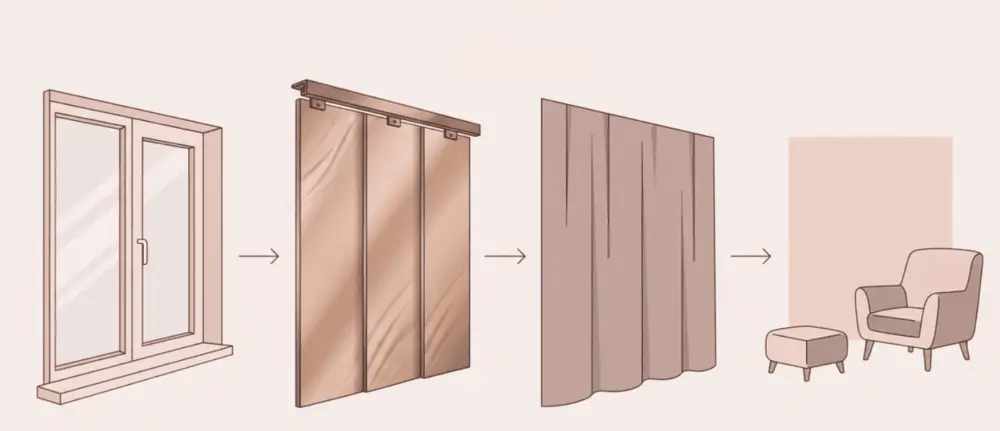
According to 24tv, Ukraine has presented the Bronel system of movable protective panels, which are mounted directly in front of windows to intercept secondary glass fragments and ammunition during detonations.
The launch of the project by representatives of the defense and construction sectors was reported by the specialized outlet Dev.ua. The design is not intended to replace stationary bomb shelters, but to serve as an operational barrier for preserving the lives of personnel and protecting critical equipment inside working premises.
Technical characteristics and operating mechanics
The basis of the protective fabric is a multi-layer ballistic package made of non-flammable materials, similar to those used in military body armor. Unlike rigid metal screens, the panel absorbs the impact impulse through plastic deformation and the distribution of kinetic energy across structural fibers.
The outer layer is made of wear-resistant synthetic Oxford fabric, which is resistant to moisture, mold, and treatment with disinfectant solutions. A standard section is 80 centimeters wide, 300 centimeters high, and 2 centimeters thick, while the installation geometry requires the window opening to be covered with a margin of 15–20 centimeters on each side.
Testing according to NATO standards
Due to the significant weight of the ballistic filling, the curtains are fixed on reinforced anchor cornices 40 millimeters wide for single-track systems and 80 millimeters for double-track systems, which are attached to concrete slabs or load-bearing walls. The effectiveness of the product was verified at the National Defense University of Ukraine according to the relevant military standard and NATO norms.
During firing tests, the panel completely stopped a standardized F5 fragment simulator weighing 1.1 grams moving at a speed of 479.67 meters per second. For comparison, the speed at which fragments of facade glass scatter during an explosion rarely exceeds 30–150 meters per second, which confirms a threefold safety margin of the structure.
Priority for data centers and critical infrastructure
The developers are targeting the system at telecommunications facilities, medical institutions, dispatch centers, and Tier III and Tier IV data centers. Installing Bronel on the technological windows of server rooms, generator zones, and cooling stations minimizes the risk of hardware systems shutting down due to fragment damage.
According to Artem Henzel, head of the project’s business development direction, the curtains remain open in their normal state and are moved into a continuous protective line only after an air-raid alert is announced.
Comprehensive protection: from window panels to anti-missile systems
In conditions of constant air terror, Ukraine’s defense-industrial complex is combining methods of local passive protection with large-scale air defense developments. Earlier, Ukraine tested systems three times for intercepting missiles in near space to neutralize the threat from the enemy’s ballistic weapons.
The introduction of protective screens such as Bronel acts as the final tactical echelon, localizing damage directly at the points of shock waves in rear cities.
Tags: ballistic curtains