Five of six top presidential managers are already under suspicion in NABU and SAPO’s Operation “Midas,” including Tymur Mindich and Herman Halushchenko, whose offshore schemes and $100 million traced destabilized the energy-sector criminal group. Andriy Yermak, former head of the Presidential Office, remains formally unsuspicious, using his influence to guide associates and potentially prepare for scrutiny. Investigations reveal coordinated actions against anti-corruption officials, harsh detention conditions for detectives, and political pressures alongside disinformation campaigns. Meanwhile, Halushchenko’s failed attempt to leave Ukraine highlights the stakes. The case exposes systemic corruption, offshore embezzlement, and the fragile balance between powerful insiders and independent anti-corruption agencies in Ukraine.
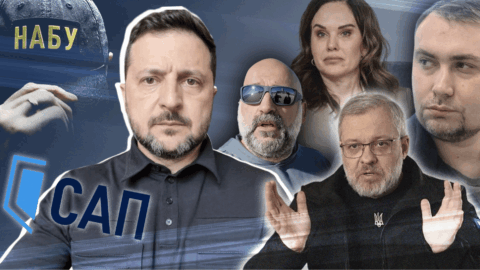
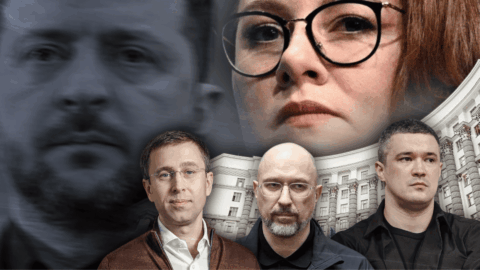
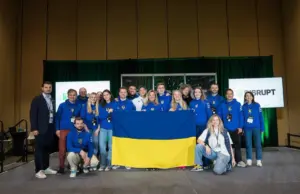
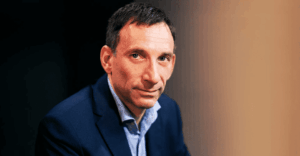
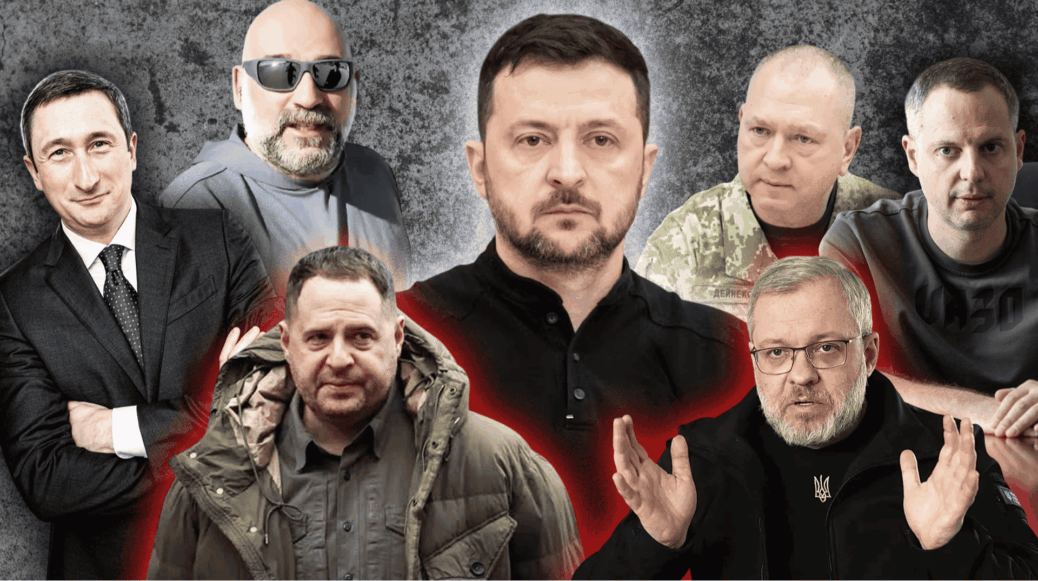
5 of the 6 “effective managers” shown in the collage below surrounding President Zelenskyy are already under suspicion by NABU/SAPO. The sixth could soon also become a suspect.
Ukrainska Pravda has received information that, despite the public bravado of Halushchenko and other figures involved, the fact that the anti-corruption agencies were able to trace over $100 million significantly destabilized the criminal group that was embezzling in the energy sector.
In particular, are there funds belonging to other influential individuals who remain without suspicion?
According to UP, the only real obstacle to uncovering all the criminal group’s “wallets” is the Financial Monitoring Service, which so far has been unwilling to assist the investigation in tracing the flow of funds.
And while the President makes statements that “Ukraine is building a major anti-corruption infrastructure,” today, as in July last year, UP writes, the key question remains open: which will happen first – NABU and SAPO reach all the money stolen in Ukraine, or the figures under NABU and SAPO who still hold influence reach NABU and SAPO themselves?
The chances of these long-time managers and presidential friends winning against the anti-corruption agencies are discussed in Mykhailo Tkach’s article.
After last November’s sensational investigative actions by NABU and SAPO pushed the “untouchable” Andriy Yermak from the green chair at the President’s right hand, much has changed in the public discourse.
In political and adjacent political circles, numerous accusations have repeatedly been leveled against the anti-corruption agencies. On the one hand, observers of the power struggle complain about alleged backroom deals between the President and NABU and SAPO — deals that supposedly explain why Andriy Yermak remains without suspicion.
On the other hand, the ruling team, behind closed doors, does not shy away from accusing NABU and SAPO of political maneuvering, hinting that in high-profile cases — particularly Operation “Midas”—the only victims may ultimately be the current suspects themselves.
Yet as early as July 2025, the country was just two steps away from the final dismantling of democracy: the destruction of the last two independent law enforcement bodies and the elimination of independent media. And the fact that the authorities went ahead with this means one simple thing: independent NABU and SAPO were more dangerous to them than an international scandal, public outrage, and direct accusations of dismantling the anti-corruption system.
Ultimately, thanks to public support and the first mass protests since the start of the full-scale invasion, independence was restored to the anti-corruption bodies. And the risks that pushed the authorities to such desperate steps became clear three months later, with the launch of Operation “Midas,” when the actions of the bureau and the specialized prosecutor’s office reached the closest circle of the country’s top official and extended all the way to Andriy Yermak.
After that, the operation moved out of the public spotlight. And it was during this prolonged pause in “Midas” that two individuals who had been prudently removed from their posts suddenly received corruption suspicions: long-time head of the State Border Guard Service of Ukraine Serhiy Deineko, who led the agency from 2019 to 2026, and the President’s long-standing manager for energy and economic affairs, Rostyslav Shurma.
According to sources in law enforcement cited by Ukrayinska Pravda, the former is preparing to go to the front, while the latter, together with his brother, was declared wanted in recent days. According to Ukrayinska Pravda’s law-enforcement sources, Shurma had visited the offices of figures involved in the “Midas” case, although for now investigators’ questions to him lie in a different sphere.
The current pause in disclosures related to Operation “Midas” has created such a vast space for insinuations that Volodymyr Zelenskyy himself denied Andriy Yermak’s resignation due to a corruption investigation a few days ago, citing “personal” reasons for the decision. Around the upper echelons of power, the question was increasingly heard: if “Midas” falls under the jurisdiction of NABU, then which top officials have they exposed and placed under suspicion?
Frankly speaking, by February 14 this year, ordinary citizens — left without electricity and, in some cases, without heating — had begun to forget altogether about the high-profile NABU operation that made headlines in the fall. Immediately after the New Year, the President carried out sweeping rotations within his team and began publicly meeting with people whom he and Andriy Yermak had only yesterday regarded as outsiders. Most interestingly, he was forced to change even his own vocabulary: instead of “my managers” and “my team,” the phrase “the team of Ukraine” unexpectedly appeared.
The hunt for corrupt figures within the President’s team slowly but steadily faded into the background. After searches at Yermak’s residence, the suspicions announced against Deineko and Shurma drew little public attention. Then, suddenly, another long-time power broker — the former minister of energy and justice, Herman Halushchenko — boarded a train to Warsaw on Valentine’s Day, thereby launching the next chapter of revelations by the anti-corruption bodies. By the next morning, February 15, NABU and SAPO had detained the former minister and transported him to Kyiv, where he was formally served with a notice of suspicion.
So, has the President emerged from the series of the loudest corruption scandals of his tenure, or has he not even truly entered it yet? Ukrainska Pravda recently reported on where the President’s closest friends, who have already “suffered” from the actions of the anti-corruption bodies, are now: Tymur Mindich and Andriy Yermak.
This time, we set out to examine the chances that the long-standing managers and friends of the country’s top official have of prevailing over the anti-corruption agencies, especially as a new wave of attacks against NABU and SAPO began several weeks ago. These attacks closely resemble the summer scenario and are therefore unlikely to be accidental.
A Train Toward Suspicion
The absence of a formal suspicion against Energy Minister Herman Halushchenko has unsettled Ukraine’s political establishment ever since last November, when NABU and SAPO released the so-called Mindich tapes in which he appeared.
“What exactly are the charges? Someone met with someone? Said something? Where is the money? Where are the stolen millions? Where is Halushchenko’s notice of suspicion?” the author of this piece has repeatedly heard in conversations with various government officials over recent months.
“One must understand that neither NABU nor SAPO runs yellow lights, so if there is no suspicion, it means the grounds are still insufficient and we need to wait,” supporters of the anti-corruption vertical commented on the lull.
“If we had sent a request to any country regarding a figure in the case before going public, the account holder could have been immediately alerted — and that would have been the end of it,” one influential anti-corruption figure explained off the record. That is precisely why all international cooperation moves within Operation “Midas” began only after the official investigation entered its public phase in early November.
According to law enforcement sources cited by Ukrainska Pravda, former Energy Minister Herman Halushchenko, who has four underage children, may have been able to leave the country almost immediately after realizing that he was not listed as a suspect in the case. Some formalities still had to be settled, such as obtaining certificates confirming the absence of alimony arrears.
At the end of last year, the editorial team of the investigative program Schemes published information about the costly education of Halushchenko’s son in Switzerland. This fact rather clearly suggested that “Sigismund” (according to investigators, a coded nickname used for Halushchenko during discussions among suspects — UP) does not keep his funds in Ukraine.
On February 16, NABU and SAPO publicly confirmed this hypothesis. Halushchenko was served with a notice of suspicion for money laundering, and Ukrainian society learned how the energy minister had “invested” millions in offshore jurisdictions on exotic and, under current conditions, notably warm islands.
Sources at Ukrainska Pravda within law enforcement say that the way the figures in the case skillfully moved money out of the country and concealed it abroad could serve as a practical handbook for corrupt senior officials.
Halushchenko’s own conduct during court hearings on the choice of a preventive measure resembles the behavior of another high-ranking figure, former deputy prime minister Oleksii Chernyshov. Amid jokes, there are constant attempts to dismiss any accusations. The facts presented by investigators in court are either ignored or, as in the case of the payment of $200,000 for his son’s education in Switzerland, commented on in a way that makes it impossible to quickly verify or refute the information through non-procedural means.
Interlocutors of Ukrainska Pravda in political and business circles insist that, despite the public bravado of the figures involved, the fact that the anti-corruption bodies managed to trace more than $100 million has significantly destabilized the criminal group.
First, do they include funds belonging to other influential figures in power who remain without suspicion?
Second, as of Monday, the “Midas” case is no longer just about recordings and words, but about recordings that may have direct cause-and-effect links to laundered funds.
According to sources at Ukrainska Pravda within the anti-corruption bodies, the state financial monitoring service remains virtually the only obstacle to uncovering all the “wallets” of the criminal group. It has numerous mechanisms for tracking money abroad, yet still shows no willingness to assist the investigation in tracing financial flows.
Third, if these funds have been identified by investigators, they will at the very least be seized or confiscated outright.
Therefore, if Herman Halushchenko plans to continue financing the living and education of his large family in one of Europe’s most expensive countries, Switzerland, he may soon genuinely need help from friends and acquaintances. Otherwise, he may be forced to bring his family back to the place where he himself is being held, that is, Ukraine.
Moreover, Halushchenko still needs to find a legal 200 million hryvnias to post bail in order to continue observing from detention how NABU and SAPO proceed with Operation “Midas.”
“A Gentleman Without Fortune”
According to numerous sources in the political corridors interviewed by Ukrainska Pravda, the fact that Andriy Yermak is clearly involved in Operation “Midas” but still has not been formally suspected despite searches poses a threat to the official investigation by the anti-corruption bodies. Those who could even theoretically provide testimony are unlikely to go to NABU as long as they understand that the former head of the Presidential Office continues to wield influence. Moreover, according to the same sources, everyone is still expected to answer calls from “AB,” follow instructions, and attend meetings at first notice.
Another risk is that Yermak could prepare for a formal suspicion. With his influence and ample time, he understands better than any investigation the exact role he may have played in the activities of the criminal group.
Recently, Ukrainska Pravda reported on how Andriy Yermak can conduct negotiations remotely with Tymur Mindich. Sources in the security bloc tell Ukrainska Pravda that if Operation “Midas” ends badly for the political futures of the country’s leaders, both Mindich and Oleksii Chernyshov will have to take full responsibility. Alternatively, they may strike a deal with the investigators, providing incriminating testimony against other members of the group.
Separately, according to sources in political circles, Kyrylo Budanov, Yermak’s successor as head of the Presidential Office, communicates with both Mindich and Chernyshov.
According to people close to the former vice president, Yermak himself spends a lot of time finding ways to maintain public visibility in order to shape a positive image. The recent appearance of a newly minted lawyer as a potential defender of Ukrainian skeleton athlete Vladyslav Heraskevych following his disqualification at the Olympic Games does not seem accidental.
As we have already emphasized in previous reports, a suspicion against Andriy Yermak could relate to illicit enrichment. In this context, sources at Ukrainska Pravda advised paying attention to the possible suspect’s declaration — or, to be precise, to the review of this declaration conducted last year by the NACP.
According to the same sources, the National Agency for Preventing Corruption is supposed to publish information about whose declarations it reviews, but it did not release details regarding the full review of Yermak’s 2022 declaration.
The official statement from the NACP only appeared after the review was completed, confirming no violations or signs of wrongdoing. Therefore, if Yermak ultimately receives the suspicion that has been widely discussed, it could serve as yet another indication of the agency’s unsatisfactory performance and Yermak’s extraordinary influence.
One Attack After Another
“Evidence after evidence,” an influential source within the anti-corruption bodies commented off the record on the work of NABU and SAPO in the framework of Operation “Midas.”
Last week, during a public report on the bureau’s activities, Semen Kryvonos stated that attempts to pressure the agencies continue. As an example, he mentioned a recent case in which a listening device was found in the apartment of the head of the detective team working on uncovering crimes in the defense sector. The anti-corruption officials have not disclosed the full circumstances, but it is unlikely that such an operation could have been carried out without the assistance of special services.
Additionally, according to sources in one of the security agencies, a drone was recently spotted at night over the premises of the SAPO. Police were called to the scene, and the ownership of the UAV is currently being determined.
All these events are unfolding alongside a new wave of negative coverage in Telegram channels. A similar campaign was observed in the summer of 2025, prior to the attempt to undermine the independence of the anti-corruption bodies.
Then, as now, NABU and SAPO were accused of corruption and inefficiency. Between January 12 and 26, 2026 alone, 238 social media posts with a negative tone were recorded. The vast majority of these mentions came from anonymous or semi-anonymous sources, which may indicate a coordinated information influence effort.
Sources within the anti-corruption agencies insist that attempts at influence will not slow down their work, especially since, for example, Operation “Midas” has moved into other jurisdictions that are willing to cooperate and are already working with the Ukrainian investigation.
Therefore, as in July of last year, a key question remains open: which will happen first — will NABU and SAPO track down all the corrupt funds stolen in Ukraine, or will the figures connected to NABU and SAPO who still wield influence move against the agencies themselves?
During one of the hearings to determine a preventive measure for former Energy Minister Herman Halushchenko, a prosecutor highlighted an important fact indicating coordinated actions by the figures against the anti-corruption vertical.
Court-released correspondence shows that Halushchenko agreed on the detention conditions for Ruslan Magamedrasulov at Lukyanivska pre-trial detention center. Magamedrasulov had been arrested the day before a vote in the Verkhovna Rada on controversial amendments that would have undermined the independence of NABU and SAPO.
According to the case materials, on July 21, 2025, Deputy Minister of Justice Pikalov contacted then-Justice Minister Herman Halushchenko, stating that the Security Service of Ukraine (SBU) requested preparation of a “free cell with unpleasant neighbors” for a NABU detective.
Pikalov sent Halushchenko a photo of the cell, and Halushchenko replied with a simple “+.”
This detective was actively involved in Operation “Midas,” which concerned embezzlement in the energy sector. In other words, the former Energy Minister approved harsh detention conditions for a detective investigating potential illegal actions by the minister himself.
Barrier-95
The failure of Herman Halushchenko in his attempt to leave the country (although the figure insists during court hearings that he did not plan to flee) reportedly alarmed many potential NABU targets, according to sources in business circles interviewed by Ukrainska Pravda.
For example, readers of Ukrainska Pravda sent in a photo of former first assistant to the president and co-owner of Kvartal–95 Studio (together with Tymur Mindich) Serhii Shefir at Warsaw airport. The photo was taken the day after Halushchenko’s suspicion was announced.
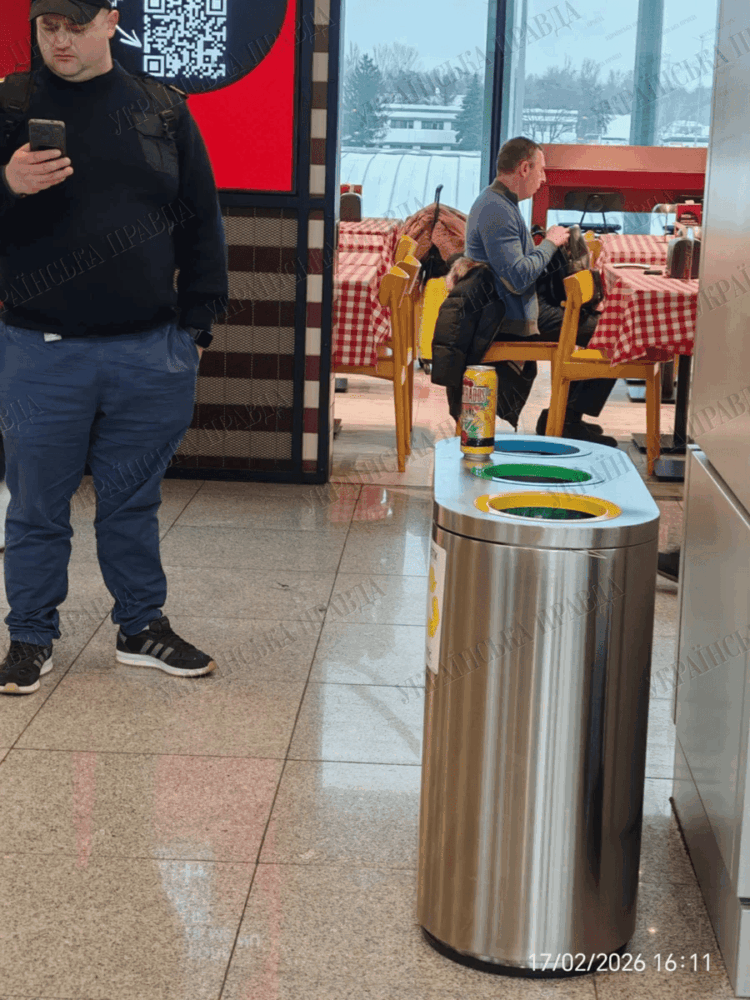
Later, Ukrainska Pravda readers spotted a man resembling Shefir on the Warsaw–Geneva flight.
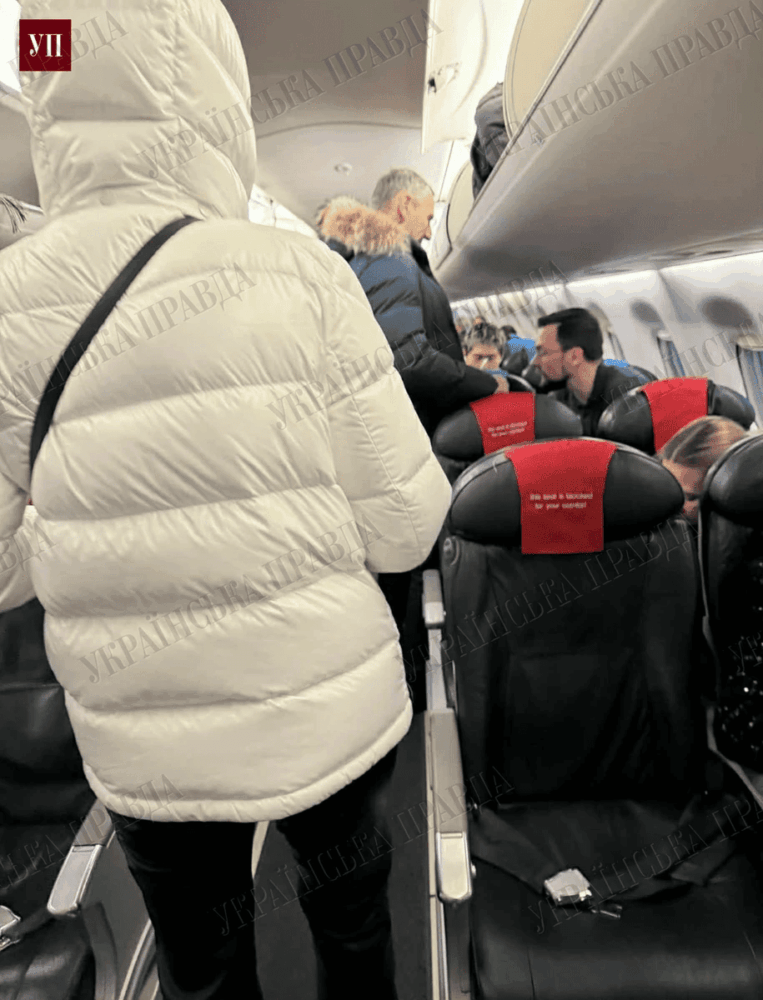
And again, a coincidence. It was in Switzerland that Herman Halushchenko’s family had settled, where, according to him, he was headed when he was removed from the train.
According to case materials already released by NABU and SAPO, Halushchenko began setting up an offshore chain to launder funds back in early 2021, before the full-scale invasion. At that time, sources in political and business circles say, the energy sector may have been overseen by Serhii Shefir. In a comment to Ukrainska Pravda, Shefir confirmed that he went abroad: “Yes, I left on my own business, and this has nothing to do with the NABU investigation, and I will be back in Kyiv this weekend.”
But the most remarkable coincidence, which sources in business and law enforcement circles cited to Ukrayinska Pravda, is the order number that made the embezzlement scheme in the energy sector, called “Barrier”. Order 95.
Order No. 95 dated August 2, 2024: “On including the Joint-Stock Company ‘National Nuclear Energy-Generating Company Energoatom’ in the list of enterprises that are debtors in enforcement proceedings, the execution of which is suspended during the period of martial law.”
According to the investigation, this very order allowed the group of officials — which included Energy Minister Herman Halushchenko, the scheme’s organizer and co-owner of Kvartal–95 Studio Tymur Mindich, and other group members — to obtain extraordinary powers:
“The main activity of the criminal organization was the systematic extraction of illicit benefits from Energoatom’s counterparties, ranging from 10% to 15% of the contract value.
In particular, Energoatom’s counterparties were forced to agree to kickback payments in order to avoid blocked payments for services rendered or goods supplied, or to prevent the loss of their supplier status. This practice became known as the ‘Barrier’ scheme.”
Tags: governance accountability leadership change political investigation presidential team reform debate Team of Ukraine Ukraine