The annual literary and artistic project “Second Autumn” will take place in Drohobych on November 19–20. It is dedicated to the memory of Bruno Schulz, a writer and artist who was shot dead by a Nazi in his hometown on November 19, 1942.
This year’s “Second Autumn” will bring together literature, visual art, documentary film, performance, and music, creating a space for dialogue about memory, the experience of war, human dignity, and what remains after loss. This was reported by Espreso TV.
Over the two days, Drohobych will host a series of book presentations and discussions featuring writers, poets, translators, and cultural figures, as well as exhibitions, concerts, film screenings, and performances.
Special guests include renowned Ukrainian writer Yurii Andrukhovych and Polish writer and Nobel Prize laureate Olga Tokarczuk. Admission to all events is free!
The detailed programme in Polish and Ukrainian is available here.
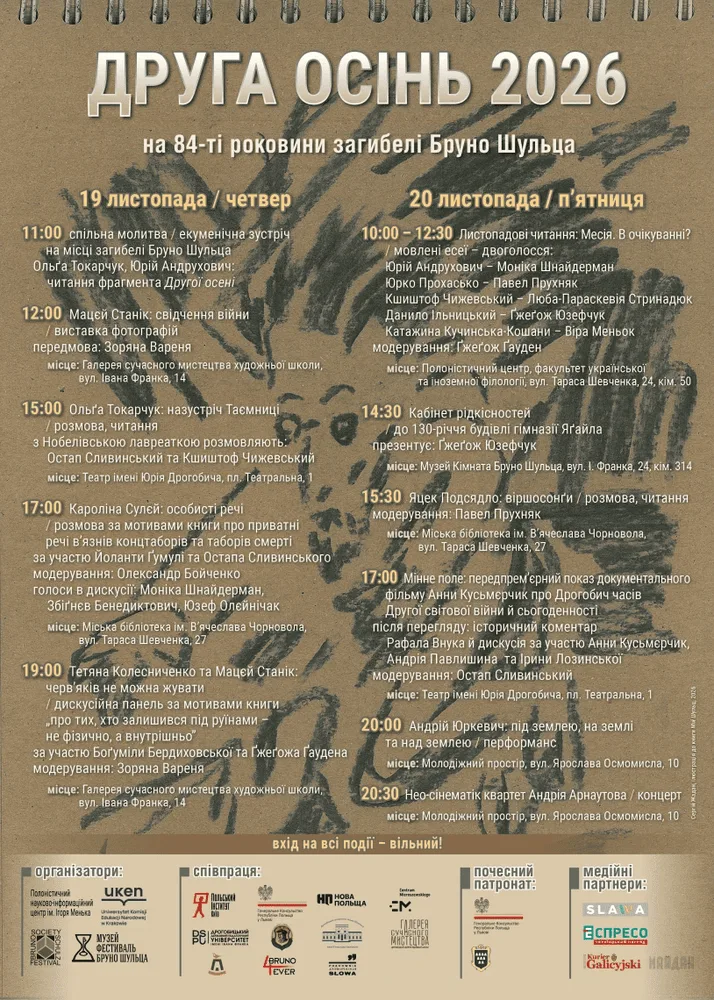
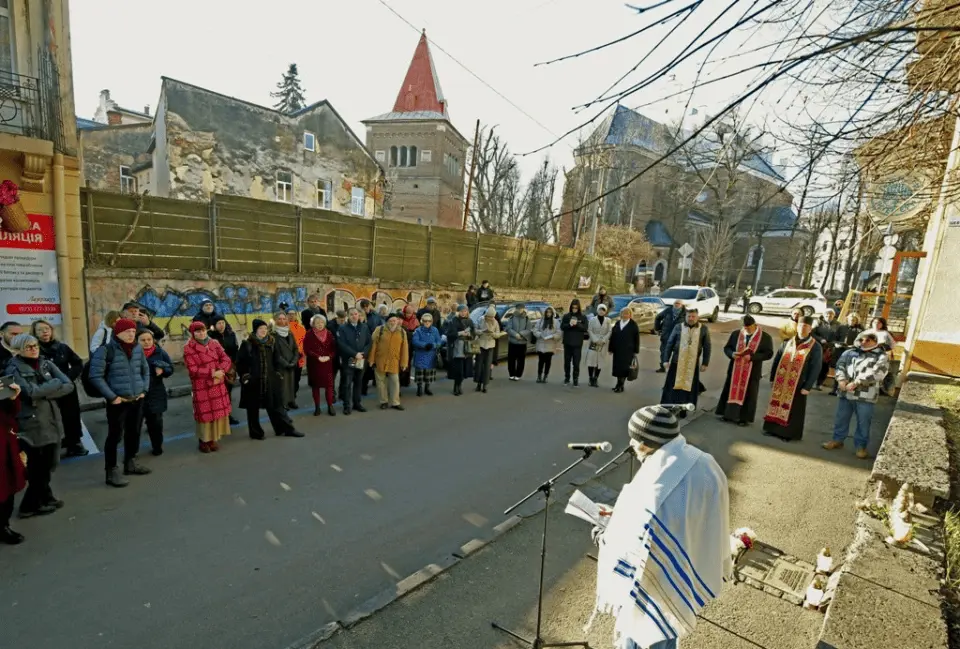
Traditionally, the programme will begin on November 19 with an ecumenical gathering at the site of Bruno Schulz’s murder. Before the joint prayer, Olga Tokarczuk and Yurii Andrukhovych will read an excerpt from his short story “Second Autumn.” A joint prayer will also be held at the Memorial Alley in memory of fallen defenders and civilian victims of Russian terror.
On the same day, an exhibition of photographs by Maciej Stanik titled “Testimony of War” will open at the Art School’s Gallery of Contemporary Art. The photographer, who has been working in crisis zones since 2019, documents the Russian-Ukrainian war, presenting not only visual evidence of the realities of war but also the experience of ethical responsibility towards those whose lives become the subject of photography.
The theatre will host a meeting with Nobel Prize-winning author Olga Tokarczuk, featuring a conversation combined with a presentation of her new book, The World Is Too Much, and a reading. Ostap Slyvynskyi and Krzysztof Czyżewski will talk with the author.
The rest of the first day’s programme will turn its attention to the personal belongings of prisoners in Nazi concentration and extermination camps. Karolina Sulej, author of Personal Belongings: Stories of Clothing in Concentration and Extermination Camps, will discuss objects as testimonies to human individuality, memory, and the struggle to preserve dignity. The discussion will feature Jolanta Gumula of the POLIN Museum of the History of Polish Jews and poet and translator Ostap Slyvynskyi. It will be moderated by Oleksandr Boichenko, with Monika Sznajderman, Zbigniew Benedyktowicz, and Józef Olejniczak also taking part.
The first day will conclude with a discussion of the book You Must Not Bite the Worms by Tetiana Kolesnychenko and Maciej Stanik, a journalistic account of people who have been left beneath the ruins of war not physically, but emotionally. The text and photographs tell the stories of parents who bury their children, soldiers returning from the front, and memories that cannot erase loss. The discussion will feature the book’s authors, as well as Bogumiła Berdychowska and Grzegorz Gauden, and will be moderated by Zoriana Varenia.
On November 20, the traditional November Readings will bring participants together for a series of two-voice presentations exploring the theme “The Messiah: Still Waiting?” One of the key motifs in Schulz’s work, along with the mystery surrounding his lost novel The Messiah, will be explored in the context of the ongoing war. Where is the Messiah? Does he exist? Are we still waiting for him – and what kind of Messiah are we waiting for? Short essays will be presented by Yurii Andrukhovych, Monika Sznajderman, Yurko Prokhasko, Paweł Próchniak, Krzysztof Czyżewski, Liuba-Paraskeviia Strynadiuk, Danylo Ilnytskyi, Grzegorz Józefczuk, Katarzyna Kuczyńska-Koschany, and Vira Menok. The meeting will be moderated by Grzegorz Gauden.
At the “cabinet of curiosities” – the Bruno Schulz Room Museum – Grzegorz Józefczuk will host a meeting marking the 130th anniversary of the building of the former Jagiellonian Gymnasium, where Schulz studied and taught. This will be followed by a presentation of new poems by poet Jacek Podsiadło and their Ukrainian translations by Natalia Tkachyk. The discussion will be moderated by Paweł Próchniak.
In the evening, the Yurii Drohobych Theatre will host a preview screening of Minefield, a documentary by Anna Kuśmierczyk about the tragic history of multicultural Drohobych during World War II and its echoes in the present day. The screening will be followed by historical commentary from Rafał Wnuk, director of the Museum of the Second World War in Gdańsk, and a discussion featuring the film’s director, Andrii Pavlyshyn, and Iryna Lozynska. The discussion will be moderated by Ostap Slyvynskyi.
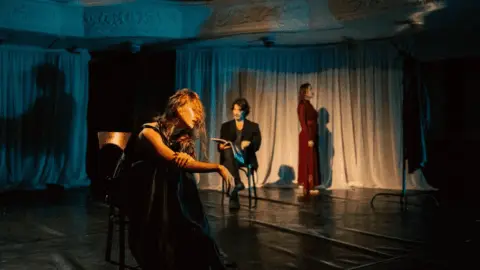
The closing events will include Andrii Yurkevych’s performance Underground, on the Ground, and Above the Ground, which brings together three symbolic artefacts and three dimensions of human memory, and a concert by the Andrew Arnautov Neo-Cinematic Quartet, an instrumental project at the intersection of post-jazz, minimalism, and contemporary film music.
“Second Autumn” is a space where the memory of Bruno Schulz enters into dialogue with the experience of contemporary war, while literature and art become ways of bearing witness, remembering, and preserving human presence.
Organisers: the Ihor Menko Polish Studies Research and Information Centre at Ivan Franko Drohobych State Pedagogical University; the University of the Commission of National Education in Kraków; the Bruno Schulz Festival Association (Lublin); and the Bruno Schulz Museum and Festival Charitable Foundation (Drohobych).
Tags: Bruno Schulz Culture Drohobych literature Olga Tokarczuk Second Autumn Yurii Andrukhovych