Ukraine’s multi-stage operation against the Kerch Bridge involved coordinated strikes using drones and missiles, supported by advanced reconnaissance and innovative communication technology to overwhelm Russian air defences and disrupt road and rail connections.
Ukraine’s attacks on the Kerch (Crimean) Bridge this week differed from previous ones and produced significant results with far-reaching consequences. Krym.Realii examined how the attacks were carried out.
On Monday, Tuesday, and Thursday, November 16, 17, and 19, respectively, Ukraine’s Defence Forces struck the bridge built by Russia across the Kerch Strait. The operation involved multiple stages and began long before the arch and a span of the road bridge were destroyed and the railway bridge was damaged.
Intelligence Gathering and Strike Preparations
The attacks on the Kerch Bridge were preceded by lengthy preparations, which involved gathering intelligence on the situation on the Kerch and Taman peninsulas, followed by strikes on surface-to-air missile systems, radar stations, and electronic warfare stations. A retired captain 3rd rank who previously served in Ukraine’s military intelligence told Krym.Realii on condition of anonymity.
“Intelligence gathering on the situation in Crimea, particularly on the Kerch Peninsula, has been ongoing since its annexation. Naturally, more information comes from the annexed peninsula, as there is an intelligence network there, as well as Crimean partisans. As for technical intelligence gathering – electronic and satellite reconnaissance across various frequency bands – the amount of data collected on Crimea and Taman is roughly the same,” the former intelligence officer explained.
He noted that NATO reconnaissance aircraft had been spotted over the Black Sea in the days leading up to the attacks.
“On Monday afternoon, reconnaissance was conducted by an RC-135U Combat Sent signals intelligence aircraft. To my knowledge, this was the first time this particular aircraft had operated over the Black Sea. The US Air Force has only two such aircraft. Their purpose is to analyze emissions from radar systems, electronic warfare stations, and radio transmitters, and to determine the locations of these facilities.
“On Wednesday, two French Air and Space Force Mirage 2000 aircraft operated over the sea, conducting reconnaissance using ASTAC pod-mounted equipment, along with a US Navy Boeing P-8A Poseidon maritime patrol and anti-submarine warfare aircraft. Today, a SAAB 340B ISR electronic intelligence aircraft operated by Canada’s CAE Aviation was spotted.
“Ukraine’s partners share intelligence in virtually real time, which is extremely important when planning operations,” the retired Ukrainian Armed Forces officer explained.
Ukrainian President Volodymyr Zelenskyy said that the strike on the Kerch Bridge was the result of a multi-week operation by Ukrainian forces.
According to the Ukrainian president, during the operation, Ukrainian forces systematically struck Russian air defence systems, radar stations, electronic warfare equipment, and other facilities protecting the Kerch Bridge.
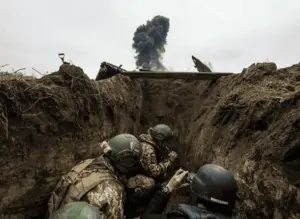
According to the General Staff of the Armed Forces of Ukraine, on November 16 and during the night of November 17, Ukrainian Defence Forces units launched a veritable hunt for the Russian army’s “eyes” and “ears.” In particular, two electronic warfare stations were destroyed near Yakovenkove in annexed Crimea and near Pryazovske in Russia’s Krasnodar Krai.
“Yakovenkove is located south of Kerch, 30 kilometres from the Kerch Bridge, while Pryazovske is 160 kilometres away. Both stations created an electronic jamming zone over the strait, and destroying them ahead of the attack allowed more Ukrainian drones and missiles to reach the target area,” the former military intelligence officer explains.
Innovative Communications Technology
Ukraine has developed “flying modems” that have become a crucial tool for its drones and missiles to bypass air defences and strike vulnerable points on the Crimean Bridge, the Financial Times reports.
The so-called “flying modems” are a network of drones equipped with communication stations that function as relay nodes. They maintained a continuous, real-time connection between pilots and missiles throughout their journeys, covering hundreds of kilometres.
Starlink and Starshield systems were not used.
“The system employed the Mesh networking principle, or a mesh topology. The signal is transmitted from one relay installed on a UAV to another. Iran is believed to have been the first to use this technology in military operations. It later shared its developments with Russia, after which Russian Shahed and Geran drones began reaching western Ukraine. Now Ukrainian engineers have developed their own system,” a military expert from Crimea, a former Ukrainian officer and retired lieutenant colonel, told Krym.Realii on condition of anonymity.
According to the expert, the continuous communication link allows operators to guide drones and missiles closer to the ground and water surfaces, making it more difficult for Russian air defence systems to detect and intercept them.
President Zelenskyy noted that the communication link worked flawlessly until the very last second. This can be seen in video footage recorded from aboard a Flamingo missile as it approaches its target.
Russian military bloggers are perplexed by these new capabilities of Ukraine’s Defence Forces.
“Let me remind you that this bridge was protected like perhaps only two other facilities in the country. If Ukraine retains this type of communication link over Crimea and the new territories (the term Russia uses for the occupied Ukrainian territories of Luhansk, Donetsk, Zaporizhzhia, and Kherson regions – KR), then something will have to be done about the satellites,” the Fighterbomber Telegram channel writes. According to OSINT investigations, the channel is run by Ilya Tumanov, a retired former Russian Su-34 fighter-bomber navigator.
“The strikes on the bridge were carried out within literally 45-minute intervals. The timing is simply unreal. The adversary’s communication link worked flawlessly, making such a high level of accuracy possible,” the pro-war Russian Telegram channel Russkiy Inzhener writes.
Tactics
OSINT analysts have published a video reconstruction of the strikes on the Kerch Bridge, providing a detailed timeline of the operation.
Even before November 16, Ukrainian drones had been attacking Russian air defence systems and electronic warfare equipment across Crimea, in Kerch, and along the approaches to the bridge, clearing the way for the main strikes.
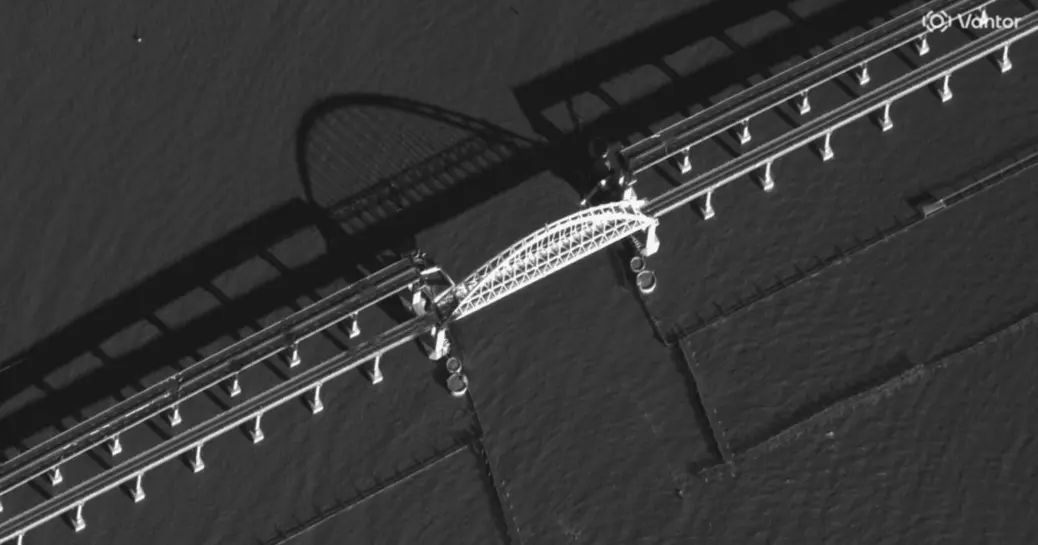
On November 16, Palianytsia jet-powered drones damaged the bridge’s road arch. The following day, a second strike on the same section caused the span to collapse along with the arch.
A series of strikes against both the road and railway sections of the bridge was carried out using Flamingo, Neptune, and Ruta missiles, as well as the An-197. The use of different types of weaponry was intended to complicate the operation of Russian air defence systems.
The aim of the operation was to completely cut off both road and rail traffic across the Kerch Strait.
Another strike on the railway bridge was carried out during the night of November 19. Ukraine’s General Staff reported that Neptune missiles had been used to hit the railway tracks on the bridge.
“The target was hit, and traffic across the bridge was halted. The railway tracks were damaged,” the Ukrainian military command said in a statement.
“The tactic of ‘overwhelming air defences’ has become a classic approach. First, a large number of UAVs and inexpensive missiles are launched toward the target, forcing air defence systems to expend their ammunition. The main missiles then carry out the strike.
“Using different types of drones and missiles travelling at different speeds and altitudes creates a complex picture on radar operators’ screens, making it more difficult to identify targets and prioritise them for engagement by surface-to-air missile systems,” the military expert from Crimea explained.
“The adversary adopted a truly systematic approach, concentrating its strike capabilities on a single target instead of repeatedly chipping away at the bridges with individual drones or launching a couple of missiles once every few weeks,” the Russian pro-war Telegram channel Voennyi Osvedomitel wrote, commenting on Ukraine’s attack on the bridge.
Weapons
On Tuesday, Ukrainian President Volodymyr Zelenskyy revealed details of the second strike on the Kerch Bridge. He said that Palianytsia drones hit the road section, while Neptune missiles, Ruta drones, and FP-5 missiles targeted the railway section.
Using Flamingo missiles, Ukrainian forces carried out precision strikes against designated targets, with the communication link working flawlessly until the very last seconds.
Before that, the Defence Forces had systematically destroyed air defence systems, radar stations, electronic warfare equipment, and other facilities along the route to the final target. The weapons used included Dovbush, Vendetta, Da Vinci, Sichen, MICH 2000, Ruta, Palianytsia, An-197, FP-1, FP-5 Flamingo, and R-360 Neptune.
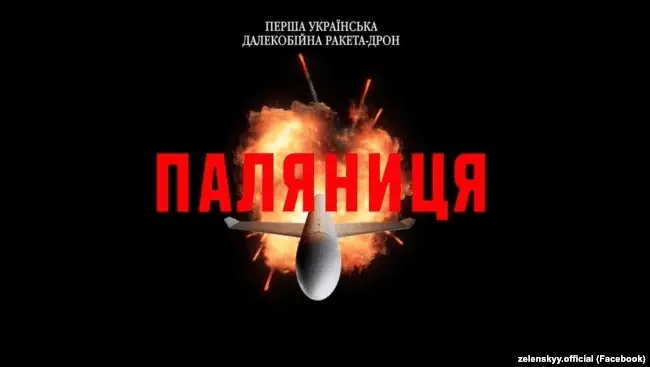
“Palianytsia is a missile-drone with a warhead weighing approximately 100 kilograms and a cruising speed of up to 900 kilometres per hour. Russian Kh-101 missiles have the same speed. Its explosive payload is relatively small, but sufficient to cause significant damage to the bridge’s roadway,” a retired lieutenant colonel of the Ukrainian Armed Forces explained, describing the weapon’s specifications.
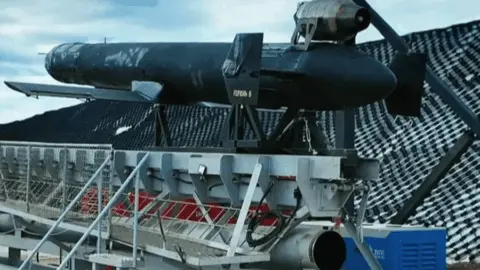
Flamingo missiles are manufactured by the Ukrainian company Fire Point. Company representatives have described the Flamingo as a missile-drone.
“The missile’s maximum take-off weight is six tonnes. It is launched using solid rocket fuel and then propelled by our own domestically developed turbojet engine, as well as a solid-fuel booster that is also our own development,” said Iryna Terekh, Chief Technical Officer at Fire Point.
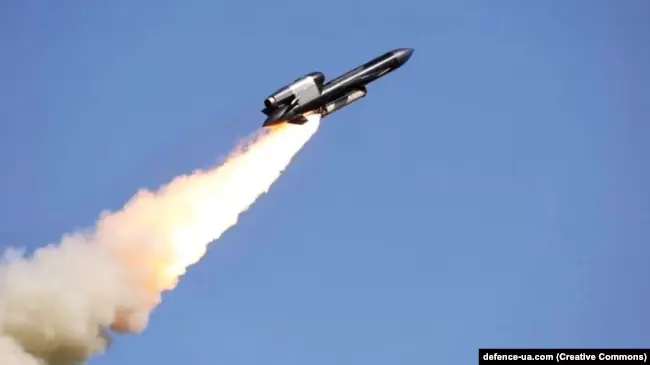
“The maximum flight range is 3,000 km, with an accuracy of up to 14 metres from the target at that distance. The maximum speed is 900 km/h. The cruising speed can vary, and I will not disclose it. The payload capacity currently stands at 1,150 kg. Initially, it was 1,000 kg, but we later found a way to increase it slightly,” Iryna Terekh said.
“The Flamingo missile was the primary weapon used to destroy the bridge’s arch during the attack. A 1,000 kg charge in TNT equivalent has enormous destructive power and is capable of completely destroying large permanent structures, bridge supports, heavy armoured vehicles, and fortified shelters. In terms of explosive power, such a blast is equivalent to a hit by a heavy high-explosive aerial bomb. This is why the strikes caused the arch span of the road bridge to collapse,” the military expert from Crimea explained.
Fire Point reported that two Flamingo missiles were used in the attack – one targeting the road section and the other the railway section of the bridge, according to the company’s statement. The accompanying visualisation shows that one of the missiles approached its target from the south, over the Black Sea.
The Ruta missile is manufactured by the technology startup Destinus, which is headquartered in the Netherlands.
According to the company’s president, Oleksandr Danyliuk, a former Ukrainian finance minister, nine Ruta Block 1 missiles were launched, seven of which reached their target on the bridge.
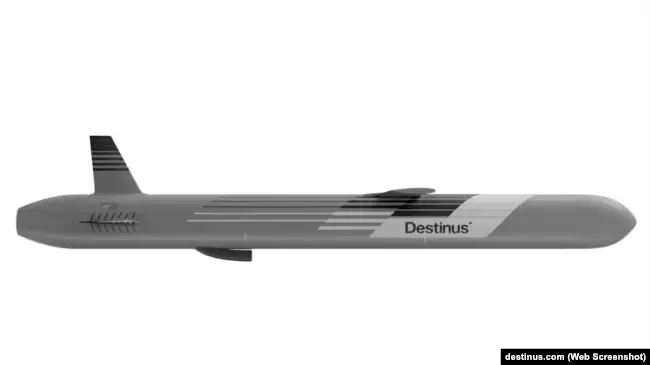
“The Ruta missile has a speed of 500–800 km/h and a warhead weighing between 100 and 150 kg. One of its key features is its ability to fly at low altitudes while following the terrain to reduce its visibility,” the retired Ukrainian Armed Forces officer from Crimea explained, describing the missile’s specifications.
The Neptune is an anti-ship cruise missile based on the Soviet Kh-35 missile. It is best known as the missile that sank the Russian Black Sea Fleet’s flagship, the Moskva missile cruiser.
Kyiv-based Luch Design Bureau began developing the Neptune in 2014, shortly after Russia’s annexation of Crimea. The missile system was officially adopted by the Ukrainian Armed Forces in August 2020.
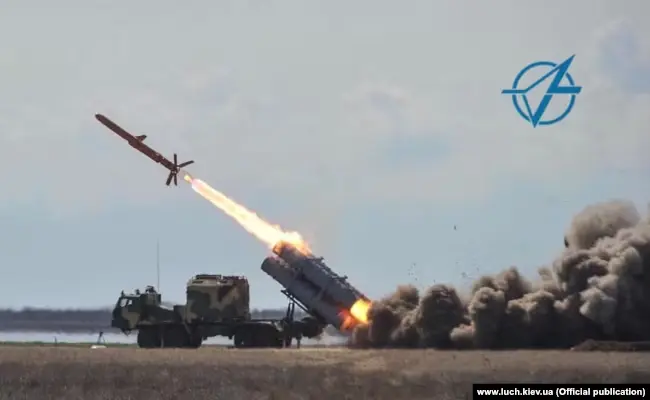
In 2025, Ukraine unveiled the so-called “Long Neptune,” an upgraded version with improved capabilities. The new missile features an enhanced satellite navigation system and an infrared seeker for terminal guidance during the final stage of its flight.
The Neptune has a subsonic speed of Mach 0.8–0.85 and a 150 kg warhead, increased to 260 kg in the upgraded version.