Since February 24, 2022, many artistic expressions have emerged reflecting on the war. On the occasion of the fourth anniversary of Russia’s full-scale invasion, Suspilne Kultura has gathered ten works that address displacement, deoccupation, exhumation, mutilation, child abduction, pain, and service.
Yarema Malashchuk and Roman Khimey, You Shouldn’t Have to See This, 2024
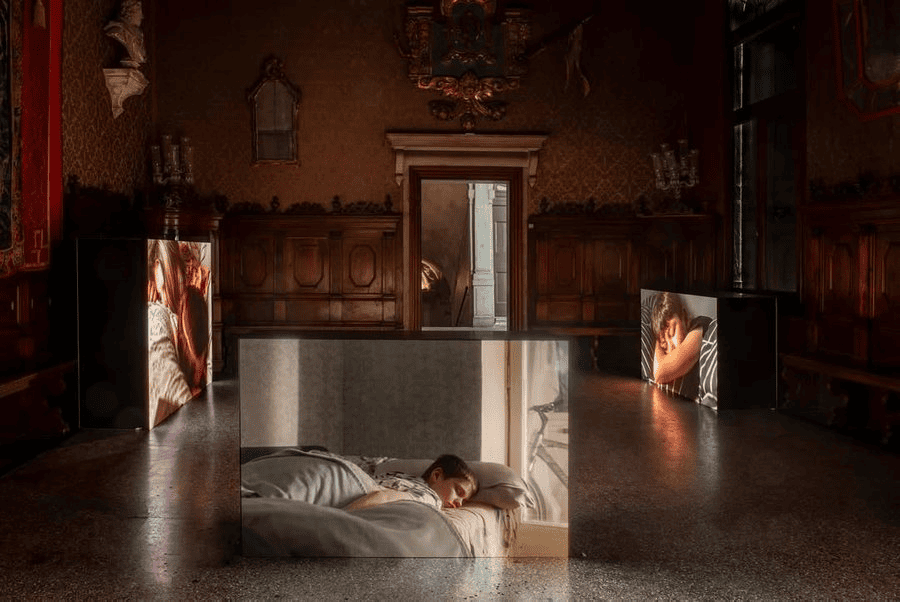
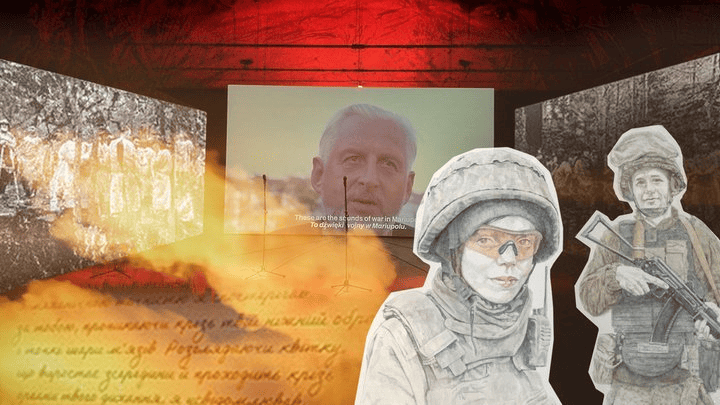
This is a six-channel video installation depicting the dreams of children who were forcibly taken to Russian-controlled territory and later returned to Ukraine. The work’s description states: “Estimates suggest that the number of such abductions ranges from 20,000 to over a million cases since the start of the Russian-Ukrainian war in 2014.”
By revealing an intimate moment that should have remained unseen, the work questions the ethics of witnessing. Each image of war is, first and foremost, evidence of a crime and only then a work of art, which, however, should never have existed. It also raises questions about the boundary between empathy and intrusion into private life.
The video installation was presented for the first time in Venice in 2024. In 2025, it received the Offscreen Paris Curatorial Award.
Margaryta Polovinko, Sleep in the Grove, 2022
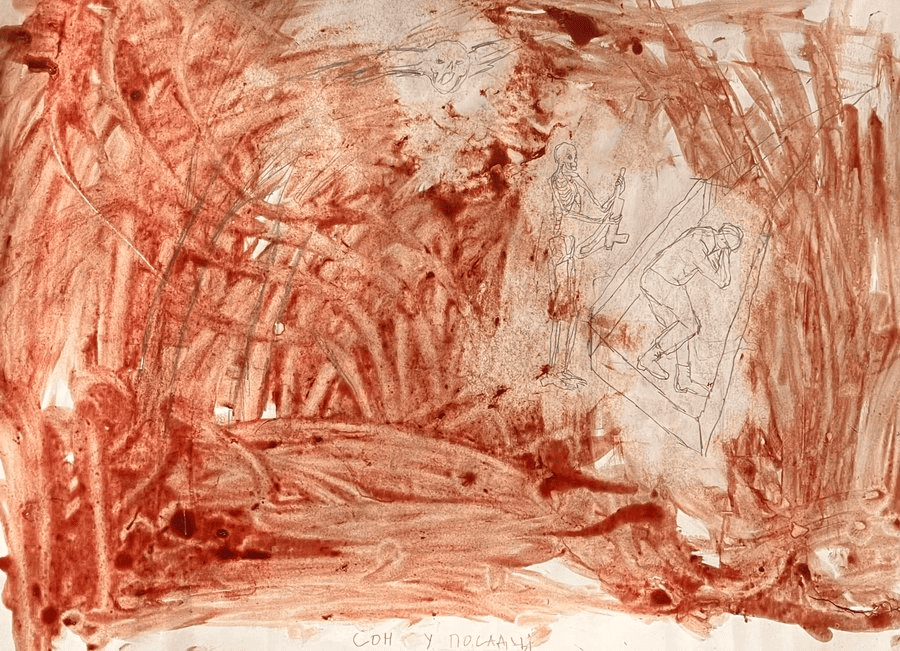
Margaryta Polovinko was an artist and soldier who died on April 5, 2025.
After the start of the full-scale invasion, she began creating drawings with her own blood to convey the unfamiliar physical pain of the new reality.
The artist explained that she did not cry for help through these works; blood was rather a material that corresponded both to the theme and to the feelings the war evoked in her.
“With the war, there is more art in my life, but at the same time I realized that I can do nothing with this art. I cannot sell it or give it away, because it is blood, it is pain, it is suffering. It is a material that has no place; I do not want it to exist. Its value now lies in working as a mirror of reality, but I want a moment to come when it no longer reflects this world,” Polovinko said.
Vlada Ralko, Lviv Diary, 2022
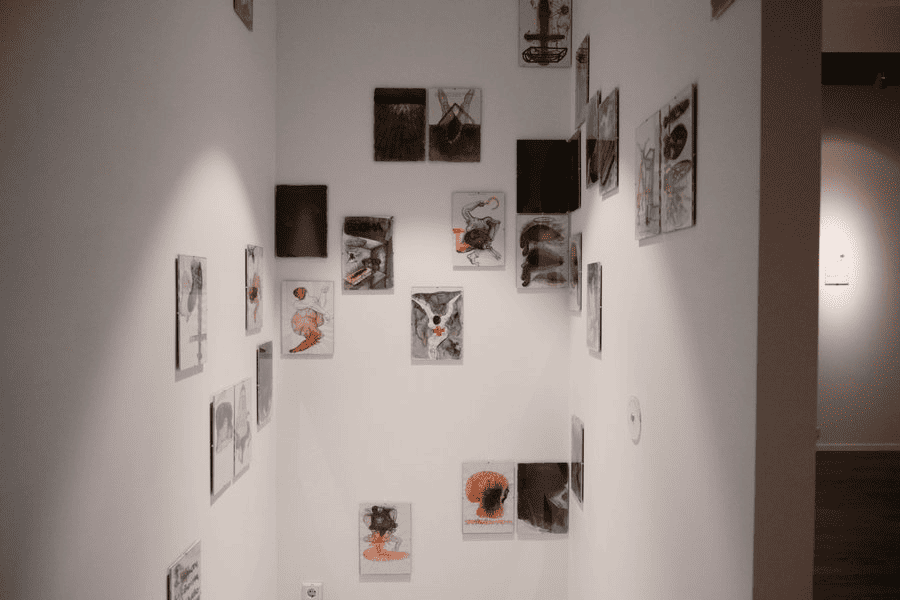
From the very first days of the full-scale invasion, Ralko expressed her emotional and psychological state through art. Thus, the artist’s diary became a testimony of both personal and collective experience of the war.
Ralko compares her artistic expression to language, which, in her view, has a political nature and makes a person human. In supporting this idea, she refers to Soviet narratives that restricted freedom of expression, as well as to Russia, the USSR’s successor, with its propagandistic slogans.
“To speak in one’s own language is the work of an artist and a matter of conscience. I make these drawings during the war because I do not want to be mute,” the artist says.
Dmytro Kupriyan, The Art of War or Rules of Caring for a Rifle, 2022 — present
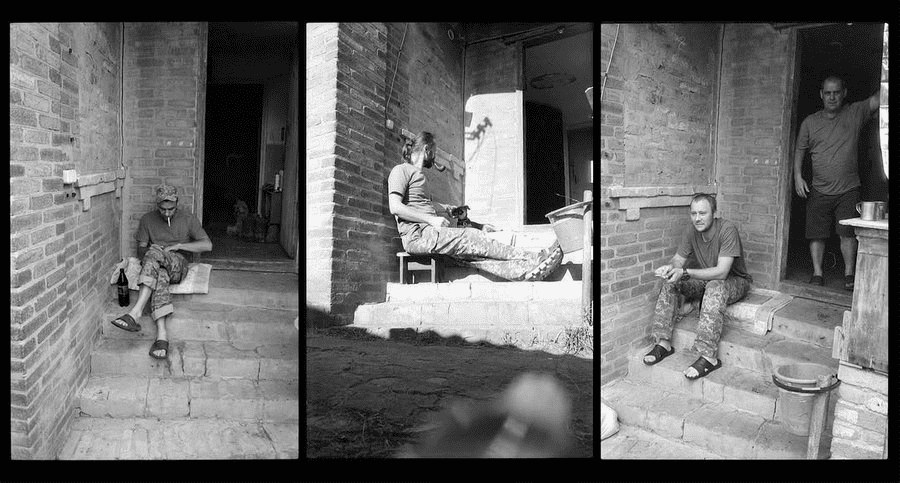
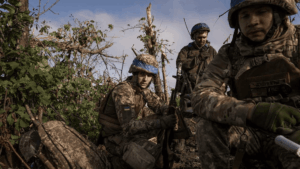
This is a photo series by the artist and press officer of the 158th Separate Mechanized Brigade, Dmytro Kupriyan. The project began in 2022, although some of the photographs included were taken in 2014–2015.
The title consists of two parts, each carrying its own meaning. The Art of War refers to the possibility of artistic expression and the dream of returning to a normal life. Rules of Caring for a Rifle reflects the visual content of the black-and-white images, capturing the monotonous everyday life of soldiers. The photographs form triptychs, grouped either by narrative or visual similarity.
This year, the artist received the Mykola Anatskyi Award for this series.
Open Group, Repeat After Me I, 2022, and Repeat After Me II, 2024
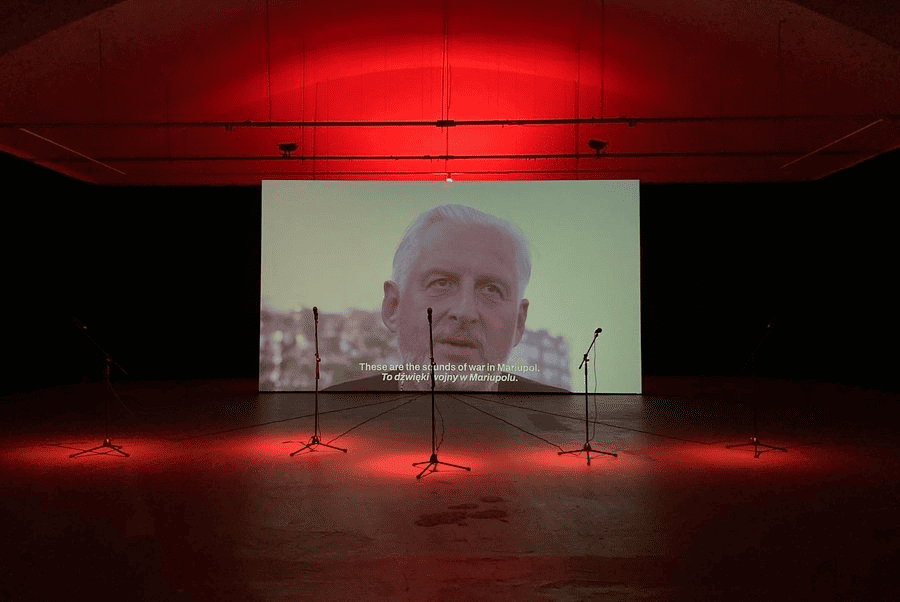
The first part of the Repeat After Me project was created with the participation of displaced people from Eastern Ukraine temporarily living in Lviv: Alla, Antonina, Borys, Kateryna, Iryna, Olena, Svitlana, and Yurii.
They share their experiences of the war by reproducing the sounds of various weapons. The artists describe this work as a “kind of karaoke-instruction,” which, however, “still cannot convey the experience of being in a combat zone, the experience that was the source of this knowledge.”
Repeat After Me II expands the geography, involving refugees currently in Wrocław (Poland), Berlin (Germany), Vienna (Austria), Vilnius (Lithuania), Tullamore (Ireland), and New York (USA). Participants again imitate weapon sounds and invite others to reproduce them.
It was with this 2024 video installation that Open Group represented Poland at the 60th Venice Biennale.
Oleksandr Len, How I Occupied Donbas, 2022–2025
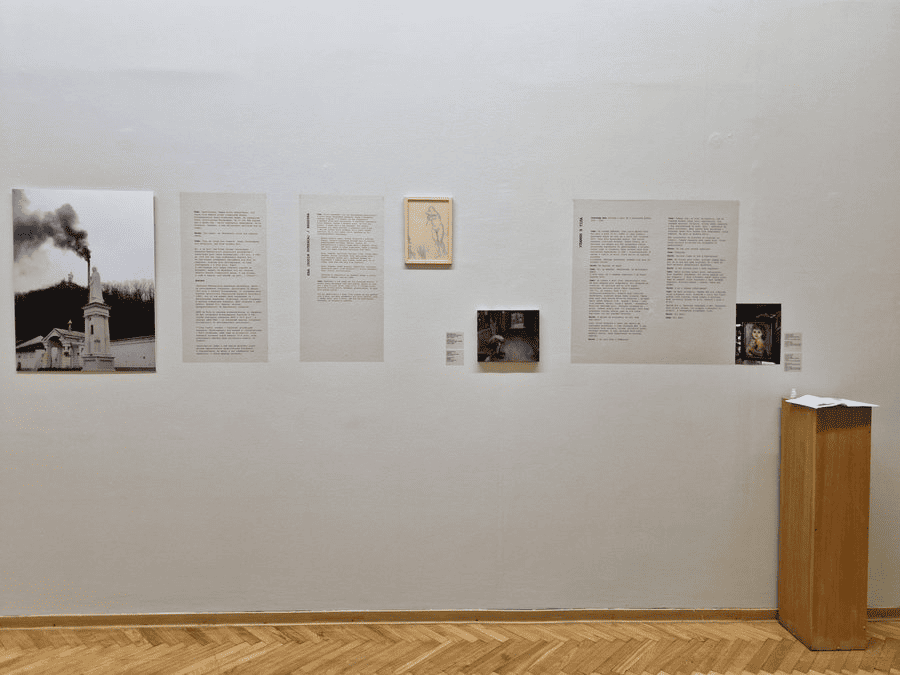
Oleksandr Len is an artist who was mobilized on April 13, 2022; before that, he was a fourth-year student at the National Academy of Fine Arts and Architecture. In August of the same year, he and a group of fellow soldiers were injured by a tripwire in Donetsk region. Shrapnel struck his right hand, and when it was successfully removed by a Latvian microsurgeon, it became the first artifact of the project How I Occupied Donbas.
The series consists of natural materials from the front, photographs of Sviatohirsk, which is now approaching the combat zone, recordings of intercepted Russian frequencies, and artworks that Len managed to create during his rehabilitation. The unifying and accompanying element is a conversation with independent curator Anastasiia Kuzmenko.
Yana Kononova, Izyum Forest, 2022
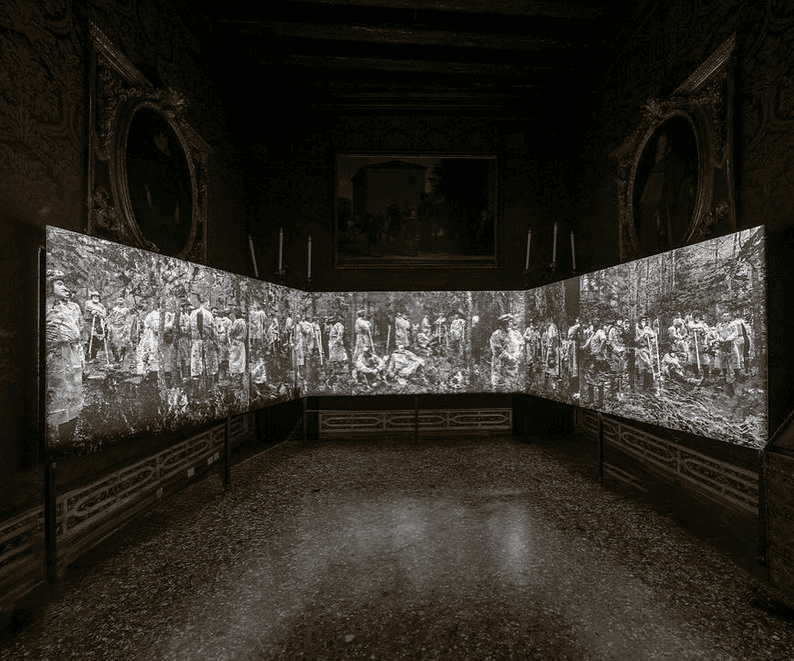
The work depicts the exhumation of Ukrainians executed by Russian occupiers in Izyum, Kharkiv region.
Kononova was struck by the number of rescuers involved, so she shifted the focus away from documenting the exhumation process and instead explored the symbolic imagery of the human gathering.
In the monumental installation, which consists of five photographs combined into a panorama, there is no direct evidence of the crime. Since the images were taken almost in the same location but at different times, viewers notice certain discrepancies, which, according to the artist’s intention, are meant to reflect the fragmentary nature inherent in our memory and perception.
Davyd Chychkan, Anarchists in the Ranks of the Armed Forces of Ukraine, 2024
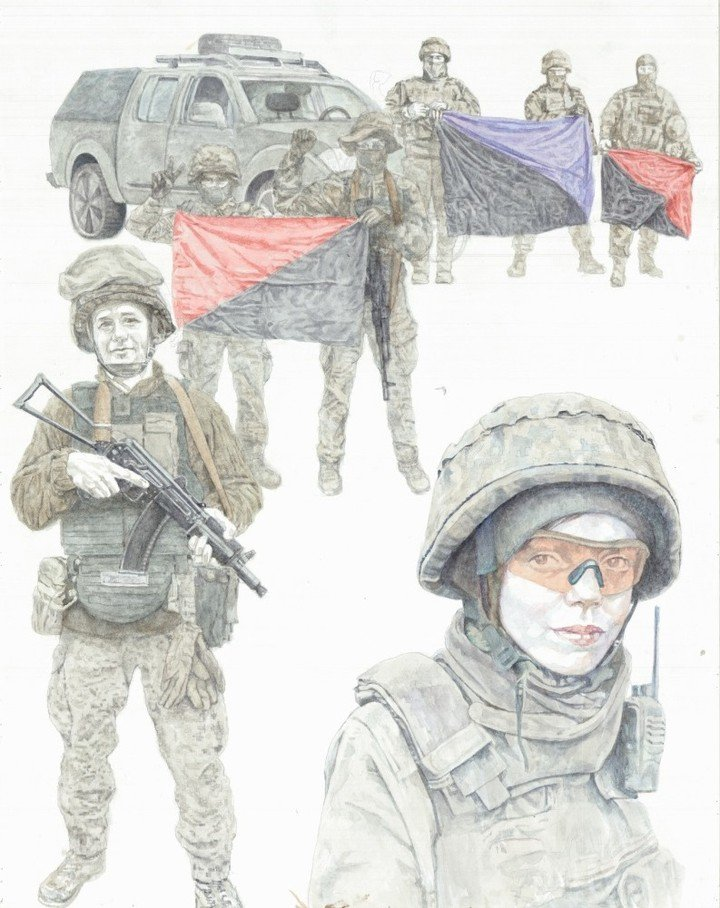
Davyd Chychkan was an artist and serviceman who died from wounds sustained during an assault by Russian infantry in the Zaporizhzhia direction in August 2025.
The artist was an anarcho-syndicalist. He described himself: “Anarchist beliefs are my escapism, a wondrous world, and a cushion in the existential pit, so I fall more softly.”
During the full-scale invasion, the focus of his practice shifted to depicting soldiers defending the ideals he held dear.
“To a large extent, Chychkan uses the tools of art to tell the stories of like-minded leftist individuals who are now on the front lines and, according to the artist, through their proactive stance, strengthen and expand their subjectivity,” notes Yana Kachkovska in Chychkan’s profile.
Kristina Melnyk, Altar, 2023–2024
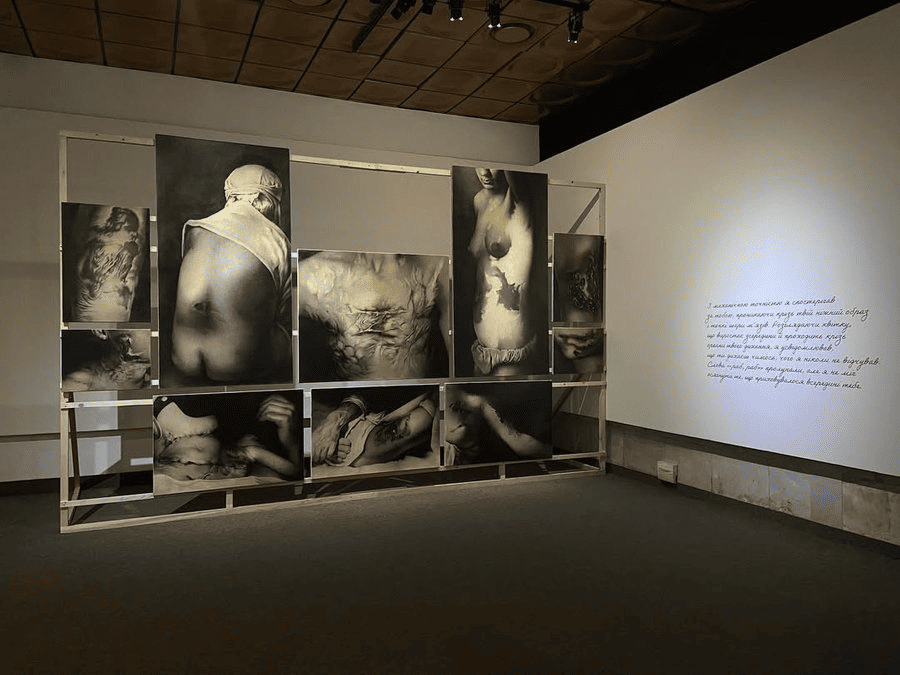
Altar, inspired by Northern Renaissance art, consists of ten canvases. At the center are the torn chest of a boy, flanked by mutilated fragments of female and male bodies.
“Pain, physical decay, wounded bodies — these accompany us daily. Yet the way the artist paints these tragic images gives space to simultaneously feel love and tenderness, proving that there is neither absolute suffering nor absolute peace,” reads the exhibition’s explanatory text, where the unfinished Altar was first displayed.
In this work, Melnyk uses oil and gesso, which she began employing under the influence of Mykola Storozhenko’s monumental painting workshop. This ground, traditionally used in icon painting, allows the work to be painted over an extended period.
Zhanna Kadyrova, Refugees, 2022 — present
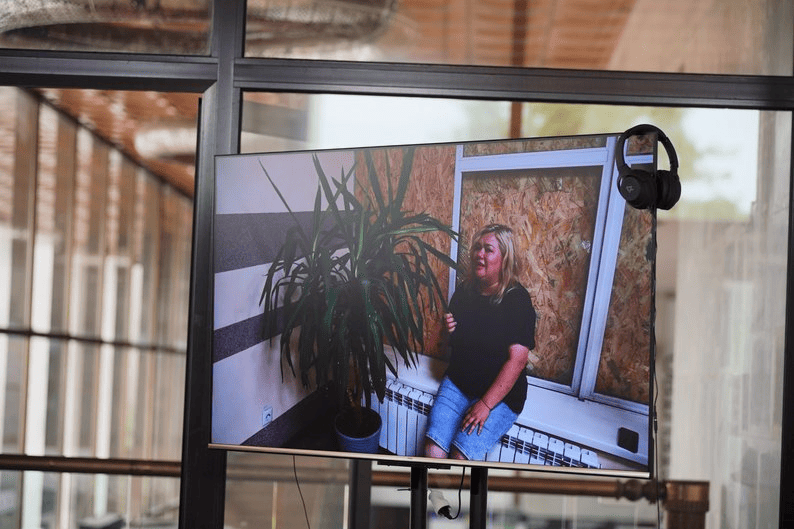
In the Refugees series, Kadyrova combines documented interiors of public buildings destroyed during the war with houseplants she removed from deoccupied cities.
The artist began the project while traveling with a group of volunteers to deoccupied areas that civilians were not allowed to enter. The first location was Kupiansk district in Kharkiv region, followed by Kherson, Kyiv, and Donetsk regions.
“I believe the Refugees project will only be complete when I can return them to their true home — when all the buildings destroyed by Russian aggression are restored, and I can return these plants,” the artist notes.
In 2025, she received the Her Art Award in Paris for this work.
Tags: contemporary artists displacement in art EMPR.media invasion anniversary resilience through art Ukraine art war reflection
![Visitors at the “Thank You With All My Heart” Ukrainian exhibition at the Council of Europe, featuring the Great Amber Heart and powerful war art. :contentReference[oaicite:2]{index=2}](https://empr.media/wp-content/uploads/2026/02/heart-480x270.png)
![Ukrainian artist creating work by candlelight and natural illumination during blackout while expressing war-era resilience and cultural creativity.:contentReference[oaicite:1]{index=1}](https://empr.media/wp-content/uploads/2026/02/roman-480x270.png)
![Outdoor photo exhibition by Ukrainian photographer Oleksandr Hlyadelov on the fence of France’s Ministry for Europe and Foreign Affairs in Paris. :contentReference[oaicite:1]{index=1}](https://empr.media/wp-content/uploads/2026/02/photo-480x270.png)


![Visitors at the “Thank You With All My Heart” Ukrainian exhibition at the Council of Europe, featuring the Great Amber Heart and powerful war art. :contentReference[oaicite:2]{index=2}](https://empr.media/wp-content/uploads/2026/02/heart-300x171.png)