
Every lineage and every state has its own symbol. And such a symbol is never chosen randomly.
For Ukraine, it is the sign of Prince Volodymyr the Great — the one you see today on the national coat of arms.
It was minted on silver coins a thousand years ago. It appeared on princely seals. It was the emblem of our dynasty, our statehood, and our land — the symbol of our Rus’.
In Muscovy, such a coat of arms never existed.
They never used the symbol of Prince Volodymyr the Great. This is a historical fact.
Why?
Because they are not Rus’.
They have no hereditary connection to it.
This emblem is not theirs.
For Ukraine, however, it is a direct link to our own history — to statehood that existed long before Moscow even appeared on the historical map.
Yet it is precisely this history that imperial narratives try to appropriate.
They are colonizers who stole the name.
But they did not — and cannot — steal the symbol.
Because a coat of arms is like DNA: it cannot be rewritten retroactively.
INFORMATION WAR OVER SYMBOLS
So what remains for them?
Discreditation.
Muscovy launched an information campaign against this symbol, against the rightful ownership of it.
Because it cannot be appropriated.
This is a struggle over meaning itself.
AND ABOUT THE WORD “TRIDENT”
Who invented it?
The term was first used not by Ukrainians and not during the Kyivan Rus’ era.
In 1816, Nikolai Karamzin — a Russian imperial historian and author of “History of the Russian State” — described the symbol on Yaroslav’s coins as a “trident” (трезубец).
He did not understand the symbol. He merely described its shape — three protrusions, three “teeth.”
And that was enough for the term to spread.
Even in independent Ukraine, we still often use a name that does not belong to its meaning.
But think: where are the “teeth” here? What kind of name is this for a sacred princely symbol of authority?
SYMBOLS OF POWER ACROSS CIVILIZATIONS
Across history, rulers and states have overwhelmingly used birds of prey as symbols of authority.
One of the most widespread heraldic symbols in the world is the eagle.
- Byzantine Empire — double-headed eagle
- Holy Roman Empire — black double-headed eagle
- Austro-Hungarian Empire — Habsburg double-headed eagle
- First French Empire — imperial golden eagle
- German Empire — imperial black eagle
- Mamluk Sultanate — falcon symbolism
- Arab Caliphate — falcon as a symbol of nobility
- Modern “Quraysh Falcon” used in Arab state symbolism
Modern states using eagle or falcon symbolism include:
- Albania — black double-headed eagle
- Serbia — white double-headed eagle
- Montenegro — golden double-headed eagle
- Egypt — Eagle of Saladin
- Mexico — eagle with a snake
- Poland — white eagle
- Germany — black eagle
- Kazakhstan — steppe eagle
- Nigeria — eagle
- South Sudan — eagle
- United Arab Emirates — golden falcon
- Kuwait — falcon
- Qatar — falcon
And many more historical and regional coats of arms also feature eagles or birds of prey.
UKRAINE’S SYMBOL IS NOT “TEETH”
So why is Ukraine’s symbol described as “teeth”?
A coat of arms is not just a graphic.
It is a sign of authority. A dynastic emblem.
According to some interpretations, it represents a falcon — the Rarog, a Slavic totem linked to our dynastic tradition.
According to others, it reflects a trinity of power and unity.
It has nothing to do with “teeth.”
It is the symbol of a prince who unified the lands and built a powerful Rus’.
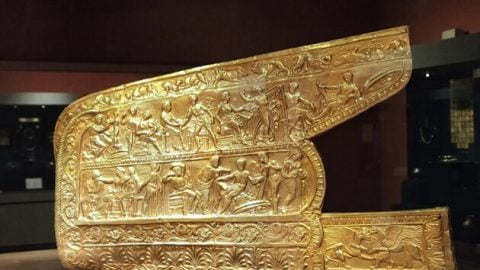
Our symbolic tradition spans millennia — from Scythian heritage through Kyivan Rus’ to modern Ukraine.
This is the symbol of our statehood. A coat of arms that never belonged to Moscow.
Let us name it with dignity — not through imposed terminology, but through meaning.
Because every colony begins with changing names.
Empire has taken much from us. We will not surrender meanings as well.
Read more in the book: “From Rus’ to Ukraine. Restoring History”