

Three-quarters of Ukrainians reject Russia’s “peace plan,” while most cautiously support a Europe-Ukraine alternative,
This data was presented according to a KIIS survey conducted from November 26 to December 13, 2025.
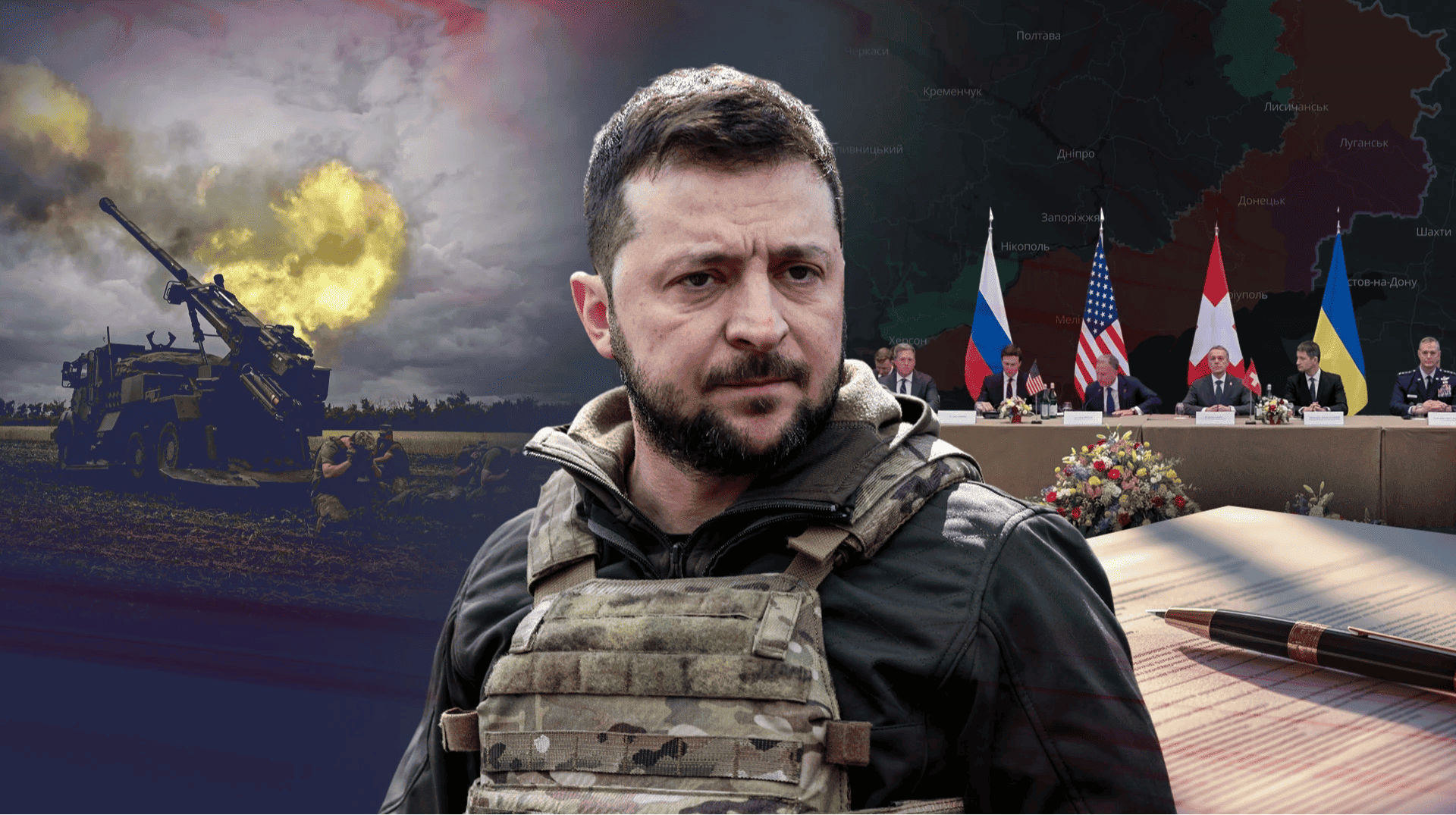
Three-quarters of Ukrainians oppose the “peace plan,” which, among other things, would include withdrawing troops from Donbas, limiting the size of the Ukrainian army, and would not contain concrete security guarantees. This was reported by Ukrainska Pravda.
Source: results of a survey conducted by the Kyiv International Institute of Sociology from November 26 to December 13.
KIIS quote: “The Russian plan remains categorically unacceptable – 75% of Ukrainians consider it completely unacceptable (the same as in September 2025). Only 17% of Ukrainians are willing to accept the Russian version of peace (the same as before).”
Details: At the same time, 72% of Ukrainians (sociologists emphasize that mostly without enthusiasm) are ready to approve the Europe-Ukraine plan. Only 14% categorically reject it.
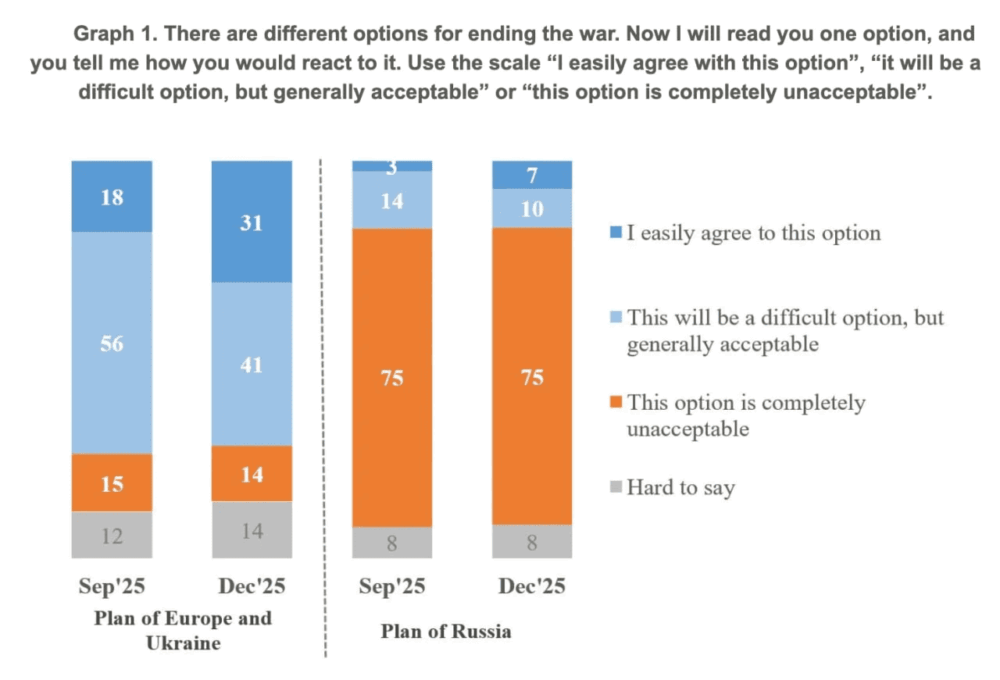
KIIS notes that for the survey, they prepared two shortened versions of the “peace plan.” One represented a hypothetical Europe-Ukraine plan, and the other a hypothetical Russian plan. Each respondent was randomly given and read one of the two versions, without being told whether it was from Europe and Ukraine or from Russia.
Hypothetical Europe-Ukraine plan:
- Ukraine receives reliable security guarantees from Europe and the US, including sustained supplies of weapons and funds in sufficient amounts, as well as protection of Ukrainian airspace from Russian attacks.
- The current front line is frozen; Russia retains control over the occupied territories, but Ukraine and the international community do not officially recognize this.
- Ukraine moves toward EU membership.
- Sanctions against Russia remain in place until a lasting peace is established and the threat of renewed Russian attacks disappears.
Hypothetical Russian plan:
- The US and Europe lift all sanctions against Russia.
- The Russian language receives official status.
- Ukraine must significantly reduce its army and limit its armaments.
- Ukraine permanently renounces NATO membership, and the West can no longer supply weapons to Ukraine.
- Russia has the right to determine the security guarantees for Ukraine and will be one of the countries guaranteeing Ukraine’s security.
- Ukraine withdraws its troops from parts of Donetsk Oblast currently under its control, including Kramatorsk, Sloviansk, and other cities.
- Ukraine officially recognizes Crimea, Donetsk, and Luhansk as part of Russia and permanently renounces them.
- Russia retains control over the occupied parts of Kherson and Zaporizhzhia regions.
The study was conducted from November 26 to December 13. Using telephone interviews based on a random sample of mobile numbers, 547 respondents aged 18 and older, living in territories of Ukraine controlled by the Ukrainian government, were surveyed. Residents of territories temporarily not under Ukrainian government control (though some respondents were internally displaced persons who had moved from occupied territories), as well as citizens who left the country after February 24, 2022, were not included in the sample.
Under normal circumstances, the statistical margin of error for such a sample (with a 95% confidence level and a design effect of 1.3) would not exceed 5.6% for indicators close to 50%, 4.8% for indicators close to 25%, 3.4% for indicators close to 10%, and 2.5% for indicators close to 5%.
Given the conditions of war, in addition to the formal margin of error, some systematic bias may be present; however, sociologists believe that the results still maintain high representativeness and allow for reasonably reliable analysis of public sentiment.
Tags: Donbas withdrawal empr.media News peace plan rejection public opinion Ukraine poll ukraine war


![Visitors at the “Thank You With All My Heart” Ukrainian exhibition at the Council of Europe, featuring the Great Amber Heart and powerful war art. :contentReference[oaicite:2]{index=2}](https://empr.media/wp-content/uploads/2026/02/heart-300x171.png)
![Ukrainian Roboneers and Latvian partners at the signing of a defence robotics and underwater technology cooperation memorandum. :contentReference[oaicite:2]{index=2}](https://empr.media/wp-content/uploads/2026/02/oboronka-300x168.png)