China is using Russia’s weakening to expand its global influence, profit from the war, and strengthen its strategic position, while Putin’s ambitions remain unfulfilled.
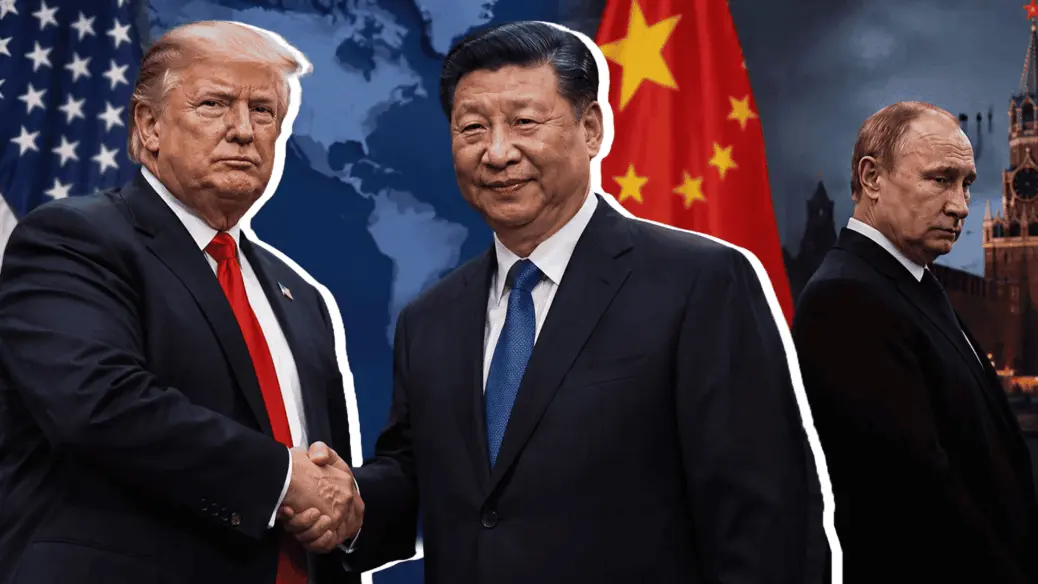
Russia expected the meeting between Vladimir Putin, Donald Trump, and Xi Jinping to mark the beginning of a new division of the world, in which the Kremlin could secure its claims to Ukraine and Europe. However, the summit revealed a very different picture: Putin was not treated as an equal participant in the negotiations, while China continues to act solely in its own interests.
Beijing is in no hurry to rescue Moscow, is profiting from the war, and is simultaneously expanding its own influence. Why is Xi Jinping benefiting from Russia’s weakening, how did he use his meeting with Trump, and could China become another threat to the Kremlin? Ivan Us, chief consultant at the National Institute for Strategic Studies, explores these questions for 24 Kanal.
The Collapse of Illusions About a New Division of the World
Russian propaganda had long been preparing its domestic audience for a trilateral summit in Shenzhen involving Donald Trump, Xi Jinping, and Vladimir Putin, portraying it as a kind of “Yalta 2.0.”
The Kremlin hoped that the leaders would gather and divide the world into spheres of influence, with Ukraine and Europe officially recognized as part of Moscow’s sphere of interest. However, reality turned out to be radically different.
As Ivan Us notes, historical parallels with the 1945 Yalta Conference are entirely inappropriate. Back then, the countries sitting at the negotiating table were victors whose troops were stationed outside Berlin. Today, by contrast, the Russian army is in its fifth year of waging an exhausting war and cannot even capture Mala Tokmachka.
Issuing geopolitical ultimatums from such a position is absurd – something both Washington and Beijing understand perfectly well. Putin’s attempts to invoke past agreements have also failed.
His claims that compromises had supposedly been reached in Anchorage, only to be rejected by the Europeans, were quickly refuted. US Secretary of State Marco Rubio made it clear: no agreements had been reached there – the sides had simply exchanged views.
Russia’s demands to roll back NATO infrastructure to its 1997 borders sound just as absurd. It was Boris Yeltsin, then President of Russia, who signed a document committing Moscow to respect the foreign policy choices of European countries, including their right to join the Alliance.
Protocol Slights: How Beijing Put Putin in His Place
The Chinese leadership did everything possible to demonstrate that there was no “great troika.” The meeting format resembled more of a “two plus one” arrangement, with Russia playing the role of an invited guest rather than an equal partner.
This was underscored by a series of telling protocol details that carry enormous significance in the East.
Donald Trump was personally greeted by Xi Jinping at the foot of the aircraft stairs – an unprecedented gesture in Chinese diplomacy (the last time a similar level of respect was shown was when Mao Zedong welcomed Nikita Khrushchev in 1960).
By contrast, Putin’s arrival was accompanied by music from the ballet Swan Lake, which in itself became a source of irony among commentators.
The traditional group photograph did not include a shot featuring only Trump, Xi, and Putin. The spot next to the Chinese leader was taken by his wife, leaving the Russian dictator at a distance.
Trump and Xi Jinping sat at the same table, while Putin was seated at a separate one nearby. Russian presidential aide Yuri Ushakov was forced to explain to the press that the leaders had “failed to talk” precisely because of the seating arrangement.
Beijing’s Pragmatism: Why China Benefits from the War
Despite its public statements about peace and calls for nuclear disarmament, China is guided solely by its own pragmatic interests. Beijing has no interest in a swift Russian victory.
On the contrary, a prolonged war suits the Chinese leadership under any scenario. If Russia wins, it is seen as a defeat for the West, strengthening China’s global position.
If Russia is defeated and becomes critically weakened, however, Beijing could see an opportunity to reclaim territories lost more than a century ago during the Opium Wars, including Tuva. It is no coincidence that reports about China forming “Siberian divisions” periodically surface in the information space.
The economic dimension of this pragmatism is even more striking. In the first nine months of this year alone, China sold $973 million worth of drones to Ukraine. Beijing disregards Moscow’s dissatisfaction with the supply of drones to the Ukrainian army because, for China, it is simply profitable business.
China profits from Russia but sees no reason to give up its billion-dollar earnings in Ukraine, while simultaneously creating problems for Russia itself.
In addition, reports emerged in October about Chinese satellite activity over Ukraine.
Nuclear Hypocrisy and UN Reform
Another telling aspect of the summit was the joint peace declaration, which made no mention whatsoever of either Ukraine or Europe. It was a compromise document hastily drafted because the parties had failed to reach an agreement on key issues.
Trump wanted to discuss nuclear disarmament, Putin sought recognition of Ukraine as part of Russia’s sphere of influence, while Xi Jinping wanted to preserve the liberalization of global trade. Interestingly, the final communiqué included a statement on the need for UN reform. This idea has long been overdue on the global stage.
As the leaders of Turkey and Poland have pointed out, the key problem is the veto power held by permanent members of the UN Security Council and the lack of mechanisms to hold states accountable for violating the sovereignty of other countries. Russia has abused this power for years, blocking any resolutions condemning its aggression.
At the same time, Xi Jinping’s calls for the complete elimination of nuclear weapons appear to be blatant hypocrisy in light of Beijing’s actual actions.
According to the Stockholm International Peace Research Institute (SIPRI), China is currently expanding its nuclear arsenal at the fastest rate, already possessing more than 620 warheads, with the number expected to reach 1,000 by 2030. Beijing seeks to limit the nuclear arsenals of the United States and Russia in order to shift the strategic balance in its favor, while remaining outside any arms control agreements.
Information Warfare: How to Exploit the Kremlin’s Vulnerability
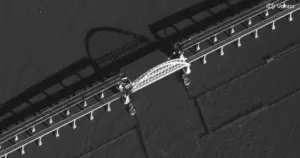
Putin’s nervous reaction to Ukraine’s successful strikes on the Crimean Bridge, following which he declared that he would refuse any negotiations on a ceasefire, points to a deepening crisis in the Kremlin. The Russian authorities do not know how to explain their helplessness to their own population and so-called Z-patriots.
In this context, the expert proposes an unconventional move for Ukraine’s information policy. Given the restrictions on using Starlink systems for military operations, Ukraine could cautiously introduce the narrative that the successful strike on the Crimean Bridge was allegedly made possible by the use of Chinese satellite systems.
Even if this is not true, such an information operation could sow serious paranoia among Russian elites. The realization that Moscow’s main and perhaps only powerful partner could be technologically assisting Ukraine in destroying Russia’s strategic assets would deal a devastating blow to Putin’s entire system of foreign policy calculations. It would demonstrate to Russians just how asymmetric their relationship with Beijing is, with Russia serving merely as an instrument that China uses at its own discretion.
It is worth noting that on November 17, the Security Service of Ukraine (SBU) and Ukraine’s Defense Forces carried out a multi-stage special operation, which caused the collapse of the Crimean Bridge’s road arch and damaged its railway section. On November 18, Ukrainian Navy spokesperson Dmytro Pletenchuk explained that the strike had created serious problems for Russian logistics. In addition, shipping between the Sea of Azov and the Black Sea was blocked due to the submerged bridge structures.