
President Zelenskyy faces a difficult choice as tensions between military leadership and technocrats grow, with Fedorov’s stance and Hnatov’s potential candidacy reshaping Ukraine’s defense debate.
Why has Volodymyr Zelenskyy continued to delay a final decision regarding Oleksandr Syrskyi, and which candidate is being described as the key to restoring balance between the military and the technocrats? Komersant Ukrainskyi takes a closer look.
President Volodymyr Zelenskyy has yet to make a final personnel decision regarding Mykhailo Fedorov’s future role within the government team and potential changes in the leadership of Ukraine’s Armed Forces. Against the backdrop of Fedorov’s reported remarks that “as long as Syrskyi remains, nothing will get done,” political circles have increasingly begun discussing an alternative figure capable of defusing the crisis.
Mykhailo Fedorov has publicly highlighted Commander of the Joint Forces of the Armed Forces of Ukraine Andrii Hnatov as a reasonable, professional, and consensus candidate for the position of Commander-in-Chief of the Armed Forces.
President Zelenskyy now faces an exceptionally difficult choice: either attempt to preserve a fragile balance or embark on a sweeping overhaul of the military leadership in the midst of the most challenging phase of the war.
Zelenskyy’s Position
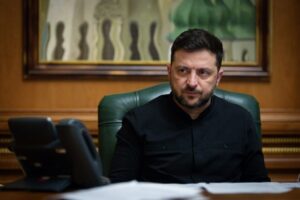
During a joint briefing with UK Prime Minister Keir Starmer, the President of Ukraine publicly acknowledged for the first time the existence of serious disagreements between the civilian and military leadership. According to Zelenskyy, the situation had reached a point where the sides were unable to find common ground without his direct intervention.
“I would very much like to see unity. The sides have not found it. Without me, they do not sit down at the table. Yet they should be working together independently — every day, on a constant basis,” the President said.
At the same time, Zelenskyy assured that Mykhailo Fedorov would remain a member of his team, although his exact role will be announced at a later date. Commenting on the street protests sparked by the personnel decisions, the President expressed solidarity with citizens’ right to voice their opinions.
“I understand, I hear, and I respond to what society is saying. We are fighting for freedom and democracy. People do what they want. They wanted to take to the streets — and that was the right thing to do,” Volodymyr Zelenskyy stated.
Fedorov’s Position
Mykhailo Fedorov himself stated during his own briefing that he does not view the President’s decision as a final endorsement of Syrskyi. According to him, the disagreements stem from fundamentally different approaches to governance and wartime reforms.
The former minister also spoke candidly about recent personnel decisions in related institutions, noting that he had not been consulted regarding the appointments of his former deputies to the Ministry of Digital Transformation and Ukroboronprom. Despite this, Fedorov expressed his full support for the President.
“I am confident that the President listens to the Ukrainian people, knows what needs to be done, and that the situation will be resolved. I have known him for seven years… Right now, both he and I are acting in accordance with our own perspectives on the world. That is normal,” Fedorov said.
At the same time, he added that Zelenskyy faces an objectively difficult task in making decisions due to the enormous number of complaints reaching him from people encountering problems within the Ministry of Defense system.
Why Does the President Have to Choose?
The central problem behind the current developments within the government is that parts of Ukraine’s political establishment have yet to fully grasp the magnitude of the challenges posed by wartime conditions.
Lyudmyla Pokrovshchuk, PhD and an expert in foreign and domestic policy, commented on the ongoing personnel turbulence.
“Unfortunately, our political elites have not fully understood that we are living in a state of war. During wartime, internal processes should not become politicized. The country cannot continue operating within the political paradigms that existed before 2014 — or even before 2022. We often appeal to European practices, but no European country has faced a situation comparable to Ukraine’s since the Second World War. There are simply no ready-made solutions,” Lyudmyla Pokrovshchuk noted.
Mykhailo Fedorov is one of the President’s closest associates, having stood alongside him since the 2019 presidential campaign and long been regarded as one of Zelenskyy’s key confidants. However, the realities of war demand different priorities.
According to Pokrovshchuk, tensions between Fedorov and Commander-in-Chief of the Armed Forces of Ukraine Oleksandr Syrskyi have reached a point at which the leaders of the defense and technology sectors are no longer capable of maintaining a constructive dialogue.
“During the most difficult phase of the war, Zelenskyy, as Supreme Commander-in-Chief, made a choice in favor of the military chain of command and Commander-in-Chief Syrskyi,” Pokrovshchuk said.
According to Pokrovshchuk, it is the President who bears personal responsibility for the country’s military and political course, which is why the decision was driven primarily by the logic of state survival.
“Whether this was the right decision will only become clear with time. Perhaps the President should have sought a consensus — or taken a more radical step by completely resetting both directions and removing both figures from their positions,” Pokrovshchuk emphasized.
At the same time, she argues that the greatest danger of the personnel scandal lies in attempts by domestic political actors to use Fedorov’s profile to destabilize the situation within the country. The politicization of this conflict, she warns, directly undermines national security.
“We need to unite, not politicize these processes. We must keep a cool head and act wisely in this situation, because the enemy will undoubtedly attempt to exploit our internal divisions against us,” Lyudmyla Pokrovshchuk concluded.
Reaction From the Military, Volunteers, and Opinion Leaders
The recent personnel changes within the Cabinet of Ministers of Ukraine, including the high-profile dismissal of Mykhailo Fedorov as Minister of Defense, have triggered a significant public response. Prominent military commanders, volunteers, political analysts, and technology experts have largely described the development as a symptom of a deeper systemic crisis in relations between civil society and the current government.
Among military personnel and defense technology specialists, Fedorov’s departure is widely perceived as a major setback for the modernization of Ukraine’s armed forces.
Anatolii Khrapchynskyi, an aviation expert and reserve officer of the Ukrainian Air Force, praised the former minister’s performance:
“Mykhailo Fedorov’s six months as Minister of Defense clearly demonstrated how a modern defense ministry should operate. He was the first head of the Ministry of Defense with a clear strategic vision and an understanding of the mathematics of modern warfare.”
The expert added that such strategic thinking in Ukraine’s corridors of power tends to inspire envy more often than a willingness to learn.
Serhii Beskrestnov, known by the call sign “Flash,” announced that he was stepping down from his role as an adviser to the minister and expressed deep regret over his inability to complete several critically important projects.
“I had access to numerous systems, which allowed me to analyze the actions of our enemy. I will no longer be able to do that. The enemy is celebrating in its channels because I am no longer at the Ministry of Defense,” Beskrestnov said.
Denys Prokopenko, known by the call sign “Redis” and commander of the 1st Corps of the National Guard of Ukraine’s Azov Brigade, thanked Fedorov for his consistent statesmanlike approach and for rapidly strengthening the country’s defense capabilities.
At the same time, he expressed cautious optimism regarding the appointment of the new Minister of Defense, Ihor Klymenko, the former Interior Minister, citing his experience in implementing the corps system and improving mobilization and territorial recruitment center (TCC) operations.
“He [Ihor Klymenko] has consistently defended the interests of National Guard servicemen and has paid close attention to ensuring that NGU units receive proper support. I believe that, from now on, this approach will be extended to fighters across all branches defending Ukraine on the front lines.”
For the volunteer movement, Fedorov’s dismissal became a worrying signal that the state is stepping away from breakthrough reforms.
Serhii Prytula, founder of a charitable foundation, emphasized that Fedorov’s team had carried out extensive work to eliminate corruption in procurement processes and establish direct communication with drone manufacturers. He described the current developments as another stage in the ongoing confrontation between society and the Presidential Office.
“The President has his own position, which today, unfortunately, does not align with the views of the proactive segment of Ukrainian society. If Zelenskyy had provided clear reasoning behind the decision to dismiss him, it could have eased the tensions. But that did not happen,” Prytula said.
Political observers and activists view the personnel reshuffle from a much broader perspective, seeing it as a sign of increasing concentration of power.
Yurii Kasianov, a public figure and volunteer, described the dismantling of Fedorov’s team as “the elimination of any alternative and plurality of opinions.”
“What we are seeing now… is another step toward absolute power, a police state, and dictatorship… Today they came for him, tomorrow they will come for you. Russia and Belarus went down this path slightly earlier than we did.”
Political expert Viktor Taran emphasized that the crisis raises fundamental questions about members of parliament and the country’s system of governance.
Journalist and publicist Vitalii Portnikov, meanwhile, approached the situation with harsh criticism directed both at the former minister himself and at society as a whole. Commenting on Fedorov’s complaints about harassment from anonymous Telegram channels, Portnikov noted that Fedorov had become a victim of the very system he helped create during the 2019 election campaign.
“This is the Presidential Office’s bet on Telegram. On bots. On liars. On scoundrels… It has created an opportunity for Russians and their agents to pretend to be domestic propagandists and attack the Ukrainian state and government. For some reason, the former minister did not notice this danger earlier,” Portnikov said.
The journalist believes that as long as Ukrainians treat elections as a lottery and focus on charismatic individuals instead of building strong state institutions and strengthening the role of parliament, the country will remain hostage to media-driven scenarios.
An insider report from military analyst Vasyl Pekhno confirms that it is still too early to draw a final conclusion in this confrontation.
“I attended Fedorov’s press briefing. In short: he said that as long as Syrskyi remains, nothing will get done. According to him, the President has not yet made a final decision either regarding Fedorov or Syrskyi,” Pekhno wrote.
The key indicator of this crisis is the emergence of the Commander of the Joint Forces of the Armed Forces of Ukraine, Andrii Hnatov, as a potential successor to Syrskyi. Fedorov has actively highlighted Hnatov as a professional and compromise alternative.
Therefore, according to Pekhno, for President Zelenskyy this means facing a difficult choice: not merely putting out the conflict, but potentially undertaking a major restructuring of the military command, with Hnatov possibly becoming a new key figure capable of restoring the balance between technological and military approaches.
Tags: EMPR media military leadership Mykhailo Fedorov Oleksandr Syrskyi Ukraine Politics Volodymyr Zelenskyy wartime governance