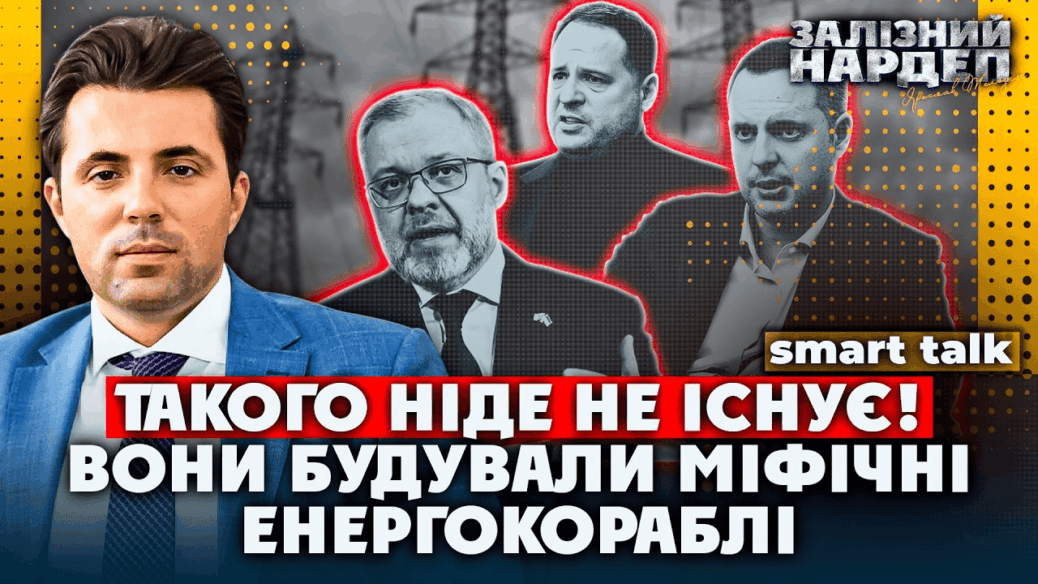
In his new video, Yaroslav Zhelezniak interviews Volodymyr Kudrytskyi about how unrealistic energy projects and mismanagement from 2022–2025 left Ukraine with limited electricity and lost opportunities.
Yaroslav Zhelezniak: Hi friends. This video will once again be about the energy sector — about preparation, or the lack of it, and about why the energy challenges will continue, not only due to Russian strikes. Frankly, I do not believe the energy truce after February 1 will last for long. And most importantly, this will be a brief historical overview of how we, as a state, prepared for the energy challenges we are facing now.
And there will once again be talk about Rostik as well — Shurma — because in most cases he was the one responsible back then, as well as about Halushchenko and everyone else. I would say this will be a fun video if I weren’t recording it for you with two heaters turned on, because it is absolutely impossible to work in my office right now. It’s actually very, very cold. And what it looks like in Kyiv and other cities is obviously even worse, because at least there is electricity in the Verkhovna Rada, unlike in our homes.
So this will be a brief overview. I won’t be doing it alone — I’ll be joined by a witness to all these events, the former head of Ukrenergo, Volodymyr Kudrytskyi. And get ready to swear a lot, because you’re going to hear things that, in my opinion, are simply beyond comprehension.
So why is it so cold and dark for us? That’s exactly what we’ll be talking about today. My name is Yaroslav Zhelezniak. This is the “Zaliznyy Nardep” channel. And we’re getting started.
I won’t keep you for long with a monologue — just a few disclaimers.
First. Obviously, all the problems with our energy sector are caused by Russian strikes. But it has also been obvious since 2022 that these strikes were expected and, accordingly, that they would happen — and they did. Let me repeat: first and foremost, the hatred here is directed at the enemy.
And second. Considering that the enemy’s ability to attack our energy sector was gradually increasing, and that even before this there had been a certain energy truce, Ukraine had time to prepare for it. But instead, we really loved making colorful presentations.
And here, before I hand over the word again to Volodymyr, with whom we quickly recorded a short interview today on these issues, let me just remind you that every year we had a conference on reconstruction, where each time, at least in Berlin, and later in London, they prepared — well, just some fantastic figures.
My personal favorite, and this, I think, is quite telling, isn’t even Zelenskyy’s 1 GW. It’s the presentation that was prepared for London in 2023. For context, even if you’re not a professional in energy, I’ll read out a few points from it, just so you can understand.
A small element. As a country, we consume 18 GW. Remember this number — it will just serve as a point of comparison.
So, in London in 2023, we said that Ukraine would become Europe’s energy hub, that our generation capacity would grow sevenfold, that the capacity of wind and solar power plants — including Shurma’s projects — would increase thirtyfold, and accordingly, that a 38 GW energy storage system would be built, gas production would quadruple, and 69 GW of electrolyzers for hydrogen production would be constructed. And, well, a lot of other things besides.
We’ll return to this point with Volodymyr later. But, as you can imagine, when foreigners read these points, they didn’t just think we were idiots — they thought we were crazy.
Then there was Berlin, a year later. That’s when the whole “Zelenskyy gigawatt” story came up — the idea that we would build 1 GW in a year, then 5 or 6 GW the following year. As you can imagine, it didn’t exactly work out, which, frankly, I’ve also made public at some point.
At this point, we’re now virtually moving into a room from 2022–2024 with the president, Shurma, Halushchenko, and, accordingly, listening to a witness of these events to hear how it all happened.
I wanted to phrase this question nicely, but I think it will be better in plain language. Tell me, please — how, thanks to the idiotic and fantastic ideas of Shurma, Halushchenko, and other well-known reformers on the run, did we end up in 2026 with no electricity, no heat, and sometimes, very often, no water?
Volodymyr Kudrytskyi: Well, in fact, we all, to some extent, became victims of the Skolkovo school of economics — that’s where Rostik studied — because in the President’s Office he was responsible for generating these concepts and paradigms about all kinds of trillions of dollars of GDP and the powerful development of hydrogen energy. In other words, all that creativity for the flashy presentations was mostly generated by Rostik. And he tried to get involved in every issue he had some understanding of, but in most cases, he didn’t understand anything.
I got the impression that, you know, back in his childhood he was constantly raising his hand in class, but the teacher rarely called on him.
Yaroslav Zhelezniak: To be honest, I thought this was ChatGPT, but okay, Skolkovo it is.
Volodymyr Kudrytskyi: Well, it’s a mix of Skolkovo and some unrealized ambitions and desires to show, “Hey, I’m smart too.”
But unfortunately, all of this resulted in us initially having this hydrogen energy concept. That is, we were supposed to build gigantic electrolyzers — costing tens or hundreds of billions of dollars or euros — to convert all electricity from wind and solar into hydrogen, then store energy in hydrogen, export the hydrogen to Europe via massive hydrogen pipelines, and create a large hydrogen valley in Ukraine.
Then we had the concept I call “London ’23.” Instead of the decentralized generation that we, as the system operator, had proposed to the president back in January 2023, in London they presented the idea that Ukraine’s energy sector should attract €400 billion in investments. We were supposed to build…
Yaroslav Zhelezniak: Easy task.
Volodymyr Kudrytskyi: It’s an absolutely easy task if you have BlackRock, if you’re in touch with BlackRock, if you have business cards from some BlackRock investment bankers.
So, for a second, in an energy system that at its peak consumes 18,000 MW, we were supposed to build 300,000 megawatts of solar. I mean, in a system that consumes a maximum of 18, we’re building 300.
Yaroslav Zhelezniak: Well, if we had attracted €400 billion, it would have been impossible not to build it.
Volodymyr Kudrytskyi: Well, you’d still have to do something with it, right? I mean, covering every train station and utility pole in the country with it would be long and difficult. So, I guess we would have had to build those 300 GW of solar.
Accordingly, at that London conference, the amount actually raised was zero. Out of those €400 billion — zero. And it’s still zero.
Then there were concepts like buying or leasing power ships — large vessels with gas power plants installed. We would sail these ships to the port of Odesa or other southern ports of our country, and supply Odesa from these power ships. Well, as we understand, that also resulted in pretty much nothing.
Yaroslav Zhelezniak: Well, some money was already spent on it.
Volodymyr Kudrytskyi: The gas transmission system operator spent money on gas infrastructure that was supposed to supply — or more precisely, deliver — gas to these power ships. That money, of course, was basically lost. No one was held accountable.
As a result, we simply lost time and money. And now, in 2026, we’re sitting with our 600 megawatts of decentralized generation, and we haven’t even built the so-called presidential gigawatt. That’s the result of all these theories, concepts, and presentations.
Yaroslav Zhelezniak: Listen, I have a few questions. First — about the so-called presidential gigawatt. As I understand it, that wasn’t London, it was Berlin, if I remember correctly. Oh, and at that time, based on the response from the late Brecht, by the way, I wrote that we were at the gigawatt at something like 12 or 13%. I remember that was the only time I spoke with Brecht, because Halushchenko was calling him, freaking out, demanding that he write “gigawatt” instead of 130 MW.
And in the end… well, all of that was supposed to be a gigawatt in 2024, and if I’m not mistaken, 5 GW in 2025.
Volodymyr Kudrytskyi: Or 50. Well, they’re all virtually built, but in reality — it’s about 0.6 GW right now.
Yaroslav Zhelezniak: Okay. Second question. In Ekonomichna Pravda or Ukrainska Pravda, it was reported that at the beginning of the invasion — when it was already clear that the enemy would target infrastructure — there were two concepts for what to do with energy. One was yours, in this case, about decentralized generation, and the other was about hydrogen and solar, which Yermak brought in, and Shurma brought it to him.
A small spoiler: Shurma’s business partners are precisely involved in hydrogen and solar generation. Just a coincidence.
Can you explain in more detail how these discussions unfolded, the logic behind them, and the so-called “Star Wars” fan thinking involved?
Volodymyr Kudrytskyi: It seems to me that the key factor here was the President’s Office’s love of big, impressive numbers. And this obsession with large figures — a billion trees, gigawatts of capacity, trillions in GDP — played a cruel trick on all of us. Because when we proposed our own concept, it didn’t involve any €400 billion investment in energy.
According to Ukrenergo’s modeling, Ukraine’s energy sector actually needs around €8–9 billion in investment to reasonably rebuild its generation in a new format. But, as Shurma explained to the president at the time, that figure was not ambitious enough. Meaning, it was considered nonsense. What’s €8–9 billion? We’re here, supposedly defending the entire Western world. So, we need €400 billion.
So basically, these numbers were just pulled out of thin air — inflated, made up. And the so-called hydrogen-solar concept was based on the idea that we would have so much solar power that the surplus could be converted into hydrogen. This hydrogen would be stored somewhere, and then, when needed, used to generate electricity when the sun isn’t shining.
In other words, we’d first convert electricity into hydrogen, store it, and then use it to produce electricity later. But the problem is that the technology of these electrolyzers, which convert electricity into hydrogen, is quite expensive, and the electricity itself would have to be extremely costly.
Plus, there’s the technical issue of transporting hydrogen through Ukraine’s gas transmission system, which is currently unsuitable for this purpose. As for Europe, even today — several years later — there isn’t a large market of hydrogen buyers. Simply put, economically, the technology isn’t mature yet.
So basically, hydrogen is a technology from the 30s, maybe the 40s. So this was just a pure PR stunt — they basically sold a flashy, empty presentation, and as a country, we lost those three years.
Yaroslav Zhelezniak: Listen, a few points alongside this. How were we building new generation and “lightsabers,” or everything else? And what about protecting energy facilities? I mean, the construction of — well, like nuclear distribution points? This part, was it discussed at all back in 2023–2024?
Volodymyr Kudrytskyi: In 2023, we were building with the Reconstruction Agency, while everyone else was saying, basically, “You don’t understand anything, it’s not necessary.” As Galushchenko and others said back then, since missiles would hit power plants anyway, why would we protect transformers from Shaheds?
But now, when they’re sending 4–5,000 Shaheds per month, Shaheds are hitting transformers at power plants without missiles. These power plants are being taken down to zero without any rockets, without any damage to the infrastructure — the transformers are just destroyed.
Accordingly, now, in October 2025, they decided: no, we still need to protect not only Ukrenergo’s transformers. And so we’ll be waiting a year or two until the transformers at power plants and distribution substations of the regional energy companies are also protected.
Yaroslav Zhelezniak: Listen, at what point in this €400 billion “victory plan” did building a nuclear unit appear?
Volodymyr Kudrytskyi: It was always there. Rostik and Herman were running around. Herman, of course, was constantly pushing this idea. We were constantly told we needed to finish two units at the Khmelnytskyy Nuclear Power Plant, then two more, then another two at Khmelnytskyy, and then they were running with the idea of the Chyhyryn Nuclear Power Plant.
There’s also the famous idea of the Chyhyryn Nuclear Power Plant. How it could even be integrated into the grid — how to build a network that could actually deliver power from it — is unclear. In other words, ten large nuclear units were announced, along with around 20 small modular reactors, which don’t even exist anywhere in the world.
None of this was actually built. Quite a lot of money was spent on various preparatory and design works, both at Khmelnytskyy and on the grids in the Odesa region, supposedly to accommodate some mythical power ships that never arrived.
So now we’re left without electricity, relying on a small amount of decentralized generation built by private businesses, entirely outside the involvement of these so-called “visionary” officials.
Yaroslav Zhelezniak: Listen, one last point — more political and philosophical. Rostik was a very versatile person, and he often had these constant, brilliant economic ideas. He would come to us with them quite frequently.
And there was, well, objective discussion in the working groups. He’d present something, and then I, or Danylo, or someone else would jump in and say, “Look, are you serious? We’ll never accept this, don’t even talk about it. And please, don’t waste time on nonsense — it’s embarrassing in front of the people who are actually here.”
So his economic ideas… well, there were a lot: abolishing cash, then our plans for banking…
Volodymyr Kudrytskyi: Ten, ten, ten — everything at ten.
Yaroslav Zhelezniak: That was the most brilliant of them all.
But he was constantly coming in with another new idea. The idea would be brought to us, and now the President’s Office would step in, he’d start explaining something. Then we’d hear, “Look, Rostyslav, please, no nonsense — refine the idea and come back later.” And we were constantly sending him off.
In energy, everything he proposed sounded completely fantastical. And surely the president or someone else should have realized that something was off.
My question is: why didn’t anyone else in the room tell the truth?
Volodymyr Kudrytskyi: Well, they tried not to allow others in the room who might speak the truth. It’s a well-known story — only those who speak in unison are allowed in the room.
Yaroslav Zhelezniak: I see.
Volodymyr Kudrytskyi: It was like choral singing — not polyphony, but unison. That’s why it turned out this way. Let’s see, maybe it’ll be better now.
Yaroslav Zhelezniak: Well, now they speak a bit differently, but we’ll see. Alright. Thank you for explaining. Not that it adds much optimism or warmth, but at least now we know who to throw our darts at on cold evenings. Thanks again.
Volodymyr Kudrytskyi: Thank you. Bye.
Yaroslav Zhelezniak: So, dear friends, as you can see, BlackRock didn’t help us after all. No one gave us €400 or €800 billion. Shurma was dismissed, later went to Munich, and is now hiding from NABU’s investigation in Vienna. And I’m convinced he’s fine with the electricity there.
Meanwhile, we are still dealing with the consequences of decisions that could have been made back in 2022–2023, which would have given us distributed generation and more electricity by 2026.
But this video isn’t about what can’t be undone. It’s more a warning: next time we get another fool in power — like Shurma or his aides — when we see these flashy presentations and ideas, we’ll know it’s in our interest to dismiss them immediately, rather than wait for a U.S. State Department representative to propose sanctions or NABU to bring suspicions.
That’s all for now. I’m Yaroslav Zhelezniak, and this is the “Zaliznyy Nardep” channel. Goodbye, and see you next time.
Tags: EMPR media energy mismanagement Halushchenko criticism Kudrytskyi interview shelters debate Ukraine energy crisis Ukraine opinion war strategy insights Yermak Shurma



![Visitors at the “Thank You With All My Heart” Ukrainian exhibition at the Council of Europe, featuring the Great Amber Heart and powerful war art. :contentReference[oaicite:2]{index=2}](https://empr.media/wp-content/uploads/2026/02/heart-300x171.png)