Ukraine’s stalled SEPA accession bill threatens $1.4 billion in international aid and hundreds of millions in savings, amid parliamentary disputes over financial monitoring, transparency, and political interests.
By mid-November, the Verkhovna Rada must pass a bill required for Ukraine to join the Single Euro Payments Area (SEPA). The reform promises to save businesses and citizens hundreds of millions of euros in transfer fees and secure $1.4 billion in international aid for the country.
Why has the bill stalled in parliament, what does it actually change, and why are MPs blocking this European integration initiative? RBC-Ukraine investigated.
Key points:
- $1.4 billion at risk: Adoption of Bill No. 14327-д is a condition for receiving funding from the EU under the Ukraine Facility and from the World Bank under DPL-2.
- Savings on fees: After joining SEPA, the cost of euro transfers could fall to almost zero, compared with current fees of €15–50.
- An account register that keeps no secrets: The register being established by the Ministry of Finance will contain only information on whether an account or safe exists, not account balances or transaction records.
- Political deadlock: Why are MPs concerned about financial monitoring, and why are they trying to tie the bill to personnel-related demands?
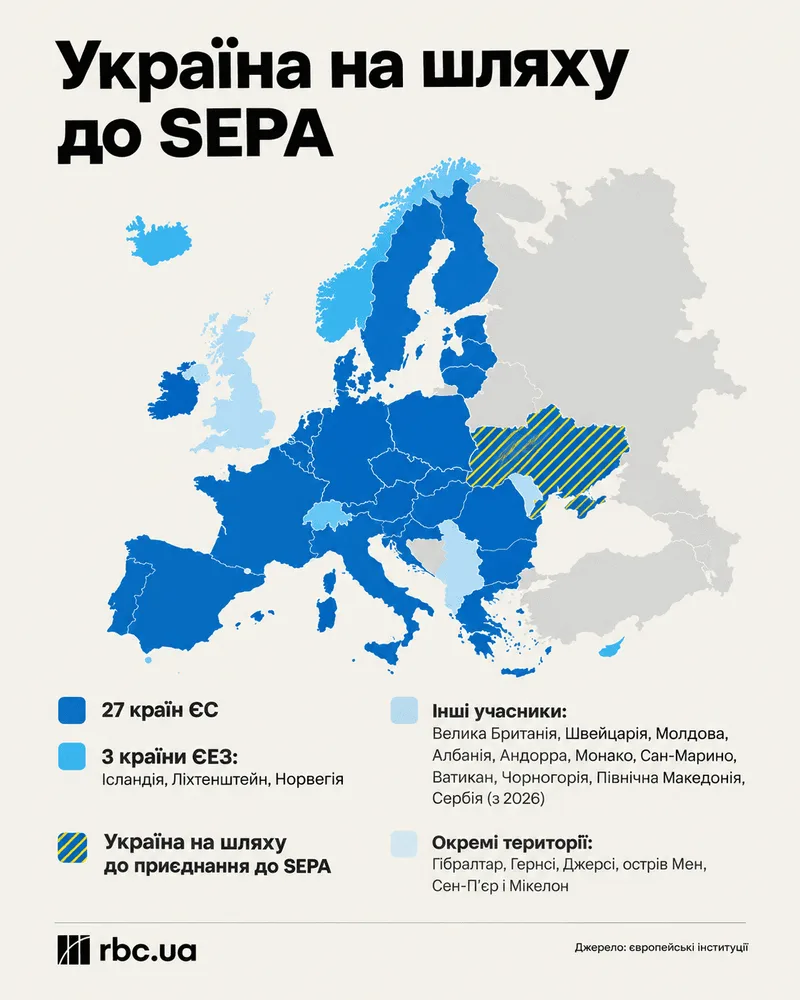
Ukraine’s accession to the Single Euro Payments Area (SEPA) is being dubbed a “financial visa-free regime.” It would allow euros to be transferred between Ukraine and the EU, and received from the EU, faster and at a lower cost.
The reform is also linked to approximately $1.4 billion in funding. Bohdan Slutskyi, an economist at the Centre for Economic Strategy (CES), outlined the breakdown of this amount in a comment to RBC-Ukraine:
- Nearly $400 million from the EU under the Ukraine Facility, contingent on meeting the SEPA-related requirement;
- Around $1 billion from the World Bank.
The parliamentary subcommittee on anti-money laundering cites a different figure for World Bank funding. As Olha Vasylevska-Smahliuk, a lawmaker from the Servant of the People party, told RBC-Ukraine, $800 million under the DPL-2 program is at risk.
The bill was already included as a requirement under DPL-1, but the condition was not met, and the World Bank waived it for Ukraine at the time. However, the requirement was carried over to DPL-2, with the World Bank making it clear that there would be no further extensions.
“If this requirement is not met under DPL-2, Ukraine simply will not receive this $800 million,” she said.
Why Waiting Is Not an Option
There is also a pressing deadline. The main requirements of EU Regulation 2024/1624, an updated anti-money laundering rulebook, will take effect on July 10, 2027, under the supervision of the new European Anti-Money Laundering Authority (AMLA). At that point, the requirements for joining SEPA will become stricter, with additional checks for sanctions compliance and ultimate beneficial ownership.
“Compared with what we will have to implement later, this bill is relatively lenient,” Vasylevska-Smahliuk emphasized.
According to her, once the law is passed and signed by the president, SEPA will accept Ukraine as a country. Each bank will then submit its own application to the European Payments Council.
“If Ukraine fails to prepare in time, the legislation will have to be revised to meet stricter rules,” Bohdan Slutskyi adds. In that case, SEPA’s launch will most likely be pushed back from 2028 to at least 2029.
The economist noted that Ukraine has previously pursued integration while continuing to implement reforms. In 2017, it secured visa-free travel for tourists even as improvements to border management continued. In 2022, the EU opened its market to Ukrainian goods before customs reform was completed. In his view, the same approach could be applied to SEPA.
How Much Could Be Saved?
According to estimates by the Ministry of Finance, joining SEPA would save €70–100 million annually in transfer fees. Analysts put the figure higher, at up to €200 million (approximately UAH 10 billion). For small and medium-sized exporters, the National Bank of Ukraine estimates average annual savings of up to €4,000.
Those making smaller transfers will feel the biggest difference. According to Vasylevska-Smahliuk, a transfer of up to €200 currently costs around €20 on average. After joining SEPA, the fee could drop to zero. A €20,000 transfer, which costs businesses around €200 today, would cost just a few euros. The lawmaker said this would be particularly important for refugees, students abroad, and families supporting relatives.
The National Bank offers another example: transferring €500 from Ukraine to an account in Poland can currently cost €15–50 because the payment passes through several financial institutions.
Exports, Marketplaces, and GDP
For manufacturers, these savings are also a matter of competitiveness. Vasylevska-Smahliuk offers a simple example: if a manufacturer in Kharkiv sells a T-shirt for €20, a European buyer currently pays around €20 in transfer fees on top of the price, bringing the total to €40. After Ukraine joins SEPA, the T-shirt, including the transfer fee, would cost around €21.
According to the National Bank of Ukraine, lower transaction costs and a boost to IT services exports could add around 0.3% to GDP, measured at purchasing power parity, in the first year after SEPA transfers are launched. Ukrainian businesses would gain easier access to a market of 500 million consumers.
Are the Banks Ready?
According to Vasylevska-Smahliuk, almost everything is technically ready for SEPA implementation.
“According to the information available to me, 57 of Ukraine’s 59 commercial banks are already technically ready to join SEPA. They are waiting only for parliament to pass the relevant sector-specific legislation,” the lawmaker said.
The National Bank of Ukraine is more cautious about the timeline. According to its survey, most banks believe technical integration could take 6–12 months from the date Ukraine joins SEPA. Under established practice, the European Payments Council then takes another 6–12 months to review an application.
The regulator dismisses concerns that banks will lose commission income. According to the National Bank of Ukraine, European banks are not opposing Ukraine’s accession, while correspondent banks would reduce their own costs under the new model and offer lower connection fees.
Serhii Mamedov, Chairman of the Board of Globus Bank and Vice President of the Association of Ukrainian Banks, told RBC-Ukraine that the bill aims to “ensure standardized, fast, and relatively inexpensive euro payments between Ukraine and SEPA countries.”
He said that while international transfers can currently take one to two business days, full integration could reduce processing times to just a few hours or, in some cases, almost instantaneous settlement.
“Contract payments will arrive faster, strengthening confidence in Ukrainian businesses as partners within a shared financial space,” he said.
Neighbors’ Experience: How SEPA Cuts Transfer Fees to Zero
Moldova became operationally part of SEPA on October 6, 2025. In the first nine months, the average cost of a transfer to the EU fell from €20 to €1.11. The number of cross-border euro payments increased by 77%, while the country saved approximately €11.6 million over the same nine-month period, according to the Centre for Economic Strategy. Montenegro reduced fees for transfers of up to €200 from €74 to zero within eight months of launching SEPA.
Andriy Pyshnyy, Governor of the National Bank of Ukraine, said in the “Follow the Money” podcast produced by the NGO AML HUB that he is impressed whenever international colleagues tell him how much their citizens save after joining SEPA. Ukrainian banks, he emphasized, are already technologically prepared; all that remains is to adopt the necessary legal framework.
“So now it’s up to parliament,” the National Bank governor concluded.
Political Power Plays or Fear of Financial Monitoring?
Although the bill is purely an EU integration initiative, it is facing resistance in parliament. Vasylevska-Smahliuk claims that the document has been “held hostage to the political ambitions of certain groups.” Some MPs, including Yuliia Sirko of the Holos faction, have described the requirements as “draconian” and are trying to tie them to a restructuring of the State Financial Monitoring Service or a change in the leadership of the National Bank of Ukraine.
Holos is demanding that the bill provide for an international-expert-led competitive selection process for the head of the State Financial Monitoring Service. Vasylevska-Smahliuk says this is not possible because the appointment falls outside the scope of the bill.
As a compromise, she included a provision for an international audit of the service. However, this has not satisfied her opponents, who are demanding a complete overhaul. In Vasylevska-Smahliuk’s view, this should be addressed in a separate piece of legislation specifically governing the service.
She said other political groups have declared they will not vote for the bill as long as the National Bank remains under its current leadership. “This is absurd,” she said, pointing out that the NBU will neither own nor administer the future register. It will be established and maintained by the Ministry of Finance.
Ukraine’s international partners acknowledge that there is resistance in parliament to passing the relevant legislation. In May, Katarína Mathernová, Head of the EU Delegation to Ukraine, said that joining SEPA was something she would strongly recommend fast-tracking.
“This involves transparency rules, anti-money laundering measures, and so on. And I understand that certain players are resisting this,” the diplomat said.
Despite the political pressure, Mathernová is convinced that the reform is genuinely needed by Ukrainians.
“I cannot tell you how fantastic it is to make a payment to Italy or Belgium without even thinking about the transaction cost. It is like making a domestic payment. When 6–7 million Ukrainians are forced to live abroad and transferring money can cost around €50–70, that represents a huge additional expense,” she explained.
According to sources in diplomatic circles who spoke to RBC-Ukraine, there are currently no technical barriers preventing Ukraine from joining the Single Euro Payments Area (SEPA), provided the necessary legislation is adopted.
Perks for MPs and Businesses
Bill No. 14327-d includes measures that Vasylevska-Smahliuk describes as direct concessions to businesses and members of parliament:
- the threshold for mandatory financial monitoring is raised from UAH 400,000 to UAH 550,000;
- no increase in fines for banking and non-bank financial institutions, despite international partners having called for such an increase;
- a provision for an international audit of the State Financial Monitoring Service and protection for whistleblowers in the field of anti-money laundering.
Whistleblower protection is one of the two key requirements set by the European Payments Council. A bank employee responsible for financial monitoring who refuses to process a suspicious payment must have legal guarantees protecting them from pressure or unlawful dismissal.
According to Vasylevska-Smahliuk, members of parliament are consistently wary of any financial monitoring initiatives. They have politically exposed person (PEP) status and are trying to abolish their lifetime PEP status. As a result, they view every new financial monitoring measure with suspicion.
Yet, the lawmaker stresses, MPs and other officials already declare their bank accounts and the existence of safe deposit boxes in their annual declarations to the National Agency on Corruption Prevention (NACP).
“No ‘new secret information’ about them will appear in the register,” Vasylevska-Smahliuk assures.
What the Business Community Says
The business community is assessing the risks without dramatizing them. In particular, the European Business Association (EBA) supports in principle the bill on Ukraine’s accession to SEPA and the harmonization of Ukrainian legislation with EU anti-money laundering rules. However, the organization is urging MPs to revise certain provisions of the document.
The business community stresses that the reform must strike a balance between European standards and the practical capabilities of entities subject to primary financial monitoring. In particular, the Association’s experts propose clarifying the definition of “senior management” in companies so that responsibility for approving internal financial monitoring rules rests with executive bodies rather than general meetings of shareholders. They argue that this would allow companies to respond to risks more quickly.
In addition, the business community supports simplifying the verification of non-resident legal entities by allowing the use of open government online registries instead of requiring paper-based legalized extracts.
The single register of bank accounts and safe deposit boxes is the main source of concern among critics. Vasylevska-Smahliuk describes claims that it would “destroy banking secrecy” or create a register “for the needs of the Territorial Recruitment Centers (TRCs)” as political manipulation. She argues that the aim is to “keep financial European integration out of Ukraine’s reach.” Rumors about “additional mass checks of individuals,” she says, are also unfounded.
What the Register Will Actually Contain
The register will not contain information about account balances, money transfers, or the contents of bank safe deposit boxes. It will contain only basic information: the account holder’s full name and the name of the bank, making it possible to identify where an account or safe deposit box is held, along with the period for which it is open. Law enforcement agencies can already obtain this information through official requests, the lawmaker emphasizes.
“We are simply bringing the procedure into line with European standards,” she assures.
The National Bank of Ukraine says the register will not affect banking secrecy. The information it contains will retain its confidential status, and access will be restricted to authorized bodies conducting pre-trial investigations through secure channels. These include the State Financial Monitoring Service, the Asset Recovery and Management Agency (ARMA), the National Agency on Corruption Prevention (NACP), the Prosecutor’s Office, the National Anti-Corruption Bureau of Ukraine (NABU), the Economic Security Bureau of Ukraine (ESBU), the State Bureau of Investigation (SBI), the National Police, and the Security Service of Ukraine (SSU).
According to the regulator, such registers are an “established, standard, and mandatory practice” in the EU. The Fifth Anti-Money Laundering Directive required all EU member states to establish mechanisms for identifying the holders of bank accounts and safe deposit boxes.
“The idea of a register is neither unique nor ‘punitive.’ In practice, it is about bringing the account-recording system into line with unified European standards,” agrees Serhii Mamedov. “Similar registers operate in many EU countries. They do not violate privacy but provide a clear data structure for competent authorities without giving third parties access to account details, such as balances or transaction history.”
The Register as a Safeguard Against Abuse
The lawmaker suggests looking at the issue from a different perspective. Currently, any law enforcement officer can find out which bank a person holds an account with simply by calling the institution. The person whose information was requested may never even find out about it, and no one is held accountable for any data leaks.
Under a centralized register managed by the Ministry of Finance, every search would leave a digital trail. Law enforcement officers would have to provide a criminal proceeding number. Any citizen would be able to check who accessed information about their account, when, and on what grounds.
“This makes the process subject to oversight and protects against abuse,” Vasylevska-Smahliuk says.
For the register to become operational, passing the law alone is not enough. The National Bank of Ukraine points out that the register will not start operating automatically; practical implementation will begin only after the law is adopted.
Both banks and the Ministry of Finance, as the register’s owner, must also be technically ready. There is already some experience in this area: banks provide the tax authorities with information about accounts held by legal entities and individual entrepreneurs.
“Smarter,” Not Stricter Financial Monitoring
Bankers assure the public that nothing will change for most people. Routine payments for utilities, purchases, and transfers to relatives will continue to go through without delays.
“Financial monitoring is becoming ‘smarter,’ not stricter,” notes Serhii Mamedov. “The bank does not scrutinize every payment under a microscope. It responds only when a transaction genuinely deviates from a customer’s normal financial behavior.”
The best way to avoid problems is to be transparent, use accounts for their intended purposes, and be able to provide proof of the source of funds when necessary. Banks focus only on unusual and high-risk patterns.
“Financial monitoring may sound ‘scary,’ but in practice it applies to a very limited range of transactions,” assures the Chairman of the Board of Globus Bank.
Beneficial Owners and European Rules
The second requirement set by the European Payments Council is a register of the ultimate beneficial owners (UBOs) of trusts and similar legal arrangements. It meets FATF requirements and is intended to help eliminate fictitious corporate ownership chains from the market.
Serhii Mamedov says the government is taking “another step toward ensuring that information about the actual owners of businesses is accurate and verified.”
“Simply filling in information as a formality is gradually becoming a thing of the past,” he says, adding that stricter liability for providing inaccurate information creates “a transparent, predictable, and trustworthy financial environment.”
The National Bank of Ukraine points to another indicator of progress. Ukraine’s banking regulatory equivalence with EU standards has been assessed at 81.7%, up from 49% in 2022. This is an expert assessment conducted by PwC at the NBU’s request, with technical assistance from the EBRD. The highest level of alignment — over 90% — has been achieved in the areas of own funds, operational and market risks, macroprudential requirements, and supervisory approaches.
Further progress requires legislative changes, particularly regarding securitization and the resolution of insolvent banks. The first of these is Bill No. 15555, which aims to improve the procedure for the National Bank of Ukraine to disclose banking secrecy information. On September 10, 2026, the relevant parliamentary committee approved the bill for its first reading.
A Test of Parliament’s Maturity
The adoption of Bill No. 14327-d is intended to bring Ukraine under the same rules as the EU. According to experts, refusing to vote for the bill or attempting to delay the process would deprive Ukrainians of savings worth hundreds of millions of euros and cost the state around $1.4 billion in support from international partners.
At the same time, the bill has yet to pass even its first reading, Bohdan Slutskyi points out. It still needs to be signed by the president, followed by an application to the European Payments Council, its review, and the integration of banks.
Moldova took around 20 months to complete this process. That is why the economist describes a 2028 launch as a “very optimistic” timeline. A delayed vote would push the reform back to 2029 or later.
If the bill fails to pass, this will be reflected in the European Commission’s report. Further delays, the economist warns, will weaken Ukraine’s position and increase the risk that Moldova will move toward EU membership faster and separately from Ukraine.
The irony is that this bill does not take money away from citizens but instead enables them to save it. Yet this purely European integration measure is now being blocked for political reasons.
Attempts to block or delay the adoption of a European integration bill are a classic example of political blackmail and the protection of vested interests, with no connection to a substantive debate about the quality of reforms at the National Bank of Ukraine or the State Financial Monitoring Service.
Reducing a purely technical bill, necessary for Ukraine to join the Single Euro Payments Area, to bargaining over personnel appointments or competitive selection procedures is an artificial form of manipulation. The bill’s authors have already made significant concessions by adding provisions for an international audit and raising the financial monitoring threshold. Nevertheless, opponents continue to put forward demands that fall entirely outside the scope of the legislation.
The real motive behind this resistance is MPs’ personal concerns about their own status as politically exposed persons (PEPs) and their reluctance to increase transparency around their financial assets, as well as attempts to use an important European integration initiative as leverage, including pressure on the NBU leadership.
Claims about a “threat to banking secrecy” and criticism of the National Bank’s leadership also appear manipulative because the Ministry of Finance will administer the future register of bank accounts, which will record only the existence of an account — information that officials already disclose annually in their declarations to the National Agency on Corruption Prevention (NACP).
Ultimately, personal and factional ambitions are being placed above national interests, while citizens and businesses become hostages to political bargaining. They lose the opportunity to save hundreds of millions of euros in fees, while the country risks missing out on $1.4 billion in critically important international support.