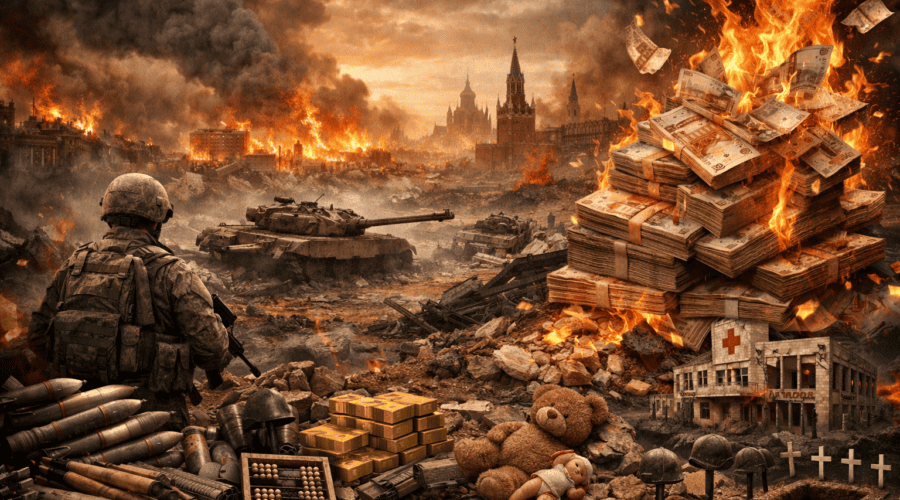
Russia has spent nearly $871 billion on its military over twelve years of war with Ukraine, massively expanding its army and draining the economy.
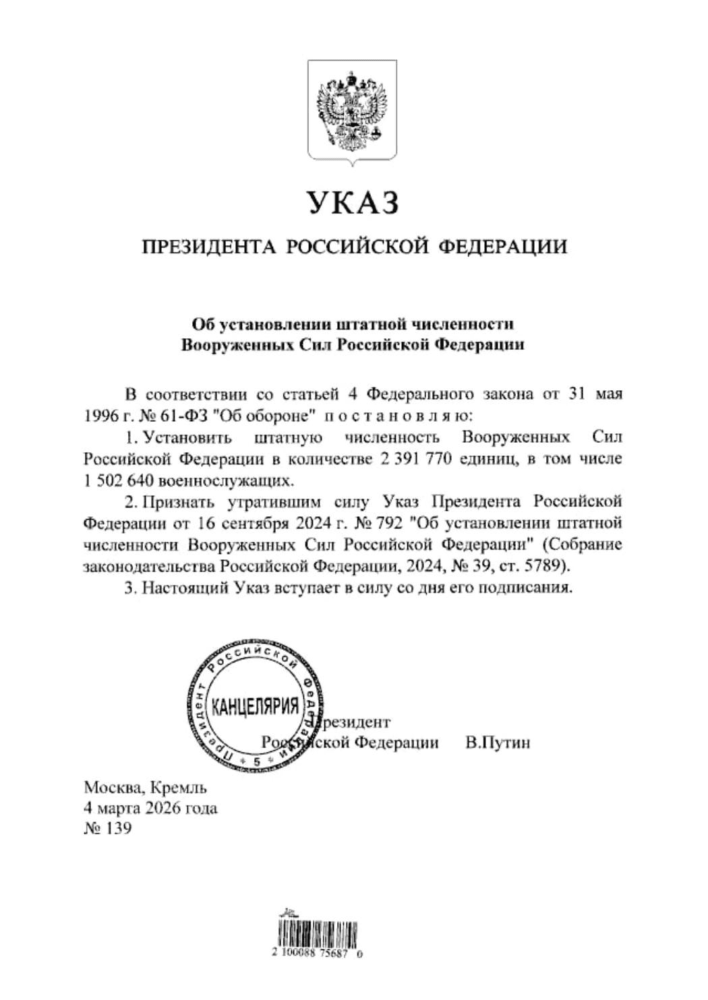
On March 4, 2026, Putin signed Decree No. 139 — the authorized strength of the Russian Armed Forces is set at 2,391,770 personnel, of which 1,502,640 are servicemen. This is not news about military planning. It is a financial verdict for a country that has been systematically stripped for twelve years to finance war. This was reported by spilno.org.
In 2008, before Serdyukov’s reform, the army numbered more than one million people. The reform reduced it — by 2014 only 766,000 remained. Then the war began, and the pendulum swung back. Today the army has once again exceeded one and a half million — but this is no longer a Soviet-style conscription ballast, but a machine tailored for a specific war and requiring very specific money.
In 2013, at the peak of pre-war buildup, the military budget amounted to $88 billion — more than that of any other European country. In 2014, when Moscow seized Crimea, it was $69 billion. Then the ruble collapsed under sanctions, and the dollar equivalent fell to $43–56 billion in 2015–2020. Not for long — because in 2022 the full-scale invasion began. In 2022 — $65 billion. In 2023 — $71 billion. In 2024 — $145 billion, a record. In 2025 — $185 billion: 39 percent of the country’s entire federal budget, a third of which is classified.
The arithmetic of war is ruthless. According to calculations by the Bank of Finland, which applied the Stockholm International Peace Research Institute methodology to official budget data, the direct cost of the war in 2022–2025 amounted to at least $280 billion. This is only the amount above what Russia would have spent on the military under normal conditions. If we calculate from the 2014 baseline — assuming that without the war military spending would naturally have declined along with oil prices and stabilized at around $50–55 billion per year — the total losses over twelve years are estimated at $300–400 billion. One square kilometer of captured Ukrainian territory, according to Russia’s own defense minister Belousov, has cost roughly $25 million. For that money, a modern hospital could have been built. Instead — a crater in the steppe.
Over twelve years of war, Russia has spent nearly $871 billion on its military. What does that mean in human terms? Each of Russia’s 55 million families would have received about $15,800 — a new Lada Granta plus $7,000 in change. Each of the country’s 75 million workers would have received $11,600 — roughly a year’s salary. Each of the 43 million pensioners — $20,000, or six extra years of pension payments. Alternatively, every worker’s salary could have been doubled for six consecutive years. Finally, this amount is 4.3 times larger than the entire GDP of Ukraine in 2021 — $200 billion. Russia has burned four times more on war than the value of its victim.
The expansion of the army from 766,000 to one and a half million does not happen in a vacuum. It means millions of people removed from the economy, from their families, from productive labor. It means a pension system drained to finance combat payments. It means a country that in 2025 spends 3.8 times more on weapons in dollar terms than it did four years ago — and calls it a victory.
The war is not a failure of the Russian economy. It is its logical continuation. Opaque military spending is the perfect environment for the redistribution of resources within the elites. The more that is classified, the less oversight there is. The longer the war lasts, the longer this machine keeps running. Decree No. 139 is not a military document. It is another bill that will be paid by the peoples of Moscow’s colonies — or, if you prefer, “Russia.”