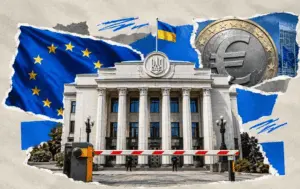

Ukraine’s proposed “OLX tax” reform could raise prices, affect cross-border shopping and volunteers, shift VAT to platforms, and is expected to take effect by 2027.
Any discrepancies between data from platforms, banks, and tax declarations would automatically become grounds for an inspection, experts explain.
Discussions are ongoing in the Verkhovna Rada regarding the adoption of the so-called “OLX tax” law. The draft law, which is currently awaiting consideration, is part of a broader tax reform and effectively proposes a revision of the basic principle that has shaped the behavior of Ukrainian consumers and small businesses for many years: the ability to order goods from abroad without taxation within a €150 limit. What lawmakers are proposing and why the bill has faced significant criticism is covered in the Glavred article.
No more exemptions?
The key idea of the draft law is to abolish the tax “exemption” for small imports. In practice, this means:
- the application of VAT to all international parcels, regardless of value;
- a revision of the current €150 threshold, which now allows goods to be imported without paying tax;
- taxation of the full value of the goods, including delivery costs.
This model is quite strict, as it does not distinguish between large and small purchases, retains a significant role for customs in the administrative process, and effectively shifts the tax burden onto the end consumer.
The revised alternative draft law No. 15112-1, which the relevant parliamentary committee has recommended as a basis, proposes changing the very approach to taxing purchases from abroad. Its main idea is to make the process simpler for buyers and more efficient for the state at the same time.
Today, the system works as follows: if you order a product worth less than €150, you do not pay taxes. If it is more expensive, customs may charge VAT upon delivery of the parcel. This often leads to situations where buyers are not fully aware of how much they will ultimately pay.
The draft law supported by the committee proposes a different model. The tax is essentially “shifted” from customs to the moment of purchase. This means VAT would be included in the product price already on the website, so the buyer would immediately see the final cost. The key change is that the taxpayer would no longer be the buyer, but the electronic platform through which the purchase is made. This platform would be responsible for calculating and transferring VAT to the state budget. For consumers, it would feel like a standard purchase: they pay for the item and receive it without any additional charges upon delivery.
Formally, the current €150 threshold may remain in place, but in practice it would lose its significance. Since the tax would be included in the price before the goods enter the country, most cross-border purchases would be taxed regardless of their value. At the same time, an exception is provided for private shipments between individuals — for example, gifts — worth up to €45.
Another important change is the reduced role of customs in this process. If the tax is already paid at the time of purchase, there is no need for it to be rechecked and charged at the border. This is expected to reduce delays and simplify parcel delivery.
It is also worth clarifying the situation regarding PEPs (politically exposed persons). During preparation for the second reading, an attempt was made to add a provision to draft law No. 15112-1 to abolish or significantly soften the so-called “lifetime” PEP status, which was not directly related to the legislative initiative. The idea was to limit this status in time (for example, to a few years after leaving office), which affects financial monitoring and bank scrutiny.
This initiative caused significant public attention because:
- it contradicted international standards of financial monitoring;
- it could have created risks in relations with partners, including the IMF and the EU;
- it was not directly related to the issue of parcel taxation.
As a result, these amendments were removed from the final version. From a practical perspective, this means that purchases from abroad are likely to become more expensive due to VAT being included in the price. At the same time, the process itself would become more predictable: without additional charges, unexpected reassessments, or interaction with customs.
Risks not only for civilians but also for the military
Lawyer at the law firm LESHCHENKO & PARTNERS and PhD in Law Ihor Bykov notes that introducing taxation of income from digital platforms means a shift toward a significantly more transparent control system.
“The state is effectively moving from a model of trust based on declarations to a model of dual control — through data from platforms and banks. This makes citizens’ income from services such as Airbnb, OLX, or Bolt fully visible to the tax authorities,” he explains.
According to the expert, the key change is that platforms are becoming tax agents.
“Personal income tax (PIT) and the military levy will be withheld automatically, and ‘unofficial’ income from platforms will effectively disappear,” Bykov notes.
At the same time, he emphasizes that direct, total control over bank accounts is not being introduced.
“It is about indirect control — through data matching. A digital trace of income is formed that is difficult to conceal,” he says.
At the same time, the expert warns about risks in the new system.
“Transferring tax agent functions to platforms may lead to errors or even double taxation. In such cases, the taxpayer will have to prove that the tax has already been paid,” he emphasizes.
Another issue concerns the approach to the tax base.
“The entire income is taxed, not net profit, which may create a disproportionate burden, for example in rental housing or goods sales,” Bykov adds, noting that the risk of audits is increasing.
“Any discrepancies between data from platforms, banks, and declarations will automatically become grounds for inspection. Regular income may also be classified as entrepreneurial activity, with corresponding fines,” he notes.
About the person: Ihor Bykov
Ihor Bykov is a lawyer at the law firm LESHCHENKO & PARTNERS and holds a PhD in Law.
He specializes in tax, financial, and administrative law, in particular the regulation of the digital economy, taxation of e-commerce, and the activities of digital platforms. In his practice, he focuses on legal support for businesses, tax compliance issues, and interaction with regulatory authorities.
He holds a PhD in Law, which reflects a combination of practical legal experience with a scientific and analytical approach to legal issues.
However, there is also a less obvious issue that sector experts point to, namely the barriers the law could create for the country’s defense capability.
“First, this concerns parcels for military personnel from relatives or volunteers sent from abroad. In the event of expanded taxation, such shipments may fall under customs procedures and additional charges, which could potentially complicate and slow down their delivery. Second, a significant share of critically important small components — drone parts, control units, goggles, adapters, batteries, and other electronics — is currently purchased not by the state, but by volunteers or the military themselves using personal funds. The concern is that more complicated import procedures could affect the availability of such goods and the speed of their supply,” explains military-political analyst of the Information Resistance group Oleksandr Kovalenko.
He also adds that, if the law is adopted, there is a risk for volunteer logistics: large-scale purchases of inexpensive goods (power banks, heating pads, clothing, etc.) could become more expensive and more difficult to administer.
About the person: Oleksandr Kovalenko
Oleksandr Kovalenko was born on December 15, 1981, in Odesa. He graduated from the Odesa Academy of Telecommunications named after A. S. Popov. Since 2014, he has been actively involved in countering Russia’s aggression against Ukraine. He is a military-political analyst with the Information Resistance group and a leading expert at the Ukrainian Center for Security Studies. He is also a Ukrainian political and economic blogger known under the pseudonym “Zlii Odesyt” (“Angry Odesa Resident”).
When the new rules will take effect
Even if the legislation is adopted, the changes will not come into force immediately. According to MPs’ estimates, full implementation is possible no earlier than 2027, after technical system preparation and market adaptation.
Tags: digital platforms EMPR.media IMF Ukraine Military funding OLX tax parcel tax taxation reform Ukraine economy Ukraine Policy