At Lviv’s Zenyk Art Gallery, 207 works by 27 Ukrainian artists explore naive art, primitivism, and art brut through vivid imagery, interactive installations, and personal stories.
Following an exhibition dedicated to the work of Taras Shevchenko, which became a notable event and attracted a large audience, Lviv’s Zenyk Art Gallery has turned its attention to Ukrainian naive art, primitivism, and art brut. The new exhibition, “OURS,” brings together 207 works by 27 Ukrainian artists and artisans, from Kryvorivnia in the Hutsul region to Slobozhanshchyna. What can visitors see at the exhibition, why has a pink elephant become one of its central figures, and how is the art space creating new ways for audiences to engage with art? Read the report by Ukrainska Pravda journalist Anna Lodyhina.
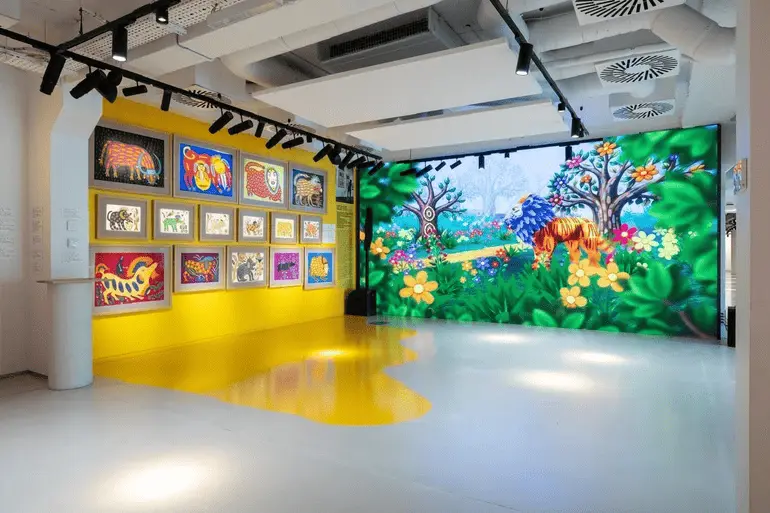
There are still ten minutes until the gallery opens, but a sizable queue has already formed outside. One group of schoolchildren is taking photos in front of a large multimedia projection featuring fantastical animals peeking out as if ready to leap into the real world — into the traditional Lviv rain. Nearby, a group of slightly older children has gathered around Babies, a three-meter-tall bronze sculpture by Czech artist David Černý. If the sculpture were a little shorter, I think the children would not only be hugging it by its arms and legs but would undoubtedly try to climb on it, too. A group of older people is watching the scene with delight, just as I am. They have also come to the gallery on this Friday morning.
Judging by the number of visitors I see gathering outside Zenyk Art Gallery before it opens, the team behind the art space knows how to draw a crowd. Today, most of them are here for “OURS,” an exhibition of Ukrainian naive art, primitivism, and art brut.
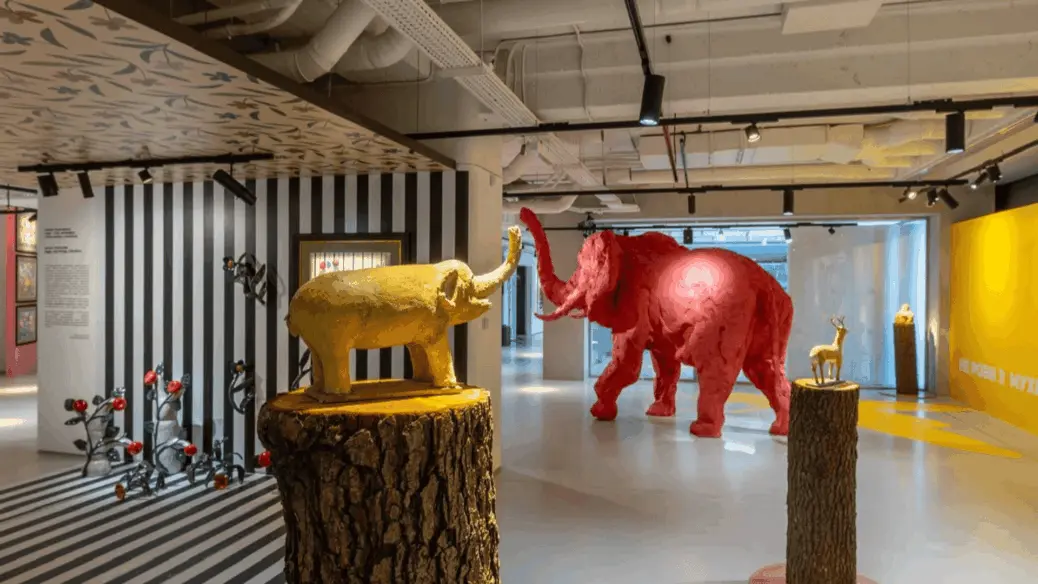
The first thing that catches your eye as you climb the stairs to the second floor, where the exhibition halls are located, is a huge pink elephant sculpture by Oleksandr Honcharov, its trunk raised high. Once I get closer, I read the words “Don’t make an elephant out of a fly” against the bright yellow background behind it. Only then do I notice that what lies on the floor beside it is not an imitation of spilled yellow paint, but the silhouette of a fly that is, quite literally, the size of an elephant.
It is an unexpected gateway into the world of Maria Prymachenko, Polina Raiko, Nykyfor Drovniak, Hanna Sobachko-Shostak, and other artists whose works are on display at the exhibition.
The curatorial text on the wall immediately explains this conceptual choice: “Every artist is capable of making an elephant out of a fly — transforming something simple and ordinary into something symbolic and monumental.” It is an apt description of the artists brought together under one roof here.
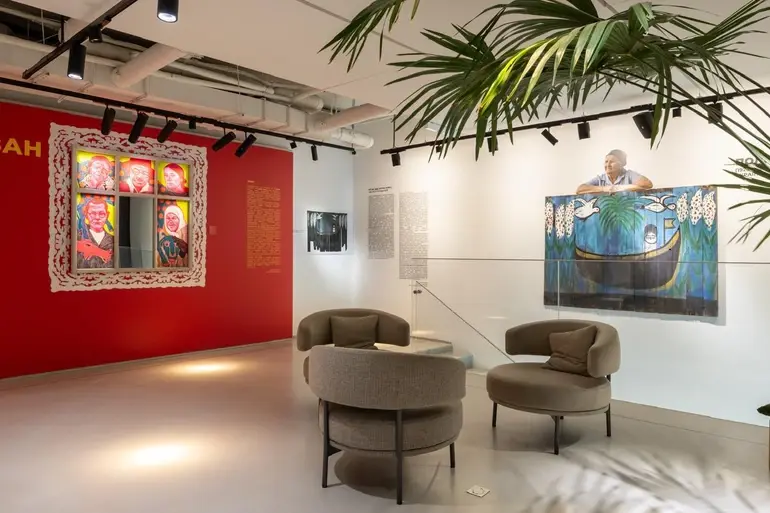
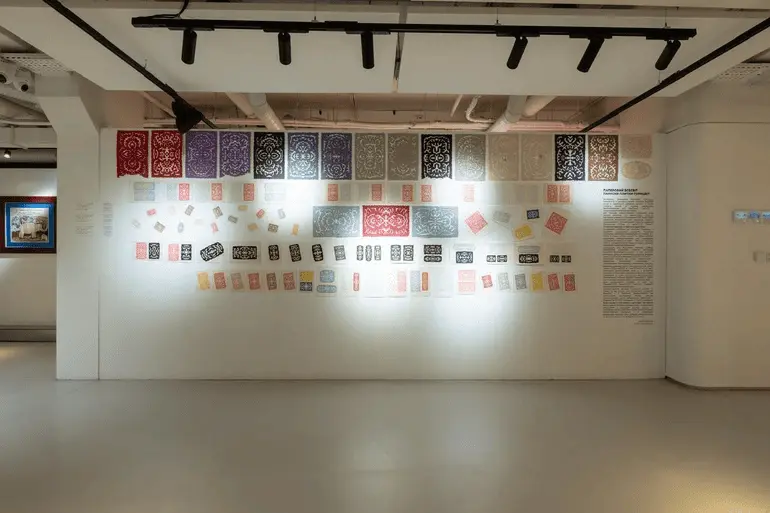
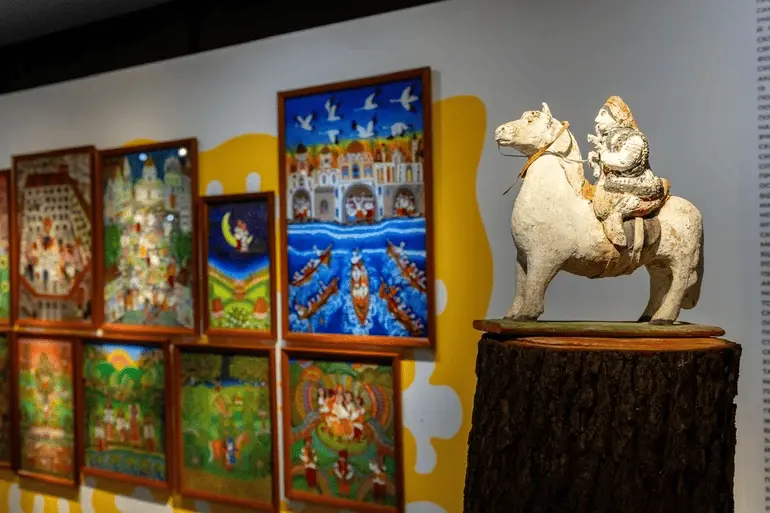
Ivan Skolozdra, who opens the exhibition route, managed to revive the nearly vanished tradition of folk icons painted on glass, expanding it beyond religious subjects into a chronicle of Ukrainian life, with its customs, beliefs, traditions, and everyday realities. Paraska Plytka-Horytsvit expanded the Hutsul world she inhabited into her own cosmos, exploring it through literature, drawing, photography, paper cutting, and sculpture, effortlessly blending reality and fantasy.
Everything Maria Prymachenko experienced — illness, training and work in the Lavra workshops during the Soviet regime’s repressions, the war and her husband’s death on the front line, raising her son alone, famine, and the Chornobyl disaster — erupted into symbolic, fantastical imagery that she painted, creating a unique artistic universe of her own.
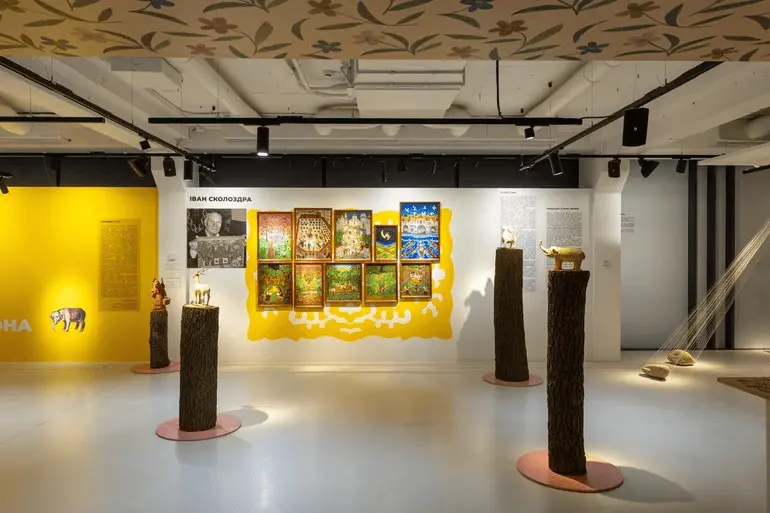
“At first, I thought it would be a huge exhibition featuring deer and elephants by Paraska Plytka-Horytsvit alone. But there are so many outstanding naive artists in Ukraine that I couldn’t leave them out. And where there is naive art, there is also primitivism and art brut. It was important to me to show the differences between them, because in Ukrainian society, and even in academic discourse, these terms are either used interchangeably or treated as equivalent,” says Khrystyna Berehovska, the exhibition’s curator, Doctor of Art History, and director of ZAG gallery.
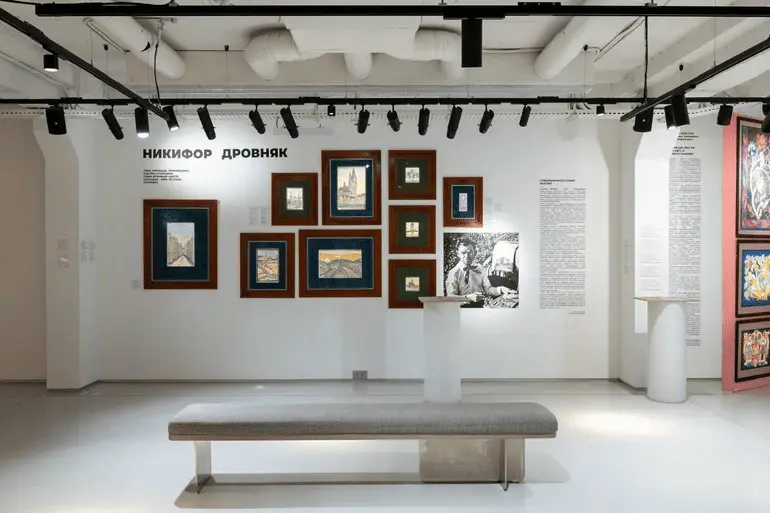
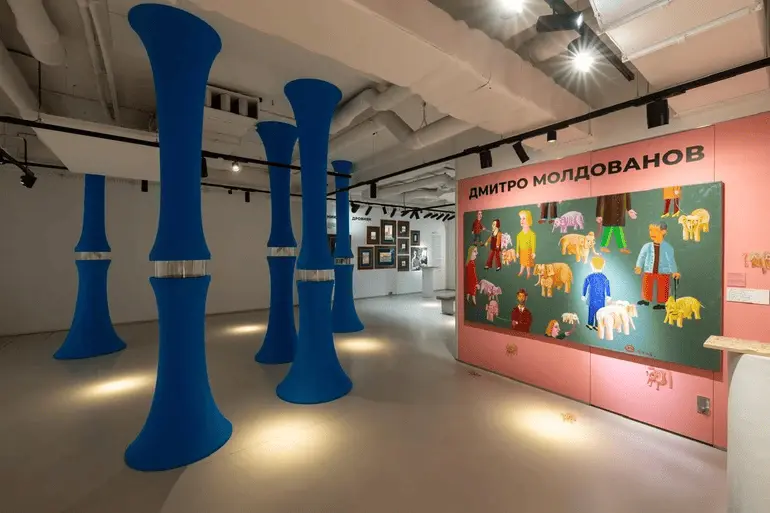
The worlds of naive and primitive artists are not set in opposition here, but rather complement one another. For example, the apples and flowers painted by Yevmen Pshechenko, who worked at the embroidery cooperative in the village of Verbivka, extend beyond the frame and take on three-dimensional form in the works of Olha Pylnyk, a contemporary ceramic artist from Uzhhorod. The fantastical elephants of Maria Prymachenko and Paraska Plytka-Horytsvit seem to enter into a subtle dialogue with the multicoloured elephants of Dmytro Moldovanov, which people walk on leashes as if they were dogs. In the neo-primitivist artist’s work, the elephants are less an expression of the artist’s boundless imagination than a deliberate metaphor for how, in response to society’s expectations, we try to control and tame our big dreams and fears.
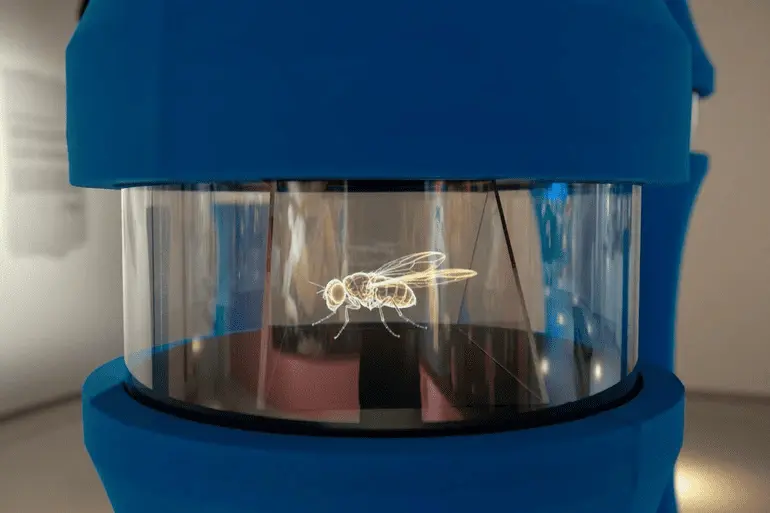
The elephant takes on an even broader meaning in a spatial installation created by Vasyl Odrekhivskyi in collaboration with Tsukat studio. Proverbs from different cultures around the world that convey the same idea as the Ukrainian saying “Don’t make an elephant out of a fly” — in other words, don’t exaggerate or attach too much importance to something trivial — are brought to life through holographic digital imagery. The only installation that might rival this space for the attention of younger visitors is the immersive room created by the same team further along the exhibition route.
For four minutes, accompanied by music by DakhaBrakha, each visitor becomes part of a vivid digital story about self-discovery, in which fantastical characters and imagery inspired by the works of naive artists come to life in a 360-degree video. The creators invite visitors to imagine what might happen if, one day, they dared to add some colour to their everyday lives and take a step into the unknown.
“I wanted to present these artists as missionaries who lived in difficult circumstances and, each following their own path in life, grappled with the ‘fate of tradition’ — whether folk art would survive or disappear. I wanted to present their work in an accessible, contemporary exhibition format that would appeal to people of all ages,” Berehovska adds.
According to the curator, perceptions of some of these artists remain narrow and are often reduced to their personal tragedies. For example, the Russian military’s destruction of the Kakhovka Hydroelectric Power Plant drew renewed attention to the work of Polina Raiko, whose house, covered entirely in her paintings, was submerged by floodwaters. The stories of most of these artists are indeed tragic and complex. The team sought to offer a fresh perspective on their lives and work, turning the exhibition into a space for discovery as well.
This vision is most vividly expressed through striking imagery, playful elements, and interactive formats that are particularly appealing to children. At the same time, for more knowledgeable visitors, this abundance of stimulation may create a certain tension between an engaging, photogenic space that effectively attracts audiences and the need to pause in front of the artworks themselves for quiet, unhurried contemplation.
“Artists working in naive art, primitivism, and art brut are often described as ‘people who couldn’t draw’ or ‘self-taught artists.’ But this is simply not true. Primitivist artists are professionally trained, with a solid artistic education, who deliberately simplify forms. Naive artists, by contrast, do not have formal art training. Art brut artists, meanwhile, do not consider their drawings to be art; they are the result of art therapy.”
While the works of naive and primitivist artists complement one another throughout the exhibition, art brut, which translates as “raw” or “rough art,” is presented in a separate section. In this tradition, the creative process itself is just as important as the finished work. That is why videos showing veterans creating their works have been included in the section dedicated to their art.
Alongside the veterans’ works are drawings by neurodivergent children. Andrii draws portals through which he can meet his father, a serviceman. Danylo draws Dalmatians that look only to the left. Vitalii depicts extraordinary animals and people — whether they exist in reality or are products of his imagination remains unknown. The intensity of each child’s experiences, expressed through a variety of images, matters more than technical skill. These works offer a glimpse into something deeply personal — something a person could not put into words but has left behind on paper or canvas.
Opposite is an exhibition of works created during art therapy sessions at the Lviv Regional Clinical Psychiatric Hospital. In their drawings, patients captured memories, dreams, fears, and events they had experienced. One of the works features a shaggy blue background with two plus signs in the centre. Its creator is a veteran who, after suffering a concussion when a shell exploded nearby, could no longer make out his comrades’ words over the radio. Lying on the ground and gazing up at the blue sky, he could repeat only these words: “plus-plus,” meaning “I’m alive.”
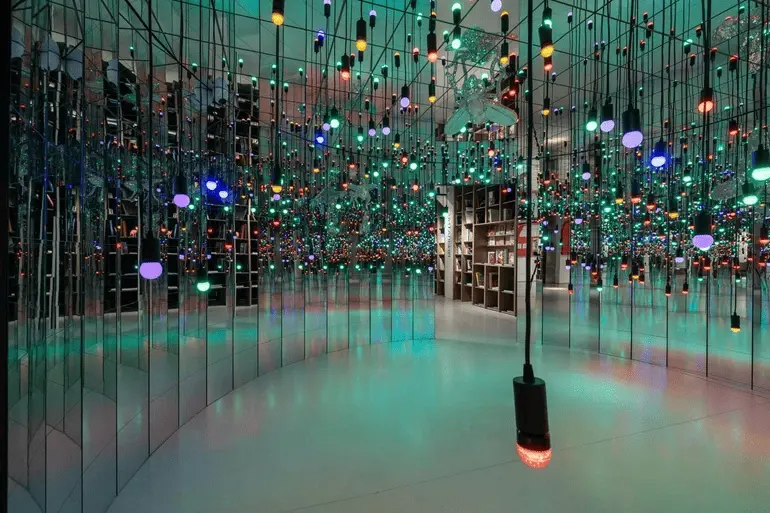
While visiting the art brut section, I hear children’s voices again. Inside a small mirrored room lit by around a hundred colourful bulbs lives what turns out to be a disco fly — another interactive feature of the exhibition that draws in children. Perhaps this is one of ZAG’s defining characteristics: here, a serious conversation about art is deliberately combined with play.
The team devises a different way for each age group to engage with the exhibition. The youngest visitors take part in interactive tours, where an elephant greets them and leads them to a birthday party for the disco fly. Older children receive tasks and explore the artworks through the artists’ “superpowers,” while teenagers are encouraged to discuss what they see. ZAG is also an inclusive space: it offers tactile replicas of artworks made from natural wood for visitors with visual impairments, as well as tablets featuring video content with sign-language interpretation.
Everyone can take a little piece of art home with them. The gallery shop offers a wide selection of merchandise designed to accompany each exhibition. Alongside colouring books, stickers, postcards, and notebooks inspired by the featured artists’ works, visitors can even buy themed treats. These include blueberry yogurt, similar to the kind Paraska Plytka-Horytsvit loved to eat, and a modern take on the caramel oatmeal porridge that Hanna Sobachko-Shostak used to make.
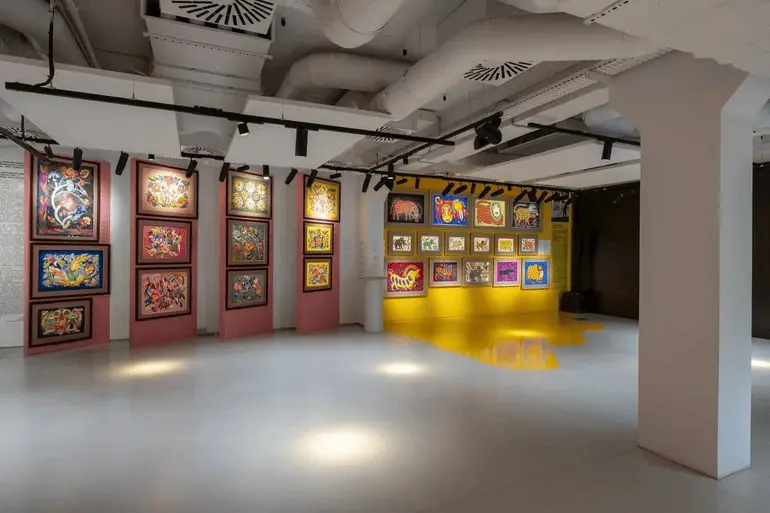
Zenyk Art Gallery is difficult to describe as a museum or gallery in the conventional sense. Original artworks share space with contemporary installations, while the traditional “viewer–artwork” relationship is deliberately expanded to include other ways of engaging with art, some of them rather unconventional for a cultural institution. Yet ZAG was conceived from the outset as an art space that would also reflect the character and personality of Zenyk Kozytskyi Jr., the grandson of the founder, in whose honour the gallery was opened. Zenyk himself studied cultural studies and, according to his grandfather, had a special sensitivity to and love for art.
Perhaps this is why the space features so many elements more commonly associated with interactive and entertainment venues than with traditional galleries. This approach may also help ZAG draw crowds and become a welcoming place for people to begin exploring the world of art.


![Visitors at the “Thank You With All My Heart” Ukrainian exhibition at the Council of Europe, featuring the Great Amber Heart and powerful war art. :contentReference[oaicite:2]{index=2}](https://empr.media/wp-content/uploads/2026/02/heart-480x270.png)