
The phrase “Kyiv — the mother of Rus’ cities” is often repeated in Russia like a mantra, used to support the claim that Moscow is the rightful successor of Kyivan Rus’ — and therefore entitled to Kyiv itself.
But this interpretation is a distortion of historical meaning.
What the Chronicle Actually Says
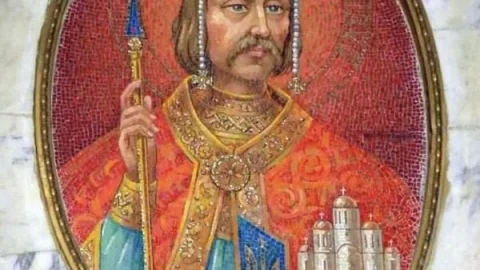
The expression appears in the Primary Chronicle (Tale of Bygone Years) and is attributed to Prince Oleg after he took Kyiv:
Tags: EMPR media historical revisionism Kyiv Rus medieval history Oleg the Wise Russian imperial narrative ukraine history“Let Kyiv be the mother of Rus’ cities.”
However, the phrase contains no reference to ethnic unity, shared blood, or a single people.
“Mother” here means capital, metropole, administrative center — not origin of a nation or ethnic family.
Kyiv Was Not “Created” by Oleg
According to the chronicles, Oleg came from Novgorod.
Yet the same sources repeatedly indicate that Novgorod itself was not originally “Rus’” in a unified sense.
When Oleg and Igor entered Kyiv, they did not create a state — they entered an already existing political system centered in Kyiv.
Kyiv was already the core of a functioning polity.
State Continuity in the Region
The state continuity of what is now Ukraine spans over a thousand years.
Before Rus’, the region included:
- Scythia — with rulers, coinage, and diplomacy with Greece and Persia
- Sarmatian and Gothic polities
- Hun, Bulgar, and Avar political structures
- Early Slavic tribal unions: Polians, Drevlians, Severians, Volhynians, Croats, Tivertsi, Ulichs
These were not “tribes without statehood.”
They were organized societies with governance, diplomacy, and territorial control.
Imperial Rewriting of History
In imperial narratives, this continuity was deliberately reduced to “tribes” like Chud and Merya.
In the 18th century, imperial historians such as Müller, Tatishchev, and Karamzin constructed an ideological framework in which:
- “Kyiv is the mother”
- “Moscow is its daughter”
- Therefore: “Russia is the heir of Rus’”
But this is not historical continuity — it is political construction.
The Moscow Claim
Moscow emerged much later.
In 1547, the Grand Duchy of Moscow renamed itself the “Tsardom of Rus’,” and Ivan IV assumed the title “Sovereign of All Rus’.”
This occurred over 400 years after the decline of Kyivan Rus’ as a state.
At that time, Rus’ no longer existed as a political entity.
This was not inheritance — it was appropriation.
Rewriting Origins
To justify this claim, Moscow reoriented Rus’ origins away from Kyiv and toward northern territories like Ladoga.
Rurik was redefined as a Scandinavian figure to sever ties with the Slavic world.
This narrative:
- dismisses Kyiv’s earlier statehood
- breaks continuity with Slavic political traditions
- places Rus’ origins outside its actual historical center
This is historical re-engineering.
Ukraine and Historical Continuity
Continuity is not defined by names alone.
It is preserved in land, memory, political tradition, and cultural symbols.
Modern Ukraine represents the direct continuation of the Kyivan political and cultural space.
We do not begin with Rurik.
We existed long before him.
Read more in: “From Rus’ to Ukraine: Restoring History”