
The 3rd Luhansk Border Detachment’s ensemble brings music to soldiers, combining performances, creativity, and psychological support, while building original programs and fostering unity amid wartime challenges.
Performances in places that can only be reached by armored vehicles, rehearsals under air raid alerts, and the creation of original music in far from ideal creative conditions — this is how the musical ensemble of the 3rd Border Detachment named after Hero of Ukraine Colonel Yevheniy Pikus operates.
The group is young — their first performances for the military took place on Christmas at the end of last year. Since then, they have been selecting the necessary musicians and working on their repertoire.
Suspilne Culture spoke with the ensemble’s head, Pavlo Dubrovskyi, and the musicians to find out how and why the border guards created their own musical group, whether there is room for creativity in the everyday life of the military, and what participation in such an ensemble means for each of them personally.
How the ensemble was formed
“This was the idea of our commander, Colonel Serhii Lozinskyi. He called me in and said they wanted to create a musical ensemble within the unit. I was tasked with finding talent among our service members—travelling around, observing, and listening to see who was capable of what. That’s how it all started in November last year,” Dubrovskyi recalls.
He himself began attending music school at the age of five, and since then, his whole life has been connected to music. Although he has a background in chemistry, he worked as a consultant in a music store. At the same time, he set up a home studio, where he worked as a sound engineer: creating arrangements and mixing music for other musicians.
“This is something I did and will continue to do when the time comes. Right now, I am fully dedicated to this ensemble,” says Pavlo, adding that it is a form of professional development for him. “I teach the musicians something, and they teach me something in return. So this is a valuable experience for me — communicating and working with such people.”
Since early December last year, they managed to bring together the first musicians, and several of them are still part of the ensemble today.
One of them is saxophonist Yevhenii Pachkin. Before becoming a serviceman in 2019, he played in jazz bands in Odesa and the surrounding region, performing both at home and abroad. He also played in the Odesa-based group “Khliba i Vydovyshch”.
“Our ‘thing’ was that we would come and play music that allowed people to take off the masks they wear in everyday life and release all the emotions they had been holding in for a long time,” he recalls.
Pachkin was one of the first to join the newly formed ensemble: “I think I was the first person Pavlo auditioned. I had just come back from duty on leave when Pavlo called me and said they were going to create an ensemble. Then we met, I brought my saxophone, and we talked. We played together right away, realized that we could work together and that it would be interesting for us. And we started thinking about how to move forward with it.”
The saxophonist acknowledges that, in addition to strong instrumental skills, personal qualities also matter: “Sometimes you have a musician who is very skilled, plays well, listens, understands everything almost instantly, but… is unreliable. Or we had a guy who hadn’t held an instrument in 30 years. He tried and put in the effort, but realized he couldn’t quite keep up.”
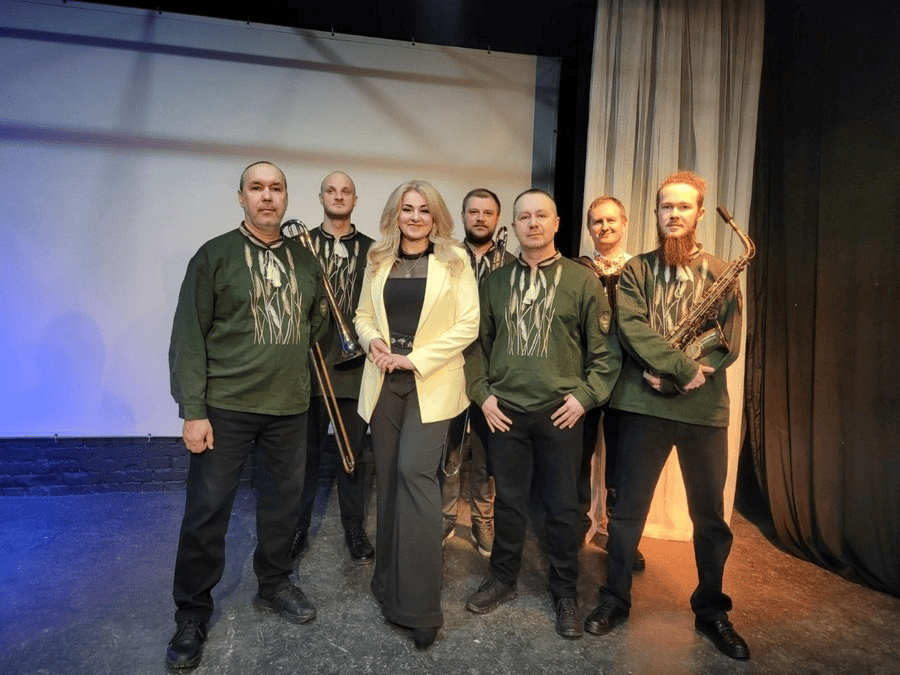
The head of the ensemble explains that he looks for military musicians with unconventional thinking, capable of collaborative creativity. “I wanted to select people who live and breathe this. Musical education is not critical. It can be there, but a person may think in stereotypes and bring nothing new. Or it can be a self-taught musician who plays incredibly well,” says Dubrovskyi.
Over these four months, he has managed to form a group of six musicians: keyboards, guitar, accordion, saxophone, and two trombones. In the near future, they expect a vocalist and a drummer to join after completing basic military training (BMT). “We are still looking for a bassist, a second guitar is needed, female vocals, and a trumpet. And then we can say this is exactly what we need,” Pavlo outlines the plans.
Guitarist Oleksandr in the ensemble is also responsible for songwriting. He graduated from music school with a focus on accordion, later taught himself guitar, and performed in vocal ensembles in his hometown in the Sumy region. He wrote his own songs and, after moving to Mariupol, performed as a bard. “Mariupol had a strong bard tradition,” Oleksandr shares, recalling that by the time of the full-scale invasion, he had already served 25 years in the maritime guard and retired, but later returned to the ranks of the border guards.
“‘The guys also liked my songs,’ he says. Saxophonist Yevhenii adds that they have already managed to build a real creative production line: ‘Oleksandr writes the lyrics. I compose music to those lyrics. Pavlo selects beautiful chords for the music, and Liubomyr arranges the parts.’”
Trombonist Liubomyr Lishchuk worked at the Lviv National Opera, taught at the Solomiia Krushelnytska Lviv State Music Lyceum, and was a member of the Luhansk Symphony Orchestra. He joined the ensemble of the 3rd Luhansk Border Detachment only a month ago.
“I completed basic military training (BMT) and was assigned to a combat unit of the 11th Border Detachment. I received a call from Pavlo asking if I would like to play in the ensemble, as my application had somehow come through. I said — of course I would. That’s how my transfer process here began,” shares Lishchuk.
Another trombone joined the group at the beginning of this year. “I was mobilized on February 21, 2025, and joined the 3rd Luhansk. I spent six months at the front, and when I returned in January 2026, Pavlo contacted me to ask if I could audition for the orchestra,” says Taras Zelenskyi, who, before becoming a serviceman, had not picked up his instrument for five years.
“I recovered in a month. And it will only get better!” Taras is confident.
Rehearsals and first performances
When asked about how the ensemble’s daily rehearsals take place, Dubrovskyi jokes: “It’s a military-creative secret.” He says that the main goal now is to build a full solo program: including cover versions of well-known Ukrainian songs, international hits, and original material.
The musicians confirm that the rehearsals are filled with an atmosphere of co-creation, where everyone influences the final result.
“The rehearsal process is very simple,” says Liubomyr. “We come, we learn to play, we practice the pieces, we play, we sing, we enjoy it, and we prepare something for our brothers-in-arms. Right now we are shaping the program. We are open to each other’s ideas, everyone contributes. There is no, so to speak, military hierarchy here. We leave the army outside the rehearsal room.”
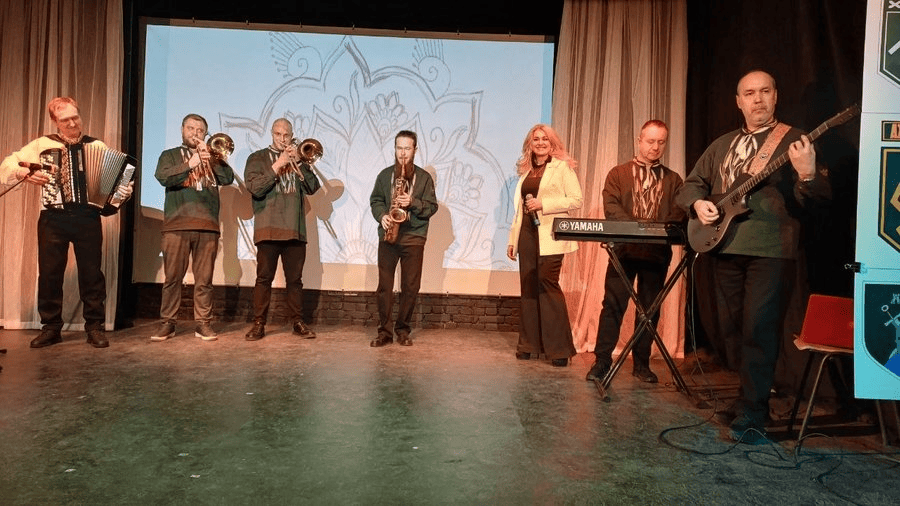
The ensemble’s first performances were pre-New Year concerts for their fellow servicemen. “Our activity started with this: at Christmas and New Year we went to different units to lift the guys’ spirits,” says Pavlo.
Oleksandr also remembers those performances. Among other pieces, they performed a carol he wrote for his daughters. “At Christmas, we traveled to different units and sang Christmas songs, including my carol. It was performed in Mariupol on the Philharmonic stage by a children’s choir. When I showed this carol to the guys, they said, ‘It’s a beautiful carol, let’s sing it.’ When we went around with these Christmas songs, it was something you had to see. The soldiers were like children: it was sincerity, smiles, and joy. It’s something you can’t forget,” he shares.
Mission and Instrument
Each of the musicians describes in their own way what participation in the ensemble means to them personally. For accordionist Serhii Dziuba, it is about developing his own skills and performance technique. He calls himself an ordinary musician who has not achieved major career success and jokes: “I just press the keys a bit.” He also admits that this new direction of activity gives him inspiration: “It inspires me that you can slightly change your activities even at an older age. I thought I would meet retirement more calmly, but here is a new direction — and it helps me stay in shape.”
Guitarist Oleksandr adds that being part of the ensemble is an important stage in his life, as music has now turned from a hobby into a profession. Saxophonist Yevhenii emphasizes that music is a tool that helps, among other things, increase the unit’s media visibility and even attract donations.
However, all members of the ensemble agree that their main motivation is to provide psychological support to soldiers — to help them release negative emotions and find renewed strength.
“First of all, it’s about helping the guys overcome psychological challenges. There is such a thing as music therapy. I hope that our ensemble of the 3rd Border Detachment will become, for our border guards, a kind of ‘music box’ of these emotions and psychological support. At the moment, this is my mission,” says trombonist Liubomyr.
The ensemble’s leader, Pavlo, adds: “You have to work very hard and put in a lot of effort to receive feedback from the guys. Because, of course, the conditions are stressful. But if you work and give your energy, the soldiers see that. It also lifts our spirits, knowing that we didn’t come here for nothing, that it’s needed. To recharge their batteries so they can continue carrying out their duties. This needs to be done, and we will continue doing it.”
Tags: Culture EMPR.media frontline human stories military music resilience soldiers ukraine war