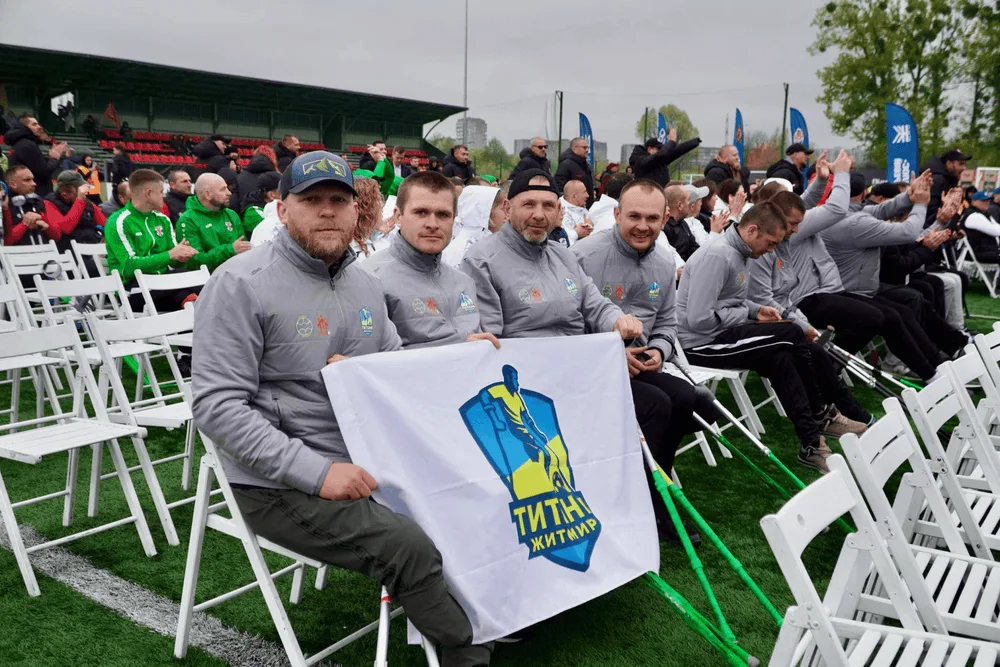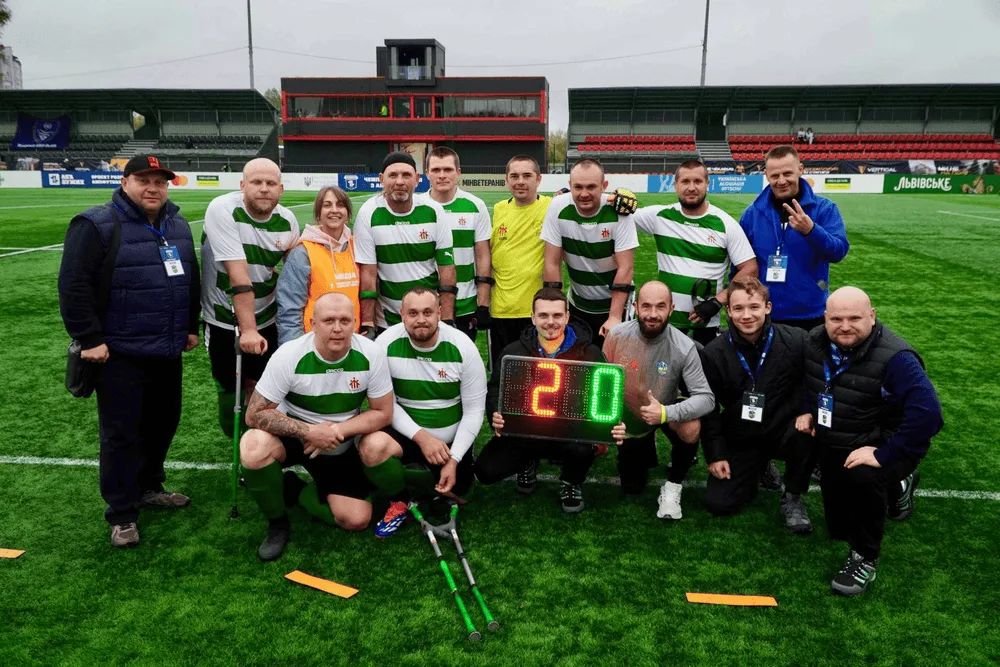
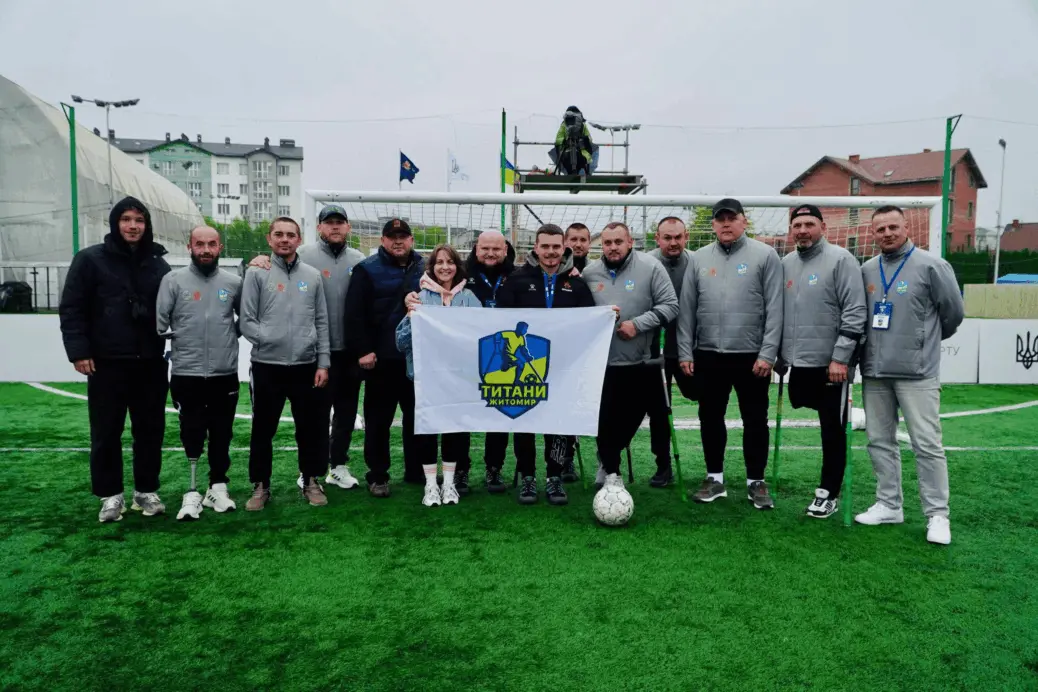
Zhytomyr’s amputee football team, the Titans, helps veterans recover, rebuild confidence, find camaraderie, and return to active life through sport, teamwork, and mutual support.
Sometimes, combat and injuries seem less frightening than what awaits a veteran upon returning to civilian life: social reintegration, coming to terms with a new self, and finding one’s place in a world that will never be the same again. Many service members are convinced that their lives will be permanently limited after the war and that losing a limb will define their future. Yet even after severe injuries and psychological trauma, it is possible to move forward again, set goals, and discover new opportunities. It is also essential to have family members and people who care about the veteran’s future by their side along the way. This was reported by nova.net.ua.
One way to return to an active life is through amputee football — an official form of adaptive football for people with amputations or impaired limb function. The sport has existed around the world for many years, but in Zhytomyr, it began to develop after Russia’s full-scale invasion and the arrival of the first wounded service members seeking opportunities to recover, connect with others, and feel part of a team again. That was how the Titans came into being — a team for which football became much more than just a game with a ball.
The stories of the players, coach, club director, and physical therapist show how taking a first step, one that seemed too daunting for a long time, can mark the beginning of a remarkable journey.
“Educating Through Sport”: How the Titans Came to Be in Zhytomyr
Behind the team’s creation is the Don Bosco Catholic Sports Club, a public organization that develops several areas of sports activities. It offers sports programs for children, adaptive sports, and an amputee football team.
The club’s director, Mykola Skreminskyi, explains that the organization was founded by Salesian priests, members of a Catholic religious order dedicated to working with young people. The order operates in 132 countries around the world, including through the development of educational institutions. In Zhytomyr, its educational work is represented by the private Salesian Vsesvit Lyceum, while its sports activities are carried out by the Don Bosco club.
“The Don Bosco Catholic Sports Club is a large public organization with several areas of activity. We offer adaptive sports for children, have an amputee football team, and also work with children who play football. Our motto is ‘Educating Through Sport,’” says Mykola Skreminskyi.
The idea of establishing an amputee football team in Zhytomyr emerged after the club’s representatives learned about the experience of their colleagues in Lviv. It was there that Salesian priests founded one of the first such teams in Ukraine and began working with veterans who had sustained severe injuries. Representatives of the Zhytomyr club visited Lviv several times to observe training sessions, learn how the team was organized, and talk to its members.
“The first team was established in Lviv. It was also founded by Salesian priests. They invited us to see the project and learn how they work with veterans. We visited their training sessions several times, observed how everything was organized, and decided to develop this area in Zhytomyr as well,” says the club’s director.
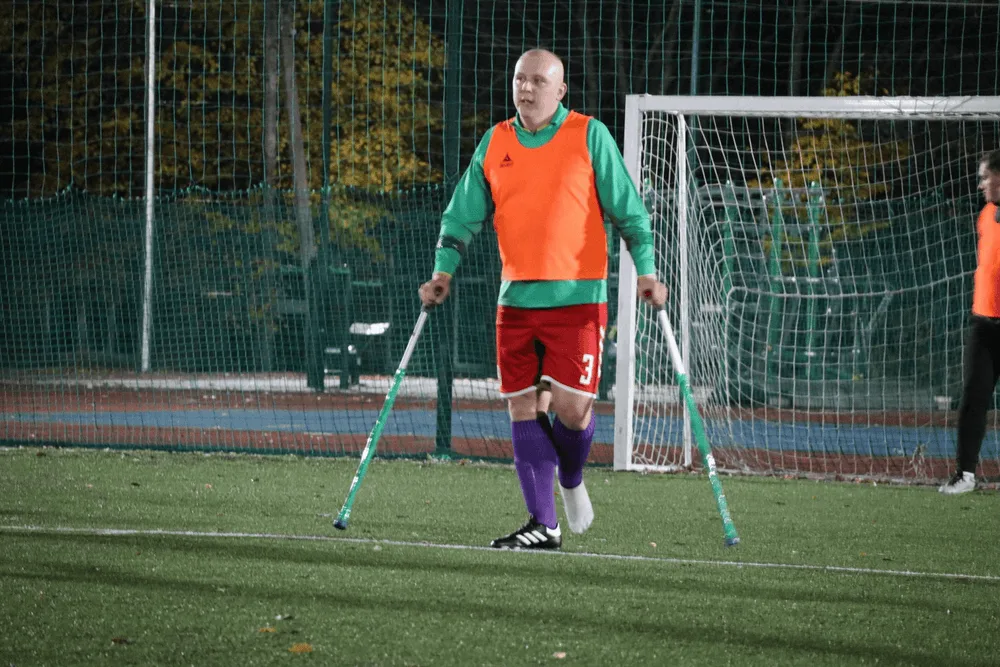
That was how the Titans gradually came into being. On November 21, the team will mark the second anniversary of its founding. Amputee football is an adaptive form of football for people with amputations or certain impairments affecting limb function. Outfield players move around using crutches, while goalkeepers have an amputation or impaired function of an upper limb. At first glance, it might seem that good physical fitness is the main requirement for this sport. However, the Titans know that sometimes the hardest part is not learning to kick a ball, but finding the courage to show up for the first training session.
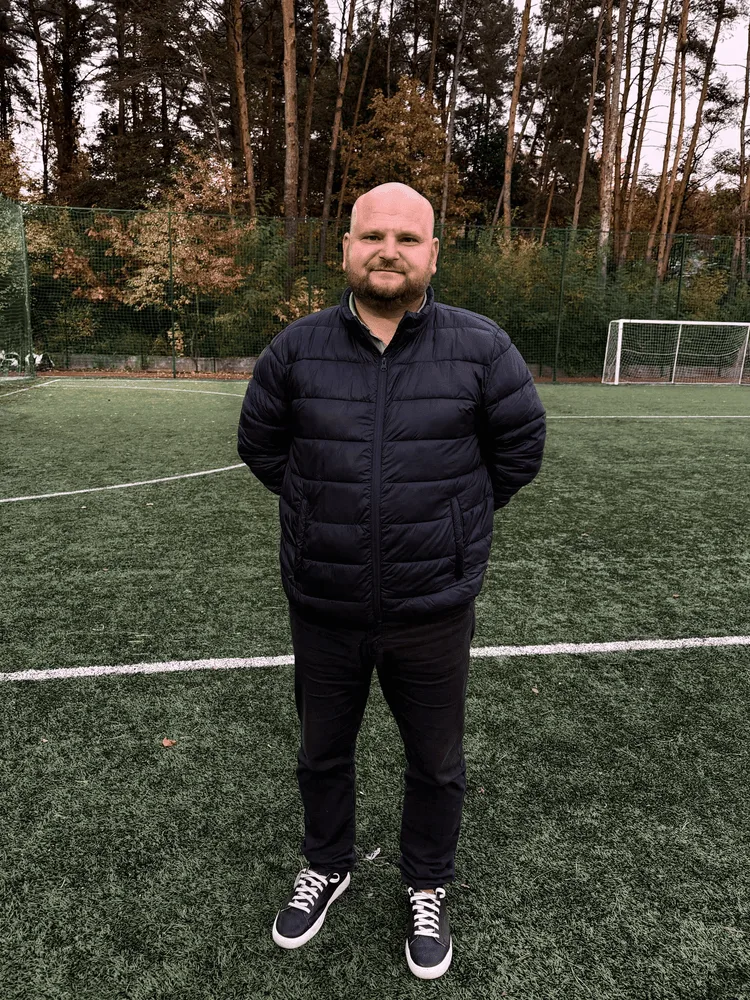
The Hardest Step Is Walking Through the Gym Door
Recruiting veterans to join the team required different approaches. The club’s representatives reached out to veteran communities, rehabilitation centers, and hospitals, visited local communities, and worked with veteran support specialists. Together, they visited service members at home, got to know them, talked with them, and invited them to try amputee football. But even when someone had heard about the team, that did not mean they would agree to come along right away.
“There is no single formula for getting a veteran involved. Everyone has their own story. The truth is, at first, the guys are not very keen on playing football. They think it is for people who played before, that it is difficult, that there are professionals there. One major obstacle is that they do not believe they can play. The second is that they do not want to step outside their comfort zone. I think this applies to more than just football. Any kind of rehabilitation and social reintegration is difficult,” explains Mykola Skreminskyi.
That is why the team’s first priority is not to teach someone to score goals or prepare them for a championship. First, they need to help the person find the courage to show up at least once. To see other players, talk to them, and understand that no one expects a newcomer to have professional skills, and that mistakes and failed attempts are a normal part of training.
“Our job is to invite them and get them to come to their first or even second training session. When they start talking to the guys and hear that only two players on our team had some previous experience with football, while all the others had no experience at all and had never played before, they begin to realize that it is possible. When they give it a try, start coming to training, and begin to succeed, they start believing in themselves,” the club’s director explains.
For some, it may sound simple: show up, train, and try again. But there is much more to it. You have to allow yourself to be a beginner, not feel ashamed when something does not work out, and accept that you may now have to do some things differently than before. And you have to give yourself a chance not to face your struggles alone.
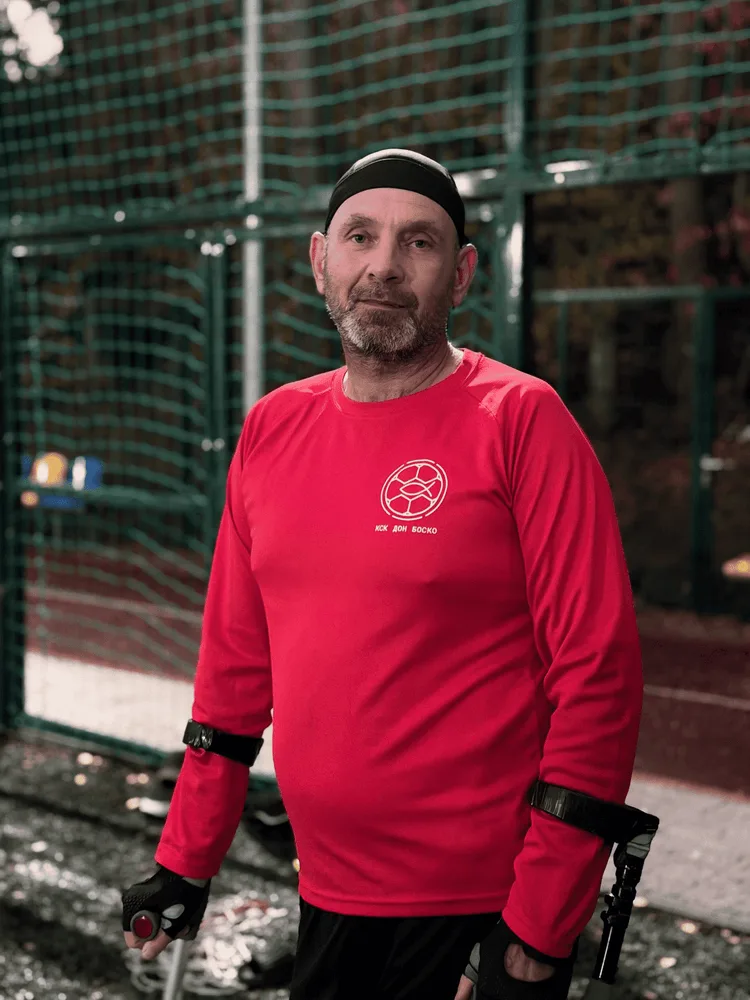
“I Started Looking Forward to Tuesdays and Thursdays”
Ihor Fasolia is the captain of the Titans. In June 2023, he was wounded in the Donetsk region, near the village of Novoselivka, while serving with the 31st Brigade. After returning home, he began working remotely and later took a job teaching the subject “Defense of Ukraine” at Levkivskyi Lyceum.
His family plays a special role in his story. His wife and daughter supported him and encouraged him not to shut himself away at home, but to look for work, interact with people, and gradually return to an active life. It was through his work at the lyceum that he learned about amputee football. At first, the idea of playing football on crutches seemed unusual, and the first training sessions were a real challenge.
“I felt somehow ashamed to admit to myself and tell them that, no, I didn’t want to do it, that I wouldn’t play. Starting to play at 49 seemed a bit late, but I thought, well, if they weren’t looking for Maradonas, if this was more for my own sake, then I might as well give it a try,” Ihor recalls.
These words reflect a fear familiar to many: What if I can’t do it? What if I’m not strong enough? What if the others are better and I end up feeling clumsy?
The first two or three months were a period of gradual adjustment for Ihor. Training sessions took place every Tuesday and Thursday. At first, he simply tried to cope with the physical demands. Over time, however, he noticed that he had begun looking forward to those days.
After an eight-hour workday at the lyceum, where he had to move around a lot while wearing his prosthesis, he would head to training. Getting home afterward was difficult at first. Gradually, though, he began to notice changes: the sessions brought not only fatigue but also enjoyment, and he still had energy and felt in good spirits afterward.
“I realized that I had been giving it my all for that hour, running and jumping, yet I felt so good and comfortable. And somehow, I got hooked,” the captain recalls.
At a certain point, football stopped being just an attempt to find something useful to do. It became something he wanted to keep coming back to. He made teammates and gained opportunities for shared trips, training sessions, and competitions. He began to feel that he was not simply going through rehabilitation, but living a full life, with room for plans, emotions, excitement, and new achievements.
When the team first began competing, it had just three or four players. They took part in the League of the Strong Cup, met other teams, and gained experience. Since then, the squad has grown. However, as Ihor explains, maintaining a consistent lineup is not easy.
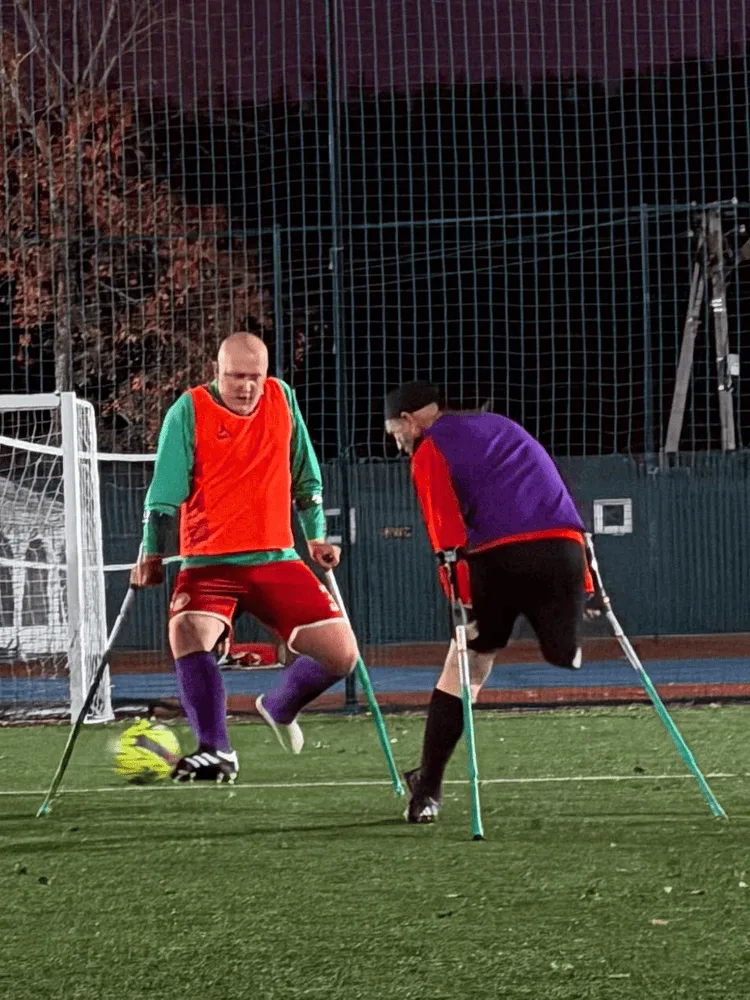
A Team Where Everyone Has Their Own Story
The Titans planned to travel to Ivano-Frankivsk for the final round of the Ukrainian Championship with ten participants: eight outfield players and two goalkeepers. However, the team’s lineup is constantly changing. Some players are undergoing treatment, others face health issues, and some cannot take several days off work to attend a competition. Family circumstances must also be taken into account.
That is why recruitment never stops. The club cannot simply finalize the lineup and stop inviting new players. Every veteran has their own abilities, needs, and limitations, and everyone’s recovery follows a different path.
“Our team has changed a lot over the past year, and we have grown significantly. I think that in another year, we will have a pretty strong team,” Ihor says, sharing his hopes for the future.
The captain himself is 49, while some of his teammates are considerably younger. Age, physical fitness, and sporting experience matter, especially in competitions, but they are not the only requirements for getting started. What matters more is the willingness to give it a try, the readiness to work on oneself, and the ability to train in a way that takes one’s health into account.
For Ihor, progress is measured not only by goals scored or match results. He pays attention to the small changes that take place during an ordinary training session. If a particular pass or exercise does not work at the beginning, he hopes that at least something will have changed by the end. That a movement will become more confident, an action more precise, and something that once seemed impossible will gradually become achievable.
It takes effort, energy, and pushing through fatigue. But this is precisely when you begin to feel that you are moving forward, Ihor Fasolia believes.
“Once you get hooked, it’s the opposite — by the end of training, you feel this light euphoria from the whole experience. And if you’re actually getting things right, that’s even better. It’s like a little drug, you know — you just want more and more,” the captain says with a smile.
Sometimes, these small victories become the most important ones because they restore a sense of one’s own capabilities: I can do this, I’m making progress, and I’m capable of learning something new.
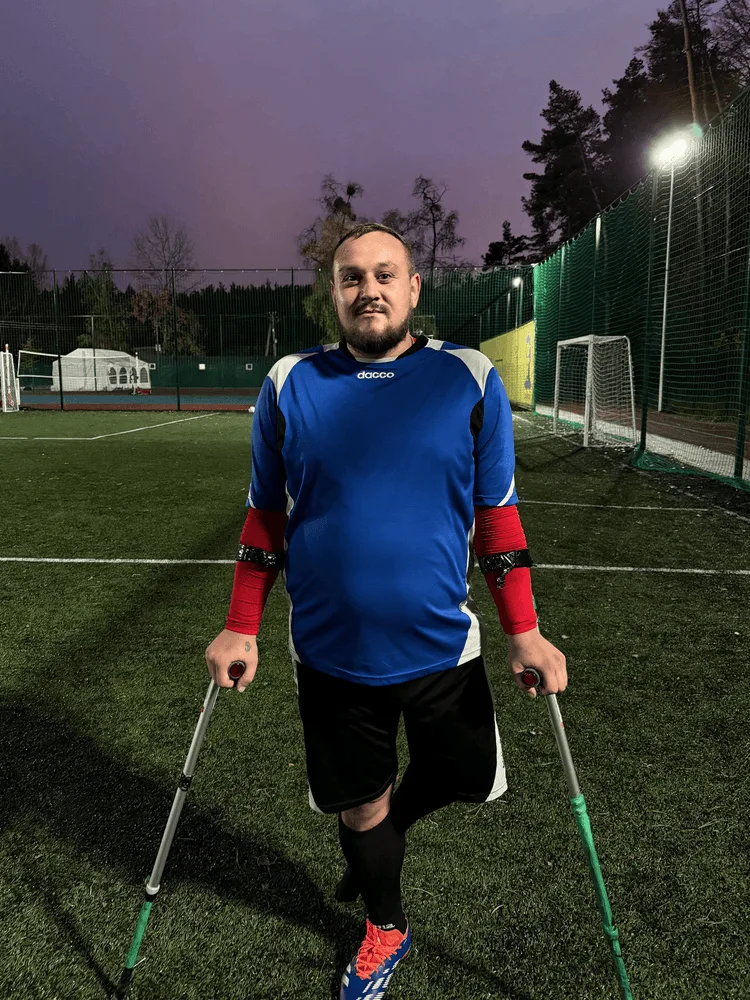
“Life Goes On”: The Story of Mykola Stetsenko
Mykola Stetsenko has been playing amputee football for almost two years. He learned about the Titans through Facebook, found Mykola Yosypovych’s contact details, called him, and asked to join a training session. His story began with a simple phone call. Mykola says he was met at the railway station and helped to join the team. At the time, he was living in Popilnia, in the Zhytomyr region, and moved to Zhytomyr about a year ago.
Before his injury, football had already been part of his life. However, in 2022, while he was seven kilometers from Izium, he was caught in an airstrike. A fragment struck his head. Mykola was bedridden for eight months and then spent another three months living with the fragment in his head. He was sent to Germany for treatment.
“In Germany, they brought me back from the dead,” he recalls.
After such an experience, returning to an active life cannot be easy. Yet today, Mykola is 30 and not only plays sports again but is also taking up two disciplines at once — amputee football and volleyball. For now, football remains his priority as he prepares for the Ukrainian Championship.
When asked what sport gives him, Mykola answers briefly, without further explanation:
“It’s adrenaline, adrenaline. Life goes on!”
His words do not promise that everything ahead will be easy. Rather, they reflect the realization that, after everything he has been through, it is still possible to find activities that inspire him, set goals, and feel the joy of doing something meaningful.
Mykola remembers his own beginnings well, which is why he advises those who are hesitant not to give up on trying simply because they are afraid they will not succeed.
“Of course, it’s worth giving it a try! They’ll teach you everything here. I came too, got on crutches, and couldn’t even hit the ball. Then they taught me here. They even have rehabilitation specialists — everything, everything. It’s great, basically,” the player says.
He was once a beginner himself, learning even the most basic skills. Now he has gained experience, competes in tournaments, and is thinking about his next step: he wants to try his hand at football refereeing. He is currently studying to obtain the relevant certification.
His story is another reminder that you do not have to know where your first step will lead. You just have to allow yourself to take it.
“Every Step Up Feels Like Starting From Scratch”
Behind the Titans’ development are not only the players, but also the people who teach, support, and help the team grow.
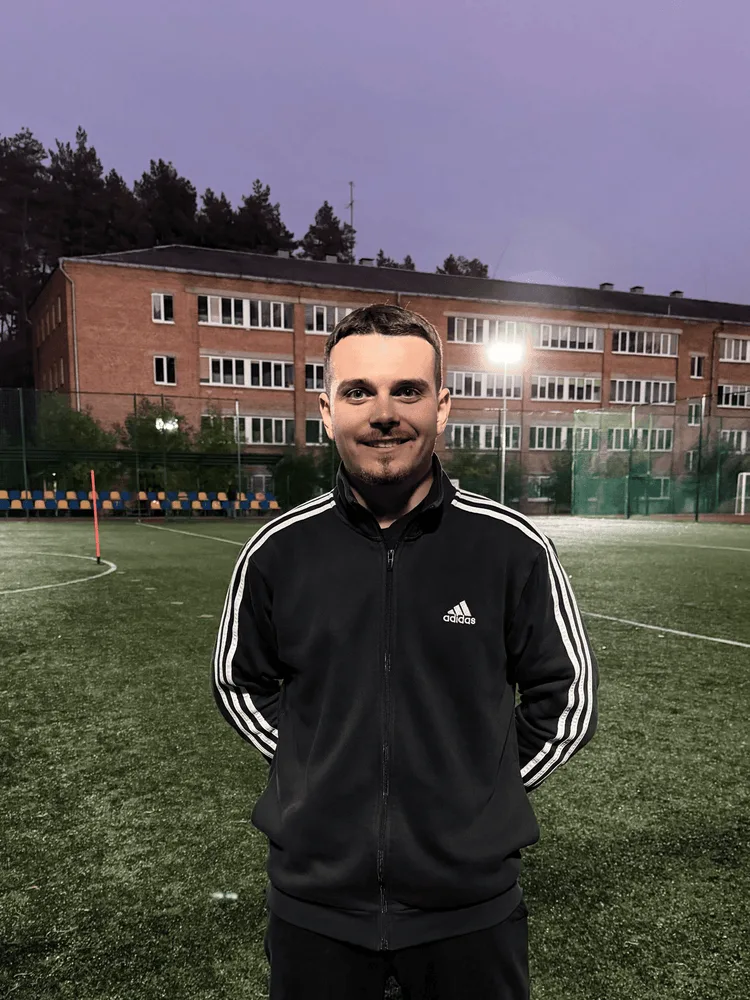
Vladyslav Skryminskyi is the team manager and a coach of children’s football teams. He is no newcomer to football. At first, he thought it would be enough to adapt his usual training methods to this new format. However, it soon became clear that amputee football has its own specific requirements and that working with veterans calls for a different approach.
“Before I discovered amputee football, I thought it was something ordinary, just like regular football. I thought I could take everything from mainstream football, apply it to amputee football, and it would work. But that wasn’t the case. The specifics are completely different, and so is the approach. The methodology is the same, but the ways of applying it are entirely different. The guys had never played football before, so everything is new to them. Every step up feels like starting from scratch,” Vladyslav explains.
For a coach, it is important to understand that every player comes with their own experience, physical abilities, and pace of recovery. An exercise that has already become routine for one player may be a serious challenge for another. That is why the training process requires flexibility, patience, and the ability to recognize even small changes.
To prepare specialists for working in amputee football, the Ukrainian Association of Football organized special training sessions ahead of the Ukrainian Championship. Experts from Turkey and Poland took part, and coaching courses were also held in Poland.
Amputee football differs from mainstream football in its rules, the number of players, and the size of the pitch. Each team fields six outfield players using crutches and a goalkeeper. Outfield players must have a lower-limb amputation, while goalkeepers must have an upper-limb amputation. The standard pitch measures 60 by 40 meters.
However, for Vladyslav, the most important discovery was not the difference in the rules.
“I enjoy working with this team. I love football, but any team, any team sport, is built on the people involved and the atmosphere within the team. I get so much joy out of everything that happens here. The guys are very open and supportive of us, and we support them in return. Overall, the atmosphere within the team is as positive as it gets,” the coach says.
With the Titans, the coach does more than teach players football skills. He joins them on a journey where every new skill, every more confident move, and every victory matters. And the support goes both ways: the players receive help, but they also become a source of strength for the people working alongside them.
Amputee Football on Crutches: How to Play Without Harming Your Health
Amputee football requires not only endurance but also careful attention to health. The strain is not limited to the legs: players move around on crutches, actively use their arms and shoulders, and may experience collisions and additional stress on their joints during matches.
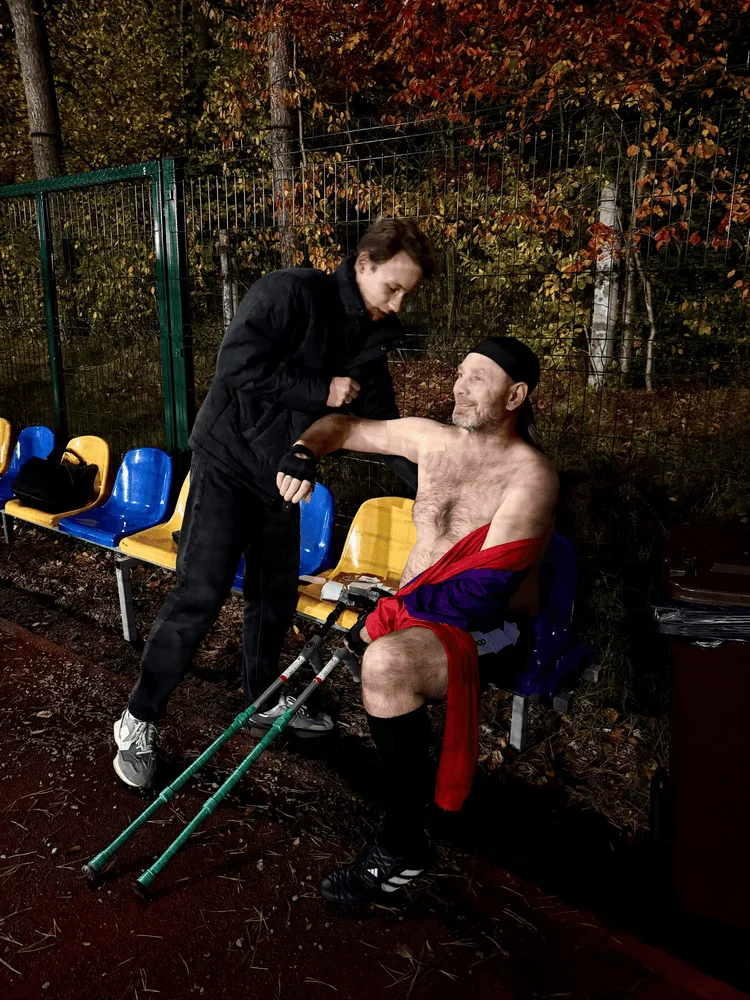
That is why physical therapist Illia Havryliuk works with the team during training sessions and competitions. Before one of the practices, he is seen strapping Igor Fasolia’s injured shoulder. To an outside observer, this might seem like an insignificant detail in preparing for a game. But for an athlete, this kind of assistance can sometimes determine whether he can train, how best to manage the workload, and how to prevent his condition from worsening.
Illia accompanies the team at training sessions, training camps, and tournaments. There is especially much work to do during competitions, when players take part in several matches in a row, fatigue builds up, and the strain on already injured parts of the body increases.
“Some injuries make it impossible for a person to continue playing sports, including amputee football, as they normally would. So we try to compensate for these limitations as much as possible and reduce the strain on injured joints,” the physical therapist explains.
He is familiar with the players’ main injuries and individual health conditions, but the situation can change at any moment during a match. It is important to spot a problem in time, assess the athlete’s condition, and help them avoid further harm.
This requires professional knowledge, attentiveness, and constant communication with the team. After all, the desire to play and win does not eliminate the need to take care of one’s health. At the same time, Illia believes that the significance of amputee football goes far beyond physical rehabilitation.
He recalls one of the first tournaments he attended with the Titans. At the time, the Zhytomyr team played against Kyiv’s Obolon and won. According to the players, their opponents in the next locker room were surprised that they had lost to such strong men. The episode stood out for more than just the sporting result. It showed how perceptions of a person’s abilities can change when, instead of focusing on their injuries, you see teamwork, strength, endurance, and the determination to succeed. However, Illia believes something else is even more important.
“The main goal is the team itself. They share a common interest, play together, socialize, and travel together. The social aspect is very significant here,” he emphasizes.
More Than Physical Rehabilitation: The Feeling That You’re Not Alone
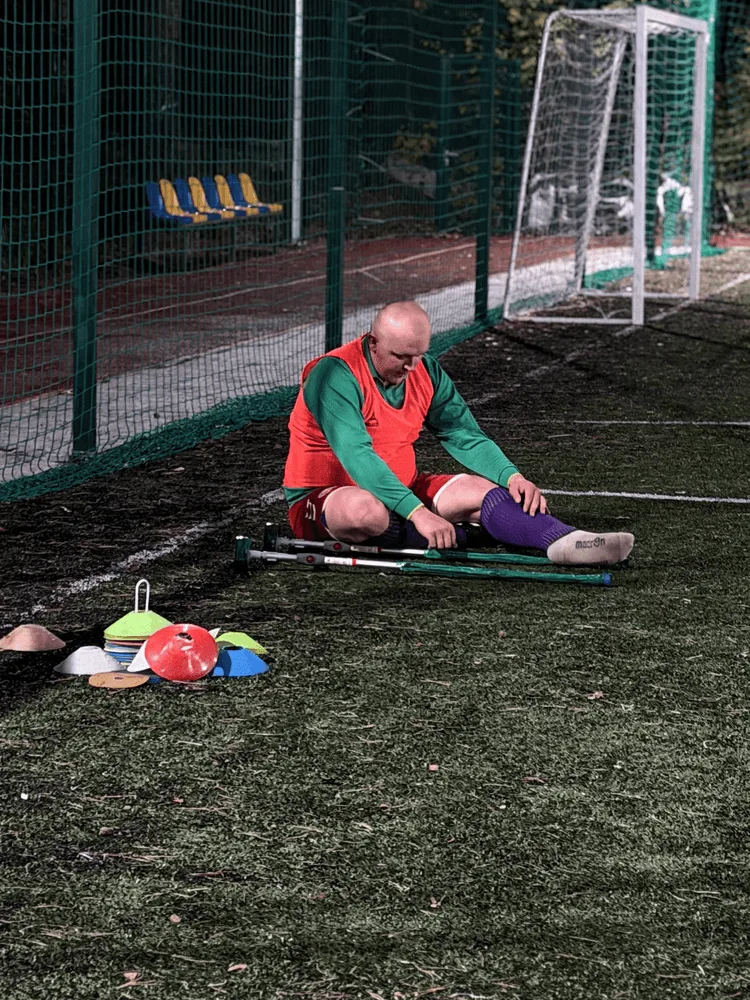
After a serious injury, it can be difficult for a person to talk about their feelings. It is not always easy to explain to loved ones what is troubling them, why they do not feel like leaving the house, or why ordinary tasks suddenly require so much effort.
Within the team, these conversations often begin not with direct questions, but with a shared activity. People train alongside one another, travel to competitions, talk along the way, and share their experiences. Gradually, trust develops, making it possible to talk about more than just football.
Illia Havryliuk does not consider himself a psychologist, but he clearly sees how important human connection is.
Some people are ready to talk openly about their feelings in a one-on-one conversation. Others find it easier to open up among their fellow servicemen. And sometimes, it is enough simply to know that there is someone nearby they can turn to when things get difficult.
“Sometimes the guys need an independent perspective — that of a specialist, someone they can trust. I hope that together we are working to improve not only their physical condition but also their psychological well-being,” the physical therapist says.
The Titans Offer Comprehensive Support, Not Just Amputee Football
That is why the club is developing a comprehensive support system for veterans. A psychologist and a rehabilitation specialist are already working there, and a center for veteran and adaptive sports is being established. The organization is purchasing rehabilitation equipment and looking for another rehabilitation specialist-massage therapist and a sports medicine doctor. In the future, the center plans to set up a gym with adaptive exercise equipment and bring on a physical fitness coach. Renovation work is currently underway on the premises.
“We are purchasing equipment to support veterans’ rehabilitation. We are currently looking for another rehabilitation specialist-massage therapist and a sports medicine doctor. In addition, there will be a gym with adaptive exercise equipment and a physical fitness coach. In other words, we are developing this area in a comprehensive way,” says Mykola Skreminskyi.
This work requires time, resources, and a team of professionals. But its goal is clear: to create a place where veterans can receive the support they need and gradually return to an active life without having to face their difficulties alone.
From Their First Training Sessions to the Ukrainian Championship
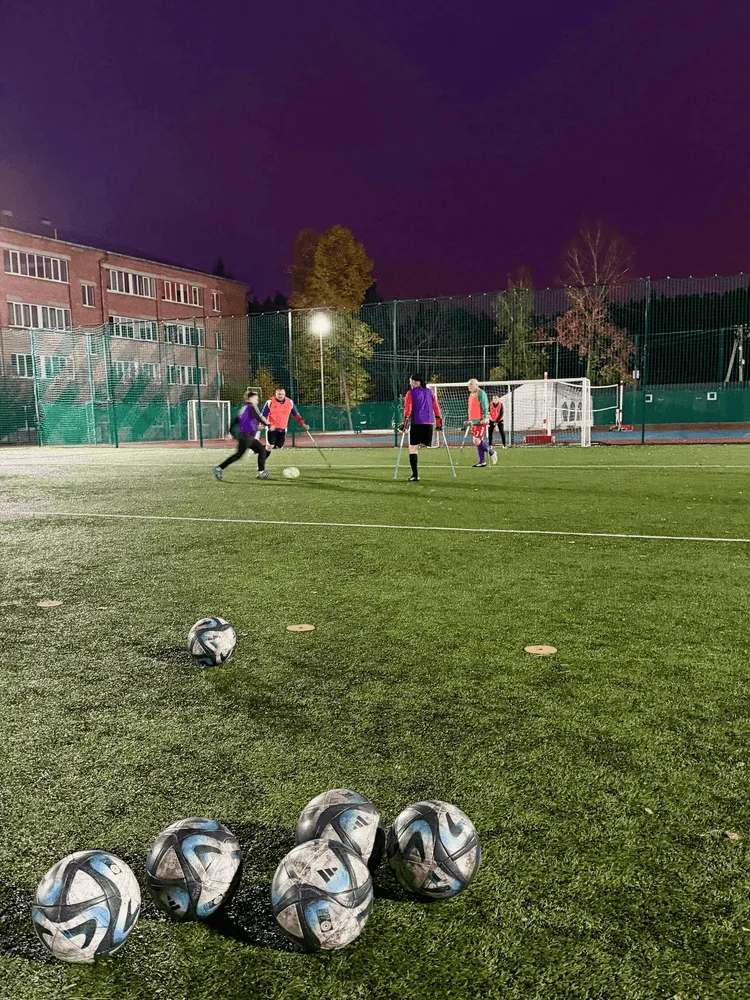
For the Titans, amputee football has become more than a form of rehabilitation — it is now a fully-fledged sporting pursuit. The team competes in national tournaments, learns, develops, and draws on the experience of other teams.
According to Mykola Skreminskyi, the Ukrainian Association of Football organizes the Ukrainian Amputee Football Championship, which had 18 participating teams at the time of the interview. The season begins in spring and runs for several months.
“Our season began in March, and now we are heading to Ivano-Frankivsk for the final round. That is where the season will come to an end,” the club director said.
New teams are emerging in different regions across the country. One such team was recently established in Kropyvnytskyi.
The Zhytomyr-based Titans also work with Poland’s Rekord team, which has been developing amputee football for 15 years. Joint training camps allow the teams to train together, exchange experience, and learn about tactical approaches that can be incorporated into player training.
“We attend training camps with them, where we train together, exchange experience, and gain tactical insights that help our coaches in their work. After all, amputee football is a relatively new sport in Ukraine,” says Mykola Skreminskyi.
Ukrainian teams have their own specific characteristics. According to the club director, 80–90% of the players are service members who were wounded during the war. Some also have other health issues, so their training requires a tailored approach. The Polish team that the Zhytomyr players work with includes people who sustained injuries in road accidents or at work. In Ukraine, however, the development of amputee football is closely linked to the need to support military personnel returning to civilian life after serious injuries.
You Don’t Have to Know How to Play. You Just Have to Dare to Try
Each of the people featured in this story had their own path to the Titans. Ihor Fasolia initially doubted whether he should start playing football at the age of 49. Mykola Stetsenko arrived on crutches and could not even kick the ball accurately. Vladyslav Skryminskyi realized that his experience in mainstream football did not provide ready-made answers to every challenge in amputee football. And physical therapist Illia Havryliuk sees every day how much attention the players’ health, recovery, and safety require.
Their stories are different, but they have one thing in common: no one had to know how to do everything from the start. They did not need to arrive as professional athletes, demonstrate excellent physical fitness, or prove they were capable of more than others. They simply had to take the first step.
The team teaches players, helps them adapt to the physical demands, offers support, and gives them the opportunity to develop at their own pace. Here, they can find more than just sport: there is companionship, new friendships, trips together, competitions, and people who understand what they have been through.
And perhaps one day, someone who initially agreed to attend just one training session will realize that they are already looking forward to the next one. It is these small steps that make up the journey back to an active life. Not instant victories or promises that difficulties will disappear, but the opportunity to do something for oneself every day, feel supported, and see personal progress.
The Titans are a team where you can start from scratch — and where football becomes a reason to move forward again. Sometimes, changing your life does not require taking a big step right away. You just have to find the courage to take the first one.