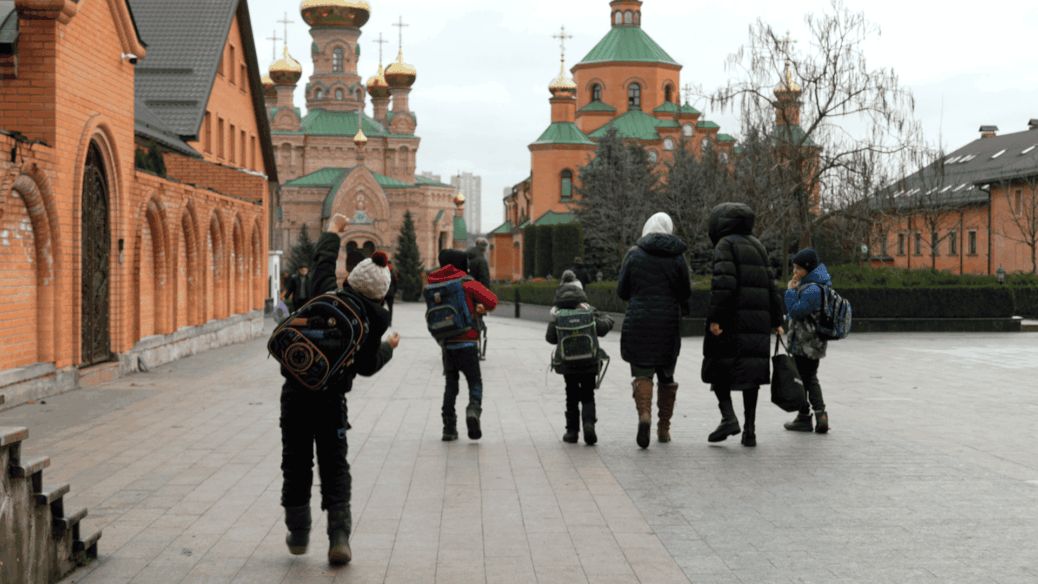
In Kyiv, an underground Orthodox school operates at a UOC (Moscow Patriarchate) monastery, teaching children Russian language, Soviet-era literature, and the principles of the “Russian world.” The school is unlicensed, yet children spend full school days there, while official documents are registered at distant private schools, allowing the monastery to appear compliant with Ukrainian law. Teachers openly instruct in Russian, and parents report ideological influence, including pro-Russia sentiments among students. State subsidies flow to the official schools, even though many children never attend them. Experts warn this setup risks ideological indoctrination, raising concerns for the Security Service of Ukraine.
There are unnecessary extra words here — just watch the report yourselves. Although everything is already clear from the cover image.
Ministry of Education — this is on you: check the licenses of the private schools that are covering this up.
SBU… now it’s your turn.
Mother of a student at the UOC (Moscow Patriarchate) monastery “school”: As for me, it’s better to read a prayer than to listen to a minute of silence, endlessly sing this weird anthem.
Yana Korniichuk: Where did you want to go?
Anna Bolgova: We wanted to go to Russia.
Yana Korniichuk: Listen, I see here: ‘Slavic language’ — what is that? What does that mean?
Larisa Abrosimova: Yes, we also have ‘Slavic language’ here. It’s basically Russian.
First of all, the place is protected, thank God, prayed over. Missiles don’t fly here — they fly around, but they don’t fly here.
Yana Korniichuk: This is Kyiv, the capital of Ukraine. In one of its picturesque corners hides a UOC (Moscow Patriarchate) monastery — Holosiivska Pustyn — and next to it, an underground school where children are taught not only to praise the Russian God but also to speak Russian. And all of this is not without the protection of licensed Ukrainian schools. While we prepare to tell more, subscribe to our channel and support our work on Monobaza.
From concerned citizens, we learned about the existence of a strange semi-legal school, where parishioners of one of Kyiv’s Ukrainian Orthodox Church (Moscow Patriarchate) temples send their children. We were surprised that it is a full-fledged educational institution, teaching from Soviet textbooks and having students memorize Yesenin’s poems, rather than a simple Sunday school or theology class. So we decided to check how all of this could really exist in the fourth year of the full-scale war with Russia.
Anna Bolgova: We were already planning to leave in general. And then, when I was thinking, “That’s it, I have to go to a neighboring country, there’s really nothing to do here.”
Yana Korniichuk: Where did you want to go?
Anna Bolgova: To Russia.
I stood there, reading a prayer, thinking how beautiful it was. I got halfway through, then the phone rang: “Hello, do you want to open a school? We were told it would be an Orthodox one. We can help.” Such a mysterious voice. Well, thanks. Actually, that benefactor later vanished somewhere, but he wanted to help, I guess.
Yana Korniichuk: Meet Anna Bolgova, the director of the underground school, which its founders and teachers themselves call a family or parents’ club. To talk with her and learn more details, we had to invent a story that we wanted to enroll a relative’s child in this underground school. This woman founded the so-called Orthodox school “Perspektyva” for Christian children, which will celebrate its first anniversary this February.
Anna Bolgova: I can’t even tell you how much there was. It’s just a miracle. The fact that this school came together at all — it’s just a miracle.
Yana Korniichuk: The director shares with us and adds that the head of the men’s monastery Svyatopokrovska Holosiivska Pustyn, Archbishop Isaaki Vorzelsky, or Fedir Pylypovych Andronik, helped with the school premises.
Anna Bolgova: The bishop completely rebuilt everything for the school. It was a disaster here, total chaos, all kinds of storage rooms. He fully renovated it over the summer, made everything for the school. These classrooms — all of this is already for the school.
Yana Korniichuk: In this school, children from first to ninth grade can study. And, most interestingly, they actually do. According to the director, the school currently has about 60 students.
Anna Bolgova: Yes, in total, over 60. I don’t even know the exact number.
Yana Korniichuk: It’s logical that someone has to teach all these children. From the director, we learned that the school employs 16 teachers, who, presumably, should be receiving salaries for their work. But more on money a bit later.
Even though the school is not yet a year old, the teaching staff is already challenging the entire Ukrainian education system with their innovations. For example, they propose to reduce the usual four grades of primary school to three.
Anna Bolgova: In our first grade, you know, our lower school is three years. Our first grade is already at the level of a modern second grade.
Larysa Abrosimova: And here we’ve already moved ahead a little. We follow a three-year plan. We divided the entire learning process into three years.
Yana Korniichuk: Don’t be surprised that the teachers speak Russian, as this language is even in the students’ timetable. However, here it’s called Slavic language.
Listen, I see here: Slavic language — what is that? What does it mean?
Larysa Abrosimova: Yes, we also have Slavic language here. It’s basically Russian.
Yana Korniichuk: Ah. So it’s literally Russian, just called Slavic language? Right?
Larysa Abrosimova: Well, more or less. Instruction is in Ukrainian, and math is in Ukrainian, but Russian is also introduced. Homework in Russian isn’t assigned because families’ attitudes are different, and we don’t… well, the parents asked that Russian also isn’t restricted. Since we’re at a non-governmental level, we can allow that.
Yana Korniichuk: And although the teacher claims that instruction is in Ukrainian, the parents of the students say otherwise. We also spoke with parents under the same cover story.
Instruction in Russian or Ukrainian?
Mother of a student at the UOC (Moscow Patriarchate) monastery school: Fifty-fifty. There’s a very big advantage here — learning Russian, reading and studying it, because I mean, a person whose native language is actually Russian should be able to write correctly in that language.
Yana Korniichuk: During the school tour, we were shown the textbooks used by first graders. Among them, for example, arithmetic from 1966. By the way, they are very proud of teaching with this book.
Larysa Abrosimova: This is “Pcholka.” It’s designed for three years, that’s why we chose it.
Yana Korniichuk: Arithmetic?
Larysa Abrosimova: Yes, it’s called arithmetic. For the first grade, and I’m not sure about the year yet, but everything is very appropriate. 1966. For three years. The assignments are logical, so the children later know mathematics quite well.
Ivanna Kobernyk: If this were a licensed school, then yes, this would be a violation, because there is a list of textbooks approved by the Ministry of Education and Science that must be used as textbooks. Of course, any teacher can use any additional literature when preparing lessons, but there is one nuance. We have the law on decommunization and the law on overcoming Russian imperial symbols and Russian propaganda. And I’m very curious what symbols are in a 1960s textbook. That is, if there is Soviet symbolism, then using it in the educational process is a violation of these two laws.
Yana Korniichuk: We won’t overwhelm you with the full amount of information we heard from these teachers, but we will show a few of their comments that help understand the environment being created for the students.
Anna Bolgova: We have a subject called “Film,” which is mandatory. On Mondays, we show them good films. And last Monday, we showed a film. There is a project called “Obshchee Delo” in Russia. There is a part called “Five Secrets of a Real Man.” I said: look, your future life depends on you right now.
Yana Korniichuk: In the timetable, we managed to see a subject called “Music,” so we decided to ask which songs the children learn and sing.
Anna Bolgova: And from the Soviet Union too, of course — there were wonderful songs, you know what I mean. Now the upper school learns, and the first grade also learns: “Under the blue sky there is a golden city with transparent…”
Larysa Abrosimova: Even though they say the Soviet Union was like that, well, there were some moral principles, that things should be a certain way. Now there are no principles, everyone for themselves, step over others, money is the main thing. Something like that.
Mother of a student at the UOC (Moscow Patriarchate) monastery school: And those who come from a regular school bring with them baggage, well, already spoiled.
Yana Korniichuk: How does that show?
Mother of a student at the UOC (Moscow Patriarchate) monastery school: And they teach other children too. How does it show? They’re already used to phones, gadgets, they’re used to swearing. And here — we have prayer, we all understand that this is, like, anti-prayer. Well, generally, we have, like, a healthy atmosphere, but the kids come already unhealthy.
Yana Korniichuk: The director of the so-called school is particularly nostalgic about the time when they went to a summer camp with the students, organized by the Cherkasy Orthodox School.
Anna Bolgova: We have Russian literature, we teach the classics, it’s all very… very important for the soul, for the upbringing of the child’s soul. And we went there — the kids are from Kyiv, they had never seen the starry sky. They ran out and saw the stars. We turned off the lights in the building. Oh, how they screamed, jumped, I couldn’t calm them down. Later they all lay down quietly. And suddenly our boy from the third grade starts reciting Yesenin: “Ziron’ki yasni” from memory in the dark.
Yana Korniichuk: And it seems the problem isn’t only with the teachers. Children go to the school who say they respect Russia.
Anna Bolgova: One boy in sixth grade drew a picture with Russian flags, someone sang the Russian anthem. The teacher comes: “Oh, how could this happen?” Well, I gathered the boy and said: “What right do you have to tease the teacher? Keep this to yourself.” The boy said: “I respect Russia.” I said: “Fine, you have every right. Keep it to yourself. You know what time it is now.”
Yana Korniichuk: By the way, about the teaching staff. The director told us that the school currently has 16 teachers. Some work for free, for the idea, while others receive salaries from the funds that parents pay each month. This is a fixed amount of 3,000 hryvnias.
Anna Bolgova: This is our family club format. We collect 3,000 from each child — 3,000 per month.
Yana Korniichuk: Monthly?
Anna Bolgova: Yep.
Yana Korniichuk: Nothing else?
Anna Bolgova: Well, we also have paid meals — 50 hryvnias per day. It’s optional. Some children bring their own food.
Yana Korniichuk: Are there many teachers in total, or one for each class?
Anna Bolgova: We have all 16 teachers now.
Ivanna Kobernyk: Well, look, if we imagine that all 16 teachers receive the same salary, then 3,000 × 60 divided by 16 — that’s 11,250 hryvnias. Obviously, this is close to the minimum wage, which is quite hard to live on in Kyiv. And most likely, obviously, some get more, some get less. In my opinion, someone supplements this school financially, and very significantly.
Yana Korniichuk: By the way, you’ve probably noticed that the educators themselves call their school a parents’ club. You’re probably wondering what that means. Well, let’s figure it out.
Parents’ club?
Larysa Abrosimova: Yes, a parents’ club. If our school were registered as an official school, the requirements would be a bit different. Everything would be strict. Well, as strict as… we are strict anyway, I mean, we can make modifications. Under the state system, we can’t change anything.
Anna Bolgova: We exist in the format of a parents’ club. We really like it because, first of all, our program is different. So no one can touch us. The parents gather, the children are officially enrolled in a distance school. We gather here and also interact additionally. This is our personal business.
Yana Korniichuk: So, we understand that this so-called school operates without an official license. At the same time, the children have a full school day — from 9 a.m. to 2 p.m. There’s a timetable, and even an after-school program. The logical question arises: what kind of document do the children receive after finishing this school, and do they get anything at all?
Mother of a student at the UOC (Moscow Patriarchate) monastery school: Let me tell you about the documents. There is a gymnasium, because here it’s not officially a school, it’s just a parents’ club. So, this isn’t a school. If you do it officially and get a license, first, it’s very complicated, and second, they just won’t let us exist in the format we consider necessary. They will check everything. You must stand for the minute of silence — why aren’t you standing? Well, that will start. That’s why no one takes a license.
There is a private school with a license — it issues state-recognized documents. And we took, for example, the documents from NUS and brought them there. That’s Khotyanivka, near Kyiv. There’s a private lyceum there. So we are registered there. Everything. We are moved from class to class, all the documents and registers are filled out. Here, the children also take tests, the tests are sent there, everything is recorded, and officially, for the state, they are studying there. Whether they go to Khotyanivka or not.
Ivanna Kobernyk: A parents’ club is not a form of education. Theoretically, a parents’ club should take children who study in any school. But that’s not the case here. Children are required to transfer their documents to specifically designated schools, which will obviously turn a blind eye to what is happening.
Yana Korniichuk: The lyceum in Khotyanivka really exists. It’s the Khotyanivka Lyceum Rancho School — a limited liability company with the same name. According to the analytical system YouControl, it was registered in summer 2020. The director of this private institution is Yana Kozhema. We got her number from the director of the monastery school and called under the pretext that we wanted to study in an Orthodox school but leave documents at the lyceum for appearances.
And also, could you please explain how the children will study, basically in two places at the same time: at the monastery school and at yours?
Yana Kozhema: They don’t actually study with me at all. They’re just officially enrolled here, but all the learning happens at the monastery school. They give us — well, it’s just friendly cooperation with Anna Anatoliivna. Later, the school gives us the grades, and we just enter everything here. Everything comes from that school. They appear as full-time students here, but they’re just registered in the school.
Yana Korniichuk: So this isn’t a distance-learning arrangement, right?
Yana Kozhema: Not at all — no, not distance learning. But, you know, if you receive any documents about the school, it doesn’t say anywhere, not on the diploma, not anywhere, what form of education it was. So don’t worry about that at all.
Ivanna Kobernyk: Well, it doesn’t look very proper. From what you’ve told us, there’s no distance learning in the schools where the children are officially enrolled. And it seems there are violations on the part of those schools because, as you said, one of them doesn’t even register the children for distance learning — they claim, for their own reasons, that these children are studying full-time, marking their attendance, giving them grades, and obviously submitting some work on their behalf.
Yana Korniichuk: What makes this story even more serious is that the private school can receive a subsidy for each student — public funds. And from the director of the private lyceum, we learned that out of 76 children officially enrolled in the institution, only 52 actually study there. The other 24 children are probably attending the underground school at the UOC (Moscow Patriarchate) monastery.
Yana Kozhema: The school receives subsidies. We actually receive — 19,000 every month.
Ivanna Kobernyk: That’s a very serious violation, actually. And here’s the important question.
Yana Korniichuk: But they’re not really studying there.
Ivanna Kobernyk: They aren’t, but the budget is paying for it, even though the children aren’t attending.
Yana Korniichuk: And the private lyceum in Khotyanivka isn’t the only school where you can leave a child’s documents. This option is also offered by the educational complex of the general education school of grades one to three — the preschool educational institution of the Kostiantynivka City Council, Donetsk region. Officially, Larysa Abrosimova works there as a teacher, and she also, on the side, works at the Orthodox school, whose comments you’ve already heard earlier.
Larysa Abrosimova: For example, at my school in Kostiantynivka, the children are officially enrolled for distance learning. For example, in our school it’s possible because they know me and know that these children are actually studying — they’re not just wandering around somewhere. They are studying in our school. We send all the grade information from here there. All the documents are filled out. So officially, you are enrolled.
Yana Korniichuk: And the director there — is she informed about all of this?
Anna Bolgova: Of course, they are interested themselves that the children are officially enrolled, otherwise the school would be closed.
Yana Korniichuk: Am I correct that they are all doing distance learning in Kostiantynivka?
Larysa Abrosimova: Yes, everything is already distance learning, and the school operates remotely, and our children are officially enrolled as distance students.
Ivanna Kobernyk: I truly feel sorry for these children, but unfortunately, at this age, the parents make decisions for them. The second point that worries me is the role of the schools where the documents are officially registered. There are clearly violations on their part. As for the activities of this parents’ club itself, the issue, from my point of view, is more for the Security Service of Ukraine. Someone is nurturing and building this center of the Russian world in the capital of Ukraine.
Mother of a student at the UOC (Moscow Patriarchate) monastery school: She came to me and said: “Mom, when will this Putin finally die?” I said: “Listen, do you think it’s normal to wish death on someone? You don’t even know him.” My child is still poisoned. Over one and a half years, they’ve managed to instill this. We have a Russian-speaking family, and constantly at school my child was told things like, “Speak Ukrainian, we are Ukrainians,” and other stuff.
As for me, it’s better to read a prayer than to listen to a minute of silence or endlessly sing this crazy anthem. The authorities will change a hundred times, the anthem will be rewritten a hundred times. But prayer is eternal.
Volodymyr Viatrovych: The fact that we’re talking about the Russian Orthodox Church adds not just a certain intrigue, but a sense of danger. Because we clearly understand that this is a fully ideological structure, and obviously the so-called education they provide to children is hardly free of ideological context. I’m afraid that, on the contrary, it’s actually a tool — essentially indoctrination of young people. And this means that it shouldn’t just be a matter for law enforcement agencies. I think this is something the Security Service of Ukraine should take a direct interest in.
Yana Korniichuk: We learned about the activities of the underground school at the UOC (Moscow Patriarchate) monastery, whose director is you. Don’t you think you are breaking the law and engaging in anti-state activities?
Anna Bolgova: Tell me, please — there is no school there at all. Tell me, please, why are you calling me from a phone number that may be marked as spam? Goodbye.
Yana Korniichuk: Well, today we’ve told you about the activities of an illegal Orthodox school at a Moscow Patriarchate monastery, which operates without a license and, obviously, teaches children the basics of the Russian world. All of this, I remind you, has been happening in the center of Kyiv for a year now. Do you think this is normal, or should the Security Service of Ukraine pay them a visit? Leave your answers in the comments.
Tags: children rights empr.media News Kyiv underground school Russian education SBU probe UOC MP
![The Kyiv Instytutska Street massacre during the Maidan Revolution of Dignity, where Berkut’s “Black Company” shot and killed unarmed protesters. :contentReference[oaicite:2]{index=2}](https://empr.media/wp-content/uploads/2026/02/photo-1-480x270.png)


![Visitors at the “Thank You With All My Heart” Ukrainian exhibition at the Council of Europe, featuring the Great Amber Heart and powerful war art. :contentReference[oaicite:2]{index=2}](https://empr.media/wp-content/uploads/2026/02/heart-300x171.png)
![Ukrainian Roboneers and Latvian partners at the signing of a defence robotics and underwater technology cooperation memorandum. :contentReference[oaicite:2]{index=2}](https://empr.media/wp-content/uploads/2026/02/oboronka-300x168.png)