
The investigation outlines alleged corruption schemes involving Tetiana Hlyniana and companies supplying food and equipment to the Armed Forces of Ukraine. It describes repeated contracts awarded to her firms despite ongoing criminal cases, including allegations of fictitious deliveries, tax evasion schemes, and undeclared cash seizures.
The report also highlights tenders where her companies won a significant share of lots, sometimes amid minimal competition or procedural rejections of rivals. Questions are raised about possible market concentration and whether companies with a criminal background continue to secure state defense contracts despite investigations and suspicions.
On April 15, 2025, NABU placed entrepreneur Tetiana Hlyniana on the wanted list as part of a case involving the embezzlement of funds allocated for food supplies for the Armed Forces of Ukraine. This concerns the same notorious “17-hryvnia eggs.” This was reported by Censor.NET.
A year later, Hlyniana continues to live freely in Croatia, while her company “Grand Consult,” based on quarterly results, is one of the largest contractors for the Defense Procurement Agency.
How did it happen that the central figure in the “17-hryvnia eggs” scandal not only avoids punishment, but is also increasing her profits?
January 2023. Yuriy Nikolov publishes a scathing article for ZN.UA, reporting that the Ministry of Defense planned to purchase eggs from a supplier at 17 hryvnias each, while ordinary people were buying them in supermarkets for 7–8. Public outrage explodes. The ministry is forced to act. It creates a public anti-corruption council to oversee procurement and returns tenders for non-lethal goods to Prozorro. By the end of the year, the ministry launches two agencies intended to procure goods for the military instead of corrupt officials.
Procurement rules change: suppliers are given a price ceiling for products, and later a minimum price as well, to prevent them from manipulating the catalog to their advantage.
But that does not mean that the key players in this market have changed.
Tetiana Hlyniana changes her front company and now supplies food for the military through the firm “Mit Prom.”
In the summer of 2024, the Bureau of Economic Security (BEB) conducts searches, and the whole country sees the trunk of the company’s employees’ car, where more than €4.7 million in undeclared cash was seized from managers of companies within Hlyniana’s network.
Case materials refer to tax evasion and fictitious schemes involving the companies “ZIVIS UA” LLC (formerly known as “VISIT” LLC), LLC “ACTIVE COMPANY”, LLC “GRAND CONSULT”, LLC “OK LAND FOOD”, and LLC “TERRA BM” (formerly LLC “PREMIUM COMPANY”).
At present, only one ruling can be found in the court register in this case—refusing to impose an arrest on the seized funds. Rumor has it that the company’s owner has settled matters in the most favorable way for herself.
In April last year, Hlyniana was formally notified of suspicion by NABU. According to the investigation, the implementation of this scheme led to two supplier companies illegally receiving more than UAH 733 million from the state budget between August and December 2022. Part of these funds was later paid out under the guise of dividends and used to provide repayable financial assistance to affiliated companies. Investigators believe that these funds may have been used by the owner to purchase hotels in the Republic of Croatia and other real estate abroad.

However, at the time the suspicion was announced — almost 2.5 years after the scandal began — Hlyniana was already living in Croatia and continues to watch law enforcement from the Adriatic shores, unbothered.
There was also another criminal case: Hlyniana’s companies ‘Active Company’ and ‘Grand Consult’ allegedly organized a scheme with military supply officers, signing fictitious delivery notes, failing to deliver goods to the military, and splitting the profits.
Do you think anything happened after that to the head of Hlyniana’s companies, for example? No, absolutely nothing.
Companies that blatantly profited off the military continue to supply food to the Armed Forces of Ukraine. And not just continue.
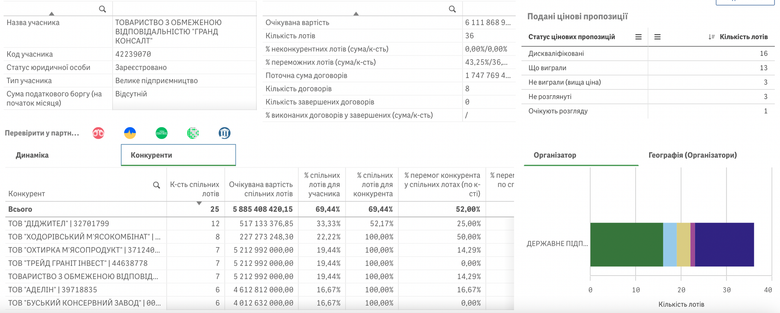
Monitoring of the latest tenders in the biProzorro system shows that Hlyniana’s company is among the top three largest suppliers to the Ministry of Defense by the end of the first quarter.
Top 3 by number of lots:
LLC “GRAND CONSULT” — 36 lots, worth ~1.77 billion UAH;
Private Enterprise “NVF TAKHO”, “EUROPA ARM SPORT” LLC, DEFENSE GROUP s.r.o. — 32 lots each;
JSC “UKRNAFTA” — 27 lots, but the largest amount won: ~3.02 billion UAH.
Top by total procurement value:
JSC “UKRNAFTA” — 3.02 billion UAH (27 lots, 5 won);
LLC “GRAND CONSULT” — 1.77 billion UAH (36 lots — the most active participant);
“UT COMPANY” LLC — 840 million UAH from just 7 lots.
Now let’s look at the details
The largest contract — worth over a billion — was awarded to LLC “Grand Consult” on March 18, when it won a tender to supply food to the Armed Forces of Ukraine in the Chernihiv region (price per set: UAH 100.95 excluding VAT).
Out of 8 participants, “Grand Consult” offered the second-lowest price, about 10 million higher than that of the “Buskyi Canning Plant.” However, the initial winner later submitted incorrect documents — and the technical errors look more like collusion.
“The participant, LLC ‘Buskyi Canning Plant,’ submitted a revised price offer following the auction in accordance with the form provided in Annex No. 2 to the announcement. However, the participant indicated the price per set including VAT, which does not comply with accounting standards or proper price reporting in accounting systems, as the VAT-inclusive price per set contains more than two decimal places and amounts to UAH 120.036. Furthermore, the stated amount excluding VAT does not correspond to the product of quantities and the unit price excluding VAT,” the Defense Procurement Agency’s rejection protocol states.
“Additionally, the participant violated the requirements for submitting the priced food catalog, namely:
the total cost of the priced food catalog does not match the cost of the meal set according to the updated price offer;
the cost of the meal set is incorrectly stated in the ‘including VAT’ section;
the caloric value requirements were not met for the following items: ‘11013 Fresh seasonal broccoli’ listed as ‘22 kWt,’ ‘11029 Pickled cucumbers’ — ‘15 Feb,’ ‘11054 Canned sorrel’ — ‘11 kWt.’
Taking the above into account, the participant, LLC ‘Buskyi Canning Plant,’ violated the terms of the announcement and effectively refused to conclude the contract,” the document states.
As is known, since February the Busk Canning Plant has been named in an investigation by the State Bureau of Investigations (SBI) into the illicit enrichment of a supply officer from a military unit in the Dnipropetrovsk region. Moreover, the case appears to involve multiple episodes rather than a single incident.
It is therefore quite likely that the tender was reassigned to another participant by prior arrangement. That participant could ultimately end up acting as a subcontractor.
Another contract was awarded to Hlyniana’s company after the Defense Procurement Agency identified violations in the documentation submitted by the company “Adelin.”
In addition, Hlyniana’s company could potentially become a monopolist in the supply of field rations. It won tenders across 17 lots. In some of them, however, its bids were rejected due to the failure to provide a certificate confirming that the company is not bankrupt.
Notably, in most of these lots, Hlyniana’s company faced no competition. As a result, the tenders were declared unsuccessful, meaning that the corresponding volume of field rations will be put up for re-tender.
Even without this, Hlyniana has already secured a significant share of the market.
Incidentally, about a year ago, suppliers of field rations suddenly began refusing to fulfill deliveries — some citing halted production lines, others giving different reasons. At one meeting, a remark was made: “Hlyniana is already at the starting line, ready to move into the field ration supply.” Well — she has.
The story of Hlyniana and the Buskyi Canning Plant is far from the only case where a company with a criminal track record is awarded contracts again.
On Thursday, Nashi Hroshi reported that on April 8, the Defense Procurement Agency, following a tender, awarded LLC “TS Trade Ukraine” a contract worth UAH 8 million for protective ballistic eyewear. Source:
The problem with this deal is that on August 21, 2025, officers of the State Bureau of Investigations (SBI), with operational support from the Security Service of Ukraine (SBU), served notices of suspicion to officials of the Ministry of Defense of Ukraine and the director of the supplier company that delivered substandard ballistic eyewear.
The case concerned LLC “TS Trade Ukraine” and tender UA-2024-08-22-007683-a.
According to the SBI’s official statement, in September 2024 one of the Ministry of Defense’s state enterprises signed a contract for the supply of 18,000 sets of ballistic eyewear. The delivery was completed, but the products did not meet the declared protective specifications and failed to provide adequate protection against fragments.
The violations were confirmed by test results conducted by the Research Center for Testing and Certification of Personal Protective Equipment at the National Defense University of Ukraine.
Suspicions were issued under the following articles: Part 5 of Article 191 of the Criminal Code of Ukraine (misappropriation of property on an especially large scale during wartime) — to the supplier’s director; Part 4 of Article 425 of the Criminal Code of Ukraine (official negligence) — to a former employee of the Ministry of Defense’s Central Quality Directorate who failed to carry out oversight functions.
This refers to the former head of the Central Quality Directorate, Ihor Leshchenko. He was detained with bail set at UAH 12 million.
According to sources of Censor.NET, suspicion was also expected to be served to Viktoriia Vynohradova of the state enterprise “State Rear Operator,” who oversaw this area until July 2025. However, Vynohradova — who later became involved in the body armor scandal linked to Mindich — avoided that fate at the time.
In the end, one key question remains open: is the Ukrainian state, in any of its institutions (the Ministry of Defense, NABU, SBI, SBU, the Defense Procurement Agency), going to defend its interests against such suppliers at all? Or does this system — profiting at the expense of soldiers’ lives and health — suit everyone involved?
Tags: Armed Forces of Ukraine corruption Defense Procurement EMPR media Investigative Journalism Ministry of Defense nabu Ukraine ukraine war wartime contracts