In 2025, Russian forces made significant advances across Donetsk, Dnipropetrovsk, Zaporizhzhia, and Kharkiv regions, exploiting gaps between Ukrainian positions and shortages of infantry.
Ukrainian brigades, though stronger in Dnipropetrovsk and Kharkiv than in Zaporizhzhia, faced command and logistical challenges. Counteractions in Kupiansk aim to block Russian crossings of the Oskil River and retake key urban positions, while Dnipropetrovsk and Zaporizhzhia see deep infiltration and UAV-led attacks.
Some commanders remain optimistic about reclaiming Kupiansk and Vovchansk, though others warn the front could reach Pavlohrad by 2026. Persistent gaps, misreporting, and high losses in assault units highlight the ongoing complexity of frontline operations.
In 2025, the Russians advanced so intensively in the Donetsk region that their military actions eventually spread into two neighboring regions – Dnipropetrovsk and Zaporizhzhia. A year ago, such a scenario in the first region was hard to imagine, as it was considered a rear area. In the second region, fighting has been ongoing since 2022, but the front line across most sectors remained relatively stable. This was reported by Ukrainska Pravda.
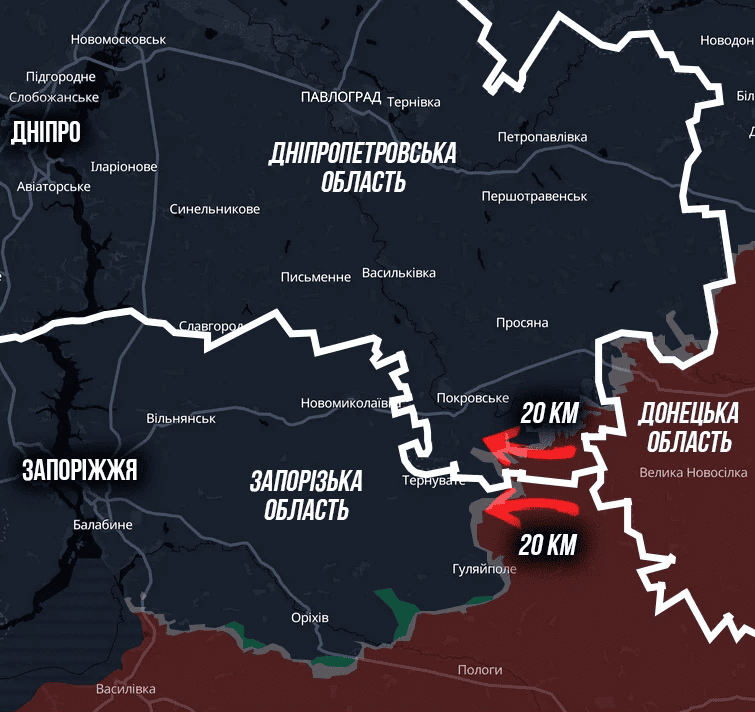
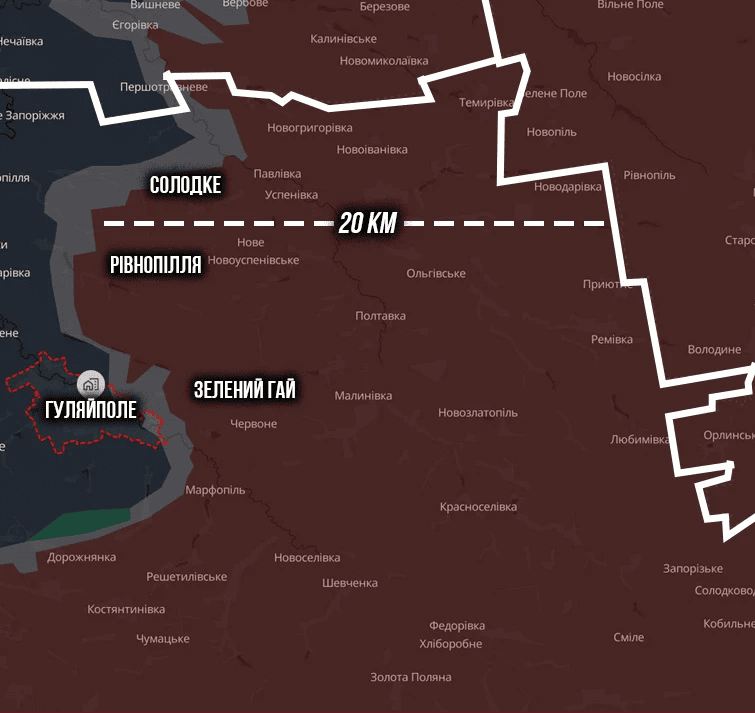
Over the past seven months, from May-June 2025, since the Russians began active assaults, they have pushed roughly 20 kilometers deep into Dnipropetrovsk and Zaporizhzhia.
By the standards of the current front, this is a genuine breakthrough.
Among themselves, soldiers joke that at this pace the Russians will “reach Zaporizhzhia unnoticed.”
The enemy advanced at a similar speed after the fall of Avdiivka in Donetsk. This rapid movement, the fastest since the first year of the full-scale war, resulted in the loss of dozens of settlements, including the once 20,000-strong cities of Novohrodivka and Selydove.
In parallel with their advance in the Dnipropetrovsk and Zaporizhzhia regions, the occupiers are doing everything possible to retake the de‑occupied part of the Kharkiv region, particularly Kupiansk — a key city on the Oskil River. The Defense Forces, for their part, are trying to regain control of the city, which is practically lost.
This is the second part of the text about the situation on the front amid U.S.–Russia negotiations on a “peace plan” for Ukraine. In the first part, we described the situation around nine key cities of the Donetsk region.
Frankly, these “peace” talks are unfolding against a backdrop that is unfavorable for the Defense Forces on the front line. Even so, all our interlocutors — including brigade commanders and representatives of corps command — are convinced that Ukraine still has the strength and resources to continue fighting. And that Russia, despite any promises or formal commitments, will not stop.
1. Zaporizhzhia region. The Russian army is positioned 20 kilometers from Zaporizhzhia and continues its advance toward Huliaipole, where an entire axis collapsed due to command and control issues. There are two sectors of Russian advance in the Zaporizhzhia region.
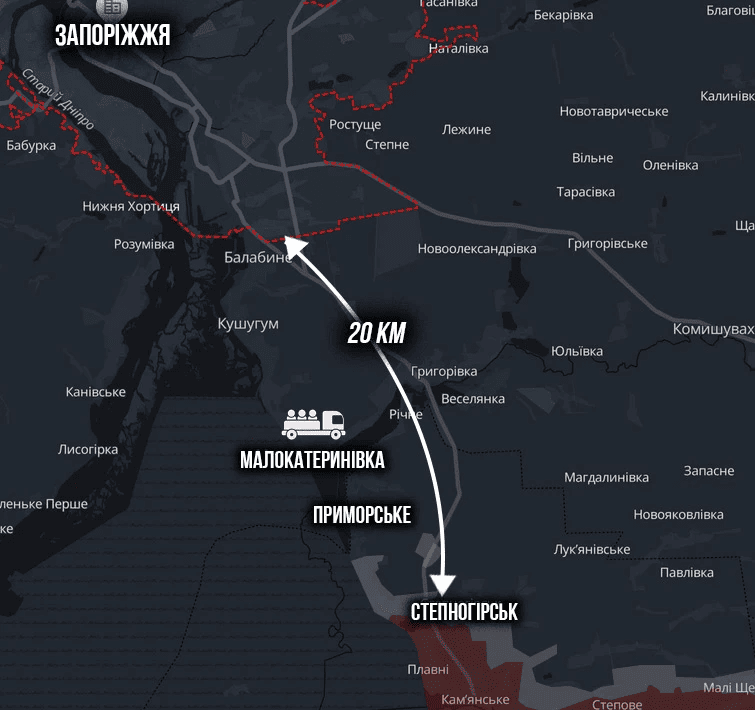
The “smaller” one, roughly around Stepnohirsk and Prymorsk, sees the enemy moving into the outer houses and streets on the outskirts, alternating with being pushed back by units of the Ukrainian Main Intelligence Directorate.
The main risk of the Russian advance in this area is not so much infantry (for now) but drones approaching Zaporizhzhia — a major regional center. The occupiers are 20 kilometers away, and just 10 kilometers from Zaporizhzhia, mandatory evacuation is already underway.
The second — the so‑called “larger” or deeper sector of the Russian advance in the Zaporizhzhia region — is located at the junction with Dnipropetrovsk and Donetsk regions. This includes the axis of Solodke, Rivnopillia, and Huliaipole. Since the beginning of 2025, the enemy’s advance here has reached roughly 20 kilometers, according to the map. In this text, we will focus specifically on this sector.
Stepnohirsk and Huliaipole fall under the responsibility of the 17th Army Corps. According to two interlocutors from the Defense Forces speaking to UP, it is currently commanded by Colonel Yaroslav Sydorov, former commander of the 17th Krivyi Rih Tank Brigade.
Information about the active advance of the Russian army toward Huliaipole leaked due to a very painful gap known as “missing in action.”
Over the past few months, relatives of soldiers from at least two brigades — the 102nd and 125th — have posted dozens of messages on social media demanding to know what happened to their fathers, sons, and husbands in the Zaporizhzhia region. This is particularly true for the areas of the villages of Malynivka, Poltavka, and Olhivske, from which the Russians began their advance toward Huliaipole.
In the 102nd Territorial Defense Brigade alone, at least 80 servicemen went missing between June and November 2025. This is confirmed in a comment to UP by the administrator of the brigade’s missing personnel page. Eighty missing in six months amounts to a loss of three to four people per week.
Why did this happen?
As of now, we do not yet have a precise answer to this question. Likely, several factors contributed significantly to the breakthrough toward Huliaipole. These include weaknesses in higher-level command — particularly at the corps level, where over 3–4 months the commander, Volodymyr Silenko, was replaced by Yaroslav Sydorov — as well as weaknesses in the command of individual brigades, many of which consisted of exhausted and depleted Territorial Defense battalions (and mechanized brigades that were formerly Territorial Defense units), notably the 102nd Territorial Defense Brigade and the 125th Mechanized Brigade.
According to UP, at the time of the breakthrough, the 125th Brigade had almost zero unit control. This means that commanders had lost contact with their subordinates, and subordinates had stopped responding to assigned tasks.
The 125th Brigade found itself in a similar situation for the second time. In May 2024, when the Russians launched another offensive in the Kharkiv region, the 125th, along with attached units, had to withdraw from the state border for various reasons.
The 102nd Territorial Defense Brigade, which had been positioned on the Huliaipole axis since 2022, faced problems with supplies, personnel, and training.
In one of the battalions we spoke with, up to a hundred servicemen had not completed basic military training. They had joined the army in 2022 out of patriotism and later were formally stamped with “100 MOS,” meaning they had a basic military specialty. This represents a completely inadequate situation and inaction, both on the part of brigade command and the soldiers themselves.
“No one among us had combat experience; mostly we were teachers, shop assistants, general laborers who joined purely out of motivation and sometimes went to training grounds. There were a few people with ATO–JFO experience whom we looked up to,” a source from one of the battalions recently withdrawn from encirclement near Huliaipole told UP.
After the start of the intensive assaults in September 2025, the 102nd Brigade began to lose personnel rapidly. In one battalion we spoke to, the battalion’s chief sergeant and deputy commander were killed on the front-line infantry positions. The Territorial Defense brigade also could not effectively resist Russian drone operators, including “Rubikon.” Logistics became unmanageable.
“At one point, we made a difficult decision for ourselves: not to evacuate the ‘200s’, only the ‘300s’. By then, there were only three drivers left for the entire front line,” our interlocutor in one of the battalions recounted.
To save the Huliaipole axis, “emergency” assault units were deployed, including the 225th Separate Assault Battalion, as well as other mechanized brigades (on top of the 33rd Assault Regiment, the parent regiment of the head of the Assault Units Directorate, Valentyn Man’ko, who had previously operated in this sector).
According to DeepState, the deployment of the 225th Battalion, due to a lack of adequate coordination with the 102nd Territorial Defense Brigade, unfortunately initially led to incidents of “friendly fire” as the 102nd withdrew inward. However, overall, the deployment of the 225th provides hope and a chance to stabilize the situation.
The outskirts of Huliaipole are already a “grey zone.”
2. Dnipropetrovsk region. The Russians are probing several possible axes of advance at once, with their greatest success in the direction of Pokrovske (not to be confused with Pokrovsk in Donetsk region). Still, the situation in Dnipropetrovsk region is more stable and controlled than in Zaporizhzhia.
In Dnipropetrovsk region, there are also two areas of Russian advance — a “smaller” one, located south of Pokrovsk in Donetsk region, in the areas of Dachne, Filiia, Ivanivka (recently cleared by the 37th Brigade), and Zelenyi Hai. From there, the Russians are reaching toward the village of Mezhova — which a year ago was entirely a rear-area settlement — in an attempt to form a wide arc to envelop Pokrovsk and Dobropillia.

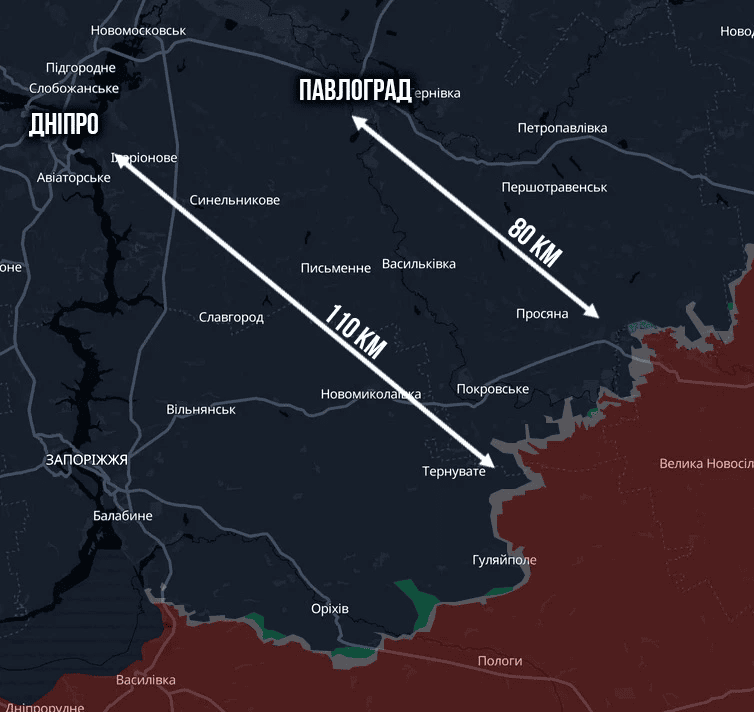
The larger, deeper sector is located closer to the Zaporizhzhia region, in the areas of Novoselivka, Verbove, Veselivka, and Yehorivka. The villages of Yehorivka and Danylivka mark the farthest points of the occupiers’ advance, nearly 25 kilometers into Dnipropetrovsk region. From this side, the Russians are pushing toward the village of Pokrovske.
Dnipropetrovsk region falls under the responsibility of the 20th Army Corps, which, according to UP, has been commanded since October by Major General Viktor Nikoliuk.

The Russian offensive in Dnipropetrovsk region began around June–July of this year. At that time, some military personnel speculated that the occupiers were trying to draw part of the Ukrainian forces away from Donetsk — the Russians’ primary objective. However, it later became clear that the pressure on Dnipropetrovsk is entirely systematic, and the occupiers will advance in all possible directions as long as they have the capability.
“If the Russians can move toward Pavlohrad, they will. If they can move toward Kyiv, they will do that too,” one commander operating on the Novopavlivka axis shared with UP.
In Dnipropetrovsk, as at the start of the offensive, significantly stronger Ukrainian brigades are deployed than those concentrated in Zaporizhzhia. Nevertheless, there have also been issues with unit command.
As in Zaporizhzhia, the corps commander in Dnipropetrovsk was replaced rather quickly. Earlier, in May, the commander of the 59th Brigade was replaced literally overnight — according to some UP sources, due to a loss of control. Later, the commander of the 72nd Brigade was also removed from his post.
The Russians infiltrated between Ukrainian positions, where there was a severe shortage of infantry, and, as in Zaporizhzhia, simultaneously disrupted logistics with their strong UAV units. Since the summer, Ukrainian soldiers have had to cover up to 10 kilometers to reach front-line infantry positions in this sector.
“They tell us there’s infantry, but in reality, there isn’t. UAV operators are literally being targeted in the dugouts. I don’t know who was stationed at Yehorivka and Danylivka, but there was literally no one there. On top of that, their pilots here are the best — both ‘Rubikon’ and ‘Doomsday’ — it’s a real mess,” one UAV operator from the 110th Mechanized Brigade shared with UP.
Some commanders operating on the Novopavlivka axis call it the hottest sector. They explain that on the neighboring Pokrovske and Dobropillia axes, the enemy acts in waves, whereas in Dnipropetrovsk, they apply constant pressure, even with armored vehicles.
“If positions are lost here, it’s usually because someone on the flank fails,” one commander from the Novopavlivka axis told UP.
The most recent example of such a loss of positions is the Russian breakthrough into the village of Novopavlivka in Dnipropetrovsk region, located 7 kilometres from the front line. On the morning of 14 November, Russian forces in tanks and APCs pushed through the positions of the 46th Brigade and entered the village itself, which serves as the rear area for the 59th Brigade.
“In the fog the enemy managed to lay a pontoon bridge across the river, drive their vehicles into Novopavlivka, and land an assault group — by different estimates, up to 60 of those bastards. Together with our neighbours we managed to destroy some of their vehicles, and with our own forces we ‘took care of’ 16 dead occupiers and 3 prisoners — those numbers are confirmed. The brigade commander himself went to Novopavlivka,” battalion commander of the “Da Vinci Wolves,” Serhii Filimonov, told UP.
Assault troops were also deployed to Dnipropetrovsk region in a “firefighter” role.
Some of UP’s sources — particularly those operating near Pokrovske — spoke positively about cooperation with these units. However, they admitted that, even after successful work by the assault troops, mechanised and Territorial Defence units often did not have enough personnel to move in and hold the positions.
Another group of sources, particularly those operating closer to Mezhova, called such cooperation ineffective.
The main observation of neighboring commanders regarding the assault units is their high personnel losses.
“Our battalion was able to liberate about 80% of the settlement of Nadiivka (Donetsk region, 8 kilometres from the administrative border with Dnipropetrovsk — UP). We did this with eight infantrymen, two vehicles, as well as artillery, FPV drones, ‘Vampires,’ and so on. We achieved this without losses; losses came later because there were heavy battles, and several dozen of our people were killed. But next to us were other troops (referring to assault units — UP) who were losing hundreds of people without any results,” Filimonov told UP.
“Mr. Man’ko likes to lie, and these ‘firefighters’ often sacrifice people without showing results. Sometimes there are good outcomes, but more often it’s false reports, inefficient use of personnel, and heavy losses,” he added.
Most of our interlocutors, including the commander of the 67th Brigade, Oleksandr Shaptala — with whom we recently recorded an interview — are convinced that the Russian advance in the Dnipropetrovsk region can realistically be stopped. They believe the enemy can even be pushed back beyond the regional border.
According to them, “no one will be fighting near Dnipro in 2026,” and “everything will be fine.”
More pessimistic UP sources assume that, at the current pace of the Russian advance, there is a risk that by the summer of 2026 the front could move as far as Pavlohrad in the Dnipropetrovsk region. This industrial city of 100,000 people lies 80 kilometres from the current front line.
UP also knows that some units are already “reserving” basements in Dnipro in advance for living and working.
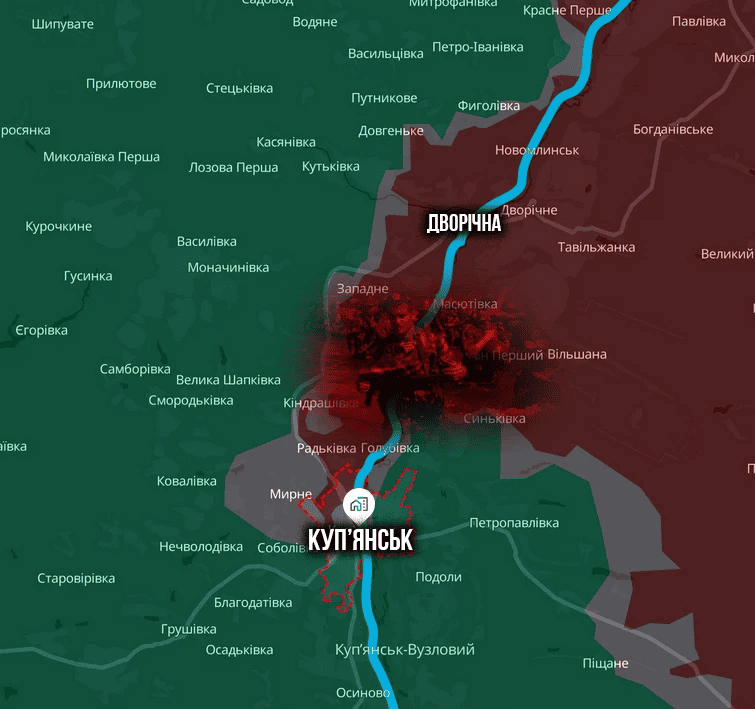
3. Kharkiv region. The Defense Forces are counterattacking in Kupiansk; participants in the operation believe the city can be brought back under Ukrainian control. At the same time, the Russians are pressing on Milove and Vovchansk. In the Kharkiv region, the Russians are keeping the Defense Forces occupied on three axes at once: Kupiansk, Vovchansk, and Milove. All of these settlements are partially or fully occupied by the enemy.
Kupiansk and Vovchansk are under partial enemy control for the second time during the full-scale war.
Kharkiv region falls under the responsibility of the 10th and 16th Army Corps, as well as the newly formed Joint Forces Grouping. The 10th Corps is consistently commanded by Serhii Perets (former commander of the disbanded OTU “Starobilsk”), the 16th by Yevhenii Kurash, and the Joint Forces Grouping by Mykhailo Drapatyi.
According to UP, citing two different sources involved in the management of units in the Kharkiv region, the reasons for the loss of positions across all three axes were gaps between positions caused by a shortage of Ukrainian infantry, which allowed the Russians to infiltrate deep into the front-line defensive zone. Another factor was the reporting of inaccurate information about occupied or lost positions “up the chain.”
Before the offensive on the border village of Milove in July 2025, local units, according to UP, were not prepared. By early December, the capture of this tiny village had expanded into an almost 30-kilometre zone along the border, connecting Milove with the Russian advance sector north of Kupiansk and Dvorichna.

Kupiansk, the main Ukrainian Army city on the Oskil River, was largely lost in September 2025. Subsequently, counteractions by the Defense Forces began in the city and continue to this day. However, according to UP, the units leading and carrying out these counteractions prefer to remain in the shadows until the operation is complete.
Perhaps the only current materials from Kupiansk are videos showing fighters from the 8th Special Operations Regiment engaged in close-quarters combat in the very center of the city. A year ago at this time, the city still had electricity and even water, albeit on a schedule, and a few grocery stores were operating — now it is heavily damaged and devastated.

According to UP, the Defense Forces’ counteractions in Kupiansk are currently focused on blocking Russian crossings of the Oskil River upstream of the city and retaking key high ground within Kupiansk itself.
There is no stable front line in the city. As on all axes of the front, Ukrainian positions can be situated between Russian positions and vice versa. Logistics are mostly on foot and involve long distances.
Some UP interlocutors involved in the counteractions are convinced that it is entirely possible to retake Kupiansk — and Vovchansk as well. However, not everyone shares this optimism.
If Kupiansk cannot be retaken, the Russians will likely push further toward Izium in order to finally cut the road to Sloviansk and apply pressure on Sloviansk and Kramatorsk, the last major cities in northern Donetsk region.
Some commanders operating in Kharkiv region do not rule out the possibility that the enemy is still interested in Kharkiv itself. However, for now, the Russians are not observed to have the forces needed to form a grouping capable of pressing on such a large city.
Tags: battle developments frontline conflict International Talks Kyiv defense Peace negotiations peace plan peace talks russia ukraine war U.S.–Russia diplomacy Ukraine war news ukraine's frontline


![The Kyiv Instytutska Street massacre during the Maidan Revolution of Dignity, where Berkut’s “Black Company” shot and killed unarmed protesters. :contentReference[oaicite:2]{index=2}](https://empr.media/wp-content/uploads/2026/02/photo-1-480x270.png)









![Visitors at the “Thank You With All My Heart” Ukrainian exhibition at the Council of Europe, featuring the Great Amber Heart and powerful war art. :contentReference[oaicite:2]{index=2}](https://empr.media/wp-content/uploads/2026/02/heart-300x171.png)