The Twisted Landscape exhibition in Kryvyi Rih explored the city’s industrial past, urban myths, and ecological futures, uniting artists’ works to reflect, reclaim, and imaginatively restore its unique urban environment.
Any city is a layering of experiences, history, personal impressions, architecture, local events, and memes — impossible to capture fully in a single non-stereotypical sentence.
First associations with Kryvyi Rih are usually steel, factories, and trees coated in red iron dust. Recently, within decolonization processes, the focus has also shifted to people — the workers of these enterprises. Imagining Kryvyi Rih beyond Kryvbas and the industrial narrative remains difficult: the city is rarely explored in the context of unique artistic experiments, cultural phenomena, or local events.
Twisted Landscape is a three-part exhibition project designed to introduce artists from different regions of Ukraine to the layers of Kryvyi Rih — its stereotypes, internal contradictions, and the true facade that reveals itself differently to everyone.
Each exhibition in the series had its own opening date, creating a sequential rhythm for the project and gradually immersing visitors in the city’s landscape history. The project has now reached its logical conclusion, offering a timely opportunity to preserve its memory. This was reported by Suspilne Kultura.
Author: Andriy Sechko
The actual engagement with the city took place during artistic residencies held in December 2025, organized by the Kryvyi Rih Center for Contemporary Culture (KRCC) under the curatorship of Kostyantyn Doroshenko.
With support from the Goethe-Institut in Ukraine, the residency Post-Industrial Memory Lab: Decolonizing Kryvyi Rih took place. The residency RUDA Project 2025: Landscapes of Recovery was supported by the RIBBON International program in partnership with Jam Factory Art Center as part of the Key Work: Artistic Grants initiative.
A parallel program of the project was implemented with support from the Heinrich Böll Foundation, Kyiv — Ukraine Bureau.
Rooting (January 17 – February 12)
The first exhibition reveals the materialist dimension of the city. The media presented are heavy and coarse: steel rods, slate, and metal sheets. Yet it is precisely these materials that most vividly convey the fragility and instability of the local urban myth.
First, I highlight Vitaliy Kravets’ installation Tumbleweed — an irregularly shaped bundle assembled from rods, rebar, and metal remnants of Kryvyi Rih’s industrial life. Not because it is semantically superior or visually more spectacular, but because this work resonated with me personally.
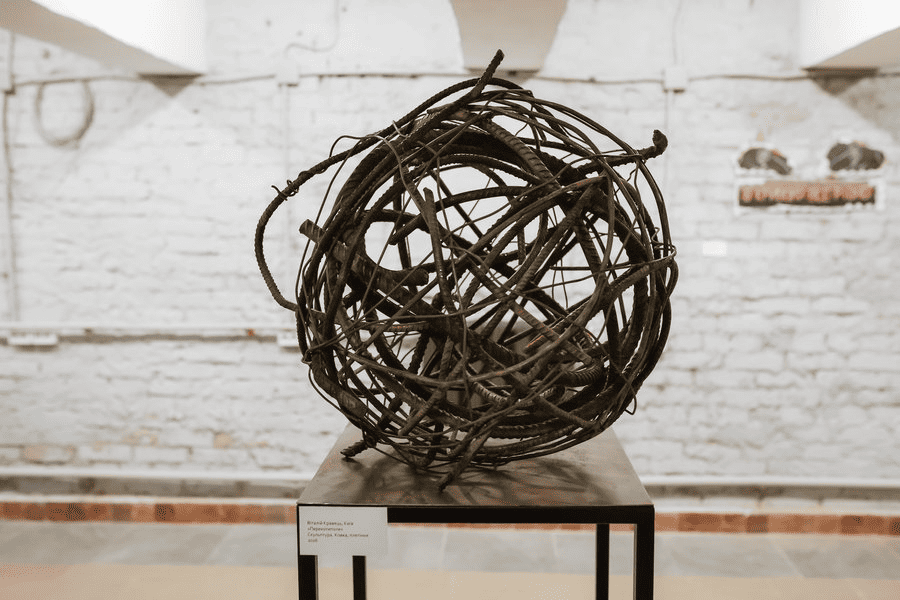
Having been forced to leave my home due to the Russian occupation, I found shelter in Kryvyi Rih but never truly felt at home. The question of my origin still makes me reflect: which place can I call my own? This sense of detachment and uprootedness, unfortunately, resonates with many people in Ukraine and beyond. The image of the tumbleweed precisely captures the reality of someone who has lost their roots and has yet to grow new ones.
Using local metal might seem like a straightforward gesture referencing the city’s familiar industrial image. Yet in this case, the material establishes a clear geographical connection for a broader Ukrainian narrative. This motif also resonates with local memory. Writer and amateur artist Anatoliy Andrzheievskyi, a long-time resident of the city, notes that Tumbleweed also reflects Kryvyi Rih’s history, where most inhabitants arrived due to migration waves linked to mineral extraction.
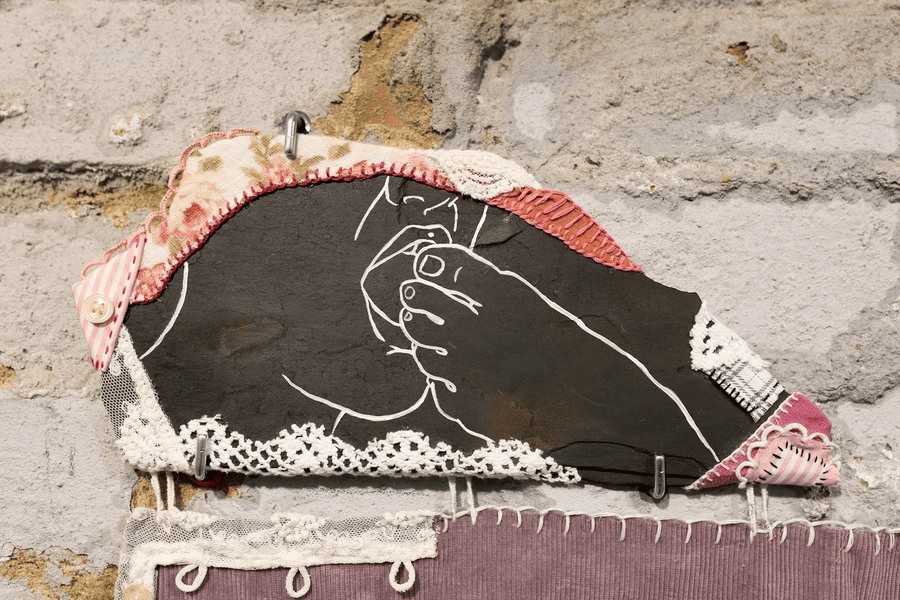
“It’s all the same in Kryvyi” — a semantically striking phrase in Asya Yakovleva’s work — transforms into a cynical quotation in a broader context. It shapes the city’s external image while coexisting with infrastructural decay, ecological vulnerability, and chronic stagnation. The phrase was popularized by Oleksandr Vilkul, head of the city’s defense council and a supporter of now-banned pro-Russian parties. Today, Kryvyi Rih remains largely neglected due to his influence.
The reuse of this mocking phrase shifts its hidden meaning and draws attention to these issues. The artist embroideries the quote on textile, framing it with two basalt stones depicting mouths devouring legs — a visual euphemism for urban brutality and the feeling of inescapability.
Eva Alvor’s works form the leitmotif of the exhibition, simultaneously serving as both the introduction and conclusion of the display. Her installation of metal sheets — rusted and new, interspersed with collage fragments of industrial history — pierced by a tree branch, resembles a kind of memory ring. Living matter grows through the layers of the urban myth, visualizing the continuity and interconnectedness of processes.
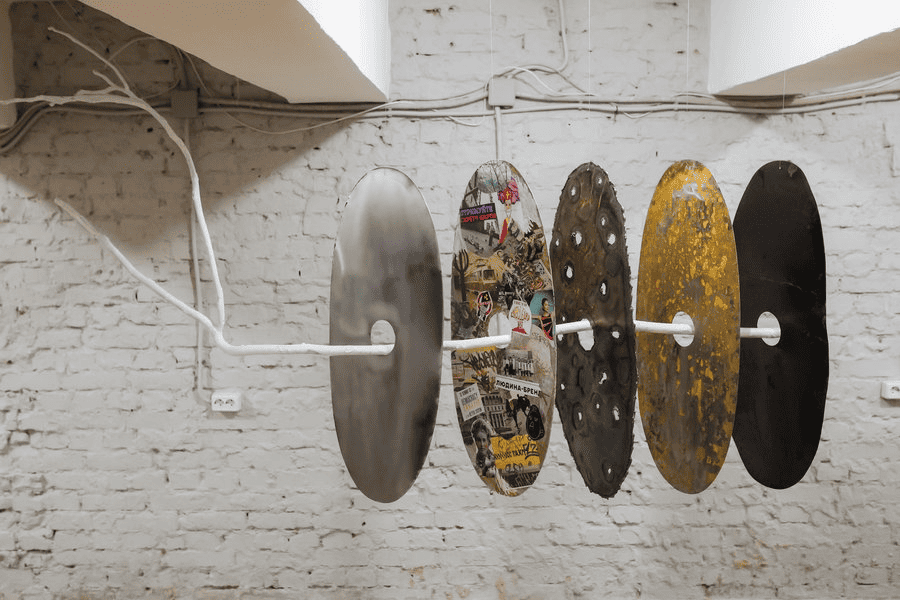
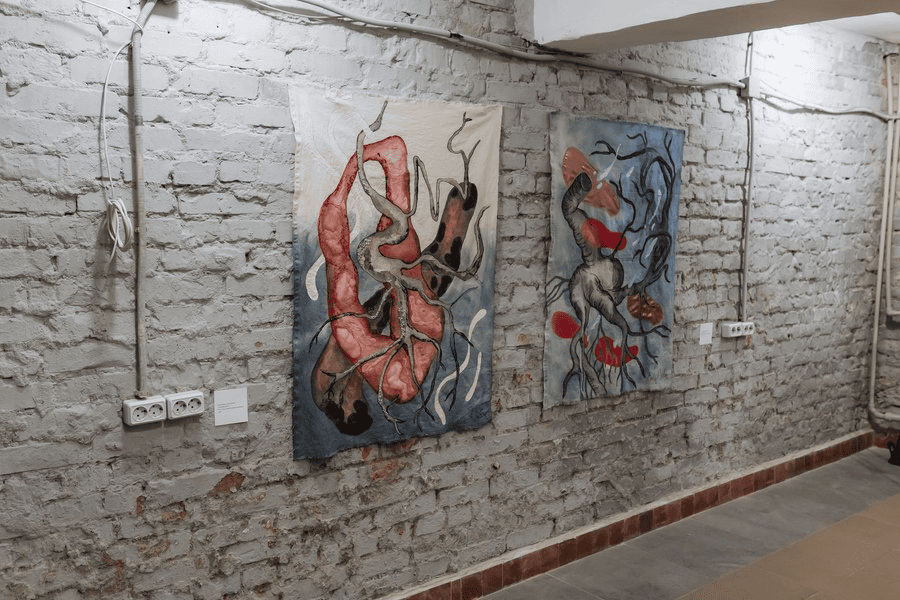
The series of canvases Rooting 1 and Rooting 2 continues this theme, depicting roots that travel through coarse industrial materials, uniting the city’s inhabitants into a single, non-toxic system.
Awareness (January 24 – February 12)
Having studied the city’s landscape and physically rooted ourselves in it, we feel the need to reflect on our role within this complex ecosystem of human interaction, heavy industry, and the search for a new artistic language.
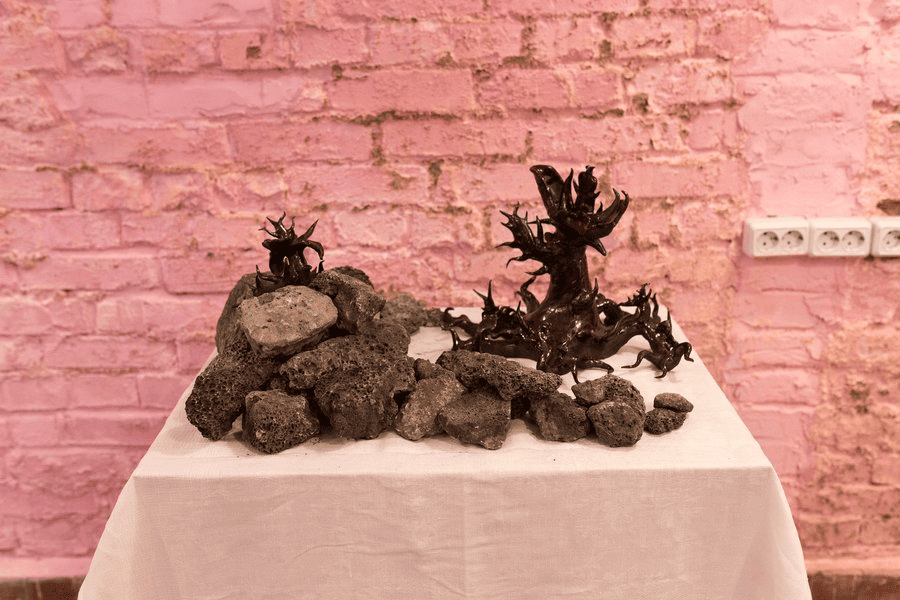
Renata Asanova’s works recreate Kryvyi Rih’s urban landscape through images of spoil heaps, soil, and stones, evident in all the exhibited objects. This occurs both materially — through the use of rocks from spoil heaps in the installations — and allegorically — by representing the city’s geography in her paintings. In each case, the compositions are complemented by fantastical plants, a recurring visual code in the artist’s practice. Conscious life in these works exists within a harsh, inert environment, performing a clearly defined function.
Breakfast of Champions — an installation by Oksana Zharun, an artist who systematically explores the question of humans as resources in her practice. The work references Kurt Vonnegut’s novel of the same name as a source for critically examining industrial stagnation and the reduction of humans to mere functions within urban space.
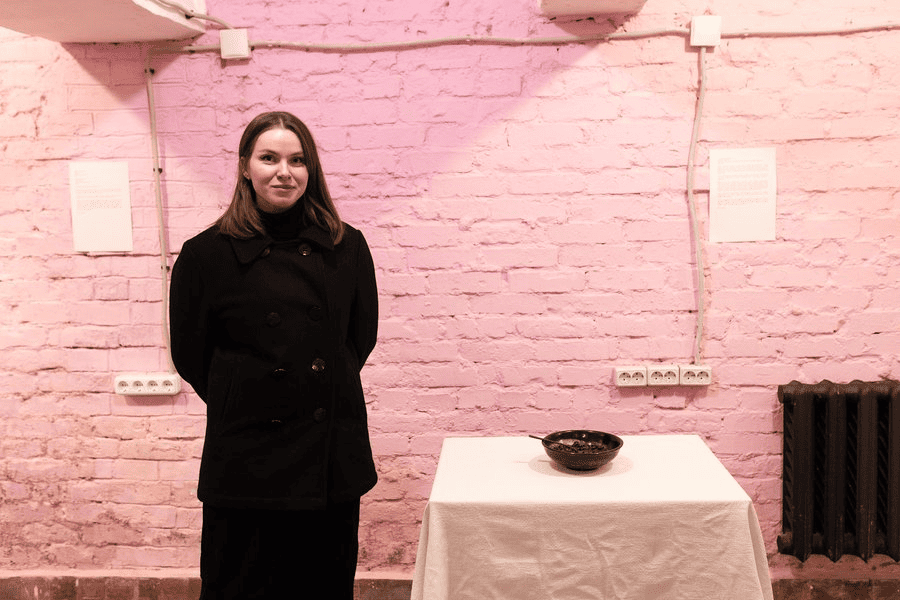
A bowl filled with industrial dust illustrates the allegorical narrative “industry feeds us,” which remains relevant to Kryvyi Rih. In this interpretation, industry appears both as the driver of urban life and as a mechanism for exhausting resources — particularly human ones.
Reconciliation (January 31 – February 12)
The final event of the project was the exhibition Reconciliation — seen as a process of harmonizing acquired experience. The display invites a delicate and attentive approach to space, fostering a gentle interaction between viewers, the city, and the material.
Ksenia Kostyanets’ handmade rug, created from fragments of used fabric, has a soft, pleasant texture while evoking the image of spoil heaps — sites of land disruption. As a native of Kryvyi Rih, the artist has a particular relationship with these landscapes and consciously forms “soft” spoil heaps — ones that do not intimidate but instead create a warm, calming atmosphere, transforming the established narrative of anxiety.
Tamara Safarova presented a video work based on a performance in which she interacts with the city, fully entrusting her consciousness to the space. During this immersion, the artist resonates with the industrial landscape, capturing shared rhythms, tension, and bodily sensations. According to the performer, she experienced an identity between the body and the exploited land, as both are treated as resources that can be damaged or wounded, yet remain unique and possess an inherent capacity for regeneration.
Artem Humilevskyi’s installation Terraforming creates a real-time green landscape of Kryvyi Rih’s “otherworldly” locations. The artist was struck by sites often called “the Ukrainian Mars,” yet beneath the captivating terrain lies land exhausted by human activity. Humilevskyi invites the restoration process to begin at least in imagination and visualization. Through a participatory element, each visitor could contribute their own image, which, via a digital algorithm, was combined in real time on the screen with a randomly generated tree, forming a shared, evolving landscape. In this way, humans transform from mere consumers into potential agents of regeneration.
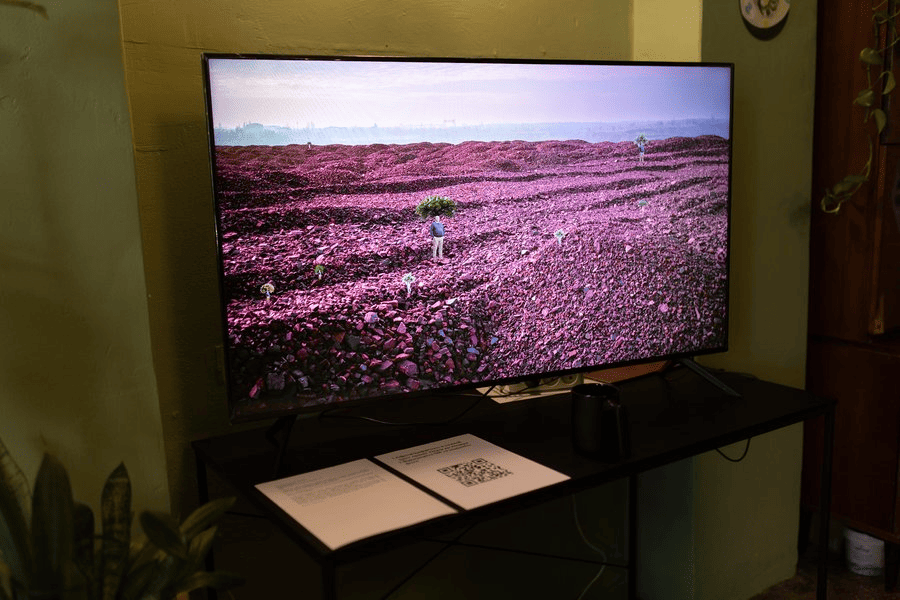
Kryvyi Rih’s industrial past and present are not a verdict for the city. Despite ecological consequences and inflicted damage, industry has shaped unique spaces and locations for industrial tourism, collective inspiration, and specific urban logistics. The project encourages residents not to reject their city’s heritage, but to rethink it through a more ecological lens, fostering a harmonious interaction between industry, urban life, and the cultural environment.
Tags: contemporary Ukraine art eco art reflection empr.media culture industrial landscape Kryvyi Rih art exhibit Twisted Landscape urban art narrative
![Czech‑made Jan Žižka FPV fiber‑optic drone in flight with long optical control cable over training field near Ukraine frontline.:contentReference[oaicite:2]{index=2}](https://empr.media/wp-content/uploads/2026/01/dron-480x270.png)