
Nataliya Zabolotna on rebuilding Ukraine’s culture, art as soft power, major museum ambitions, and her vision for a new contemporary art museum.
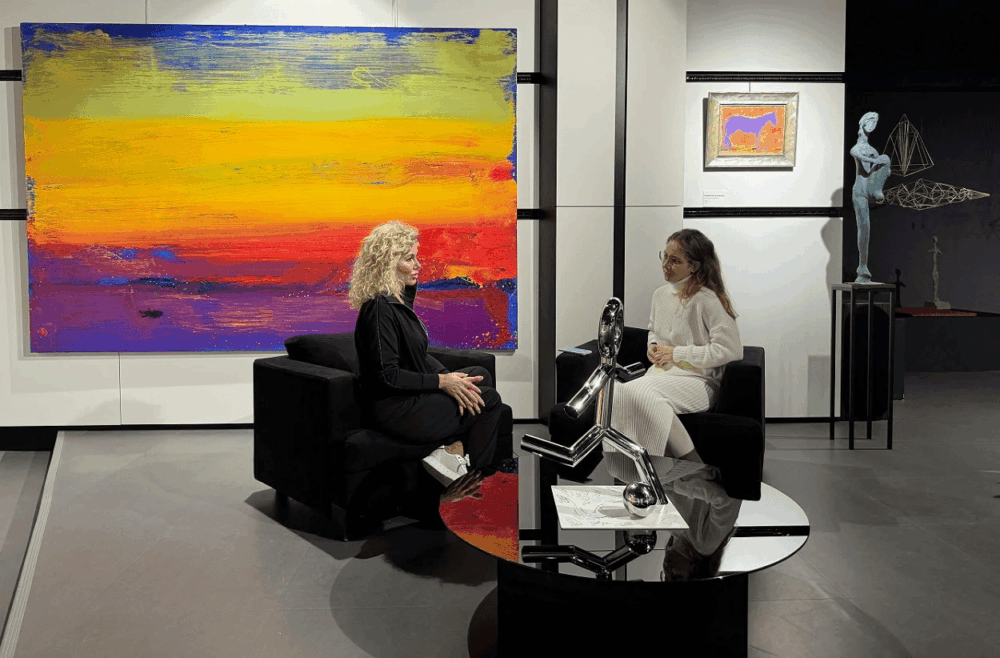
The name of Nataliya Zabolotna is associated with a new era of cultural development in Ukraine. Under her leadership, the Ukrainian House and the Mystetskyi Arsenal became symbols of contemporary art and creativity, where Ukrainian culture found a new breath. Today, Nataliya Zabolotna is the founder of Art Ukraine Gallery and the President of the Humanitarian Development Foundation of Ukraine. In an exclusive interview for Marbeks with Anastasiia Kurinska, she shared her views on cultural diplomacy, the changing perception of contemporary art, the uniqueness of Art Ukraine Gallery, and plans to create her own museum.
We are currently at Art Ukraine Gallery, which you founded in 2016 and reopened in 2023 in a new format as a charitable gallery in partnership with Domosphere and two non-governmental organizations: the Humanitarian Development Foundation of Ukraine and Vidchuy. What made you rethink the purpose of the gallery, and how did you find the courage to relaunch it during the full-scale war?
Of course, the war resonates within each of us and leaves its marks: it either completely throws you off course or activates all your inner resources. At some point, you realize that you need to do what you know how to do, what you are capable of — perhaps even with double or triple strength. You need to act despite everything and be as useful as possible for your country.
The idea of creating a charitable art gallery emerged around the fifth month of the war. It was like an obsessive thought that kept following me everywhere. Everyone said it was absolute madness to do this during wartime, when people were supposedly not interested in art at all. However, I had a goal and since the summer of 2022 I had been looking for a large space in Kyiv. I believed that rental prices were low because of the war. After the Mystetskyi Arsenal, I developed a kind of claustrophobia toward small spaces: if I need a gallery, it has to be on a large scale. Moreover, this has been my long-standing dream — to create a gallery representing a large group of artists, something closely connected to a major museum of contemporary Ukrainian art. However, landlords likely did not believe in my idea, so they were unwilling to offer long-term leases, while a gallery requires long-term cooperation and extensive daily work.
Back in 2020, in order to support my children, I started working in luxury real estate sales and within a year became the top real estate agent in Ukraine according to the American company REMAX. In January 2022, I became a broker and registered my own company for real estate and art sales — Malevych Group. I dreamed of opening a contemporary art gallery and a real estate agency at the same time. That is how I ended up at the Domosfera shopping center: I arranged a meeting with the director to discuss advertising options for my real estate company. During the meeting, I was recognized as the former director of the Mystetskyi Arsenal and was offered to look at an empty gallery space on the third floor.
To be honest, at first I did not really like the idea, because coming from a high-level art environment and suddenly opening a gallery in a shopping mall felt almost like bad taste. However, when I went upstairs and saw the space, I realized it had truly been designed with an understanding of gallery practice, and the only thing it was missing was my energy and Ukrainian contemporary art.
I said then that I would open a gallery in 10 days — they, of course, did not believe me. But after a week and a half, the opening already took place, and we presented 300 unique works of Ukrainian art to our guests. In other words, my dream of a contemporary art gallery and a real estate agency came true simultaneously. This case, by the way, works very well in synergy: many of my real estate clients, even without being involved in art, visit our space and discover Ukrainian artists.
When I was still searching for the ideal space, I met my longtime friend Liudmyla Pyshna. We talked about how we experienced the beginning of the war and about future plans. I told her that I wanted to open a charitable gallery in partnership with my Humanitarian Development Foundation of Ukraine, and suggested she join with her charitable initiatives, as I was already familiar with the work of the Vidchuy foundation. We had also cooperated back when I was heading the Mystetskyi Arsenal, so we decided to combine our efforts by creating a charitable art friends’ club.
How does charity combine with commerce, given that a gallery is still a commercial project?
Of course, the gallery is a legal entity that carries out commercial activity, and as a private entrepreneur I lead this activity. However, despite being a commercial institution, we hold charitable auctions and campaigns here, from which 100% of the funds go to support those in need. Moreover, as a business, we also have our own social responsibility, and we additionally allocate part of our profits to charitable causes.
I take care of wounded children from Okhmatdyt, while the Vidchuy Foundation helps soldiers who have lost their hearing during combat operations, as well as providing service members with equipment that helps prevent hearing loss during bombardments. It seems to me that during a full-scale war every business should contribute and unite; military taxes are paid by everyone, but that is not enough.
What distinguishes Art Ukraine Gallery from the array of galleries in Kyiv and Ukraine in general, apart from its charitable format?
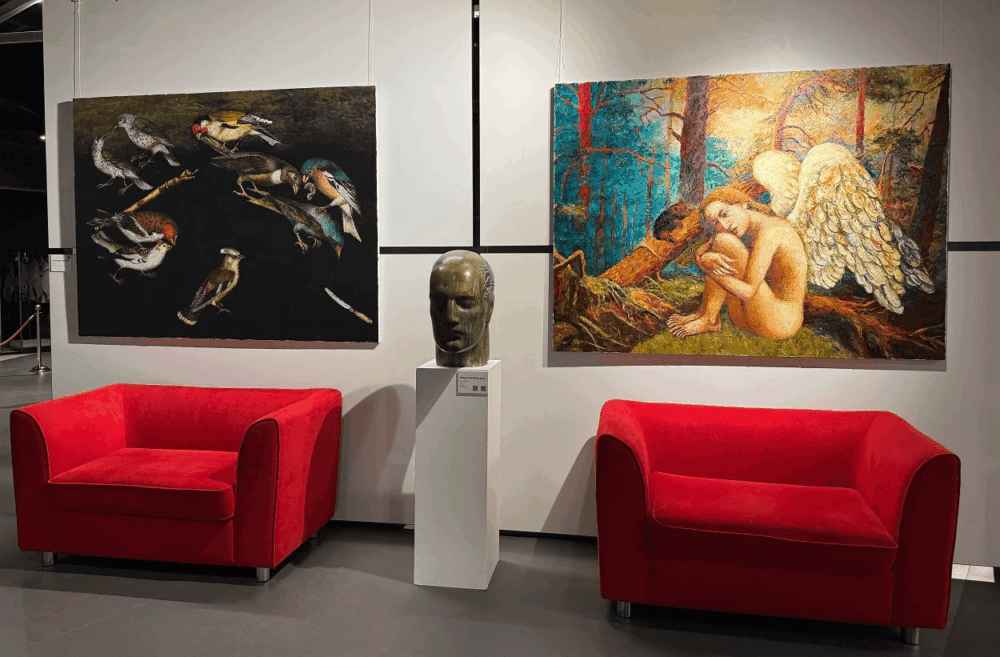
It is not only the largest, but also the only gallery in Kyiv that is closely connected to the concept of a Museum of Ukrainian Contemporary Art. We present essentially the core spectrum of first-tier artists — around the top 30 names of Ukrainian contemporary art, those already inscribed in the history of Ukrainian art of the 20th–21st centuries.
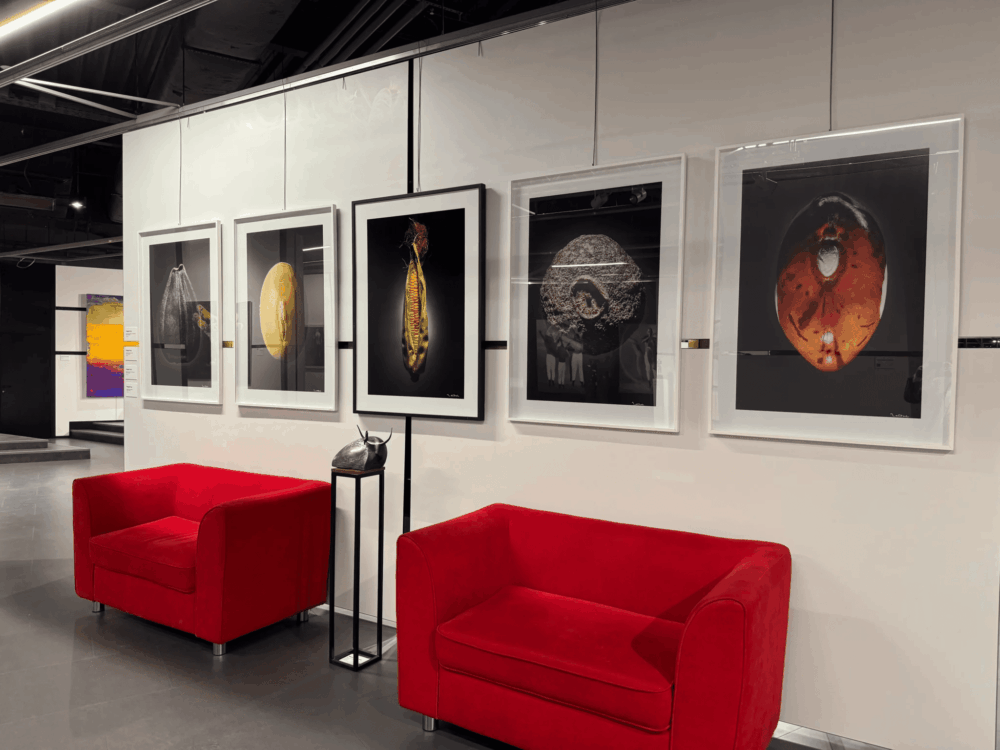
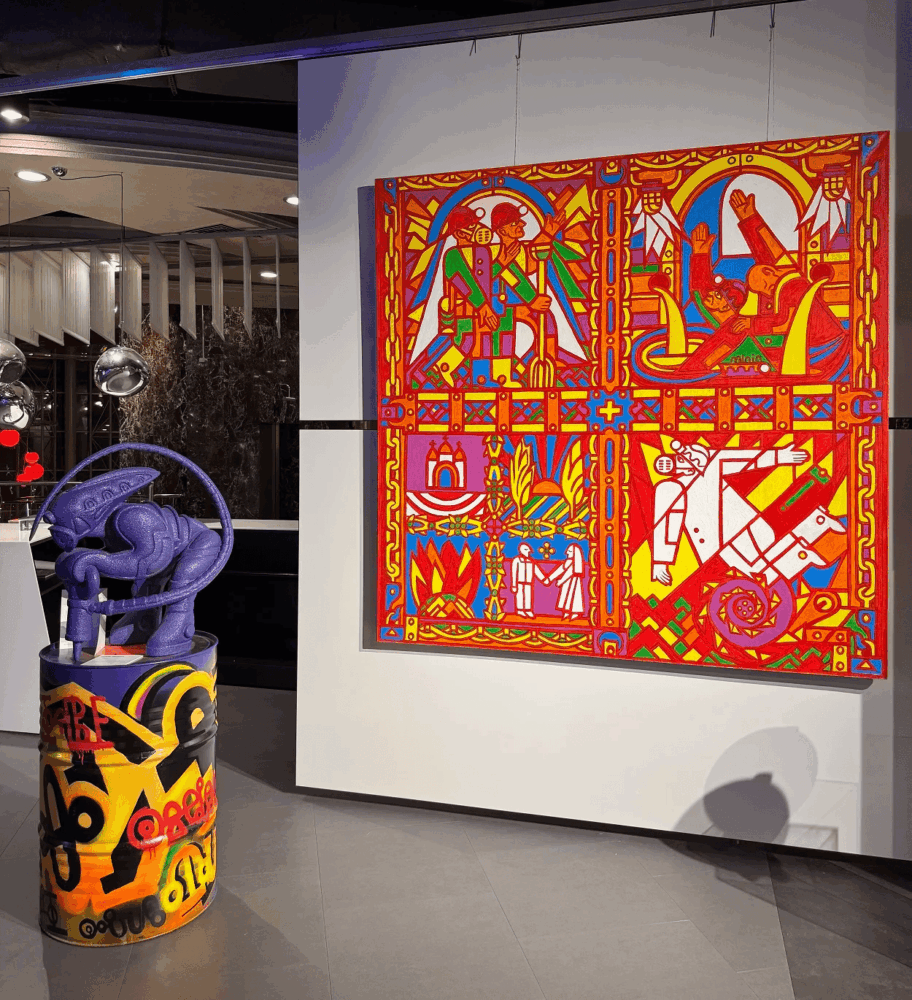
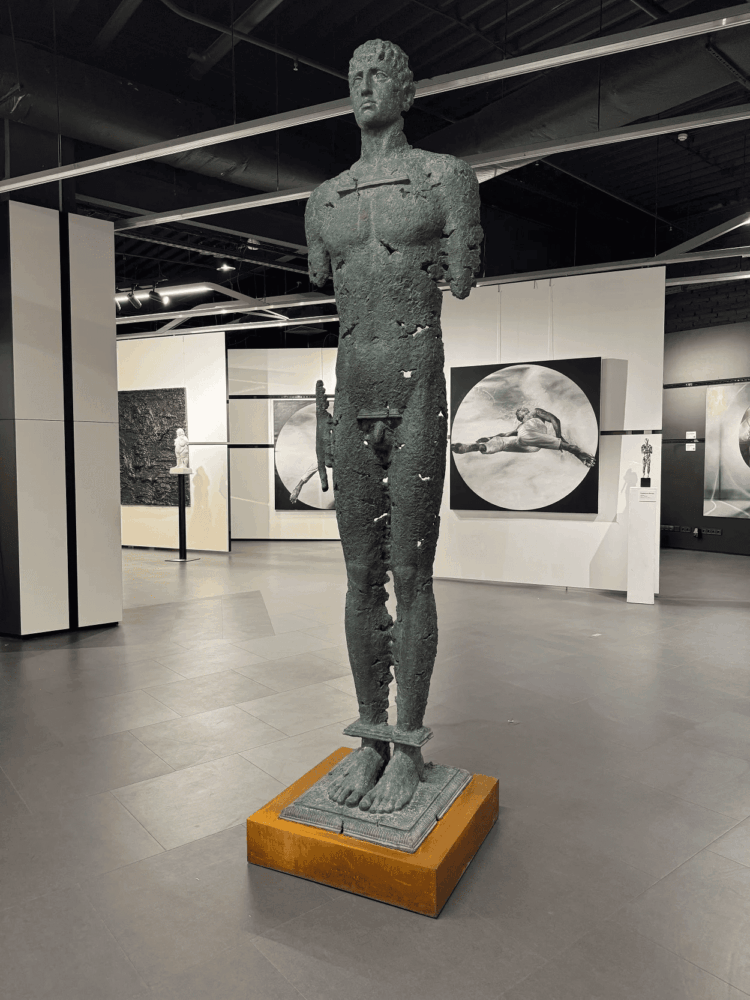
Because the gallery is large, we can present — and do present — multiple series at once, effectively creating mini-retrospectives of these artists. Depending on the scale, we simultaneously exhibit between 200 and 500 works. The exhibition features works by living classics such as Anatoliy Kryvolap, Oleksandr Sukholit, Oleksandr Dubovyk, Tiberiy Silvashi, as well as works by well-known artists such as Oleh Tistol, Illya Chichkan, Masha Shubina, Mykola Matsenko, Viktor Sydorenko, Petro Lebedenets, Olia Rondiak, Roman Zhuk, Hanna Kryvolap, Max Vityk, Oksana Mas, Roman Minin, as well as artists of the new wave — the 2000s generation: Lina Kondes, Yuliia Belyaeva, Nazar Bilyk, Oleksii Zolotaryov, Sasha Chichkan, Petro Hronskyi, Roman Mykhailov, and Oksana Levchenia-Konstantynovska.
The exhibition also includes works from private collections of a unique figure and a phenomenon in Ukrainian art — Oleksandr Roitburd.
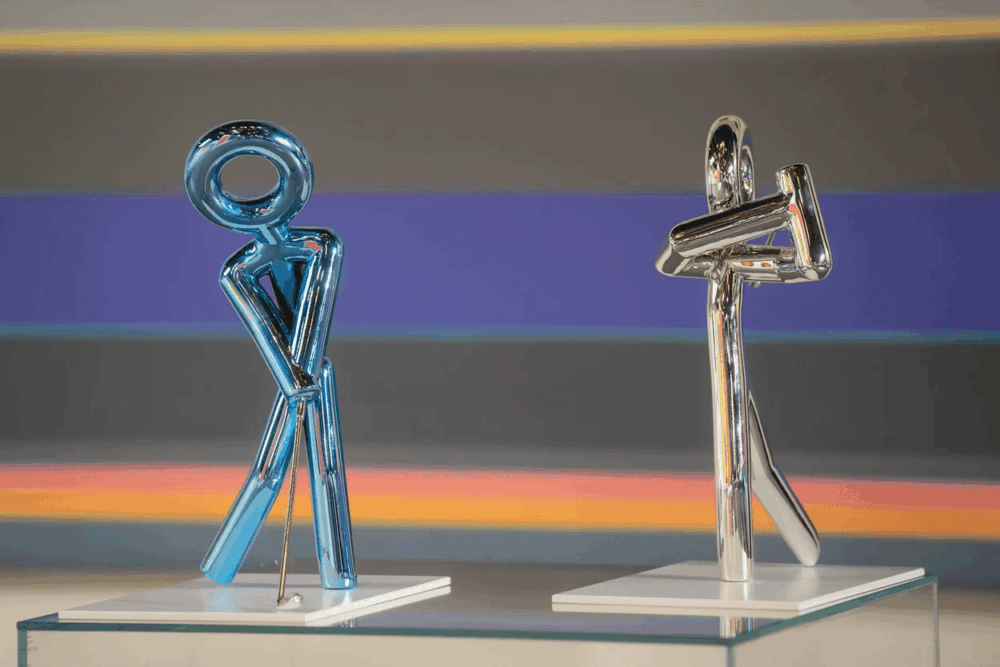
I think this is currently the only place in Ukraine where you can come and immerse yourself in art: spend an hour or an hour and a half and leave with a certain understanding of what Ukrainian contemporary art is. Thanks to the gallery being located within a multi-brand space like Domosfera, people who have absolutely no connection to the arts often come here as well, which is also an advantage. It is an educational mission.
I have been working in the cultural field for 20 years, and for me this is a very interesting cross-section. There are people who do not know which artist is renowned and which is not, and I observe and analyze their reactions. For example, almost 90% of visitors said that Anatoliy Kryvolap’s black horse is a masterpiece, and I am interested in how this works.
People were not previously immersed in art, so masterpieces are distinguished by scale and the motif of the first impression. Even non-professional art observers can recognize artists who have already become part of the history of Ukrainian art.
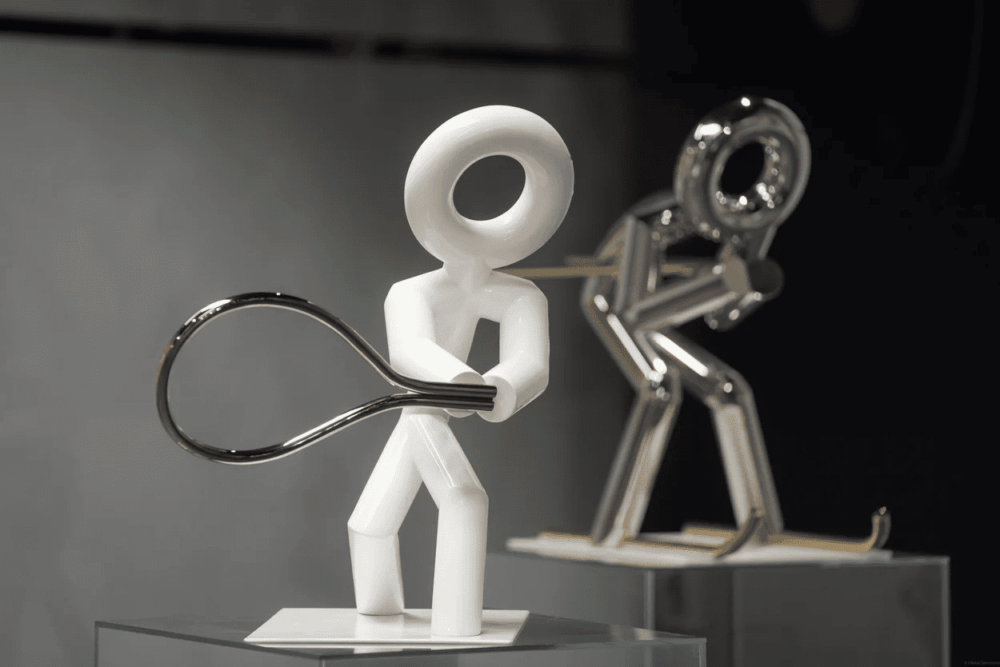
The exhibition at Art Ukraine Gallery includes works by both incredibly well-known artists and quite young ones whose careers are only gaining momentum. Could you tell us how you choose whose works to display and whom to decline?
Indeed, we have artists such as Petro Hronskyi, Alona Shybunova, Oksana Levchenia-Konstantynovska, and Lina Condes. They are relatively young, but they are already established artists with international provenance, widely exhibited in Europe and the United States.
Every object in the gallery is selected and placed in the exhibition by me personally. Perhaps my considerable experience already allows me to rely on my own intuition. I see these works, I feel them — therefore they must be here. What I do not feel, I do not exhibit. For me, this gallery is like a mega-installation of 2,000 square meters: a territory of my love and responsibility toward visitors. Sometimes I come when there are no people, and I simply enjoy this exhibition — the space in front of me.
When I was creating large-scale projects at the Mystetskyi Arsenal covering 10,000–20,000 square meters with my team, the press often asked me which artwork I liked the most. I always answered that I love the museum itself, and now — the gallery — as a whole. Every artwork could be beautifully displayed in my home. Each of the works presented here is something I would gladly have in my personal collection.
When people come who want to purchase a work, they often ask me to give them a reason why they should buy it. I tell them that these are works you, your friends, or your business partners will be able to pass down as an inheritance.
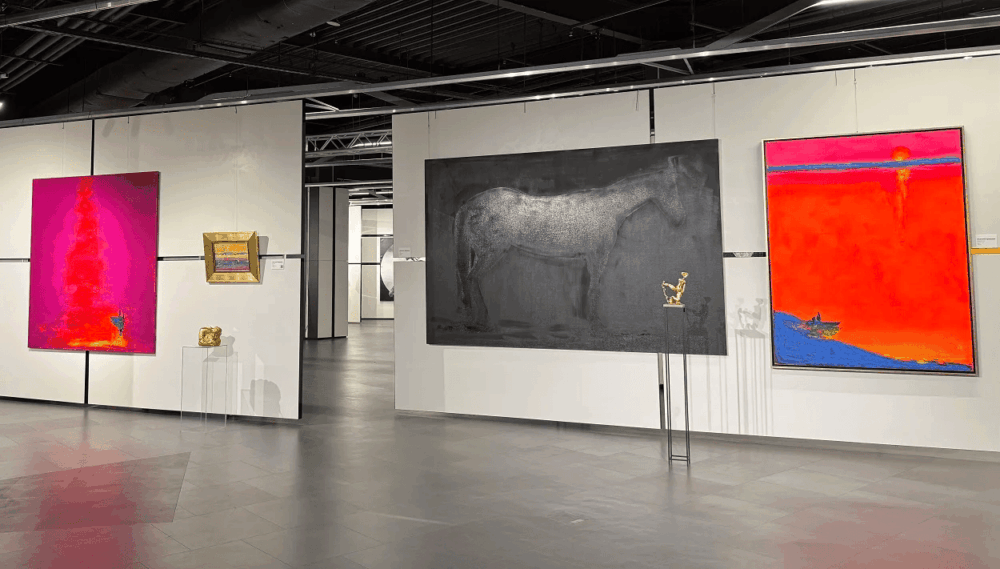
There are many works by Ukrainian artists in Art Ukraine Gallery who currently live abroad. This includes Olia Rondiak, who was born into a family of Ukrainian emigrants in America; Lina Condes, who moved to Miami from your native Cherkasy; the Zigura brothers, who are now based in Nice; as well as Oksana Mas and Arsen Savadov. In your opinion, does their living abroad contribute to cultural diplomacy?
Absolutely, absolutely it does. I want to emphasize that some artists were born abroad. Take Olia Rondiak, for example. Her grandmother spent 25 years in the Gulag for embroidering and singing Ukrainian songs. Her grandfather took his young daughter abroad, so Olia was already born in New York. Despite this, she feels her roots so deeply that her messages are very close and understandable to us.
Lina Condes has also been living in Florida for about 15 years. I am glad to know that at the dawn of her artistic career, I also contributed to the development of such a talented artist. I believed in her and invited her to participate in Art Kyiv Contemporary, which I organized for 10 years, from 2006 to 2016. It was the main platform for showcasing Ukrainian artists and a major driver of their development. At that time, Lina presented her painting, and today she has established herself in the United States as a sculptor. Her works are held in major American collections. Next to Auguste Rodin’s “The Thinker,” there is Lina Condes’ “The Thinker.”
I would very much like Ukrainian artists not to become cosmopolitans who lose their Ukrainian character. I do not want them to become American, Belgian, or French artists — I want them to remain Ukrainian. Many of them will not return to Ukraine and will remain only in the annals of history, like Alexander Archipenko, Kazimir Malevich, and Oleksandra Ekster. They made their first steps here, but achieved recognition abroad.
In your opinion, has the art scene in Ukraine become more competitive in recent years? And has the audience’s attitude toward contemporary art changed in particular?
In my opinion, when the war began, it was the only opportunity to quickly knock on the doors of the world’s most important museums — such as the Metropolitan, MoMA, Guggenheim, the Louvre, Musée d’Orsay, and Centre Pompidou — and immediately launch large-scale projects there. At that time, Ukraine was in the spotlight, and it was our chance to enter these institutions with major, value-driven projects. However, unfortunately, this was not done on the scale that our country deserves.
I remain convinced that culture is a soft power that is capable of transforming even enemy guns into cultural capital.
What projects or initiatives do you think should be implemented to promote Ukrainian art abroad?
We need to create large-scale projects. We must build the country’s reputation in the same way athletes do. We cheer for every gold, silver, and bronze medal, for Olympians, and we celebrate Usyk’s victory in the ring in Saudi Arabia. We show the world that Ukraine is not only a country marked by war and corruption, but a state capable of winning — an ancient land with a deep culture and traditions, a land that has belonged to us since time immemorial.
That is why we must not only participate in global art events; we must aim to win them: to take the “Golden Lion” at the Venice Biennale, to win the “Palme d’Or” at the Cannes Film Festival. However, in order to achieve all these results, the state must consciously and systematically support its artists.
Tell us about your own experience, since I understand that during the full-scale war you also created charitable art projects.
Yes. At the beginning, I had to take care of my own children, my nieces and nephews, and the children of friends. And while being outside the country, I began to feel what is known as “survivor’s guilt.” When new horrific scenarios were unfolding in Ukraine, and we were seeing their consequences in places like Bucha, Hostomel, Borodianka, and Mariupol, how could one just sit with folded hands?
There is a concept called “survival guilt” — the guilt of the one who has survived. It pushed me to continue active volunteer work and do everything possible and impossible. So already in June 2022, I opened a large exhibition called “Independent. Rescue Art” in Miami, Florida. The exhibition featured works by eight Ukrainian artists, including Arsen Savadov, Oksana Mas, Roman Zhuk, Olia Rondiak, Tetiana Kalivoshko, and Oleksandr Dubovyk. For the local audience, it was a very powerful project that stood out from the usual art they were accustomed to.
You led some of Ukraine’s largest cultural institutions, such as the Mystetskyi Arsenal and the Ukrainian House. Having been involved in the art field for several decades, can you say that Ukrainians’ attitude toward art — especially Ukrainian and contemporary art — has changed?
Yes, and I am proud to have been part of that change. The Mystetskyi Arsenal, which I headed from 2010 to 2016, was visited by more than 3.5 million art enthusiasts. People came to cultural events that we created with the team on very limited funding. When I was the director of the Ukrainian House, the press wrote that they were seeing queues for art for the first time.
In 2006, I created “Art Kyiv Contemporary,” the first Ukrainian art fair, with the idea that one day Kyiv could become a cultural capital of the world, because, as we know, it keeps shifting — from New York to Paris, from Paris to Berlin. But before that, I traveled half the world: to The Armory Show in New York (USA), Frieze in London (UK), FIAC (Foire Internationale d’Art Contemporain) in Paris (France), and Art Basel in Basel (Switzerland). I could not understand why there was Art Moscow, but no Art Kyiv.
In 2007, I launched the first Great Sculpture Salon, which I organized for 10 consecutive years. At that time, sculpture was in a difficult position — a transitional period after the Soviet Union, when monuments were produced through state orders. Sculpture was still in demand then, but afterward it suddenly lost its place, and there was no clear understanding of what would come next.
I called sculpture “heavy artillery” of art. It is difficult to produce and create, requiring a complex manufacturing process to support a sculptor’s work. Thus, the Sculpture Salon became a real celebration and a stimulus for sculptors. Their works began to be purchased, and both visitors and collectors eagerly awaited the next event. Sculpture became fashionable again.
In 2007, I also launched the Great Antique Salon, which initially took place at the Ukrainian House and later at the Mystetskyi Arsenal, where everything reached a larger scale. We encouraged people to grow, demonstrated high quality, and nurtured an audience. At the Ukrainian House, thanks to ticket sales, our state institution, which had minimal funding, began to sustain itself through these revenues.
Just like this, the Mystetskyi Arsenal, which I took over as a scandalous frozen construction site — with no heating, no toilets, no exhibition walls, and with debts — came to life thanks to high-quality and bold projects that drew huge queues. Of course, the scale of the Mystetskyi Arsenal itself also inspired the creation of ambitious projects: its beauty and the pure architectural forms of early classicism.
I constantly visited the Venice Biennale. The Mystetskyi Arsenal, in terms of its format, was so similar to Venice that I began to dream of launching our own international biennale. And I did it: 100 artists from 30 countries around the world. From Yayoi Kusama and Louise Bourgeois to Ai Weiwei. These are world-renowned names, and all of them were presented at the Mystetskyi Arsenal — it was a major educational project.
Many people come to Art Ukraine Gallery because it is associated with me and with iconic artists’ names. People are curious about what I have created again, and my surname is already associated with high-quality art.
Today, such conceptual art with its highly refined, subtle conceptual messages has somewhat faded into the background; people now greatly need paint and color. Visitors include military personnel, children, and pathologists, who say they come here to avoid losing their sanity. Once again, through this gallery, we have confirmed that art is something that inspires, rehabilitates, restores, and gives hope for life.
By the way, the implementation of projects at Art Ukraine Gallery reminded me of our active work at the Mystetskyi Arsenal in 2014–2015, when we began receiving the first refugees from Crimea, Luhansk, and Donetsk. We tried to hold workshops with children and mothers, and they truly came back to life. In other words, art is capable of rebirth, inspiration, and giving hope.
Finally, a question about the future. I understand that especially during wartime it is difficult to make long-term plans, but you have repeatedly said that you always think on a large scale, so perhaps you already have a super-goal that you aim to achieve?
We must elevate and promote Ukrainian culture in Ukraine and around the world. We have lost a great deal during this war, and even more was lost before it — due to the narrow-mindedness and ignorance of politicians, the obsession and closed thinking of those in power, the egocentrism and backroom nature of cultural figures, and the corruption of the Ministry of Culture across all periods.
Unfortunately, many people have never managed to realize what they could have gained — and what they have truly lost. Culture and art are what provide meaning, a sense of pride and belonging to the greatness of a nation, and participation in a great country. Despite everything, we must build temples of art, generate powerful cultural beacons, and we must start doing this today.
A country without culture is just a territory, and as we can see, territory is easily taken over. There is no separatism where people feel themselves part of a cultural genesis and feel a connection to the land on which they were born and which they will never betray.
We must create the largest museum in the country — the Mystetskyi Arsenal — so that it becomes one of the most significant museums in the world: a museum of the history of Ukrainian art from antiquity to the present. We must restore castles and palaces, modernize regional museums, create cultural and sports centers for children and youth, and develop cultural routes. These are the best rehabilitation measures for a society exhausted by war. And then we must fill local budgets through cultural tourism — because it is better to earn from cultural revival than from ruins, like Chernobyl.
And for now, I will continue to generate and build my own museum, where I will realize the kind of history of contemporary art that I love and feel. And I am convinced that I will do it.
Tags: contemporary art cultural diplomacy EMPR.media Global Influence museums Soft Power Ukraine war and culture
![Paul Manandise speaking passionately in an interview about Ukraine’s existential struggle, global propaganda wars, and cultural resistance against Russian aggression. :contentReference[oaicite:2]{index=2}](https://empr.media/wp-content/uploads/2022/02/empr.media-interview-480x270.jpg)