

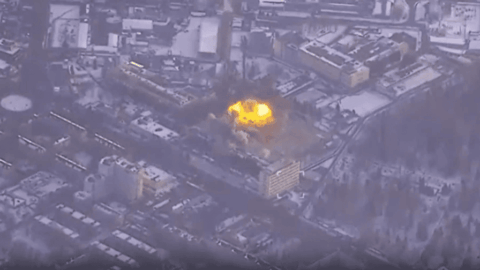
Ukraine’s Defense Forces struck the Kremniy El microelectronics plant in Bryansk on the evening of March 10. Several Storm Shadow cruise missiles hit the territory of the facility, which is strategically important for the enemy.
Ukraine had previously attacked Kremniy El, but never this successfully before. Specifically for 24 Kanal, aviation experts and military analysts explained whether the strike on the Russian plant in Bryansk could halt the production of, for example, Iskander missiles, as well as reduce the quality of missiles and other military equipment that use modern electronics.
What is the key objective of the strike on the Kremniy El plant?
Military analyst Vasyl Pekhnyo noted that the need to strike sites where Russian missile weapons are produced has existed for a long time. Ukraine simply did not previously have the capabilities to do so. According to the analyst, the Kremniy El plant has actually been hit multiple times before, but those attacks were mostly carried out with drones.
“It’s like in the game Battleship — you wound it but don’t kill it. When missiles start flying in, it creates a completely different effect,” Vasyl Pekhnyo noted.
The General Staff of the Armed Forces of Ukraine reported that there were at least five hits. The strike targeted the building of the main workshop No. 4, where microelectronics were assembled.
Kremniy El is an enterprise that produces microelectronics — essentially the brain and nervous system for almost every type of missile used by Russia, from the Pantsir, S-300, S-400, and S-500 air defense systems to the entire line of Kalibr, Iskander, and Kh-59 missiles, as well as avionics for Su- and MiG-series aircraft, and even components for intercontinental ballistic missiles.
“For us, it must be obvious that Ukraine will not have interceptors for Russian ballistic missiles in the near future. Even though Volodymyr Zelenskyy reported that Germany would supply a number of PAC-7 missiles for the Patriot system, this does not solve the problem,” Pekhnyo said.
There were reports of 35 missiles, but this number is not enough to repel even a moderately intense enemy attack involving ballistic weapons. It is roughly 10% of what the Air Force used during the winter period.
Therefore, Ukraine currently has two ways to counter Russian ballistic missiles. The first is to train, prepare, and build engineering fortifications that would at least allow the country to withstand ballistic strikes with reduced damage. For example, constructing some kind of “fantastic” domes over thermal power plants, power stations, and similar facilities — which is generally not very effective.
Important! Ukraine’s president Volodymyr Zelenskyy stated that the attack on the Kremniy plant in Bryansk was successful. Systems used to control missiles were manufactured there.
The second path is to act proactively by destroying enemy operational-tactical missile systems in Russia that can carry out launches, or by striking the locations where these missiles are assembled. In this sense, Ukraine is conducting systematic work. Just the day before, there was also a strike on the Votkinsk Machine Building Plant, where Iskander and Oreshnik missiles are assembled.
Reminder! The Flamingo missiles produced in Ukraine carried out a successful strike on the Votkinsk plant in Russia. The facility manufactures components for Iskander missiles and intercontinental ballistic missiles, which could significantly affect Russia’s military potential.
Why didn’t Russian air defense intercept the missiles?
According to military analyst Vasyl Pekhnyo, Russian air defense failed to intercept the missiles for several reasons. On the one hand, Storm Shadow cruise missile can be programmed to follow complex routes and approach the target from unexpected directions.
The OSINT community conducted its own analysis of the strike. According to their data, the missiles most likely approached from the eastern direction — that is, from Russian territory. Accordingly, the routes were designed to bypass interception systems.
On the other hand, Russia has recently moved more of its air defense systems to protect Moscow.
“But we should not underestimate the fact that the Unmanned Systems Forces of Ukraine are actually destroying many of the enemy’s air defense systems. According to the statistics of the General Staff of the Armed Forces of Ukraine, in the first eight days of March alone, 18 enemy surface-to-air missile system targets were destroyed or damaged,” Pekhnyo said.
According to him, March is a favorable month for such attacks because the sky is clearer and there are significantly fewer obstacles for drones. As a result, Ukrainian systems have been flying missions much more intensively.
What interesting details are known about the strike?
Retired Ukrainian Armed Forces colonel, pilot-instructor, and military expert Roman Svitan noted that striking a target at a distance of about 200 kilometers is possible only with the use of ballistic or cruise missiles. This refers to weapons such as the Storm Shadow cruise missile, SCALP‑EG cruise missile, or Taurus KEPD 350 cruise missile, which are capable of flying at very low altitudes, following the terrain, and remaining difficult for radars to detect.
“The main task was to break through the frontline air defense system and create a corridor for the missiles. After that, carrier aircraft could engage the target, while the facility’s air defense systems were no longer able to intercept the missiles effectively,” Svitan added.
In addition, the missiles may have been equipped with electronic warfare systems to counter Russian radars. According to the expert, a decoy missile such as the ADM‑160 MALD was also likely used.
Svitan noted that such missiles effectively help create a corridor for the main strike. They can temporarily “blind” the enemy’s air defense system, which is enough time for the main missiles to pass through the engagement zone and complete their mission.
What consequences will the strike on the microelectronics plant have for Russia?
Aviation expert, reserve Air Force officer, and defense industry development director Anatoliy Khrapchynskyi noted that Russia could lose the ability to produce goods at the Kremniy El plant for a long time.
Such facilities are equipped with high-tech machinery and specialized equipment that operate under precise technical parameters. Even a minor blast can disable individual production lines. According to him, a significant portion of the equipment cannot be restored or replaced by the occupiers.
“Some machines are manufactured for specific production tasks and may exist in only a single copy. That is why their destruction essentially means the permanent loss of certain technological capabilities,” the aviation expert explained.
He also noted that about 14 facilities in Belarus could potentially partially replace some components previously produced at this plant. At the same time, Ukraine cannot strike Belarusian territory, as this could have serious political and military consequences.
Attention! Ukrainian intelligence discovered that the Kremniy El plant supplies components to the control unit of the BUBS-30 warhead of Russia’s new Izdelie-30 cruise missile.
Going forward, it will be important to monitor how Russia uses its ballistic missiles: how many are deployed and whether supplies from North Korea or Iran are restored. According to Khrapchynskyi, the Iranian regime has largely lost launchers but may still have certain stockpiles of ballistic missiles that it could potentially provide to Russia.
What is known about other attacks on Russia?
On March 9, explosions were reported near the Akron chemical plant in Velykyy Novgorod. The facility produces a wide range of chemical products, but detailed information about the impact of the strikes is not yet available.
On the same day, a fire broke out at the KuibyshevAzot chemical plant in Tolyatti. Preliminary reports suggest the blaze may have been caused by a drone attack. This facility is one of Russia’s largest fertilizer producers and plays an important role in the chemical industry and the agricultural sector.
Meanwhile, on March 11, Sochi came under a drone attack. As a result, local airports reported flight delays. The city’s mayor described the strike as an “unprecedentedly long” drone attack.









![Visitors at the “Thank You With All My Heart” Ukrainian exhibition at the Council of Europe, featuring the Great Amber Heart and powerful war art. :contentReference[oaicite:2]{index=2}](https://empr.media/wp-content/uploads/2026/02/heart-300x171.png)