
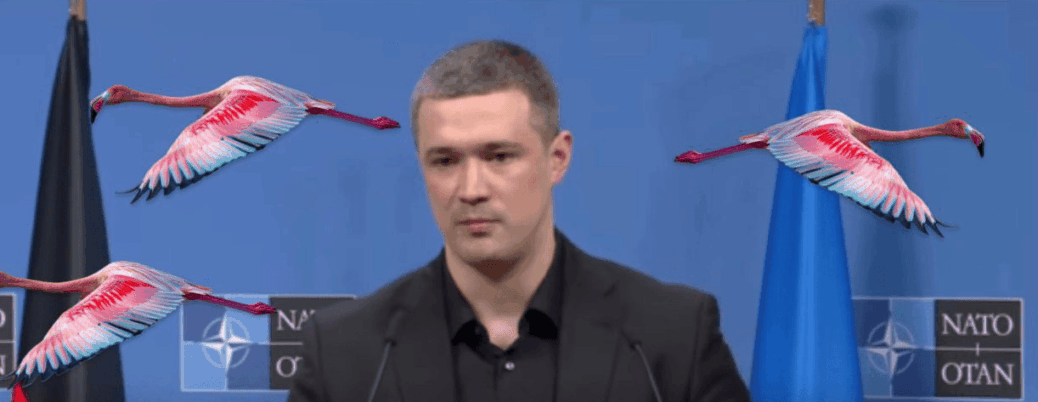
Ukraine’s Defense Forces remain critically under-equipped, yet Minister Fedorov plans to sell scarce drones abroad. This raises doubts about priorities, transparency, and the survival of the nation itself.
Instead of finally ensuring that the Armed Forces of Ukraine are properly equipped, Ukraine’s minister of defense has decided to sell weapons to interested countries. He stated this openly at Ramstein on February 12, 2026. This was reported by Kostiantyn Korsun.
At the same time, he noted that “the export of Ukrainian weapons is possible only after the needs of the Defense Forces are fully met.” Umm… so how exactly is that supposed to work?
I hope no one is questioning a simple and obvious fact: by the end of the fourth year of the full-scale invasion, the Ministry of Defense has still failed to provide the Armed Forces of Ukraine with everything they need — even though this is the sole purpose of the existence of such a massive ministry. Many brigades and battalions either cover their needs on their own or are critically dependent on fundraising and volunteers. Some supplies do come through the Ministry of Defense — but often they are “not what’s needed,” and in quantities far removed from real requirements. There are countless examples — just ask any military personnel you know what they think about “supplies from the Ministry of Defense.”
Okay, tanks, aircraft, and large-caliber ammunition are hardly something volunteers can purchase (although some even manage to obtain missiles). But our Western partners mostly sell (!) us aircraft and armored vehicles that are already morally outdated for their own armies. And even that is far from complete, and in critically insufficient quantities.
Meanwhile, they want from us the most modern systems — those that have proven themselves exceptionally well on the real battlefield. Even though this domestically produced equipment is exactly what we ourselves need the most. Simply to survive as a nation and as a country — here and now.
So what exactly is Mr. Mykhailo Fedorov planning to sell to these “partners”? The option of “giving away what we don’t need” won’t work — there are no fools there. Ninety years ago, the Soviets sold Ukrainian grain, which led to the Holodomor in Ukraine.
And now they are going to sell precisely what the Armed Forces of Ukraine critically lack?
And how does this align with the intention of “our army first, and only then for sale”? These are mutually exclusive things.
If our troops had surrounded the remnants of the aggressor’s army near Moscow — then fine. That would mean the Armed Forces of Ukraine are fully supplied with military equipment, and any surplus could be sold. But the situation at the front hardly suggests any significant successes, does it?
For some reason, three thousand “Flamingos” failed to cause a blackout in Moscow; thousands of interceptor drones are not stopping nightly air attacks; the “Army of Drones” and the “Wall of Drones” bearing Fedorov’s name have remained nothing more than advertising slogans.
Meanwhile, the real front critically lacks exactly the drones that Fedorov intends to sell abroad. Supposedly “to finance the development of production” — but this, too, raises serious doubts.
Look: effective UAVs are produced mainly by private manufacturers. Export licenses will be granted to an exclusively narrow circle of “Fedorov’s friends” — do you really doubt that? Then, when these “elite manufacturers” sell scarce drones abroad, will the foreign-currency revenue actually return to the country? And if it does — will all of it?
And even if it returns — won’t this money be stolen again, as has been happening in the Ministry of Defense for the past thirty years? It is far more likely that the money will end up in the pockets of officials than that it will reach the brigades fighting at the front.
It feels like, on this Titanic, some looters are very eager to quickly cash in — doing so almost legally and quite publicly.
At one time, Mykhailo Fedorov was extremely unhappy with the case when National Anti-Corruption Bureau of Ukraine arrested his protégé Yurii Shchyhol (then head of the State Service of Special Communications and Information Protection of Ukraine), who, as part of a group of officials, organized the theft of 600 million hryvnias — precisely during the procurement of drones for the Armed Forces of Ukraine. So has Fedorov now decided to legalize this scheme?
“Sell drones in order to produce drones — and then sell them again,” right? A perfectly fine way to make money.
Except that the problem is this: we are not talking about business here — we are talking about the survival of the country itself.
Moreover, over the past four years our Western partners have provided us with some truly astronomical sums and invested in weapons production — yet the notional “Flamingos” still fail to reach Moscow. So why would money from selling drones suddenly solve this problem now?
I don’t understand — please explain it to me.
When journalists asked, “What quantities of drones are we talking about for export?”, Mykhailo Fedorov replied: “This information will not be made public.” Well of course — who would tell you how much they plan to steal. The most convenient way to do this is in the dark, so everything will be classified to the maximum, no doubt about it.
The arms trade has always been a secretive feeding trough for political elites in Ukraine. But when some are raking in money while others freeze, sit without electricity, lose their homes, and die at the front and in the rear — this has never happened in Ukraine’s history before.
This is some fundamentally new level of cynicism from the ruling team.
Tags: defense policy Ukraine drone exports debate global security analysis military strategy U.S. defense news ukraine war Ukrainian industry






![Visitors at the “Thank You With All My Heart” Ukrainian exhibition at the Council of Europe, featuring the Great Amber Heart and powerful war art. :contentReference[oaicite:2]{index=2}](https://empr.media/wp-content/uploads/2026/02/heart-300x171.png)


![Ukrainian Roboneers and Latvian partners at the signing of a defence robotics and underwater technology cooperation memorandum. :contentReference[oaicite:2]{index=2}](https://empr.media/wp-content/uploads/2026/02/oboronka-300x168.png)