Andriy Klymenko on Radio NV: Ukraine’s drone strike crippling Caspian oil and gas production exposes Russia’s vulnerability, targets shadow fleets, reshapes energy warfare, and signals a new strategic standard for Europe.
Andriy Klymenko, editor-in-chief of BlackSeaNews, on Radio NV about the Security Service of Ukraine’s drones that halted oil and gas production in the Caspian Sea, how such an event can be assessed, why this particular field was chosen, which oil facilities should be targeted, the scale of losses Russia is expected to face, the significance of hitting Russian tankers of the shadow fleet, the example Ukraine is setting for Europe, and whether this could create any issues with our partners.
Bohdan Mashay: Good afternoon, friends. My name is Bohdan Mashay, and today we will talk about the events of the past weeks in the Black Sea area, and now, starting from today, there is reason to discuss events in the Caspian Sea area as well.
There are overall certain signs indicating that the naval war is entering a new phase of escalation. To understand what this could lead to, I am joined on our broadcast by Andriy Klymenko, editor-in-chief of BlackSeaNews.
Mr. Klymenko, good afternoon.
Andriy Klymenko: Good afternoon.
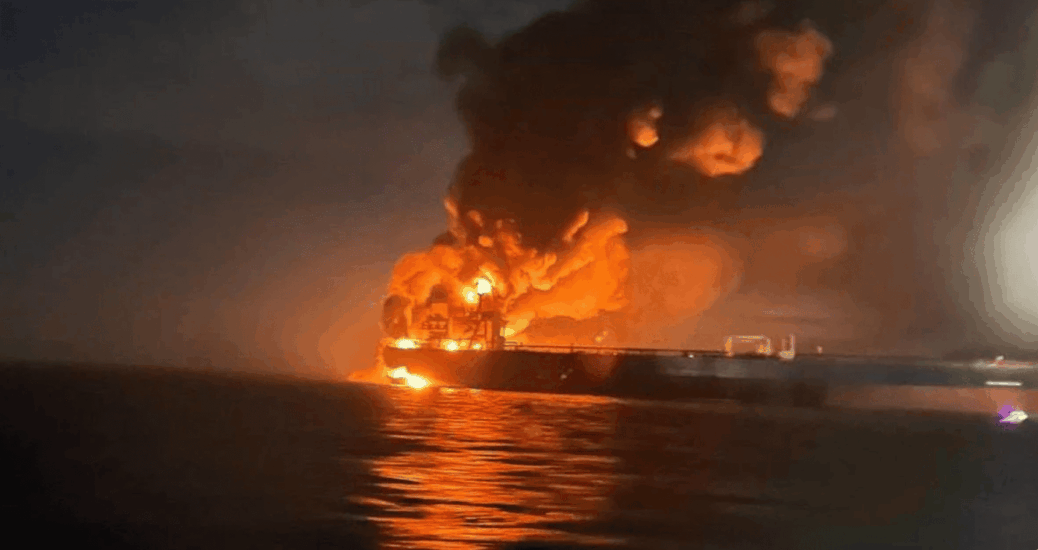
Bohdan Mashay: I would like to start our conversation with something topical. Today it became known that drones from the Security Service of Ukraine struck a Russian oil platform in the Caspian Sea. At least four hits were recorded there. As a result of the attack, oil and gas production from more than 20 wells was halted, according to the Security Service of Ukraine.
The affected site was the Filanovskyy field — one of the most explored in the Russian Federation and in the Russian sector of the Caspian. Its reserves are estimated at 129 million tons of oil and 30 billion cubic meters of gas. Mr. Klymenko, how do you assess the significance of this event?
Andriy Klymenko: This event was expected. The morning was a good one after we heard all this, of course. And what can I say — we want more, and we will hope that there will be more of everything connected to Russian oil and its transportation by sea.
Bohdan Mashay: Why do you think this particular field was chosen as the target? Because of its scale, or perhaps other factors played a role? What significance does this field generally have for Russia’s energy sector?
Andriy Klymenko: I don’t think it’s crucial. In this sense, most likely the main point is the demonstrative effect. And I would say that this demonstrative effect, believe me, is already there, and it is already spreading around the world. Dozens and hundreds of experts and commentators are making reports, all expressing their assumptions — let them express them.
Ukraine is showing the whole world that it has the cards.
Besides, you understand: it’s difficult to strike a seaport. Why? Because a seaport is a very large area. Look how many months and years the Russian Federation has been trying to destroy our Black Sea ports. In November — if earlier they attacked Odesa, Chornomorsk, and Yuzhny from the air once every three days with missiles and drones — in November it was almost every day. And the ports are still functioning.
Moreover, in October we had a record: 266 ships arrived with cargo and departed with cargo from the ports of Odesa. Why? Because a port — well, we once looked at Russia’s oil ports in the Baltic — they cover from 5 to 10 square kilometers. To put such a port out of operation, you need dozens of missiles.
Here we are dealing with an oil platform — it’s a small object, essentially a large ship standing still. Theoretically, disabling it is much easier than disabling a port. It’s hard to say what exactly our military considered when planning this attack, but I think this was taken into account as well.
Bohdan Mashay: In your opinion, what scale of damage can Ukraine inflict on the Russian Federation if the geography of strikes on such small platforms in different seas continues to expand?
Andriy Klymenko: Russia doesn’t have that many such platforms. There are some in the Arctic. This, I would say, is an exceptional case. As we know, Russia extracts its oil mainly beyond the Urals, so it’s much more complicated.
I’ll say it again: this is a demonstrative effect.
And with all this, it’s very hard — I honestly first reacted with irony, then I started laughing — when foreign journalists, colleagues from huge analytical agencies, start calculating how “Russia will lose this amount” of revenue. They simply haven’t read the Russian Tax Code. The Russian budget receives money from oil production even before that oil is sold.
The main source of revenue for the Russian budget is not the profit a company makes from selling oil — it is the mineral extraction tax. It’s calculated using a special formula, which takes into account oil prices and various coefficients. This formula has been classified for four years now. So when they convert it into “the price was 60 dollars per barrel, and now it’s 48,” that’s all nonsense. They will receive whatever the government tells them to receive. And the government — actually the president of the Russian Federation — does not care if oil companies “under-earn” something. Because these are their companies, even if they are privately owned. So they’re calculating it from the wrong angle.
But we understand that profits from oil exports make up the largest part of Russia’s foreign currency earnings — according to our estimates, energy resources account for about 60%. But this money does not return to the Russian state budget. The money paid to them stays in foreign accounts. With these funds, Russian intelligence services purchase everything needed for the defense industry and the Russian army. Everything bought with this money, from these accounts, via shell companies — this is the so‑called parallel import of sanctioned goods for the Russian defense sector, which then gets delivered to Russia’s defense industry through China, Kazakhstan, and other friends of Putin. This is how it works.
So all channels for exporting Russia’s energy resources must be disrupted as much as possible.
Bohdan Mashay: If, in your opinion, the key effect of this attack was meant to be demonstrative, then besides showing the capability to carry out such a strike, what else did Ukraine want to demonstrate with it?
Andriy Klymenko: Well, I want to immediately emphasize that I am expressing only my own opinion.
Bohdan Mashay: Yes, of course.
Andriy Klymenko: Look. The three tankers that were hit in recent days — they were not only under sanctions, they were mostly under European Union and UK sanctions. They were also without flags, meaning either with fake flags — which is essentially the same thing.
What does this mean? This is not random. The point is that for at least a year, Ukrainian diplomacy, together with EU diplomacy, has been working very strongly to pressure the so‑called “flags of convenience” countries. These are several African countries and a few island nations where it is easy to register a ship.
And this pressure consisted of requiring, gently but firmly, that if a tanker is on the sanctions list, and it is registered in that country’s registry, they must remove it. Otherwise, their relations with the European Union will be damaged. And this led to a wave of deregistration of these tankers on the sanctions lists. They are stripped of their registration — which automatically means they are stripped of their flag. To make it clear, it is like a car without license plates, without state registration. And, of course, without insurance, because no insurance company will cover an unregistered “iron object.”
So what do they do? They “run” to another flag-of-convenience country, and this continues. We can see that over the past year there are “champions” that changed flags four to five times. And there’s no need to go to Gambia or Malawi — legal firms handle this online for a relatively small fee in just a few days. But the next country also comes under pressure, and eventually it also strips them of registration.
As a result, they get fed up with it. On every ship, there is a large cabinet with flags of all countries — they just take any flag, hoist it on the mast, and declare, “This is our flag.” But it’s still as if there is no flag.
So, such ships… and here’s the point: in November of this year in the Baltic Sea, there were five tankers with unknown flags that we recorded, and nine tankers with fake flags. That makes a total of 14. This accounted for over 16% of all tankers, which numbered 86 last month.
So, 16% of the oil was transported this way. In other words, those 14 tankers out of 86 passed without any obstacles through the Danish straits into the Baltic Sea, loaded oil in Russian ports, and exited without any interference. And no one questioned them, even though they should have.
As for the Black Sea, the situation is roughly the same. Out of 34 crude‑oil tankers — only crude, not oil products — that we recorded in November, four had unknown flags and two had fake ones. That is 12%.
And Turkey, which considers itself a major maritime power — and indeed, Turks are strong sailors, and indeed, more than 40% of the ships arriving at the Odesa ports belong to Turkish companies, the largest share — they did not stop them. Why?
And this is exactly why the Turkish reaction to the attacks on these vessels in Turkey’s exclusive economic zone has been rather restrained. They understand that, pardon me, they themselves are implicated, because they should have detained these ships, turned them around, not allowed them in. Because they are uninsured, unregistered, without flags or with fake flags — yet they passed through Turkish straits, where Turkey is “king and god.” That’s their problem: whether there were bribes or something else — let them sort it out.
And in fact, Ukraine’s defense forces (and I don’t think that only the SBU was involved — in fact, I know it wasn’t only the SBU; this was a complex operation, and credit to everyone who took part in it) — they showed the Baltic states: “You are doing nothing, and it’s becoming ridiculous. Here is what should be done with unregistered tankers.” It is a signal of dissatisfaction.
Last month, in November — and starting roughly from August — 34–38% of oil in the Baltic Sea is being transported by tankers that are on sanctions lists. And this percentage is increasing every month. Our European friends — without whom we would long ago be “partisans in the Carpathians” — report to the world: “We have sanctioned another 100 tankers; now we have almost 600 on the list.” So what? Sanction another 100, another 100. Then the percentage of ships you let pass without obstacles through your straits will not be 38.8%, as it was in October, but 49, then 60. And then what?
So we are showing that sanctioned ships must be dealt with properly.
Bohdan Mashay: After the first two tankers were hit by Ukrainian UCAVs in the Black Sea on November 29, you wrote: “We still don’t know, and we can hardly guess, what the recent high-profile events in the Black Sea mean: attacks on empty tankers without flags and registration, damage to the external loading facility of the CPC…”
Andriy Klymenko: The Caspian Pipeline Consortium.
Bohdan Mashay: Ah, you mean the consortium here. “Is this a strategy? Is this a tactic? Or…?” Please tell us, after today’s strike on the platform we began our discussion with, and after another attack on a tanker — has it become clearer to you what this is?
Andriy Klymenko: Of course, this is a strategy. Where there is strategy, there is also tactics. We are showing that we have the means, we have the capabilities. Despite the way sharks fight behind the glass in an aquarium, while mothers with children walk by and say, “Look at that monster!” — that’s how Putin fights and threatens the whole world — we are showing that he can do nothing, because he lacks the capabilities at sea to prevent it.
Bohdan Mashay: In your opinion, what risks does Ukraine face with this strategy? After all, the Caspian is not Russia’s internal sea, but a complex region where the interests of Kazakhstan, Azerbaijan, Iran, Turkmenistan, and some Western energy companies intersect. Could we face diplomatic problems due to dissatisfaction, particularly from those countries where, as you said, “they themselves are implicated”?
Andriy Klymenko: You know, I think we don’t care about all that. I really liked the comment from the Foreign Ministry spokesperson when the Kazakhs started hinting that this was an “international project, the Caspian Pipeline Consortium.” The Foreign Ministry didn’t say it was us. The Foreign Ministry said: “We expected from Kazakhstan, which is supposedly a friendly country, that they would at least express condolences — because a day or two before that there was a huge missile strike on Ternopil, where more than 30 people were killed, and they stayed silent. So what do they want?”
So the context is being set that we are entering a tough phase of the war, and we are demonstrating that we are not going to play diplomatic games, that we are taking a hard line and have the resources to maintain that hard line.
As for Kazakhstan — there is an interesting nuance that is not widely discussed. The fact is that in Kazakh oil, which goes through the port of Novorossiysk via the Black Sea and is not subject to embargoes unlike Russian oil, there is a share belonging to Lukoil, which is now under U.S. sanctions that everyone fears. Within the Caspian Pipeline Consortium itself, along with the British and Americans, there are Rosneft and Lukoil among the shareholders.
So it’s a huge question: is the Caspian Pipeline Consortium oil now free from sanctions? I believe that after October 20 of this year — it is under U.S. sanctions.
Bohdan Mashay: In the post I quoted, you wrote at the end: “Thus, the war in the Black Sea is once again becoming an active factor in world politics.” Why do you think so, considering that in the Black Sea, Ukraine is not just an observer, but essentially an actor? In your opinion, what benefits can we gain from this new phase?
Andriy Klymenko: Well, let’s put it this way. What can this new phase be? First, Russia is trying to scale up the production of maritime drones. Those who remember: almost a year ago, when Musk shut down Starlink, several of our first drone models — not the ones now — were navigating at sea, lost control, and ended up on the coast of occupied Crimea. They disassembled them, copied them, and now produce them. And I have a feeling that it was exactly such a Russian copy that the Romanian Navy destroyed a few days ago near Constanța. We know of at least two successful instances of combat use of these drones.
Bohdan Mashay: Excuse me for interrupting, only a few minutes remain.
Andriy Klymenko: So what awaits us — I can’t say exactly when, but in the near future — is a drone war in the Black Sea. That’s first.
And, of course, as a tool, the Black Sea is very strategic — it is a “window to the world” for exporting Russian grain, coal, mineral fertilizers, sulfur, and so on. We are showing that we have the means to stop not only Russian oil exports, but also these other exports.
Bohdan Mashay: Thank you for your time. Andriy Klymenko, editor-in-chief of BlackSeaNews, was speaking to Radio NV. The special broadcast continues.
Tags: economic impact fuel infrastructure military intelligence russia - ukraine war Russian economy Strategic Strike tanker attack ukraine war