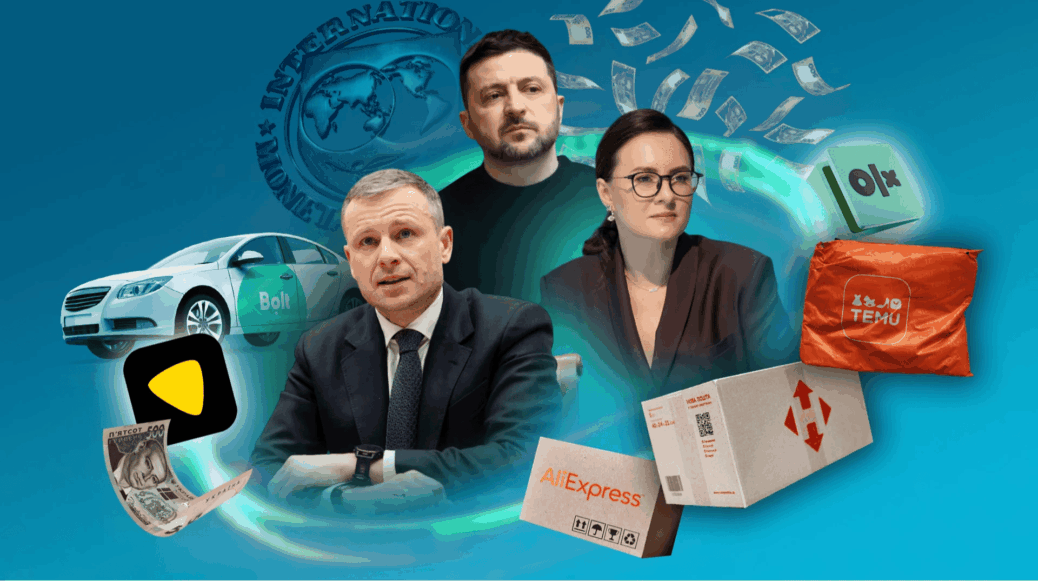
Ukraine’s “One Big Tax Law” proposes taxing digital platforms, abolishing parcel exemptions, fixing military tax, and introducing VAT for FOPs, raising UAH 60 billion and securing IMF funding.
On March 19, the Ministry of Finance website published a draft law that was dubbed “One Big Tax Law” even before it was fully developed. The document contains the key tax obligations Ukraine has undertaken under its program with the International Monetary Fund (IMF). The IMF mission is currently working in Kyiv.
This was reported by Ekonomichna Pravda.
According to the memorandum, all tax changes are supposed to be adopted by the end of March. However, it is likely that Yuliia Svyrydenko’s Cabinet will aim for June, when the program review will take place and a decision on granting the second tranche will be made.
Despite this, the chances of the law being passed are slim: MPs consistently refuse to vote for unpopular tax hikes, especially when the government keeps introducing new measures for cashbacks and social benefits.
What does the draft law propose, and how much fuel cashback could be funded by the additional revenue from higher taxes?
What’s in the document
The Ministry of Finance draft law contains four key tax requirements included in the IMF memorandum:
- Introduction of taxation for digital platforms (the so-called OLX tax);
- Cancellation of the duty-free allowance for parcels worth up to €150;
- Fixing the military tax rate for individuals at 5% and requiring its mandatory payment by “simplified system” taxpayers even after martial law ends;
- Introduction of mandatory VAT payment for simplified system taxpayers with annual income exceeding UAH 4 million.
The Cabinet will submit the corresponding changes to the Verkhovna Rada for a second time. The first attempt was at the beginning of 2026. At that time, the government’s plan was for MPs to vote in the first reading on the draft law introducing taxation for digital platforms, and by the second reading, amendments were to be added regarding the cancellation of the duty-free allowance for international parcels and the “permanent” military tax.
The government had planned to introduce VAT for individual entrepreneurs (FOPs) as a separate draft law, since at that time the IMF only required the registration of the corresponding changes in parliament.
However, this attempt failed: MPs did not pass the draft law, so the government had to develop a new document. Moreover, the IMF’s requirements have now changed from those set at the beginning of the year.
To still provide Ukraine with a new loan, the IMF refused to make the adoption of tax changes a mandatory precondition of the program. All of them were “shifted” into structural benchmarks. Furthermore, whereas previously the IMF’s only requirement was the registration of the draft law introducing VAT for FOPs, it now demands that the authorities adopt these changes together with other tax initiatives by the end of March.
The total IMF loan amounts to $8.1 billion. Although this is only enough to service loans the government took from the Fund in previous years, the program is critically important for the country’s financial survival.
Having an IMF program is also a condition set by other international partners for providing funding. In particular, without the Fund’s program, Ukraine would not be able to receive a €90 billion loan from the EU, even if it manages to bypass Hungary’s veto.
Adopting tax changes is important for Ukraine as well. They are intended to close “white spots” in tax legislation and combat tax evasion schemes (splitting large businesses into FOPs, using FOPs instead of hiring employees) and goods smuggling (by splitting large shipments into small parcels from abroad).
Ukraine would need to adopt these changes even as part of European integration. The Ministry of Finance draft law is set to implement three EU directives into Ukrainian legislation: 2021/514/EU, 2006/112/EU, and 2006/79/EU.
OLX Tax
The first part of the draft law concerns the taxation of income earned from digital platforms such as Bolt, Uber, Uklon, Glovo, OnlyFans, and OLX.
Although “taxation of income from digital platforms” may sound like a new tax is being introduced, this is not the case. Under the law, all citizens are required to declare their income and pay taxes on it. The exception is income received from a tax agent (an employer or a bank in the form of interest on a deposit).
In other words, current legislation already requires all citizens who earn extra money as Uklon drivers or sell goods through OLX to declare such income and pay 18% personal income tax (PIT) and a 5% military tax.
But no one currently does this, largely because the State Tax Service does not have data on Ukrainians’ earnings from digital platforms. The draft law aims to change this.
Specifically, the document introduces a simplified taxation system for income from digital platforms. Individuals earning through these platforms will need to open special bank accounts to receive their platform income. The tax authorities will have access to information on these accounts, and the digital platforms will report Ukrainians’ earnings to them.
The draft law also introduces a reduced personal income tax rate for income from digital platforms: 5% instead of 18%. Together with the military tax, earnings from Bolt, Uber, Uklon, or Glovo will be taxed at 10%. The platforms themselves will handle administration, acting as tax agents. Individuals will no longer need to file a tax declaration (which is currently required).
Special tax rules will not apply to individuals who have an active FOP; are subject to sanctions; have hired employees; sell excise goods; or do not have a special bank account accessible to the tax authorities.
The maximum annual income from digital platforms that can be taxed under the preferential conditions is 834 minimum wages per year (about UAH 7.2 million). Income above this limit will be taxed at the full rate (23%).
At the same time, an exception is made for individuals selling goods through digital platforms (for example, via OLX): they will not need to open a special account or pay taxes if their total sales income does not exceed the equivalent of €2,000 per year.
When FOPs Will Pay VAT
One of the most controversial tax changes is the introduction of VAT for simplified taxation system entities. Currently, this tax can be paid by third-group “simplified system” taxpayers voluntarily, with a reduction of the single tax rate from 5% to 3%.
The changes proposed by the Ministry of Finance stipulate that the obligation to become a VAT payer will apply to all “simplified system” taxpayers with annual income exceeding UAH 4 million.
According to the initiative’s authors, this requirement is part of Ukraine’s European integration obligations, specifically harmonizing domestic VAT legislation with EU rules. In the EU, entrepreneurs with an annual turnover exceeding €85,000 (about UAH 4.33 million) are required to register for VAT.
Despite this, the initiative to extend VAT to the simplified taxation system has been strongly criticized by both entrepreneurs and tax experts. The main concern is that the VAT administration system in Ukraine is extremely complex and burdensome, requiring significant effort and additional paperwork.
Any mistakes in handling VAT can cost the taxpayer at minimum the inability to reclaim a tax credit, and at worst, the blocking of invoices and being placed on a “blacklist.”
To ease the new rules for small businesses, the government is offering a number of concessions for FOPs. In particular, it is extending their tax reporting period from one to three months. Additionally, for the first five violations made in VAT administration during the initiative’s first year, FOPs will be fined only UAH 1.
According to calculations by acting head of the State Tax Service Lesia Karnaukh, the introduction of VAT will affect about 252,000 of the 2.1 million FOPs. Despite complicating life for this category of small businesses, the government expects that implementing this measure will help combat tax evasion schemes.
“According to our estimates, approximately 30% of businesses under the simplified taxation system use business-splitting schemes,” Karnaukh said.
The key question is when the changes will take effect. In agreements with the IMF, the date of January 1, 2027, was mentioned. On the eve of this, Forbes reported that the Ukrainian side had managed to negotiate with the Fund to postpone the introduction of VAT for FOPs either to 2028, or to one year after the end of martial law, or until the moment Ukraine joins the EU.
At the same time, the draft law published by the Ministry of Finance does not reflect these agreements. The effective date of the changes is January 1, 2027. However, this does not mean the date is final or that MPs will not try to change it. Not only will FOPs struggle to prepare for the new operating conditions, but the tax authorities themselves will likely face a significant increase in workload.
The “Permanent” Military Tax
The third part of the draft law concerns the military tax. It was introduced in 2014 and was initially levied only on individuals’ income at a rate of 1.5%.
After the start of the full-scale war, the Verkhovna Rada increased the military tax rate to 5% and extended it to FOPs in the first, second, and fourth groups at 10% of the minimum wage per month (currently UAH 864.7), while for the third group it was set at 1% of income. These rules were supposed to remain in effect only until the end of martial law.
The Ministry of Finance draft law proposes to make them permanent.
“The continuation of the obligation to pay the military tax at the current rates, which were introduced as temporary for the period of martial law in Ukraine, is justified by the need to provide sufficient resources for defense and the country’s post-war reconstruction,” the explanatory note to the draft law states.
Abolition of Parcel Tax Exemptions
The final part of the draft law provides for the cancellation of the duty-free and tax-free allowance for international parcels. Currently, VAT (20%) and customs duties (usually around 10%) are not charged on parcels valued at up to €150.
This exemption has been one of the drivers behind the growing popularity of Chinese marketplaces like AliExpress and Temu. At the same time, domestic businesses have opposed it, as they are required to charge VAT even on low-cost goods, unlike Chinese suppliers.
The government justifies the need to cancel this exemption by citing the implementation of EU directives and the fight against smuggling. In particular, customs and tax authorities have previously uncovered cases where large shipments were split into hundreds or thousands of individual parcels. This allowed goods to enter Ukraine without proper accounting or tax payment and be sold on the black market.
The Ministry of Finance draft law abolishes the exemption and places the responsibility for calculating and paying VAT on the marketplaces where the parcels were purchased.
At the same time, it introduces an exception: Ukrainians will be able to receive parcels without VAT or customs duties if they are sent from abroad by other individuals free of charge (for example, items sent by relatives). The value of such parcels must not exceed €45.
Raising Taxes to Fund Zelenskyy’s Three “Thousand” Payments
The cancellation of parcel tax exemptions, the taxation of income from digital platforms, and the introduction of VAT for a quarter of a million FOPs — what the Ministry of Finance calls a “killer” measure — are expected to bring UAH 60 billion to the budget per year. But is that a lot?
For example, this amount could fund the winter “eSupport” payments three times over (this year, they cost the budget about UAH 17.8 billion). Alternatively, it would be enough to finance the fuel cashback program for 15 months (according to the Ministry of Finance, one month of this cashback costs UAH 4 billion).
However, these tax changes also have an immediate effect: they will allow Ukraine to continue cooperating with the IMF and receive critically needed funding from international partners — funding that covers half of the state’s expenditures, including defense.
At the same time, the government continues to spend this funding on cashback payments, for which citizens and businesses ultimately pay through higher taxes.
Tags: digital income tax Economic policy FOP taxation global finance news IMF program Ukraine Ukraine tax reform VAT changes