
Ukraine is preparing cities for all-round defence, strengthening fortifications, protecting logistics routes and maintaining defensive lines as essential long-term measures against potential Russian threats.
All-round defence of cities is intended to strengthen Ukraine’s protection against a possible Russian offensive. Such defence is planned in advance, as fortifications take time to build.
President Volodymyr Zelenskyy has enacted a classified decision of the National Security and Defence Council of Ukraine on the construction of engineering barriers to protect Ukrainian cities. The document provides for the preparation of an all-round defence system, but the list of settlements, funding allocations and deadlines for the work remain undisclosed.
Glavred has examined what all-round defence of cities entails, how fortifications are constructed, and whether the new decision indicates a threat of a large-scale Russian offensive.
What the Classified NSDC Decision on the Defence of Ukrainian Cities Entails
On October 26, 2026, President Volodymyr Zelenskyy signed Decree No. 1067/2026, enacting a National Security and Defence Council of Ukraine (NSDC) decision dated September 25 on the construction of a line of engineering barriers to ensure the proper protection of settlements. The document entered into force on the day of its publication.

The decision is titled “On Measures to Develop a Line of Engineering Barriers to Ensure an Adequate Level of Defence for Cities and Mechanisms for Their Implementation (All-Round Defence of Cities).” However, the full text of the document is classified as “For Official Use Only,” so the specific measures envisaged to implement the plan remain unknown.
No information is publicly available on which cities are to be fortified, the amount of funding allocated, or the deadlines for completing the work. Oversight of the implementation of the decision has been assigned to the Secretary of the National Security and Defence Council of Ukraine.

What Is All-Round Defence of a City and How Does It Work?
All-round defence involves preparing a city for a situation in which the enemy attempts to bypass it from several directions and threaten to encircle it. Military expert Oleh Zhdanov explained in a comment to TSN.ua that Ukraine had already faced similar situations at the beginning of Russia’s full-scale invasion, when Russian forces attempted to isolate major population centres.
According to the expert, Sumy, Chernihiv and, to some extent, Kharkiv were examples of such situations. Preparing for all-round defence involves not only establishing defensive positions but also creating conditions for military units to hold a city for an extended period.
“All-round defence is when a city is under siege, when enemy forces have bypassed it from all sides. We had Sumy and Chernihiv, and partly Kharkiv. These cities were almost encircled, or at least partially encircled,” Zhdanov explained.
The expert also emphasised the need to ensure supplies for military personnel and civilian infrastructure in the event of a possible blockade. In his assessment, a city must be able to function for an extended period even if its usual supply routes are disrupted. This requires stockpiles of food, water, ammunition and medicines, as well as facilities to accommodate personnel and provide medical care.
“This means building up material and technical reserves and military stockpiles, ensuring there is ammunition, food, water and medicine, and establishing a base where medical facilities can be set up if necessary. There must be shelters for personnel, the wounded and the staff who will maintain all of this. These measures are enormous in scale and costly,” he stressed.
Is Russia Preparing a New Large-Scale Offensive Against Ukrainian Cities?
Military expert Oleh Zhdanov believes that publicly available intelligence does not indicate that Russia is preparing a new deep breakthrough into Ukrainian territory. In his view, this raises questions about the appropriateness of applying the same defensive measures to all settlements.
“At present, there is no threat of an invasion by Russian forces, let alone a deep breakthrough,” the expert said.
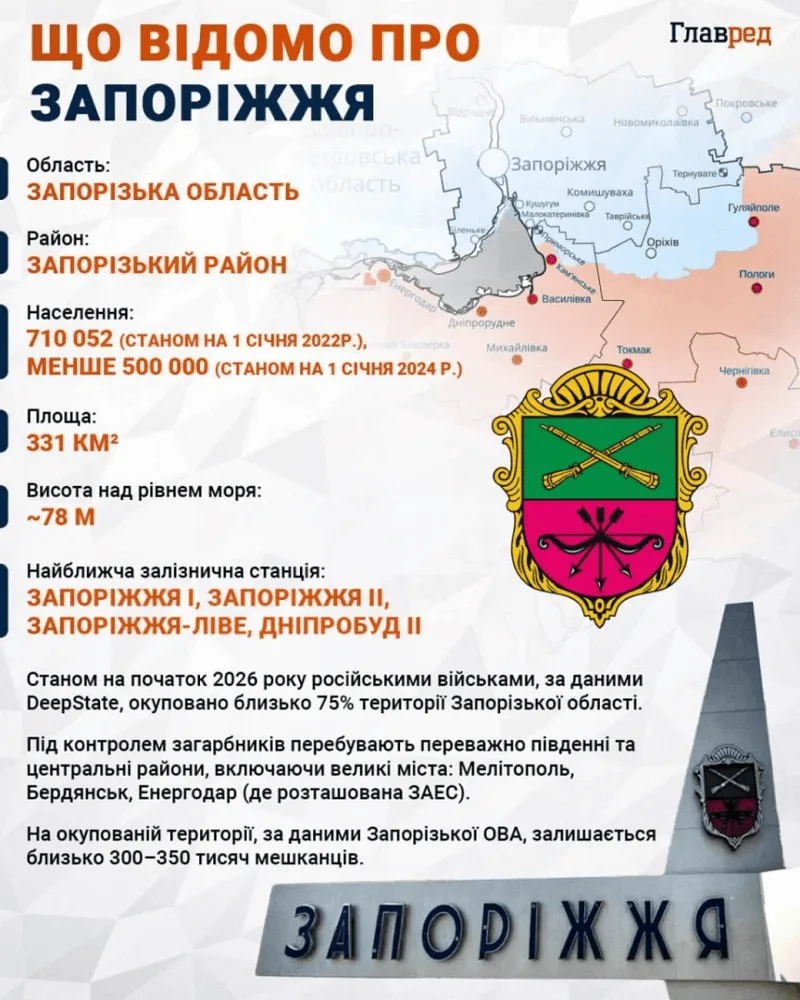
At the same time, Zhdanov acknowledges that enhanced preparations may be justified for certain frontline cities, particularly Zaporizhzhia and Kherson. However, the potential threats to these cities differ depending on their geographical location and the capabilities of the Russian army.
“I understand that frontline cities can be prepared for defence, possibly all-round defence. Zaporizhzhia is the closest to the front, along with Kherson, but there is a river there, and crossing it does not currently pose a direct threat,” Zhdanov explained.

The expert also assessed the risks facing Odesa. In his view, Russia currently lacks the capacity to conduct an amphibious landing operation, while an airborne assault is also unlikely. Zhdanov emphasised that the conditions of warfare have changed significantly since the beginning of the full-scale invasion.
“We know that Russia no longer has a landing fleet capable of deploying an amphibious assault. Nor can it carry out airborne landings or enter our airspace — this is no longer 2022,” he noted.
As an example of a capital’s preparations for defence, Zhdanov cited Kyiv in 2022. At the time, several lines of fortifications were established around the city, but some of these structures were later dismantled. According to the expert, the current situation does not indicate an imminent threat of the capital being captured.
“I remember the summer of 2022 — Kyiv was fully prepared for all-round defence. We had several rows of trenches dug along the ring road; everything had been excavated. Then all of it was quietly dismantled,” Zhdanov said.
Are the Costs of All-Round Defence for All Cities Justified?
Oleh Zhdanov questioned the wisdom of allocating substantial funds to large-scale engineering works without taking the army’s current needs into account. In his view, establishing a comprehensive defence system for many cities would require significant financial resources, which must be weighed against the needs of units on the front line.
The expert stressed that setting priorities requires taking into account the situation at the front and the military’s need for ammunition and weapons. He does not dispute the need for defensive structures but raises the question of how funding for different areas should be prioritised.
“Enormous sums will now be allocated for engineering fortifications, followed by purchases of the necessary equipment and materials. But perhaps what is needed today is to buy weapons and ammunition for the army carrying out defensive operations along the front line?” the expert said.
Why Is Ukraine Building Defensive Lines in the Absence of an Immediate Threat?
Oleksandr Kovalenko, a military and political analyst with the Information Resistance group, believes that fortifying Ukrainian cities does not necessarily indicate that Russia is preparing for a new offensive. According to him, engineering works in various regions may be part of long-term planning that enables Ukraine to respond to changes at the front without losing time.
“Ukraine is entering its fifth consecutive year of full-scale war, and it is extremely important for us to act not so much in response to the situation and events as they unfold, but proactively. What we are now seeing in a number of cities is precisely this kind of pre-emptive action,” Kovalenko explained.
The analyst also highlighted a shift in approaches to building defensive lines. Whereas previously considerable attention was focused on individual strongpoints, extended engineering barriers now play an important role in making it more difficult for enemy military vehicles and infantry to advance.
Kovalenko cited anti-tank ditches, barbed wire, specialised obstacles and concrete anti-tank blocks among these structures. Combining these elements is intended to impede the advance of Russian units and create additional difficulties for organising offensive operations.
“Multi-kilometre anti-tank ditches are now being dug, with concertina razor wire laid in front of, behind and alongside them, while tangled wire obstacles are installed and concrete anti-tank blocks (dragon’s teeth) are put in place. This is a combined barrier system designed to impede both enemy vehicles and infantry,” Kovalenko noted.
Why Are Fortifications Needed 40–50 Kilometres From the Front Line?
Oleksandr Kovalenko stresses that defence preparations should cover not only the immediate line of contact. In his view, areas within 40–50 kilometres of the front line should be considered at risk, making engineering preparations essential.
This involves more than just building fortifications. The analyst also emphasises the need to protect logistics routes, particularly roads used to transport military supplies and support the operations of military units. Additional passive protection measures, including specialised nets, can make it more difficult for Russian drones to strike these targets.
According to Kovalenko, combining engineering barriers, logistics protection and advance planning should limit the enemy’s ability to advance through prepared areas.
“In addition, regions and cities located near the line of contact should consider at least the area within 40–50 kilometres of the line itself to be a risk zone. The construction of fortifications in these areas should be mandatory. This involves not only building engineering structures but also ensuring at least passive protection for logistics routes along highways and lateral roads by installing protective nets,” the analyst noted.
Why Do Defensive Structures Need Regular Repairs?
The presence of active work on defensive lines does not always indicate a new military threat. Oleksandr Kovalenko explains that some of the work may involve maintaining existing fortifications after seasonal rainfall and other natural impacts. Fortifications require regular inspections, repairs and adaptation to local terrain conditions.
According to the analyst, rain and snowfall can damage various elements of defensive lines: anti-tank ditches fill with water, obstacles become submerged in mud, and concrete anti-tank blocks may sink into the ground. In addition, changes in the methods of warfare mean that previously established positions must be reassessed.
“Any defensive line requires maintenance, repairs and additional work after the rainy or snowy season. The same anti-tank ditches fill with water, concertina wire sinks into the mud, concrete anti-tank blocks sink into the ground, and so on. No defensive line or fortification is built on the principle of ‘build it and forget about it’; it requires constant maintenance,” Kovalenko explained.
The analyst believes that regular maintenance of fortifications should become an integral part of the security system for Ukrainian cities. In his view, what should cause concern is not the presence of defensive structures itself, but their absence or state of disrepair.
“Over the coming decades, the idea that defensive lines are an essential and permanent feature of most cities across the country must become deeply rooted in Ukrainian society. Unfortunately, firing positions, concrete anti-tank blocks, concertina wire and anti-tank ditches are becoming an integral part of our lives, just like flower beds and paved streets. What should cause concern is not their presence, but rather their absence — especially when the Russian or Belarusian border is just 30 kilometres away,” Oleksandr Kovalenko concluded.