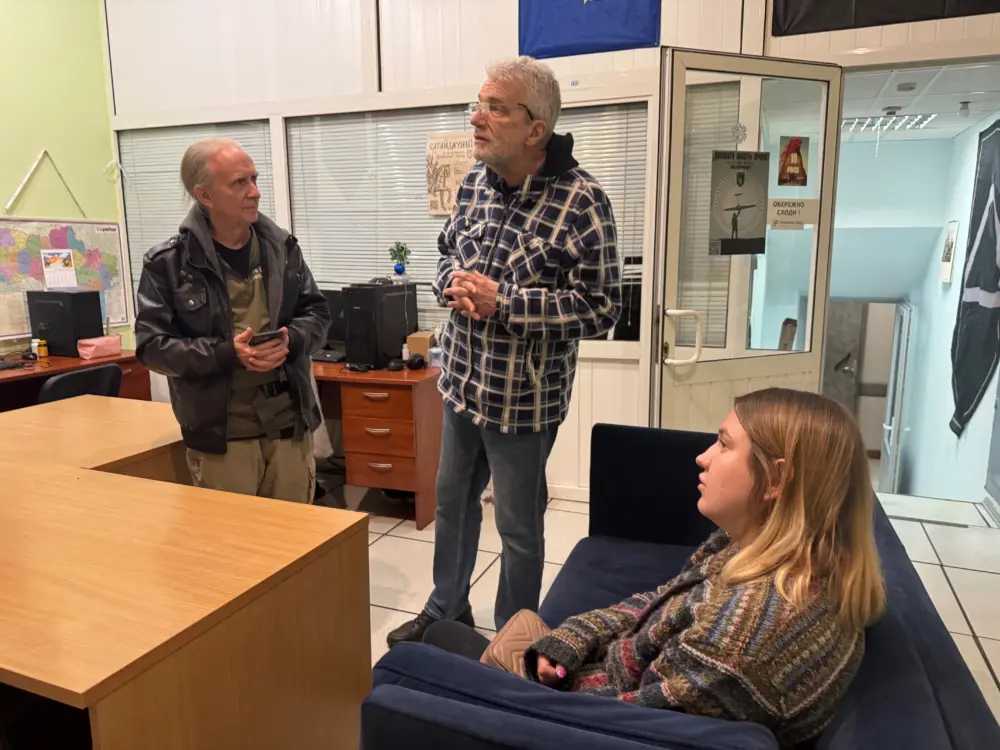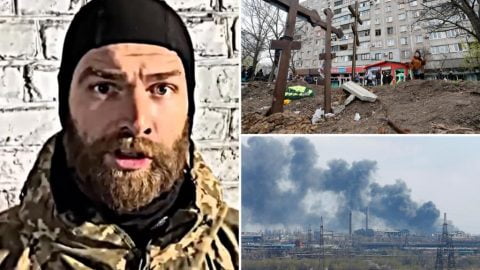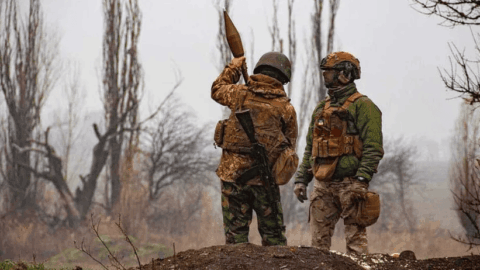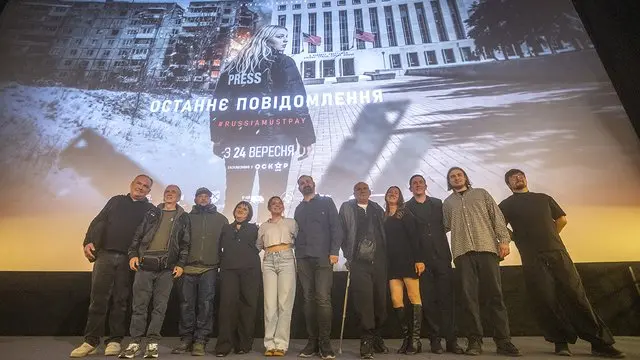

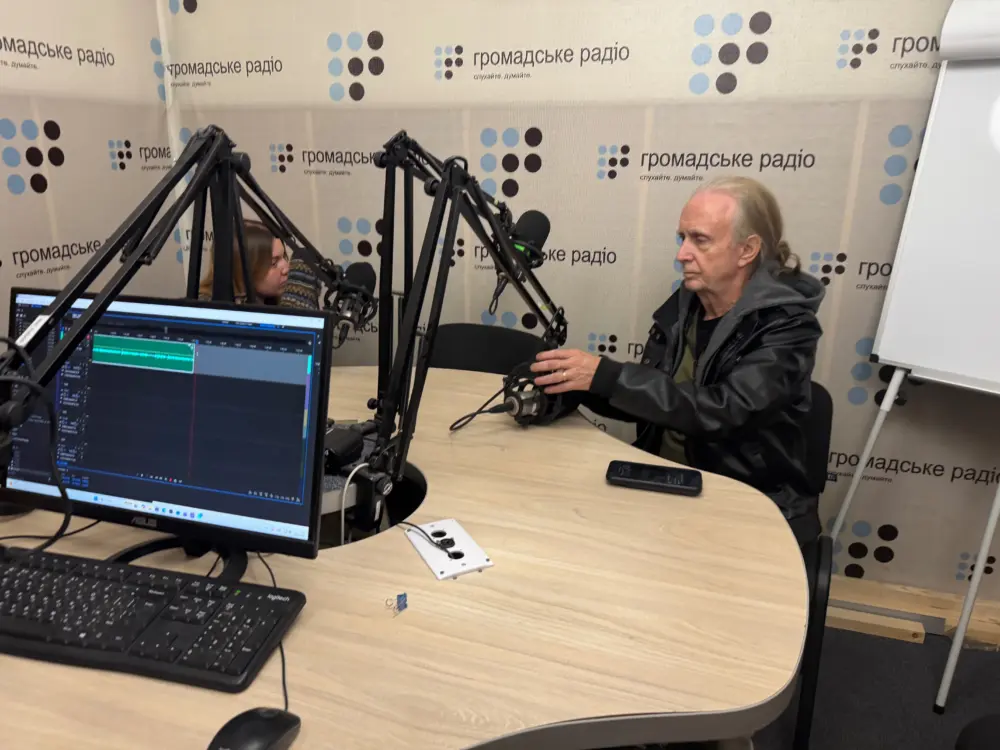
The Last Message Documentary interview by Andriy Kulykov, a prominent Ukrainian journalist, radio and television presenter, media expert with American – Ukrainian singer and activist Kelsie Kimberlin and filmmakers. Discussion exploring Ukraine’s war, personal loss, frontline experiences, and efforts to bring Ukrainian stories to international audiences.
A conversation that recently aired on Hromadske Radio and is worth listening to again.
Andrii Kulykov: We are now speaking with Kelsie Kimberlin, Brett Kimberlin, and Andrii Samerkhanov, who were involved in the making of The Last Message, a documentary film. This is Andrii Kulikov on Hromadske Radio. I’ll take up 22, or perhaps 25, minutes of your time, which is much less than the 87 minutes your film runs. Did you ever consider making the film longer or, conversely, shorter? How satisfied are you with the final result?
Kelsie Kimberlin: I think a lot was left out of the film. There is quite a bit I would have added. However, many people in America have relatively short attention spans. And our goal is to reach a global audience. We wanted to fit in as much as possible while keeping the audience engaged and making an impact. But under different circumstances, I would have added a lot more. For example, more interactions with the different people we met along the way. Everyone talks about territory. Many people don’t want to talk about people. I would have cut a lot of the music and included much more about people.
Andrii Kulykov: That was Kelsie Kimberlin. Now, let’s hear what her father, Brett, thinks.
Brett Kimberlin: I agree with Kelsie. We wanted to make a film that would not bore viewers and would keep them interested throughout. I believe we succeeded because there are no real lulls in the film. When we screened it in Kyiv this week, the audience never lost focus for a moment. It was really interesting to see how they anticipated each new segment and became immersed in the film as a whole.
Andrii Kulykov: Of course, what we discussed with Kelsie and Brett Kimberlin has to do with the film’s quality. So, what does producer Andrii Samerkhanov have to say about its quality? How satisfied are you with the result?
Andrii Samerkhanov: I’m very satisfied with the result because we believe the film has turned out to be unique. It has been well received by audiences. The film has already won more than 50 awards at international film festivals. We also saw the audience’s reaction in the United States, in New York, and later witnessed how Ukrainian audiences responded to our film in its Ukrainian translation. The reception has been very warm as well. For us, the greatest reward is seeing the range of emotions it evokes, from tears to laughter. Yes, the film is difficult to watch, but it is also captivating.
Andrii Kulykov: Kelsie, you mentioned the journey. This brings me to my next question: To what extent does this film fit the criteria of the road movie genre, meaning a film that depicts one person’s or several people’s journey, both in terms of physical travel and personal development?
Kelsie Kimberlin: I don’t think we show much of our journey, except when we travel to my mother’s village. But it could have been a road movie, too. We travelled from Mykolaiv and Kherson to Izium. We went to so many places. Almost every segment features a new location. We wanted to show as much of Ukraine as possible.
And this brings me back to your question about what else I would have added to the film. I think you’ll agree with me that in Ukraine, men rarely show their emotions or cry. I even got disapproving looks for it. However, we filmed one such interview with a commander who found a torture chamber in Bucha and told us the story. At the time, I thought that including it would have had a powerful impact on the audience because Americans don’t know what that is like.
Andrii Kulykov: The film’s press release doesn’t specify whether your brother, Andrii Rachok, who was killed defending Ukraine, was Ukrainian American, like you, Kelsie, or Ukrainian by birth and upbringing. So I’d like to hear his story from you.
Kelsie Kimberlin: My cousin Andrii was born and raised in Ukraine, so he was Ukrainian through and through. He grew up in a small village called Raipole. It means “paradise field,” and that’s exactly what it was like, with sunflower fields everywhere. It was a tiny village in the east, just a dot on the map that was very hard to find.
Andrii was killed shortly before his 22nd birthday. He was serving in the Third Assault Brigade. His father had not been part of the family since Andrii was very young. And Andrii lost his mother at a young age, too. So he was greatly shaped by having to care for other children, as well as for his grandparents and other relatives. By the age of 14 or 15, he had become the main man in the family.
He was always genuinely caring. I grew up with him in a place with gravel roads, sunflower fields, raspberry thickets, mandarin trees, and barns. I probably spent all my summers with Andrii. I don’t think many people get to experience summers like those.
When I was younger, I sometimes complained that I had to run through the chicken coop to get to the toilet, and there was this really nasty rooster there. But now, looking back on those years, I think most people have never experienced anything like that. And when I look back, I feel those experiences shaped both Andrii’s character and mine.
Then I left Ukraine for America, where, of course, I had an indoor toilet. But now I think it was wonderful to grow up in both environments and experience both ways of life.
It is also heartbreaking that the village no longer exists. It has been completely destroyed. Every single house we knew is gone. I think that is the saddest part. And I think many Ukrainians and Ukrainian Americans would agree with me.
I don’t think I will ever be able to take my children there, and my future husband will never get to see the place where I grew up. Even the graves of our relatives are gone. There is nowhere left to return to.
You know, we Ukrainians are strange people. We eat in cemeteries with those we love. I’ve told Americans about this, and they just can’t understand it. And that explains a lot.
I remember our Andriushа as perhaps the most caring person I had ever known. He could also be somewhat hot-tempered, which was one of the reasons he joined the Third Assault Brigade. He had a temper, but he also had a great sense of humour.
Andrii Kulykov: My next question is for Brett Kimberlin. Do you think you and Kelsie may have acted a little impulsively when you decided to make a film in Ukraine, especially in such a dangerous way?
Brett Kimberlin: We were very angry with Putin and wanted to make our position clear, especially Kelsie. When she was growing up, Andrii was just like a brother to her. After his parents passed away, my wife and I acted as his parents for years, providing him with everything he needed.
When he decided to join the military, we were all concerned, especially Kelsie, who didn’t want him to enlist at such a young age. He wasn’t obligated to serve. So, in the film, she is also trying to find answers to the question of why people join the military at a young age when they are not required to do so.
There was also a sense of guilt, because he came to Kyiv when we were here in 2023. Andrii and Kelsie were supposed to meet, but they never did. That was another source of the profound regret and guilt she felt.
Kelsie Kimberlin: We didn’t meet because we were arguing about his decision to join the military. He disagreed with me, and I didn’t even reply to his last text message. Then he was killed.
That is why the film is called The Last Message. I think many people can recall looking back at the last messages they received from people they loved, or remembering the last words they said to one another. That’s why I chose the title The Last Message, because I believe it will resonate with everyone.
Andrii Kulykov: And now a question for the film’s producer, Andrii Samerkhanov. What was the decisive factor in your decision to make this film?
Andrii Samerkhanov: The decision came about because our team has been working with Kelsie and Brett for almost 10 years. We are friends as well as colleagues. Kelsie visited Ukraine many times before the full-scale invasion. We filmed a very meaningful video here that was seen by millions of people around the world.
When the full-scale war began, I decided to invite Kelsie and Brett here to shoot music videos that would show the situation we were facing and the human cost of Russia’s full-scale war against Ukraine. We filmed in Bucha, Irpin, Hostomel, and other areas devastated by the war. These videos were also seen by millions of people. One of them, Another Chance to Live Again, received a special award from the United Nations.
We realised that we needed to create something longer, because music videos are too short to convey the full meaning of what we Ukrainians are experiencing in this war.
Then Andriusha joined the military and was killed. We decided to ask Kelsie and Brett whether they were willing to come to Ukraine and travel with us to the front line. They had the courage to say, “Of course, we’ll come.”
And this brings me to another unique aspect of the film. Kelsie is not just an artist who came to Ukraine for a few hours or a day. She spent almost a week in the frontline area, travelling from Kherson to Izium through Donbas and Dnipropetrovsk Oblast.
We spent nights under crossfire. We experienced bombings and drone attacks. Fortunately, we all made it out unharmed. By the way, just 12 hours after we left the hotel where we had stayed in Kryvyi Rih, two Russian Iskander missiles struck it.
We also visited areas that were heavily mined. So Kelsie is the first foreign artist to experience firsthand what life in a frontline area is like.
Andrii Kulykov: I get the feeling that you are very proud of Kelsie and of the opportunity to work with her, Mr Samerkhanov. One of Kelsie’s songs was mentioned here, Another Chance to Live Again. Let’s talk about second chances. This question is for Brett Kimberlin first, although Kelsie answered it at the very beginning of our conversation. If you had another chance to make this film, what would you change?
Brett Kimberlin: Like Kelsie, I think about the interviews she conducted. She did many interviews that didn’t make it into the film. She interviewed Jamala, Oleksandra Matviichuk, and the commander who led the defence of Kyiv, in Bucha. These were in-depth interviews, which we uploaded to YouTube in their entirety.
But when you make a film, you have to cut things out. Everyone knows that.
As for another chance at life, I want to point out that thanks to this film, Andriusha is living again. He continues to fight because the film allows people to learn what is really happening here.
This film is not just a story of grief. It is about grief and action. That is why we are working to bring this film to a global mass audience as quickly as possible. We are therefore campaigning to secure Oscar nominations for the film in Ukraine and the United States.
This is very important because even if we don’t win the award, we will gain something truly unique through the Oscar campaign in the world of cinema.
Andrii Kulykov: Grief often goes hand in hand with anger. The title of one of Kelsie Kimberlin’s songs, “Turn Back,” reminds me of another title, Look Back in Anger. How much anger is there in your film?
Kelsie Kimberlin: Yes, there is anger. And now seems like the right moment to ask whether I’m allowed to swear here. Am I? There’s a scene where I say, “Kill those motherfu*ers.”
Yes, there is anger in that scene, but there’s another kind of anger, too. A silent anger that comes when you see those children, and when you see an elderly couple who each lost a leg to a butterfly mine that flew into their home in a village.
This silent anger takes hold of viewers who watch the film and think, “Oh, my God, we’ve forgotten that people live there, that all of this is happening to real people.” This isn’t just about territory, or politics, or endless talk about Putin, Zelenskyy, and Trump. There are people living through this every single day.
And this anger brings out what is beautiful about the people who live there: they still smile despite such horrific circumstances.
I wasn’t trying to scream at people. I was trying to strike an emotional chord, to make people almost angry with themselves for having been largely indifferent, for failing to provide ammunition when they had promised to do so.
But everyone wants to go on television and talk. Politicians come to Ukraine to take pictures giving thumbs-up next to a gleaming armoured vehicle. Then they leave instead of actually doing something, for fuck’s sake, rather than just talking.
Andrii Kulykov: Well, when a singer talks about silent anger, it carries even greater significance. But let’s return to producer Andrii Samerkhanov. I realise this is a completely unprofessional question, but still, what would you change about the film?
Andrii Samerkhanov: Nothing. The film is perfect.
Andrii Kulykov: A thoroughly professional answer to a thoroughly unprofessional question. And now, my final question in this conversation is for Kelsie. You spoke about audiences in the United States. However, the United States is a huge country. I imagine, for example, that audiences in New England are very different from those in California or elsewhere. So where in the United States are you hoping to reach the largest and most important audience with your film?
Kelsie Kimberlin: Honestly, I would choose California, because that’s where everything in the film industry seems to begin. People in California are more inclined to take to the streets and stand up for their rights. We sometimes call them granola people because they pretend not to care about anything, but that’s not true.
I would also mention the District of Columbia, where I was born and raised. But the District of Columbia has changed a lot. These days, many important people just sit around talking. Young people, in particular, don’t seem to care that much. California, on the other hand, still has many young people who are active and observant, who care about what’s happening and want to do more.
Andrii Kulykov: Let’s hear what Brett Kimberlin has to say about that.
Brett Kimberlin: We live in Washington, D.C., and we want to influence politicians to support Ukraine. That’s important. One of the reasons we travelled to California for the film’s US premiere was to engage the entertainment industry, generate interest in the film among industry professionals, and reach the public.
As for Kelsie, I think she is unique because not many young people from outside Ukraine come here and give people hope. Kelsie is brave. She comes here and says, “Look, I’m young, and I can see what the future will look like if Ukraine doesn’t win. And that’s not what I want for my children or my grandchildren.”
That is her message, her banner, and her call to action: Don’t sleep through this — take action. We cannot afford to fall asleep or look away. This is truly important not only for American audiences, but for audiences around the world.
Andrii Kulykov: And what does the producer of The Last Message, Andrii Samerkhanov, hope will happen after the film’s US premiere?
Andrii Samerkhanov: We hope to enter into negotiations with various cable television networks. We’ll see whether they are interested in our film. We hope for a successful premiere in Los Angeles. We hope Ukrainian diaspora communities and people interested in Ukraine will join us. After that, we hope the film will be screened as widely as possible, bringing this story from Ukraine to audiences abroad.
Because this film tells a true story. It reflects the reality people live with every day. And this story resonates with many, many thousands of other families. Millions, in fact.
Andrii Kulykov: That was my conversation with Kelsie Kimberlin, Brett Kimberlin, and Andrii Samerkhanov, the people who made The Last Message and whose stories are featured in the film. And, of course, since Kelsie is a singer, we’ll now hear her song “Another Chance to Live Again,” dedicated to Andrii, her cousin, who was killed defending Ukraine.
This has been a conversation with Kelsie Kimberlin, Brett Kimberlin, and Andrii Samerkhanov, all of whom were involved in making the documentary The Last Message. Andrii Kulykov was your host on Hromadske Radio.
You have been listening to Kelsie Kimberlin’s song “Another Chance to Live Again.”