Pavlo Ostrikov’s U Are the Universe captivates audiences with a relatable hero, blending cosmic adventure and real-life authenticity, earning critical acclaim and sparking endless discussion in wartime Ukraine.
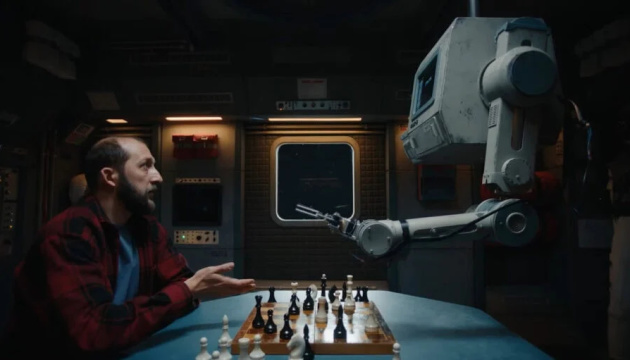
Pavlo Ostrikov’s film hit theaters on November 20. In the past ten days — Mindich’s case, Yermak’s resignation, horrific shelling, negotiations — and amidst all this, vying confidently for our attention is a film where a cosmic trucker Andryukha talks with a robot and a French woman.
This was reported by Espreso.tv.
Box office numbers are hard to compare with a Hollywood “blockbuster success,” but they are quite respectable for a domestic film. The main thing, however, is the endless discussions on social media. And this is at a time when — as mentioned above — blackouts, air raid alerts, and everyday life give people a perfectly reasonable excuse: “Not really the time for the cinema.”
The world premiere took place last year at the Toronto Film Festival.
This fall in Ukraine, the film already won the main prize at the Odesa Film Festival, and just recently — the main award from the film critics’ “Kinokolo” awards (actually several, as the film, the screenplay, the director as Discovery of the Year, and the lead actor were all honored). Film critics and audiences have never been closer.
Why did it succeed?
Why is an intimate story set somewhere between Jupiter and Saturn being discussed and hailed as a sensation?
This isn’t a joke, nor a carousel of computer graphics, nor a costume drama about love — not the kind of distraction we’re used to, the kind that lets us escape a grim reality with cinema-therapeutic popcorn. I’ll risk explaining it this way: cinema has finally stumbled upon our contemporary hero. One who resonates with audiences precisely because he is real, not artificial. Not exemplary, but relatable. By no means an ideal, not a model to emulate, but there is something in him that strikes a chord.
For at least a decade, there has been much discussion about what a modern Ukrainian film hero should be. I myself asked this question in interviews with various film speakers. Reflective, decisive, quirky, responsible, escapist, exemplary… Different approaches were tried. Attempts were made to break free from stereotypes. Failures were shown. Determined characters were shown. Uncompromising superheroes. Narrow-minded villagers. Foolish ones. Brave ones with perpetual doubts. Some resonated, some didn’t. Ultimately, they all have a right to exist, because the hero of our time can barely keep up with the rapid changes of our era. I can even recall the “update” of Bond, who went from a fearless superhero with nerves of steel to a reflective, disappointed man, questioning the right path and the absolute notions of good and evil… Everyone is searching.
Andryukha, as portrayed by Volodymyr Kravchuk, is exactly that neighbor who bangs on the radiator (remember that heartbreaking social ad?). He’s the careless tenant who once moved out, leaving behind unpaid utility bills and trash, and then, ten years later, died heroically in the war. He’s the nerd who unexpectedly turned out to be braver than the people who bullied him as a teenager. He’s those ordinary men who couldn’t speak beautifully on camera but stood in the front lines on Hrushevskoho, and later joined the volunteer battalions.
The polished Hollywood hero, refined in his stereotypical masculinity, no longer moves us.
But what about the guy in slippers with an old Berdanka rifle taking down the enemy somewhere near Karachun in 2014?
Because we know real people. They can look and act like heroes. Or they may not look heroic, may not inspire the desire to befriend them, but at some moment, they act.
Andriy, played by Volodymyr Kravchuk, is an ordinary man from whom you never know what to expect. He seems universal, yet very much ours. Someone who might misplace nuclear waste, but then “snap” and fly across the universe for love. Someone who doesn’t despair when the world is falling apart, but opens his soul… Someone who listens to refined pop classics on vinyl and speaks in a terrible Surzhyk (I could debate a bit about the Surzhyk, but its defenders are so passionate that it’s better to stay silent. After all, I read in one of the comments a comforting thought: these days, it’s a pendulum — from artificially correct language to overly casual speech, but eventually cinema will find a reasonable middle ground).
I came across a comment from someone offended by those who suggested watching the film, saying it wasn’t life-affirming for her. Well, that’s exactly the point. Are we living in a world of happy endings right now? (Irony).
In You Are the Cosmos, there is no hopelessness. The hero doesn’t perform feats of valor, but he fights until the very end. Not against alien invaders or to save the planet — he simply follows the call of his heart.
And the last people on this Earth, in humanity’s final moments, feel not Fear, but Love. Isn’t that life-affirming in itself — even as a paradox — that the disappearance of physical life does not prevent Love from asserting itself? As an absolute that never vanishes.
I can’t help but mention another film recognized at the Kinokolo awards: Life Begins, which won in the live-action short category. No Universe here — just our reality, painfully familiar. A veteran and civilian life. Parallel worlds (“astronaut” from the war in a seemingly peaceful life). A script by Pashtet-Belyanskyy, who defends us on the frontlines. And again, Kravchuk in the lead role. The heroes are different, yet somehow alike. Ours. Ordinary. Saving a world that seems doomed simply through their authenticity.
Tags: 2025 films box office hit Pavlo Ostrikov sci-fi film Ukraine culture Ukrainian cinema You Are the Cosmos




![Visitors at the “Thank You With All My Heart” Ukrainian exhibition at the Council of Europe, featuring the Great Amber Heart and powerful war art. :contentReference[oaicite:2]{index=2}](https://empr.media/wp-content/uploads/2026/02/heart-300x171.png)