

Ukrainian-born nanotechnology leader Yuriy Gogotsi, creator of MXenes, supports Ukrainian scientists, leads global research teams, collaborates with NASA, and shapes next-generation materials and energy technologies.
Yuriy Gogotsi is one of the most influential scientists of our time and a leader in nanotechnology in the United States and worldwide. He is credited with numerous discoveries of major scientific and practical significance. Gogotsi holds 80 invention patents granted in Europe and the United States and has been included in the ranking of the world’s top researchers across all scientific disciplines — both living and deceased — where he placed 53rd. Yuriy Heorhiiovych is a member of the U.S. National Academy of Engineering, an honorary professor at the University of Tokyo, and a recipient of numerous international scientific awards. Since the start of Russia’s full-scale invasion of Ukraine, Gogotsi has actively supported Ukrainian scientists by helping them secure international grants, assisting with evacuations from active war zones, and promoting Ukrainian science globally.
This was reported by OBOZ.UA.
The son of a chemistry professor
Yuriy Heorhiiovych Gogotsi was born in Kyiv on December 16, 1961, into the family of Heorhii Gogotsi, a professor of physics and head of a laboratory at the H.S. Pysarenko Institute for Problems of Strength. His father’s field of research was the mechanics of solid deformable bodies. It is therefore unsurprising that both Yuriy and his brother Oleksii devoted their lives to science.
Yuriy Heorhiiovych graduated from the Igor Sikorsky Kyiv Polytechnic Institute with a degree in metallurgical engineering. At the age of 25, he defended his dissertation, becoming the youngest Candidate of Chemical Sciences in Ukraine. Nine years later, Gogotsi defended his doctoral dissertation at the I.M. Frantsevich Institute for Problems of Materials Science of the National Academy of Sciences of Ukraine, after which he moved almost immediately to Germany and later to the United States.

A new class of two-dimensional materials with unique properties
Overseas, the scientist’s career reached unprecedented heights. He worked at leading universities around the world — in Japan, Germany, Norway, and, of course, the United States — where he collaborated with the largest and most renowned research institutions. His areas of interest included nanotubes, carbon materials, and electrodes for supercapacitors.
As early as 2011, the team led by Gogotsi discovered a new class of two-dimensional materials with unique properties, including lightness, flexibility, superconductivity, and the ability to store information. They were named MXenes, and today their properties are actively studied by researchers at Harvard and Stanford. MXenes are now considered fundamental building blocks for next-generation nanotechnologies, encompassing many important and highly relevant inventions — from flexible electronics to space batteries.

Founder of new scientific fields
However, nanotechnology alone soon proved too narrow a field for Yuriy Heorhiiovych, and he also became a founder of new directions in science. The most notable among them include corrosion of structural ceramics; the science and technology of surface treatment under pressure; and the synthesis of new inorganic materials and compounds through selective corrosion and extraction. These terms may mean little to non-specialists, but the fact that his work is used by major corporations such as Samsung, Tesla, and Bosch speaks volumes.
Interests spanning sky and Earth
The research conducted by Gogotsi’s team is aimed not only at significantly improving life on Earth but also at advancing space exploration. The team actively collaborates with NASA, the U.S. National Aeronautics and Space Administration. In particular, joint work is currently underway on next-generation batteries designed for use in the extreme conditions of outer space.
The secret of success is doing what you love
When Yuriy Heorhiiovych is asked about the secret of his success, he replies that the main thing is doing what he loves and taking pride in having his own scientific school, with his and his colleagues’ research contributing to the development of global science. To those who are just choosing the direction of their life path, he advises selecting something a person can truly be passionate about — then everything will fall into place.
As for luck, he believes it is far from the most important factor and means little without passion, enthusiasm, and hard work. At the same time, Gogotsi considers himself… unlucky. It all began back in his school years, when he did not get a chemistry textbook. The books were distributed at school, but there were more students in the class than copies available. Yuriy had no choice but to memorize everything the teacher said. He liked chemistry so much that he became deeply interested in the subject and, on his father’s advice, began attending a chemistry club at the Palace of Pioneers.
When it came time to apply to university, Gogotsi very much wanted to enter the Faculty of Chemistry at Kyiv National University, but once again he was unlucky — he was not admitted because he failed the medical examination: the young man had color vision deficiency (color blindness).
The era of lone scientists is over
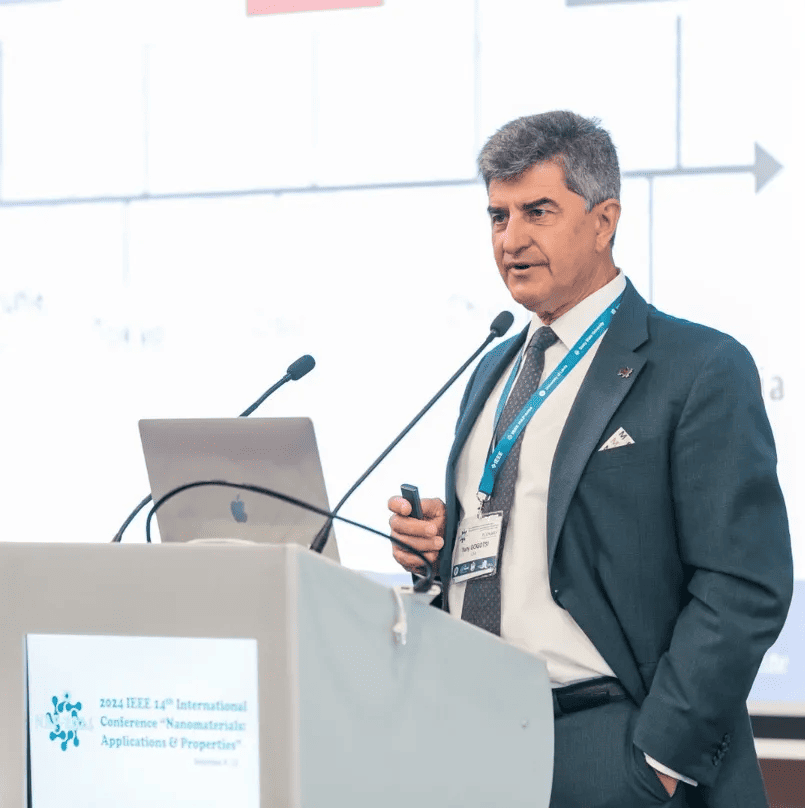
In Gogotsi’s view, the age of brilliant lone scientists has passed — today, all major scientific breakthroughs are made by teams, sometimes very large ones, numbering up to a thousand people. He believes such groups should include researchers representing different scientific schools and countries and holding diverse perspectives on the subject of study, as it is only through such scientific debate that truth can emerge.
Today, Yuriy Heorhiiovych’s own team — 40 scientists from 11 countries — is working to minimize the environmental impact of batteries, improve medical sensors, and develop materials that will help increase internet speeds. Their base is Drexel University in Philadelphia, which includes the Nanotechnology Institute headed by Gogotsi. The team receives USD 1.5 million annually in funding from the U.S. federal budget for its research.
Tags: EMPR.media invasion support Kyiv native nanotechnology Ukraine science Yuriy Gogotsi
![Ukrainian Roboneers and Latvian partners at the signing of a defence robotics and underwater technology cooperation memorandum. :contentReference[oaicite:2]{index=2}](https://empr.media/wp-content/uploads/2026/02/oboronka-480x270.png)













![Visitors at the “Thank You With All My Heart” Ukrainian exhibition at the Council of Europe, featuring the Great Amber Heart and powerful war art. :contentReference[oaicite:2]{index=2}](https://empr.media/wp-content/uploads/2026/02/heart-300x171.png)



![Ukrainian Roboneers and Latvian partners at the signing of a defence robotics and underwater technology cooperation memorandum. :contentReference[oaicite:2]{index=2}](https://empr.media/wp-content/uploads/2026/02/oboronka-300x168.png)