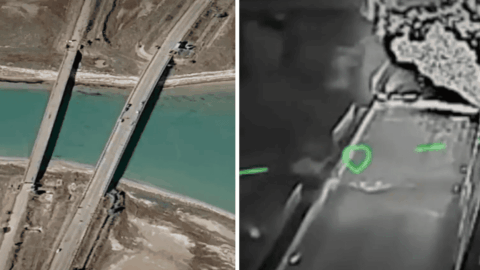

Chonhar Bridge has been struck again, forcing the closure of a vital route between occupied Crimea and southern Ukraine. The attack further disrupts Russian military logistics.
The strategically important Chonhar Bridge, one of the main transport corridors connecting Russian-occupied Crimea with occupied territories in southern Ukraine, has been struck again, forcing authorities to suspend vehicle traffic and reroute transport through alternative crossings.
According to reports from occupation authorities and multiple regional sources, the overnight strike damaged the bridge structure near Chonhar, leading to the closure of the route and the suspension of traffic through the nearby Dzhankoi checkpoint. Drivers have been redirected through the Armiansk and Perekop crossings while engineers assess the extent of the damage.
The latest attack marks the second successful strike on the Chonhar crossing within days, highlighting Ukraine’s growing ability to disrupt Russian military logistics deep behind the front line. Occupation officials acknowledged the damage and confirmed that emergency services and repair crews were deployed to the site.
Why the Chonhar Bridge Matters
The Chonhar route serves as one of the most important land connections between occupied Crimea and Russian-controlled areas of southern Ukraine. Military analysts have long identified it as a critical logistics artery used for transporting troops, ammunition, fuel, and military equipment.
Any disruption to this route forces Russian forces to rely on longer and less efficient supply lines. Alternative routes through Armiansk and Perekop increase travel distances and place additional strain on military logistics already challenged by ongoing Ukrainian drone operations.
The strike comes shortly after Ukrainian Special Operations Forces reported establishing aerial control over portions of the Melitopol–Chonhar logistics corridor, using drones to target military vehicles, supply convoys, and infrastructure supporting Russian occupation forces.
Growing Pressure on Russian Logistics
The repeated targeting of Chonhar reflects a broader Ukrainian strategy aimed at isolating Crimea and weakening Russia’s ability to sustain military operations in southern Ukraine.
Over the past year, Ukrainian forces have increasingly focused on supply depots, fuel facilities, command centers, bridges, and transportation hubs that support Russian military operations. Analysts note that logistics disruption often produces long-term battlefield effects by slowing troop movements and complicating resupply operations.
The latest strike also follows a series of successful Ukrainian attacks against military infrastructure across occupied Crimea, including fuel depots and transportation networks.
Strategic Implications
While the full extent of the damage remains under assessment, the closure of the Chonhar crossing underscores the vulnerability of Russian supply routes connecting Crimea to occupied territories on the mainland.
For Ukraine, operations targeting critical infrastructure demonstrate an expanding capability to challenge Russian control far from the front lines. For Russia, repeated disruptions create additional logistical burdens at a time when the war increasingly depends on the efficient movement of personnel, ammunition, and equipment.
As drone warfare continues to evolve, transportation corridors such as Chonhar are likely to remain among the most contested and strategically important targets in the broader conflict.