Mykola Osychenko discusses Crimea’s economic decline, Russian propaganda, conscripts serving in occupied territories, alleged violations of children’s rights, and collaborators’ ambitions under Russian occupation.
In occupied Crimea, residents complain about the lack of a tourist season, business closures, sharp increases in food prices, and supply problems. Meanwhile, a scandal has erupted on the peninsula after a schoolgirl’s mother claimed that her child’s blood was taken without the parents’ prior consent.
Mykola Osychenko, former president of Mariupol Television, volunteer, and civic activist, explained in an interview with 24 Kanal host Kateryna Solyar why economic problems have not changed some Crimeans’ attitudes toward Putin. He also discussed the activities of collaborators in Melitopol, Russian conscripts serving in occupied territories, and the occupation authorities’ treatment of local residents.
Crimea Is Left Without Tourists, Jobs, or Money
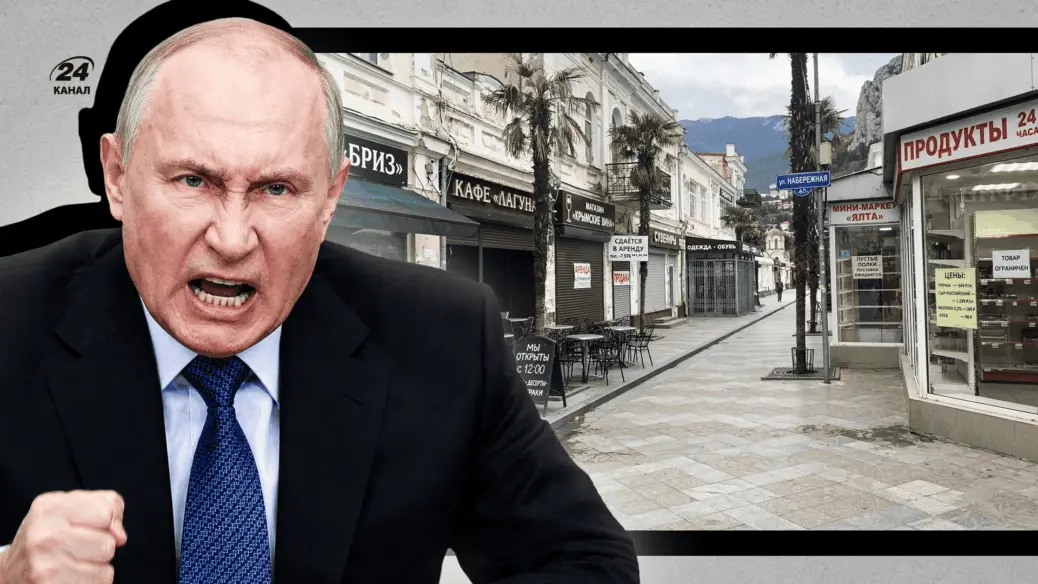
In Yalta, commercial premises that previously housed shops, beauty salons, and cafés are becoming vacant en masse. Were these consequences of the tourist season, or the lack of one, expected?
Back in the summer, we warned Crimeans that there would be no tourist season, that people would be left without income, and that prices would rise. We advised them to look for opportunities to relocate while it was still possible to rent housing in other Russian regions.
Now, doing so is becoming increasingly difficult. People did not earn any money during the season, while food and other goods continue to become more expensive. And the longer this goes on, the fewer opportunities they have to change anything.
But something else concerns me. Even when faced with these problems, some Crimeans continue to believe that Putin is not to blame for anything.
A Crimean resident complains about prices, power outages, and unemployment, despite previously emphasizing her support for Putin. Is her attitude toward the Russian president changing?
I think she still has a very positive attitude toward Putin. For people like her, certain moral anchors are important—the same Russian “spiritual bonds”. And now, essentially, Putin is all they have left.
Yandex services are no longer functioning properly, there are problems with Wildberries and other services, but Putin is still doing a great job. Some officials, business owners, or other people are to blame for everything—anyone but him.
If one day they realize that Putin is also responsible for what is happening, I fear their lives will become very bleak. After all, they will have to abandon the beliefs they have clung to for so long.
The situation with prices simply confirms what we were saying back in the summer: there will be no tourists, there will be no money, and expenses will continue to rise. All of this is happening now, but far from everyone is willing to acknowledge the causes of their problems.
Russia Imports Powdered Milk from India and Vegetables from China
Russian television is already reporting problems transporting Crimean produce, farmers going bankrupt, and imports of powdered milk from India. How do you assess this situation?
Importing powdered milk from India is simply disgraceful. Russia has vast territories, incredibly fertile land, and enormous expanses. It could develop its livestock industry, raise cattle, and produce its own milk. But why bother when it can import powdered milk from India?
The same story applies to Chinese horseradish. It is embarrassing. A country with such abundant resources is importing food products from abroad that it could easily grow itself.
At the same time, people are constantly talking about the enormous potential of Russian agriculture. Then it turns out that even basic food products are becoming a problem.
Why is it difficult to transport Crimean products to Russia?
But how much of it is actually being produced in the first place? That is a big question, too. Any production process requires not only raw materials and equipment, but also packaging, various components, and materials that have to be brought in.
If there are problems with logistics, how are all these supplies supposed to be delivered? A business cannot operate properly when supply chains are constantly disrupted. And then it still has to find a way to transport the finished products out.
That is why I am talking about a complete collapse. They cannot organize the transportation of Crimean goods properly, yet somehow they manage to import powdered milk from India.
There was a time when Russia imported American chicken leg quarters, known as “Bush legs.” Now it has come to importing powdered milk from India. For a country that constantly talks about its greatness and self-sufficiency, this is very telling.
Collaborators Are Being Groomed for Leadership Positions in Occupied Territories
Melitopol propagandist Maksym is delighted by Trump’s conversation with Putin and calls the US president “one of ours.” Why does he view these developments this way?
Maksym is feeling very confident right now. He recently returned from Russia’s Rostov Region, where he attended the “Russia — Land of Opportunity” forum. So-called opinion leaders from occupied territories were brought there and trained in how to influence people going forward.
In addition, these participants are being placed in a personnel reserve for the occupation authorities’ administrative structures. In other words, if Melitopol remains under occupation for some time, Maksym could well be in line for a leadership position. It is even possible that they might want to make him the city’s mayor.
And now he has returned from the forum, heard that Trump spoke with Putin, and felt that he was part of big politics. He says, “Trump is one of ours.” As if it were some kind of personal victory.
But what does this mean for the residents of Melitopol? There was no gasoline before, and there still isn’t any. There were problems with logistics and electricity, and they remain.
Nothing has changed in people’s everyday lives, but Maksym is happy right now. I think this excitement will wear off pretty quickly.
How do Putin’s agreements with Trump fit with Russian propaganda about the threat posed by NATO?
That is a very interesting question. The United States is supplying weapons to Ukraine, while Russian propaganda has spent years claiming that NATO wants to move closer to Russia’s borders.
And now Putin decides to sell diesel fuel to Trump. In other words, he is effectively helping supply fuel to one of NATO’s founding members. How are they going to explain this to people who have been convinced for years that America is the enemy?
At the same time, Trump is strongly urging Ukraine not to strike Russian oil refineries. US officials have reportedly warned that if such strikes continue, the United States could stop providing intelligence on targets inside Russia.
However, if Ukraine stops attacking oil refineries, US intelligence support for strikes against other targets could continue. So what exactly is so special about the friendship between Putin and Trump? It is a rather strange friendship.
I do not understand why Maksym is so happy. He says this is important news for Melitopol, but he does not explain at all how these agreements will help the people living in the city.
Maksym also claimed that Melania Trump was helping reunite children with their families. What is wrong with his report?
He describes this as particularly important news for the residents of Melitopol. But which children and families is he talking about exactly? I still do not understand.
We know that Russia has taken a large number of Ukrainian children to its territory. If he is referring to their return to their families, then of course that is a good thing. But who, specifically, is Maksym talking about? Which families are supposed to be reunited?
He does not explain this. He was given certain talking points, read them out, and that was it. There is a briefing document and specific points he is expected to communicate, but he is no longer interested in what lies behind them.
And I feel very sorry for people who watch such reports and take them as explanations of international politics. Especially residents of occupied territories, who are already in a difficult situation.
In reality, neither Trump nor Putin cares about their everyday problems. Yet local propagandists continue to convince people that another conversation between the two presidents supposedly changes everything.
Russian Conscripts Are Serving in Occupied Crimea
A woman from Russia’s Rostov Region moved to Feodosia, where her son is serving. Why did this story outrage you?
I am struck by the pride with which she talks about her son’s military service. She says Feodosia called to her, that she felt some special connection to the city, and decided to stay there.
But her son is serving in the military in occupied Crimea. And I have a simple question: what will happen if he is deployed to repel drone attacks, as can happen to conscripts?
Where will his funeral take place then—in Shakhty, in Russia’s Rostov Region, or in Crimea? Does she ever think about that when she speaks so proudly of her son’s service?
I think that if something happens to him, she will blame Ukraine, not Putin. She will not ask why her son was sent to serve in an occupied territory where a war is ongoing.
But we are talking about a human life. It can be cut short at any moment. And I am astonished by how carelessly some people treat this reality.
How long has Russia been using conscripts in the war?
There are now many videos circulating online showing conscripts being pressured into signing military contracts. Their relatives are trying to prevent this, arranging powers of attorney to ensure the young men do not sign the documents, turning to the courts, and investigating the circumstances under which these contracts were signed.
I remember March 15, 2022, very well. That was the day we left Mariupol for Zaporizhzhia. There were approximately 24 or 26 Russian checkpoints along the road.
The first ones were manned by militants from the so-called “DPR,” the last by Kadyrovites, and Russian military personnel were stationed in between. At one of the checkpoints, a very young man checked my documents. He looked like a child—clearly a conscript.
He was ashamed. He avoided eye contact, looked down at the ground, and his face was completely red. It was obvious that he did not even understand where he was or what he was supposed to do.
So Russia has been using young men like these since at least 2022, and possibly as far back as 2014. And after all this, a woman from Russia’s Rostov Region speaks with such pride about her son serving in Crimea.
Blood Draws from Children Without Parental Consent Reported in Crimea
A schoolgirl’s mother claimed that her child’s blood was taken without prior consent. Hospital No. 5 maintains that consent had been obtained, but the woman disputes this. What is known about the case?
As I recall, this woman moved to Crimea from one of Russia’s regions. I cannot say exactly which one at the moment. She previously posted videos talking about how much she enjoyed life on the peninsula and how she had decided to move there with her children.
Then the incident involving her daughter’s blood draw occurred. According to the mother, the procedure was performed without the parents’ prior consent, sparking a major scandal.
Previously, she had praised life in Crimea, saying that she would somehow manage even with financial difficulties. Now, however, she has faced a situation in which her own child was subjected to a medical procedure without her permission, as she claims.
And that gives her a completely different perspective on life in an occupied territory. It is one thing when you are looking at other people’s problems, and quite another when your own family is affected.
There have also been reports that children may be taken to hospitals to donate blood for wounded Russian soldiers. What is your assessment of this?
This story reminds me of the film The Matrix, in which people were plugged into a system and used as a source of energy. It brings to mind a similar situation.
For the occupation system, people in the seized territories are simply a resource. Their interests, rights, and wishes take a back seat whenever something is needed from them.
And if children really are being taken out of schools, transported to hospitals, and having their blood drawn for wounded Russian soldiers, that is extremely cynical — especially if their parents have not given their consent.
The woman raised the issue, but she is already facing criticism. The argument is that people should help Russian soldiers and that she refuses to understand this.
But why should children be used for this purpose? And why should parents learn about medical procedures only after they have already been performed?
Could those responsible for such actions face punishment?
I very much doubt that anyone will be punished there. In my view, things like this cannot happen without the leadership’s knowledge, although the specific circumstances of this case still need to be established.
What strikes me is not only the allegation that blood was taken, but also the reaction to it. Instead of investigating whether the parents had given their consent, people start telling the woman that she is wrong because Russian soldiers need help.
This is very characteristic of the occupation system. The needs of the military are placed above people’s rights, and any questions about the authorities’ actions are treated as something unacceptable.
If the woman’s account is confirmed, it will be yet another telling example of this attitude toward people in occupied territories.
Collaborators Are Trying to Leave Occupied Cities for Russia
A TV presenter from Luhansk has moved to Moscow and is proud of her new job. Why are employees of occupation-controlled media eager to leave their cities?
Let them leave. For many people working in occupation-controlled media, it is a real dream.
But I am surprised by what has happened to their local patriotism. Before 2014, it was very strong in Donetsk. I, for example, did not want to move to Kyiv, Moscow, or Astana, even though I had been offered jobs there.
I used to say: this is my city, and I want to live and work here. Even before 2022, I did not want to leave Mariupol for Kyiv. I was happy at home.
Now, however, many people working in occupied territories are eager to leave. And they are not necessarily heading to Moscow. They are willing to look for work in Rostov, Taganrog, or any other city, as long as they can get out of the occupied territories.
Because it is frightening there. And all those declarations of love for one’s hometown quickly come to an end when an opportunity to work somewhere else presents itself.
She calls herself a queen and is proud that, after seven years working behind the scenes, she has become a TV presenter. Will she be able to establish herself in Moscow for the long term?
She is now convincing herself that she has achieved everything through talent and hard work. She calls herself a queen, talks about the crown she has no intention of taking off. Let her enjoy it if it matters that much to her.
But I would not be so sure that any of this will last forever. Today, one producer needs you, and tomorrow, he finds someone else, and your job may come to an end.
We have already seen many similar stories. People moved away, talked about huge career prospects, and then returned home, explaining how much they had missed their hometown.
I would not rule out the possibility that, after some time, this woman will also return to Luhansk and say that she could not live without it. For now, she is confident in her success, but we will see how long it lasts.