
Canada may grant residency to hundreds of thousands of Ukrainians—but the move is sparking debate over demographics, defense, and the future of migration in wartime.
Canada, Ukrainians, and new policies: how demographic challenges, refugee status, and questions of responsibility are shaping the future of migration policy and people’s choices.
Around 1990, an acquaintance of mine, upon seeing a banner on the street reading “Canada is Ukraine’s sister,” became outraged: “Why not Russia? What is Russia then?” I replied as politely as possible: “Russia cannot be anyone’s sister, because it constantly claims the role of an older brother.”
This was reported by Serhii Hrabovskyi in OBOZ.UA.
Why am I recalling this? Because Canada may soon reaffirm its sisterly status once again. In its own way, but still reaffirm it — by granting permanent residency to hundreds of thousands more Ukrainians.
The reason is that a petition has been submitted to the Parliament of Canada, calling for all Ukrainian refugees who arrived in the country after the start of Russia’s full-scale invasion to be granted permanent resident status.
“We call on the Government of Canada to develop a one-time special immigration program for residents of Canada who arrived under the Canada–Ukraine Authorization for Emergency Travel and other temporary migration programs,” the petition states.
At the same time, the government is urged not to act blindly, but to take into account factors such as the length of lawful stay in Canada, local work experience, and language proficiency (English or French) when granting Ukrainians permanent status.
Currently, the petition has been published on the website of the House of Commons of Canada, where it has already gathered 48,000 signatures. It was submitted for parliamentary consideration by Ivan Baker of the Liberal Party of Canada. The government now has 45 days to prepare a written response.
To this it should be added that in March 2022 (a very swift response to Russia’s invasion!), the CUAET program began operating in Canada. It allowed all Ukrainians who wished to do so to obtain a temporary permit to work and live in Canada. Applications for this program stopped two years ago, and during its operation, about 300,000 Ukrainian asylum seekers arrived in Canada. In fact, people continued to arrive afterward and are still arriving now, fleeing the United States and its current, to put it mildly, ambiguous immigration policy.
It seems that this petition emerged as a response to numerous requests from refugees from Ukraine asking for Canadian citizenship. They argued that they had either lost their homes and property due to the war or were forced to sell them because there was no one left to maintain them. In other words, they emphasized that they had nowhere else to go from Canada, and that they would work and contribute to the country.
However, the author of the petition, taking these appeals into account, acted wisely: not citizenship, but only permanent resident status. This effectively grants all rights except, above all, voting rights, and imposes all obligations except military service (in the event that conscription is introduced under extraordinary circumstances).
All of this together provoked a rather mixed reaction among ethnic Ukrainians who are citizens of Canada. While agreeing with the need to shelter elderly people, women, and small children, they pointed out the unusually large number of physically strong men who are fully capable of defending Ukraine from Russian aggression. Would they not flee Canada in the event of some crisis as well? — this was a question raised in conversations among Ukrainian Canadians. “They are poor citizens of their own country—who said they would become better ones in the future?”
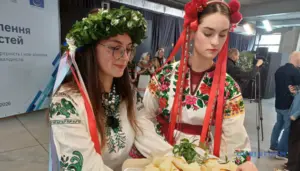
Another important detail was noted: although the newcomers consistently wore vyshyvankas to Ukrainian churches on holidays, in everyday life they almost all communicated with each other in Russian. “There has never been so much Russian spoken in Toronto!” — a Canadian professor I know remarked with sadness.
From my side, I would add: it is still unknown how many individuals holding Ukrainian passports who have settled overseas may include agents working against Canada, against Ukraine, and against NATO member states…
It seems the author of the petition took certain sensitive circumstances into account, as it does not call for automatically granting permanent resident status to all refugees from Ukraine — rather, a range of factors will be considered.
However, it seems that the petition will, sooner or later, be supported, meaning that a corresponding law will be adopted, and two hundred, or three hundred, or perhaps even 350,000 Ukrainians will become de facto, and later de jure, Canadians. This is because the country is facing a serious issue: at the end of last year, Canada recorded its first population decline since 1867. The population decreased by 0.2% (over 100,000 people). The number of not only citizens but also temporary residents with work and study permits declined. The number of deaths exceeded the number of births. Finally, the economic situation worsened, and the cost of living increased significantly, which also affects demographic indicators. This means that newly arrived Ukrainians are highly needed in Canada, especially those who have children and are of childbearing age.
What should be done? I do not know. However, it is clear that punitive measures will not help here, and there is no way to encourage at least men to return and fight. In my view, it would be necessary to negotiate with the Canadian government, for example, to grant immediate citizenship to those families in which the men (or even women) join the Armed Forces of Ukraine or the National Guard. And to those who return to work in Ukraine’s defense industry until the end of the war. Simply returning to one’s homeland is something few would choose, but the transformation from a refugee into a fighter is something worthy of recognition both in Canada and in Ukraine; such individuals would have full grounds for dual citizenship and the freedom to choose their place of residence. In my opinion, only then will Canada truly become a sister nation to Ukraine.
Tags: CUAET program empr media analysis geopolitics migration immigration policy Canada residency debate Ukraine refugees Canada Ukrainian diaspora