
Ukraine has completed less than 10% of key EU reforms, raising concerns in Brussels about trust, governance, and the country’s path toward membership.
Ukraine is making almost no progress on the “Kachka–Kos plan,” raising serious concerns about its EU accession path, with reforms still largely stalled across institutions.
A coalition of eight think tanks and organizations has released an expert assessment of Ukraine’s progress in implementing priority reforms on the path to EU membership. The verdict: progress is nearly zero.
The report refers to 10 points of a plan proposed by Deputy Prime Minister Taras Kachka and EU Commissioner Marta Kos, the fulfillment of which is a condition for joining the EU.
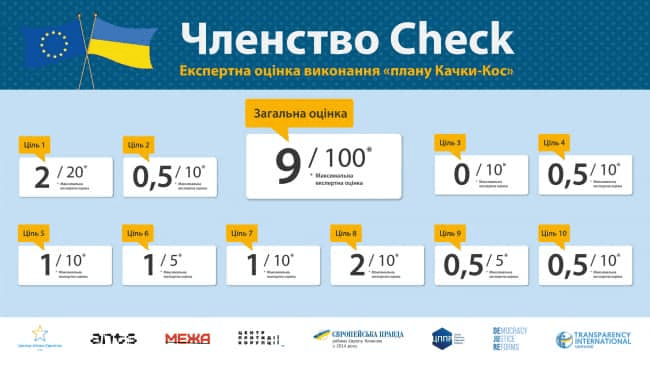
The coalition of expert organizations, which also includes the Anti-Corruption Action Center (AntAC), assessed the implementation of this reform plan at 9% out of 100.
Obviously, maintaining such dynamics would mean a complete failure of the plan. However, President Volodymyr Zelenskyy speaks about how the EU is failing to keep its promises.
It is worth reminding that Ukraine must also fulfill its own commitments. Especially since these reforms are fully supported by the Ukrainian people and are primarily needed for the country as a whole.
That is, almost the whole country. They are certainly not needed by Mindich and other associates of the president.
Full report on the implementation of requirements.
On December 11, 2025, a symbolic and highly important meeting of the EU Council for Ukraine took place in Lviv. First, Ukraine received its initial “benchmarks” — criteria that must be fulfilled as a condition for joining the European Union. Second, the Ukrainian government and the European Commission — in the presence of representatives of all member states — agreed on the steps needed to restore confidence in Ukraine’s reform process.
Investigation by European Pravda.
The final document was informally dubbed the “Kachka–Kos plan,” after the officials who formally signed it.
However, for the EU this is much more than just a declaration by a Ukrainian deputy prime minister.
“There is a need to restore the trust of EU member states in Ukraine after the events of July 22 (when Ukraine undermined its own anti-corruption reforms – EP). Therefore, we agreed with the Ukrainian government that we jointly define priorities and send a positive signal to the member states. Ukraine committed to fulfilling all of this within a year,” explained the logic behind the document EU Commissioner Marta Kos in an interview with EP.
Since the document was prompted by a lack of trust from EU capitals following Ukraine’s attack on anti-corruption institutions, the plan is focused — it addresses only anti-corruption reforms and rule of law issues.
Three months have passed out of the 12 the government allocated to itself to implement all 10 points of the plan. Yet progress is nearly zero.
It is not surprising that at the same time, European diplomats and officials are increasingly saying that there are serious problems with trusting Ukraine’s intentions to carry out reforms for its EU accession.
Parliament does not demonstrate a willingness to work. And even the government, which itself took on the commitments necessary to restore trust, is stalling in implementing them. We are publishing the first expert analysis of the implementation of the “Kachka–Kos plan,” which shows where the biggest problems lie and where there is at least some progress that can be developed further.
Kyiv must deliver results as soon as possible. Because at stake is the trust of European partners in the government’s next promises — and therefore in the foundations of Ukraine’s path toward the EU.
Who is counting and how is it being measured
The implementation of the so-called “Kachka–Kos plan” is widely recognized in both the Ukrainian government and expert circles as one of the critical issues in relations between Ukraine and the EU, including in the context of accession.
To some extent, it is paradoxical that, formally, this document is not part of the accession process and exists separately. However, in reality, for many European capitals, its implementation serves as an indicator of whether Ukraine is making genuine progress in carrying out accession-related reforms.
This was also explained by EU Commissioner Marta Kos during her visit to Kyiv a month ago. In an interview with European Pravda, she publicly emphasized that the main reform priorities monitored by European capitals are collected in this very plan. “This document helps your government with priorities… These 10 points are a list of what really matters. And we expect Ukraine to fulfill them,” she said in an interview with EP, stressing that Ukraine itself set the timeline: the plan is set to be completed in 2026.
In that same interview, Marta Kos also said that she is aware of the “public monitoring” of this plan and is in contact with the organizations conducting it. “For us, it is important to look at the situation in Ukraine through their eyes,” the EU Commissioner explained.
This article presents the first results of the monitoring initiative called “Membership Check.”
Yes, these are far from all the reforms needed for Ukraine’s EU membership.
But without these, there will be no real progress. That is why they receive special attention.
The monitoring is conducted by a coalition of eight expert organizations that systematically work on European integration, anti-corruption issues, and judicial reform, under the leadership of the New Europe Center. The group also includes Mezha, EP, ANTS, DEJURE, the Center for Political and Legal Reforms, the Anti-Corruption Action Center, and Transparency International Ukraine.
First of all, it is necessary to explain the methodology — that is, how we reached the conclusion about the serious problem and how exactly it was measured. If you are not interested in the details of this methodology, you can skip ahead to the next section, which presents the results.
At present, the consortium is measuring only the implementation of the “Kachka–Kos plan” by the Ukrainian state. In this regard, we are acting in the same way as the EU: although formally the plan was approved by the government and signed by Deputy Prime Minister Taras Kachka, for Europeans it is a plan for the whole of Ukraine. The final result is what matters. And if there is no result, then the question of who “messed up” and why a certain Ukrainian commitment was not fulfilled is of no interest to Brussels or other capitals.
This is, by the way, how other accession reforms are assessed as well.
Moreover, the final outcome is of key importance. It is not enough to create “working groups” and hold “comprehensive dialogues,” which sometimes merely simulate progress. No reform — no high rating.
Of course, the political process also matters. Therefore, even statements by top government officials that Ukraine agrees to carry out a certain reform, or the development of a reform strategy, deserve initial points. However, this can earn a maximum of 10% of the total score.
The development and registration of a draft document in parliament can yield no more than 20% of the points (including the 10% mentioned above).
Further, if the draft is of high quality, its preparation for adoption (such as passing a law in the first reading, submitting amendments for the second reading, obtaining EU expertise, etc.) can bring the score up to 50%. Because even a good law or secondary legislation only matters once it is adopted. The coalition is convinced that no more than half of the total points can be awarded for preparation.
And only the adoption of a law or the actual implementation of a reform allows for a score of up to 100%.
This is not about a purely mechanical approval. The decision must be of high quality and effective, which is why the coalition also analyzes the substance of the proposed reforms.
First, there must be alignment between the proposed or adopted reform and the objectives of the “Kachka–Kos plan.” Second, reforms are not made “for Marta Kos,” but for practical changes in Ukraine, so the chosen way of implementing reforms must deliver institutional and practical results. And third, this reform track is significant in the context of Ukraine’s path toward EU membership, which is why reforms are assessed for compliance with the Interim Benchmarks under the “Fundamentals” cluster (chapters 23–24 of the accession negotiations). If these benchmarks provide a more detailed definition of a given reform, then the actions of the authorities must take them into account.
To conclude the description, it should be emphasized that the consortium’s assessment may not coincide with that of Brussels. This consortium (though in a slightly different composition) has already had such experience when it conducted the “Candidate Check” study on Ukraine’s fulfillment of EU candidate requirements. Our goal is to show Ukraine’s real progress, to push forward reforms that are being stalled, and to highlight the achievements that do exist, while ensuring that the European assessment is also fair and accurate.
However, for now, there is frankly nothing to “highlight.”
A Quarter of the Time and Minimal Progress
All points of the “Kachka–Kos plan” are important, but their complexity and practical impact differ. The most extensive is Point 1. In the plan’s text itself, it takes up the most space, consisting of five major elements, which is why this point carries the highest weight — 20 points. We also single out two points — No. 6 and No. 9 — which do not require the development and adoption of new reforms; these points were assigned a weight of 5 points. The remaining seven elements of the plan are each worth 10 points, bringing the total maximum score to 100 points.
A timeframe has also been defined for the full implementation of the plan. In the document signed by Taras Kachka and Marta Kos, Ukraine declared its intention to “implement the measures (of this plan) within a year.” And although this wording allows Kyiv the possibility to extend the timeline, the European Commission expects Ukraine to complete everything in 2026.
The reality, for now, is far more disappointing.
Three full months of 2026 have passed — that is, 25% of the time during which the EU expects Ukraine to implement the entire plan. However, the current expert assessment gives Ukraine only 9 points out of 100 for its implementation, which is less than 10%.
For some points, the score is zero or 0.5 (for example, when a point consists of two elements and there is progress in only one of them — and even that progress is minimal).
This result is far from normal. And maintaining such dynamics for a long time would mean a complete failure of the plan.
It is sad to write this, but this is the reality.
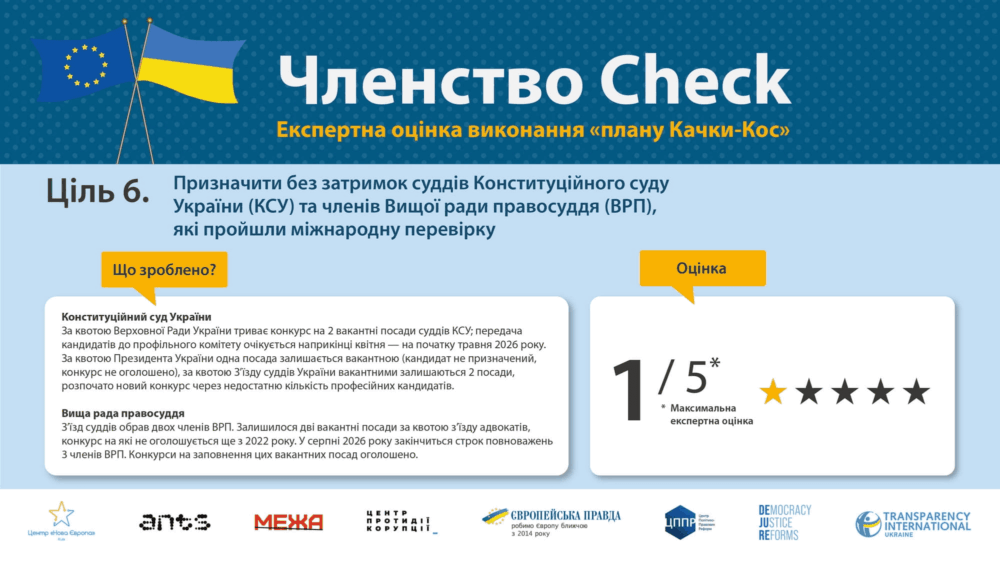
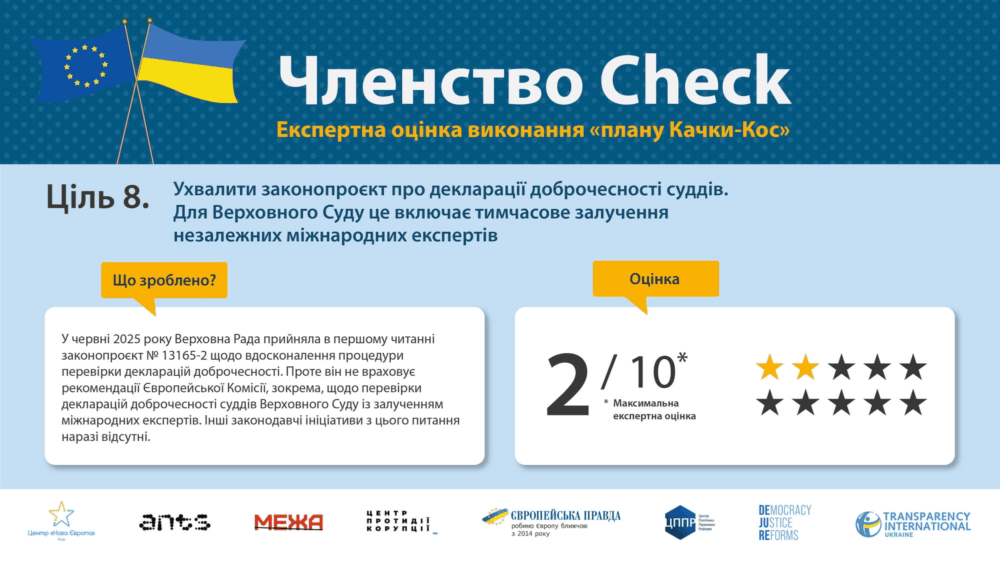
At present, there are only 2 out of 10 points in the plan where Ukraine has achieved at least 20% implementation — that is, a level comparable to a “bill registered” stage — namely points 6 and 8. Moreover, for the latter, even this assessment is somewhat generous. The draft law on judges’ integrity declarations does not take into account a direct requirement of the “Kachka–Kos plan” — it does not apply to judges of the Supreme Court.
Point 6 (the appointment of members of the Constitutional Court and the High Council of Justice who have passed international vetting) is simpler, as this is the element of the plan that does not require any new reforms — Ukraine simply needs to fulfill what it has already committed to.
In contrast, as many as four points of the plan are clear outliers.
Two of them demonstrate the failure of the prosecutor’s office reform, which the European Commission and experts already pointed out last year (see the article “Prosecutor’s Office vs. Europe”). Despite these warnings, Kyiv is currently showing no signs that it has taken on board its European partners’ concerns. It should be noted that, under the European approach, the prosecutor’s office is part of the justice infrastructure, which is why “prosecutorial” requirements were included in this plan.
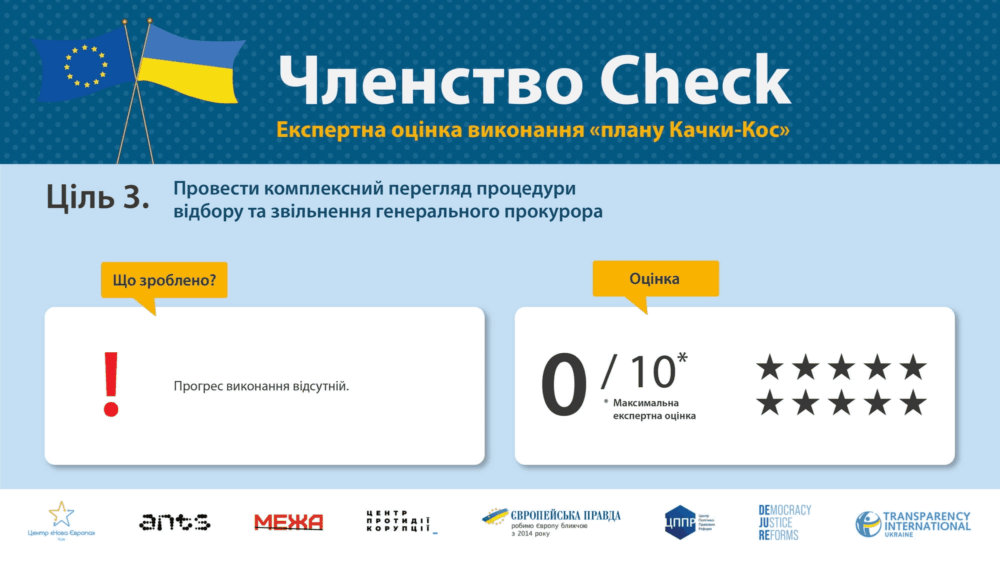
Thus, under point 3 (review of the procedure for selecting and dismissing the Prosecutor), Ukraine has an extremely low score — 0 points and a mark of “no progress.”
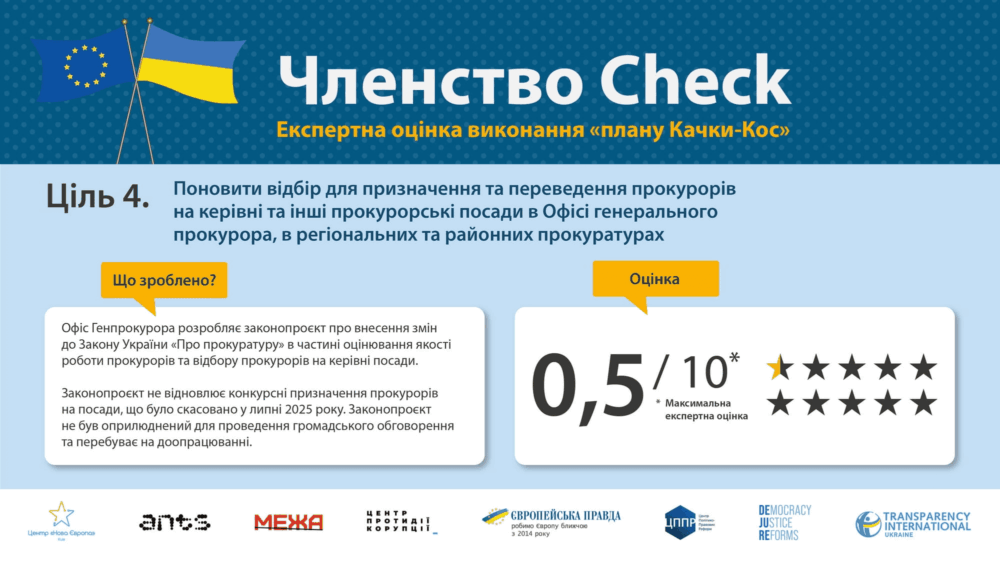
Under point 4 (the requirement to resume the selection of prosecutors for appointment and transfer to senior positions), there are at least some formal actions and discussions, so here Ukraine has 0.5 points out of 10. This reform is particularly important, as it concerns the restoration of the “anti-corruption reform” reversed on July 22, 2025, when parliament voted, and the president immediately signed a law rolling back anti-corruption changes and introducing authoritarian shifts in the operation of the prosecutor’s office. And while the “anti-cor” reforms were eventually restored, the authorities have “forgotten” about the prosecutor’s office and still show no intention of addressing the issue.
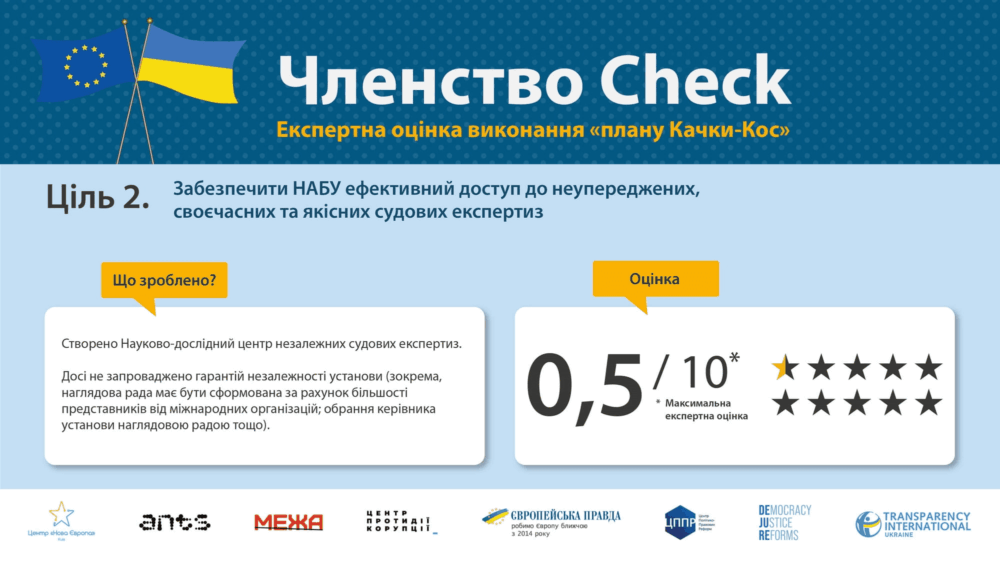
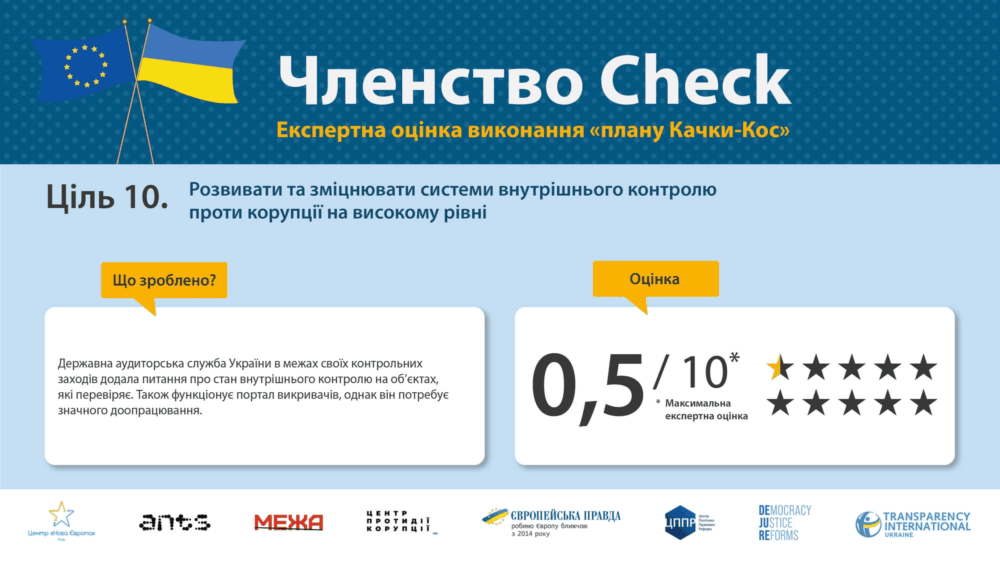
Two more points have extremely low scores of 5% each — point 2 (a forensic tools mechanism for NABU) and point 10 (development of internal anti-corruption control systems). Needless to say, these elements are a litmus test for partners — yet Kyiv has shown no noticeable progress in their implementation.
Another three elements could be described as “mid-performers” in terms of results, as they currently stand at 10 points — that is, slightly above the average score.
But can something be called a “mid-performer” when there are no tangible results?
After all, 10% is a level where there are only general ideas about how to implement a given point of the plan, or statements from top officials, but no official draft decisions even exist.
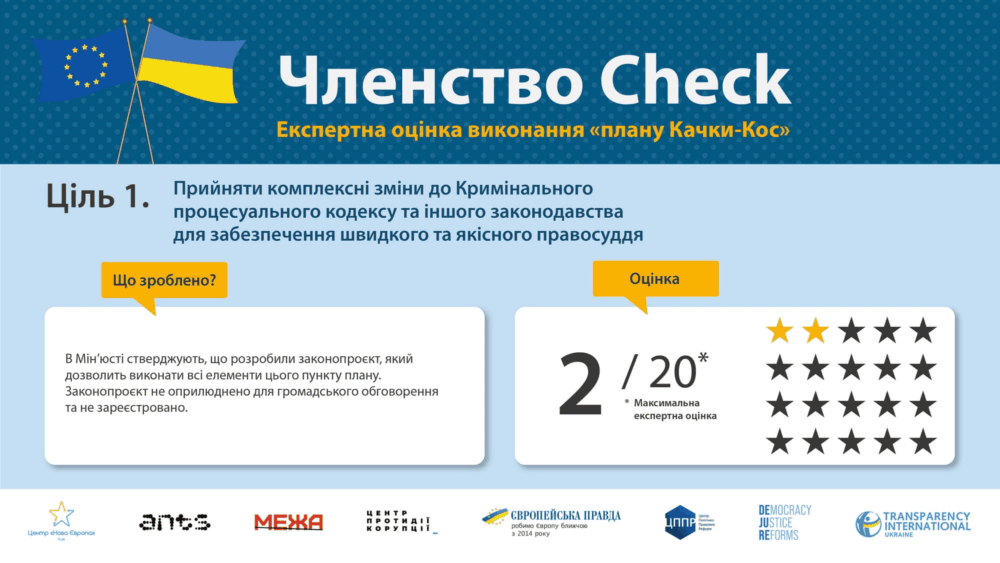
For example, this applies to point 1, which concerns a comprehensive overhaul of the Criminal Procedure Code. There are statements (for instance, by Deputy Prime Minister Kachka) about Kyiv’s intention to fulfill this point, and there even appear to be initial drafts of a bill, but the document has not even been submitted for a government vote.
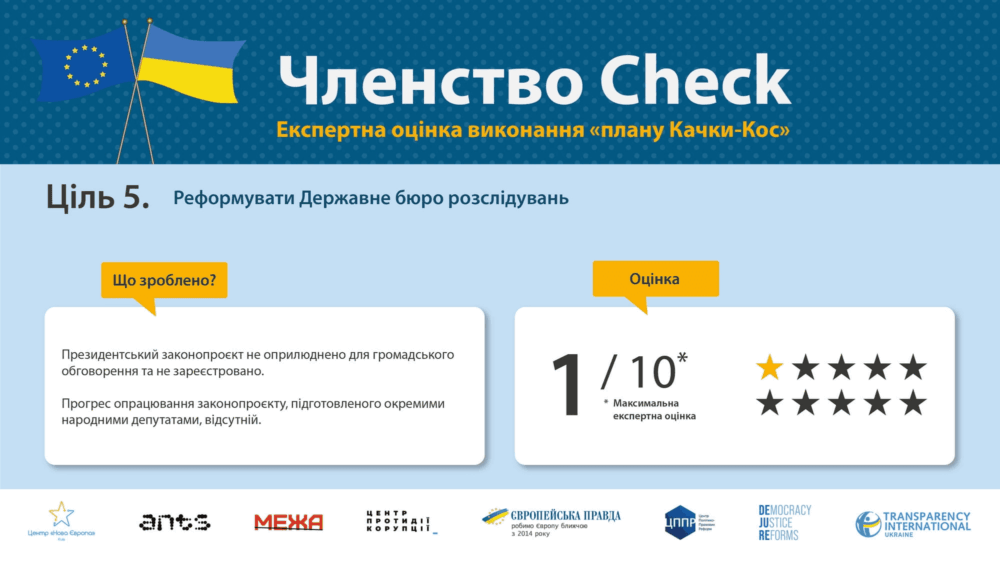
The same applies to point 5 on the reform of the State Bureau of Investigations. There are statements about its necessity, but no documents.
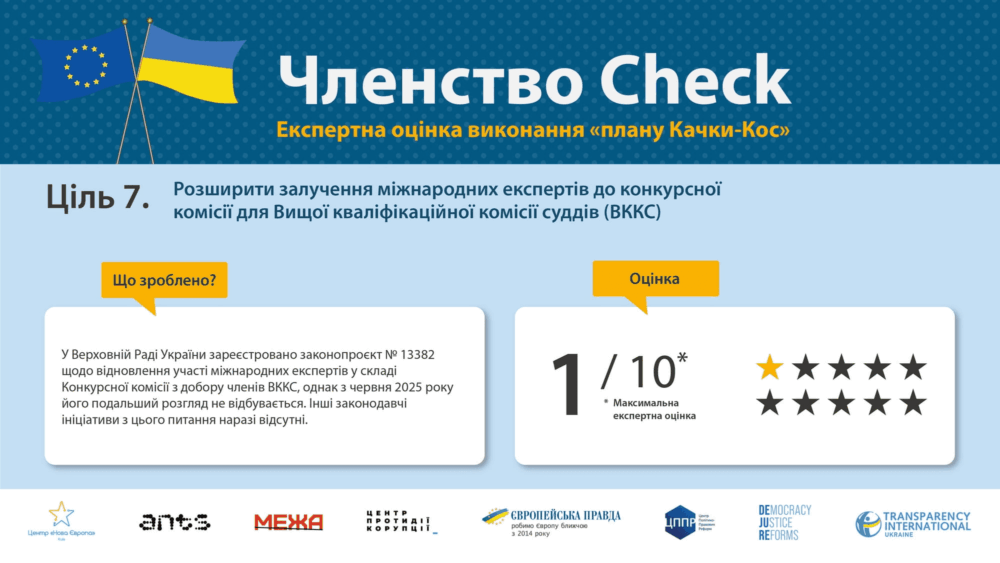
The same situation is observed with point 7 on involving international experts in the selection of candidates for the High Qualification Commission of Judges.
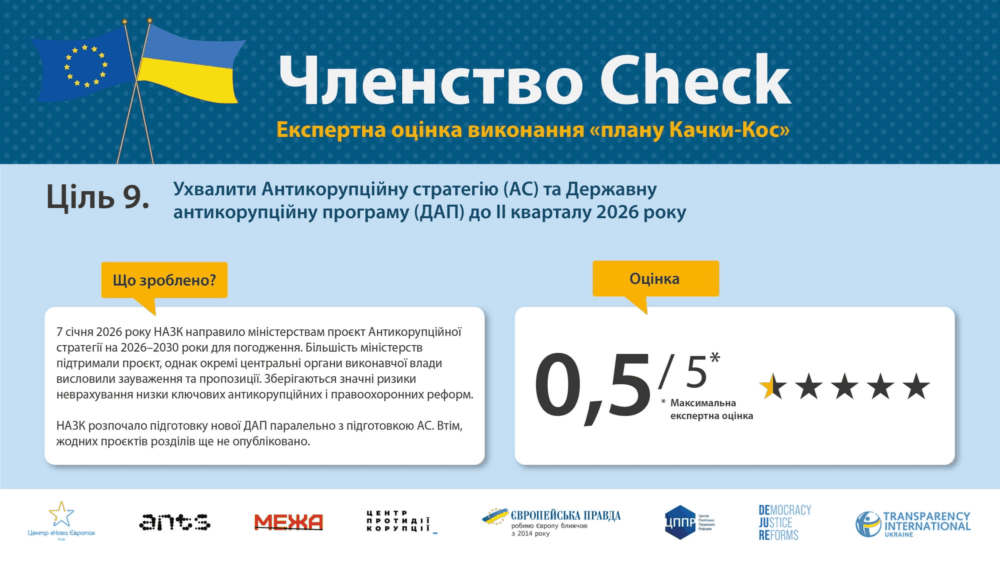
A separate case concerns the approval of the Anti-Corruption Strategy and its implementation plan. This is not a reform per se, but rather a strategic overview of the situation. However, even these steps are still at an initial stage.
What Should Be Done?
Finally, it is worth reiterating that the “Kachka–Kos plan” does not exist in isolation; it represents a concentration of the EU’s most priority requirements for Ukraine within the accession process. All of its elements must be fulfilled both to restore the EU’s trust and to meet the accession “benchmarks” — the criteria used to assess readiness for membership. This means that progress on these benchmarks is also close to zero. The New Europe Center is also publishing detailed conclusions of the consortium for each of the points, describing the link between this plan and the benchmarks.
Thus, the situation that has developed is extremely concerning. And delays in implementing the plan are already having consequences for relations with the EU.
Yes, it may be noted in Kyiv that the parliament is currently not functioning very effectively. But this explanation does not hold.
First, for the EU it does not matter who exactly is slowing down the implementation of changes. Either Ukraine fulfills its commitments, or it does not. After all, it is not the Verkhovna Rada, the government, or any other body that joins the EU — it is the entire state.
Second, the delays are not always due to parliament alone; in many cases, there are not even draft laws in place.
Third, the narrative of a “non-functioning parliament” is very dangerous. If the parliament is unable to pass laws, how can one talk about moving toward EU membership? This path requires the adoption of hundreds of laws. And if Ukraine is unable to do that, then what kind of accession can there be?
Therefore, Ukraine — from the government to parliament and the president — must finally do everything necessary to prove to the EU that it is capable of carrying out fundamental reforms and restoring this process. Progress under the “Kachka–Kos plan” provides an ideal tool for this.
Tags: Anti-Corruption EU accession european union Geopolitics reforms rule of law Ukraine zelenskyy