

Ukraine’s FP-5 “Flamingo” cruise missile has completed testing, entered serial production, and is already striking Russian targets, expanding Ukraine’s long-range capabilities and changing the logic of missile warfare.
On the eve of the meeting between Zelenskyy and European allies with Trump in Washington on August 17, 2025, the first information and photos of Ukraine’s new FP-5 “Flamingo” missile, capable of flying 3,000 kilometers, appeared. Later, President Zelenskyy himself spoke about it, promising that in just a few months Ukraine would have a large number of these projectiles.
The entire second half of 2025 was a period of trial by fire for the “Flamingo.” The missile also narrowly became a victim of political struggles within Ukraine, facing information attacks.
Finally, in February 2026, the proud bird spread its wings and began to cause the Russians significant damage. What is known about the “Flamingo” missile, why it was given this name, its potential, and the benefits it is already providing to Ukraine — read in the 24 Kanal article.
What is known about Ukraine’s new “Flamingo” missile?
On the evening of August 17, 2025, Ukrainian photojournalist Yefrem Lukatsky of the Associated Press shared good news — the new domestic “Flamingo” cruise missiles had entered serial production.
The journalist, who personally visited one of the missile production facilities on August 14, also reported that the missiles have a range of 3,000 kilometers and a warhead weighing over 1,000 kilograms.
This news became a sensation and a piece of good news for Ukrainians, while enemies, on the contrary, were very upset. Not only in Russia, but also in distant Iran (an ally of the Russians), they brushed up on their geography and calculated that the “Flamingo,” if needed, could reach them as well.

On the same day, the start of production of the new Ukrainian cruise missiles was confirmed by Defense Minister Denys Shmyhal.
Later, “Dzerkalo Tyzhnia” published a video on its website showing the launch of a “Flamingo” missile, similar to the German V-1, first during tests and later in combat conditions, striking targets on Russian territory.
On August 20, at a closed meeting with journalists, which included 24 Kanal, President Volodymyr Zelenskyy confirmed the information and stated that by the winter of 2025/2026, Ukraine would have a sufficient number of “Flamingo” missiles, making them impossible to ignore.
“There have been successful tests of our long-range ‘Flamingo’ missile. So far, it is the most successful missile we have — it flies 3,000 kilometers. By December, we will have more of them. And by the end of December or January–February, mass production should begin. We need to look at the success of the tests and at the funding of this program,” Zelenskyy said during a meeting with journalists.
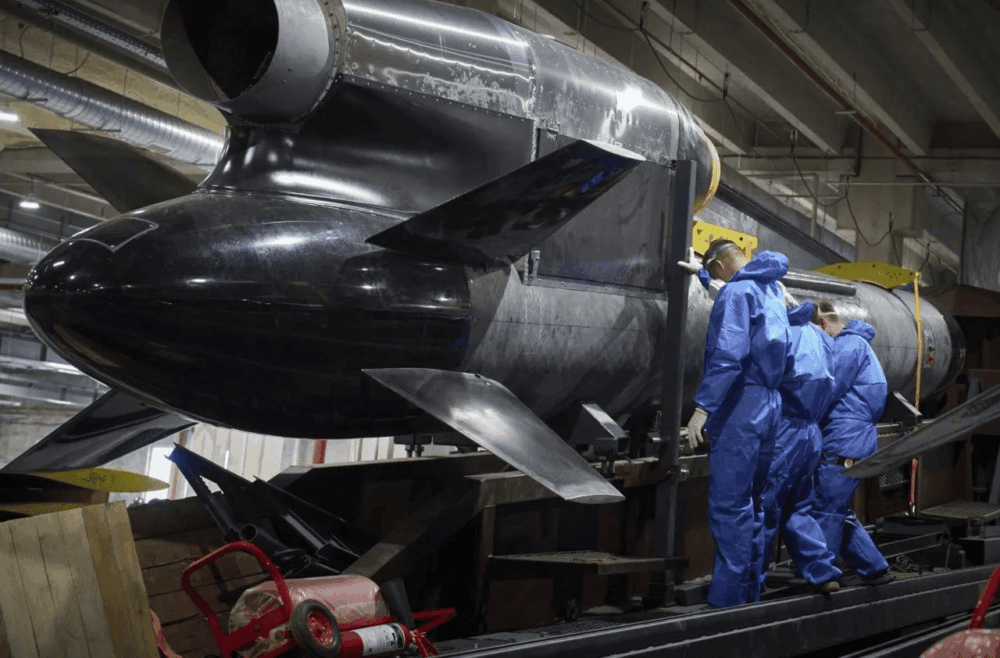
Finally, on August 21, the much-anticipated Associated Press report announced by Lukatsky was released, allowing a clear view of the 6-ton missile itself and providing some details about the “Flamingo.”
Who manufactures the “Flamingo” missiles?
Journalists reported that the missiles are produced by the Ukrainian company Fire Point. Their technical designation is FP-5 (an abbreviation of the company’s name and the model number).
Note! The bird-inspired name is a nod to the pink color of the first test samples, which were mistakenly painted pink. Unfortunately, at a certain stage of production, this novelty — and the option to strike Russians with the power of beauty — had to be abandoned in favor of more traditional colors.
Fire Point produces not only missiles but also drones. Their most successful and already well-scaled project is the FP-1 unmanned aerial vehicles.
Production takes place at the company’s secret factories, which are decentralized and well-protected by both natural obstacles and technical measures.
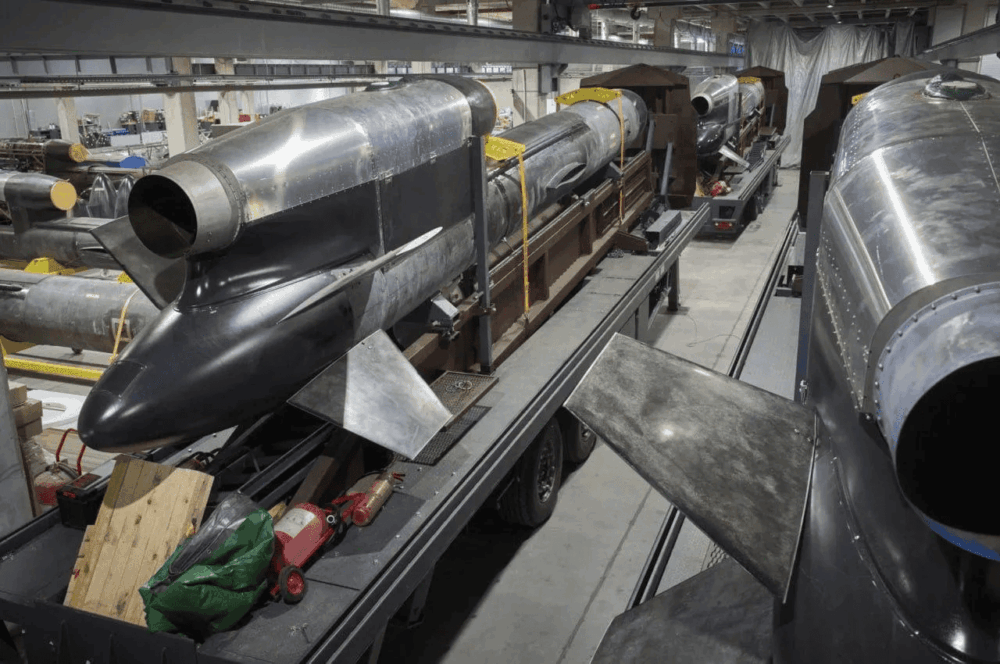
In August 2025, Fire Point was producing one “Flamingo” missile per day. At that time, the company promised to scale production in October to seven units per day, or about 200 missiles per month.
The company Fire Point was founded in early 2022 by close friends who had virtually no combat experience but were experts in various civilian fields (construction, design, architecture). Their goal was the mass production of inexpensive drones that could match the power of the Iranian “Shaheds” used by Russia in the war against Ukraine.
The company’s first successful project was the long-range FP-1 drones, capable of covering 1,600 kilometers. Today, they are responsible for 60% of Ukraine’s “long-range” strikes on Russia.
Now Fire Point has expanded its operations and is scaling up the production of cruise missiles.
Are “Flamingo” missiles better than Tomahawks and Russian “Kalibrs”?
The “Flamingo” is a cruise missile with a range of 3,000 kilometers and a payload of 1,150 kilograms. In terms of payload per second, this is twice as much as the American Tomahawk.
The missile’s deviation from its target is no more than 14 meters, which is an excellent result for such range and warhead power.
“Essentially, the ‘Flamingo’ is Ukraine’s equivalent of the Russian Kh-55 or even ‘Kalibr’ missiles, but much cheaper and, accordingly, more scalable for mass production.”
It should be noted that the “Flamingo” is not purely a Ukrainian development but the result of cooperation between several countries, including the United Kingdom, which grew tired of watching Russian missile terror and decided to balance the sides. So we can expect a new wave of hysterical tweets about the supposed scheming of the Anglo-Saxons.
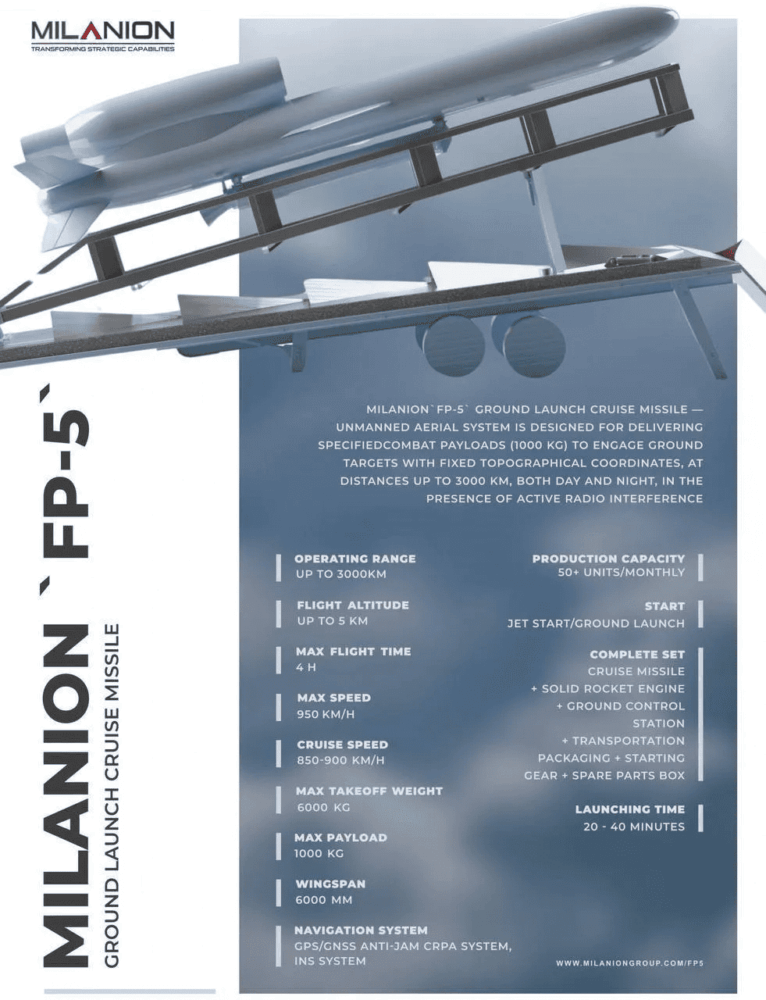
The projectile model was shown by the UAE-based company Milanion Group at the IDEX-2025 arms exhibition in early February 2025. This revealed the missile’s tactical and technical specifications.
FP-5 “Flamingo” – key characteristics:
- Manufacturer – Fire Point (Ukraine)
- Start of serial production – 2025
- Type – cruise missile
- Class – surface-to-surface
- Launch platform – ground-based
- Range – 3,000 kilometers
- Time in flight – over 4 hours
- Maximum speed – 950 km/h
- Cruise speed – 850–900 km/h
- Wingspan – 6 meters
- Maximum takeoff weight – 6 tons
- Warhead weight – 1,150 kilograms
- Maximum deviation from target – 14 meters
- Production rate – 1–7 units per day
Why is disinformation being spread about the “Flamingo”?
At the end of 2025, the project suffered an unexpected setback. Top Ukrainian opposition politicians suddenly (well, not really) felt like experts and began aggressively attacking the “Flamingo.” The campaign was led by former Ukrainian President Petro Poroshenko.
He publicly claimed that the missiles were very poor, the project was raw, and, moreover, already outdated because it used old engines, and that the “Flamingo’s” effectiveness was nearly zero.
According to the politician, FP-5 missiles were just empty PR, supposedly only effective when used in tandem with other systems (for example, the Neptune missiles, whose active development began during his tenure but never reached the required performance). He claimed that on solo flights, “Flamingo” missiles did not hit their targets at all.
Some saw jealousy and pettiness in these statements, while others who still believe this politician felt sadness and betrayal. In reality, however, such claims are manipulative, as someone with no expertise in this field took a single test episode of the missiles (remember, the project was just starting) and presented it as a final verdict.
Another blow to the missile came from a friend of the current Ukrainian president — Tymur Mindich. According to media reports, the 2025 “top corruptor” was somehow connected to the company producing the “Flamingo.” Although Fire Point itself firmly denied these allegations, a negative impression, as they say, remained.
Fortunately, successful “Flamingo” launches in 2026 already disproved Mr. Poroshenko’s claims. And his opponents will be sure to remind him of this.
If we set aside political judgments about the actions of politicians trying to gain PR from the war, it must be recognized that there is no betrayal in missiles of different types working in tandem. This is standard practice, and moreover, effective. Even the Russians are doing this this winter to confuse and bypass our air defense — and unfortunately, they often succeed.
At the same time, comparing the “Neptune” and the “Flamingo” is a big mistake, since the “Neptune” is a complex technological system and also very expensive. In contrast, the “Flamingo” is simple and cost-effective. This project can be easily scaled (which Fire Point is successfully doing), and it is precisely the mass production that creates its impact.
The missile is also still “learning” and correcting its shortcomings in flight. So even if the first prototypes didn’t quite match the hypothetical performance of a Tomahawk or a Neptune, it doesn’t mean “everything is lost.” In reality, it’s just the beginning. The “Flamingo” is learning to fly and evolving. The key point is that this is a flexible project built for the long game.
How the “Flamingo” strikes Russia
On February 12, 2026, first Russian bloggers and then the General Staff of the Ukrainian Armed Forces confirmed the destruction of an arsenal at a combined storage site for missiles, ammunition, and explosives of the Main Missile and Artillery Directorate of the Russian Ministry of Defense near the village of Kotluban in Volgograd Oblast.
Thanks to attentive Russians, powerful explosions at the site were recorded, followed by secondary detonations. This location is one of the largest ammunition storage sites for the Russian army.
The explosions were caused by FP-5 “Flamingo” missiles, which hit the target located about 500 kilometers from territory under Ukrainian control.
In response, the Russian General Staff hurriedly claimed that the occupiers’ air defenses had shot down five “Flamingo” missiles. In reality, there were at least six, clearly visible in videos of the missile launches on the night of February 12.
The attacks on the GRAU facility in Kotluban were not the FP-5’s only success. Earlier, in January 2026, “Flamingo” missiles destroyed infrastructure at Russia’s Kapustin Yar test range, known as the “home” of Putin’s “Oreshnik,” and in November 2025 they caused explosions in the temporarily occupied territories of Crimea and Zaporizhzhia Oblast.
These operations became further confirmation that the “Flamingo” has a future — and that Russia has serious problems.
What should Russians prepare for next?
The new Ukrainian missile uses satellite navigation resistant to electronic warfare, as well as an inertial guidance system.
So once the “Flamingo” completes its nesting period and finally heads into full migration (and as of February 2026, this seems to be exactly what is happening), it will become a serious challenge for Russia. The Russians will now have to deploy even more air defense systems and fly their aircraft far more intensively — aircraft that are already in short supply, having either been destroyed or worn down to exhaustion.
Ukraine has now gained even more opportunities to strike targets inside Russia.
And there is no need to listen to skeptics who claim that such a “behemoth” is easy to detect in the air and therefore easy to destroy. It is not easy — and the successful strikes by our old “Stryzh” drones only confirm this. Moreover, the number of “Stryzhs” could be counted on one hand. But what will Russia do when hundreds of six-ton missiles, each carrying a warhead nearly comparable to the much-hyped “Oreshnik,” start flying toward it?
The missile is launched from a ground-based platform, and the missile itself has a fixed straight wing that does not fold. All these compromises were made in favor of mass production and lower cost.
Launching a “Flamingo” takes up to 30–40 minutes, but given the missile’s range, this is not a problem, as it can be deployed deep inside Ukrainian territory and still strike targets even in Moscow. First and foremost, however, it is meant to hit production facilities and logistics hidden beyond the Urals.
Ukraine is forced to launch missiles from the ground, while a significant number of Russian production sites are located beyond the Urals. Reaching them requires a missile with a range of 3,000 kilometers. This will make it possible to eliminate not only military production facilities but also logistics linked to North Korea,” military expert and founder of the NGO “Reaktyvna Poshta,” Pavlo Narozhnyi, told 24 Kanal, outlining potential priorities for the “Flamingo.”
So now Russians will no longer be able to shell Ukrainian cities with impunity — they will face a mirror response, as well as denazification and demilitarization.
Tags: long-range weapons Moscow range missile Russia threat Ukraine missile breakthrough Ukraine war tech





![Ukrainian Roboneers and Latvian partners at the signing of a defence robotics and underwater technology cooperation memorandum. :contentReference[oaicite:2]{index=2}](https://empr.media/wp-content/uploads/2026/02/oboronka-480x270.png)









![Visitors at the “Thank You With All My Heart” Ukrainian exhibition at the Council of Europe, featuring the Great Amber Heart and powerful war art. :contentReference[oaicite:2]{index=2}](https://empr.media/wp-content/uploads/2026/02/heart-300x171.png)


![Ukrainian Roboneers and Latvian partners at the signing of a defence robotics and underwater technology cooperation memorandum. :contentReference[oaicite:2]{index=2}](https://empr.media/wp-content/uploads/2026/02/oboronka-300x168.png)