Yurii Ihnat discusses emerging Russian drone threats, Ukraine’s air defence capabilities, Starlink’s role in combat operations, preparations for a difficult winter, and the need for continued Western support.
Jet-powered Shahed drones, which previously mostly targeted Kyiv and central Ukraine, are now reaching the Lviv and Volyn regions. Russia is testing their range, increasing its use of missile-drones, and developing networked control of unmanned aerial vehicles. Meanwhile, Ukraine is testing new interception systems, while it has to practically beg its allies for Patriot missiles a few at a time.
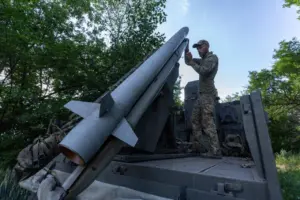
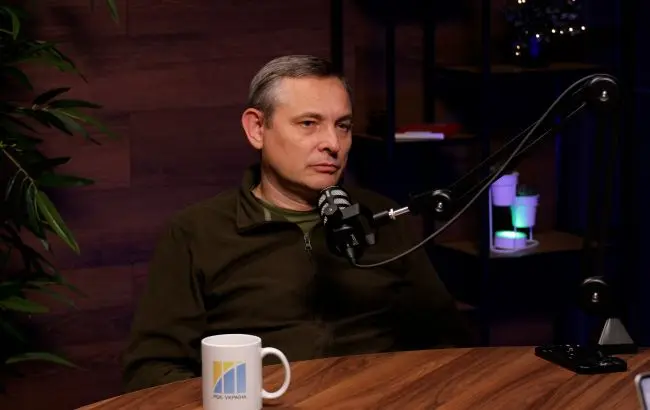
How jet-powered Geran drones are reaching Ukraine’s western regions, which systems are most effective against the new drones, how effective AI-powered turrets are, and how the shortage of interceptor missiles affects the defense of Ukrainian airspace were discussed on RBC-Ukraine’s podcast TSE BAZA by Yurii Ihnat, Head of the Communications Department of the Ukrainian Air Force Command.
Key Points:
- Interceptor Missile Shortage: Ukraine sometimes has to ask its allies for literally just a few missiles at a time. The ammunition expended in the Middle East would have been enough to sustain Patriot operations for years.
- How Jet-Powered Drones Reach Lviv: The Russians may reduce the warhead size to increase fuel capacity. Ihnat does not rule out the possibility that these drones are being used for reconnaissance and to test their range.
- Air Defense Effectiveness: During some attacks, up to 85% of jet-powered drones are shot down. Fighter aircraft achieve the highest interception rate against these drones, while AI-powered turrets are deployed at low altitudes. Jet-powered interceptor drones are still undergoing combat testing.
- Russia’s New Missile-Drones: Last month, Russia deployed around 350 Banderol and Dan-T drones, with the latter expected to gradually replace the former.
- Dependence on Starlink and Starshield: Satellite communications are used by helicopter crews, tactical aviation, and jet-powered interceptor drones. If the United States restricts terminal speeds at high velocities, air defense effectiveness will decline.
- Aviation Reform by 2035: Ukraine is transitioning to an air wing structure, with the 107th F-16 Wing already established, and preparing universal air bases capable of accommodating any type of aircraft, including the Gripen.
Ballistic Missile Warnings
– Just a few hours before our meeting, a ballistic missile was heading toward Kyiv. One of the pressing issues in recent weeks has been warnings about Russian ballistic missile launches. On several occasions, we were not given any warning. Could you explain the current situation?
– Unfortunately, there have been cases when we did not receive information from our partners. The President of Ukraine has also spoken about this. And there is no point in hiding it: sometimes an explosion occurs first, and the air raid alert sounds only afterward or at the same time.
But in any case, we rely on information from our partners. We have our own information sources and intelligence capabilities. We have radar coverage over Ukraine – we can detect aerial targets at certain distances beyond Ukraine’s borders, up to several hundred kilometers away.
At the same time, we receive information and intelligence from our partners about the use of ballistic missiles and missiles that attack along a ballistic trajectory, such as Zircon hypersonic missiles and missiles for the S-400 system, among others. It is critically important for us to receive this information as quickly as possible.
Do you remember the recent attack on Kyiv, when around 39 missiles were launched? During the first wave, at around 10 p.m. (on the evening of October 18, – ed.), we unfortunately did not receive a warning for certain reasons. Perhaps there were technical issues, or perhaps something else. Our partners are now working with our specialists to determine what happened and are doing everything possible to ensure there are no such gaps in the future.
After 10 p.m., there were three more waves of attacks, continuing until 7 a.m. It was one of the largest attacks. During the subsequent waves, warnings did arrive, sometimes earlier and sometimes later. But even those few minutes gained thanks to a warning make an enormous difference. People, especially residents of major cities such as Kyiv, have at least some time to find shelter somewhere: to come down from the upper floors, move to a lower floor, or reach the nearest shelter, because when it comes to ballistic missiles, every second counts.
– How does this warning system work in practice? Is there a flash that, as experts say, can be detected from space?
– Of course. We may also have human intelligence sources that can inform us that a launch is being prepared somewhere. But it is clear that space-based intelligence is of great interest to us. Many countries around the world have satellites that monitor the Earth’s surface, making it possible to detect a flash. This could be a missile launch, and not just a ballistic missile launch, but also a multiple-launch rocket system (MLRS). Such launches can be detected from space, weather conditions permitting.
That is why we rely on receiving this information as quickly as possible and then transmitting it just as quickly through the Air Force’s alert system. The relevant procedure then kicks in. Some processes are automated and operate very quickly. The information is relayed to the State Emergency Service of Ukraine (SES), to the main control post, and to civil protection authorities. The sirens and loudspeakers are then activated, and notifications are sent through the Air Alert app.
– The app now shows which targets are currently in Ukrainian airspace…
– Yes. This is a joint project involving the Ministry of Digital Transformation, the Ministry of Defence, the General Staff, and the Air Force. Information about aerial targets that now appears in the app comes from our systems – specifically, the Virazh-Tablet system. However, the information displayed there is quite limited.
There is a separate explanation available that you can read about why this does not compromise security and why the enemy cannot obtain the information it needs through the app. The main goal of the updated app is to alert the population as effectively as possible. It displays Shahed drones, guided aerial bombs, and cruise missiles. Unfortunately, the app will not show ballistic missiles…
– It simply won’t have enough time, as I understand it.
– Yes. Perhaps something will be developed in the future. But the agencies I mentioned have made the Air Alert app more effective.
It is no longer just a map that turns yellow or red depending on the threat level. Now, for example, small markers indicating Shahed drones, including jet-powered ones, appear on the map. You can tap on a marker, zoom in, and see which region the target is flying over, its speed, and its direction.
Of course, the information may be somewhat inaccurate to avoid compromising Ukraine’s defense. But the level of public awareness will be high enough for anyone with a smartphone to make an informed decision.
– How will it help if the information is obviously provided with a delay? We don’t want to give the Russians an accurate picture of what’s happening. But that means we’re not giving ourselves one either.
– Look, there is the real-time Skymap, as well as our Virazh-Tablet and Delta systems. The Ukrainian Armed Forces use many different systems. They contain highly detailed information about both enemy and friendly targets, including their movements, direction, and exact locations. Of course, all of this is intended for military use.
As for the civilian app, believe me, there were a great many discussions about it. Experts debated at length how exactly to present the information without compromising security. All the risks were taken into account, while also ensuring that the app would be convenient for the public. From what I can see, people have responded well to it. Of course, there will be criticism too, but we’ll see how things develop.
It is still effectively operating in test mode. There were problems at launch because millions of Ukrainians accessed the app at once, placing an enormous strain on the system. Traffic was extremely high, and the app kept crashing. But those issues have now been resolved.
The app also makes our work easier, including for our press service. We run the Air Force’s official Telegram channel. I have officers working around the clock, taking turns on duty. It is difficult for the communications team to handle both alerts and media relations at the same time.
Perhaps in the future, the app will take over some of this role. Telegram channels that currently publish essentially the same information will then no longer offer anything unique in that regard, because the app itself will display it all.
However, we will continue to issue warnings about ballistic missiles, because this is a matter of public safety.
– I fully understand that you do not comment on political issues, but the suspension of intelligence sharing is nevertheless being viewed as a possible means of pressure by the United States on Ukraine. Experts say we receive satellite data not only from the US but also from our European partners. If we assume that the US has withdrawn from this system, will we be able to rely on data from other partners in the future? Or will it always be insufficient?
– We receive information from NATO centers. We have partners such as the United Kingdom, France, Germany, and other countries. Of course, we rely on all of them, including the United States.
We would not want to lose this cooperation under any circumstances, because we can see how much American weaponry and technology the Armed Forces of Ukraine, particularly the Air Force, use. Even European weapons systems – including the Gripen aircraft we hope to receive – contain a significant proportion of parts and components made by the American company Lockheed Martin.
Intelligence is a very broad term: it includes information about the situation along the front line and much more. We are also counting heavily on our partners to continue providing us with this data consistently, because having accurate information about what is happening is extremely important.
Air Defense and Patriot Interceptor Missiles
– Regarding interceptor missiles, as I understand it, the issue is not just who does or does not supply them to us, but also how many are actually being produced. Production is far lower than the number of ballistic missiles Russia, North Korea, and China manufacture. In other words, there are simply fewer anti-ballistic missiles available. Will this always be the case?
– I think we are entering a stage where we must be prepared for these kinds of challenges. Let’s look at the three most recent missile attacks: one involved around 39 missiles, another 16, and today’s attack involved 23. If we include isolated launches, that comes to around 80 missiles in a week. At that rate, we are talking about more than 300 missiles a month attacking along ballistic trajectories. Although I doubt the Russians will be able to sustain this pace indefinitely, their stockpiles are not unlimited either.
However, if the enemy launches more than 300 such missiles a month, an obvious question arises: how many PAC-2 and PAC-3 interceptor missiles for Patriot systems would we need, or how many missiles for other advanced systems promised to us by France and Germany? These include the SAMP/T NG and a new version of the IRIS-T, which is reportedly expected to be capable of intercepting ballistic missiles.
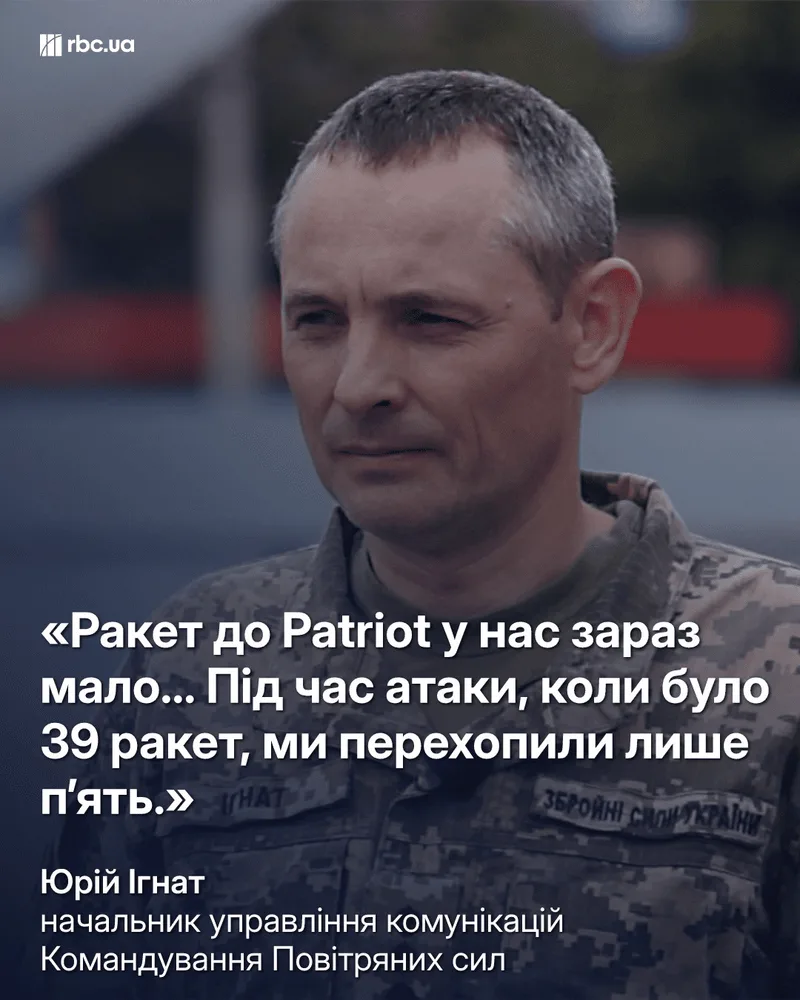
This is a rather complicated question. You understand that we have so few missiles at the moment… During the attack involving 39 missiles, we intercepted only five.
What could help in such a situation? A preemptive response – in other words, taking reciprocal action. We need to strike their launchers and the facilities that manufacture the missiles themselves and their components. Most importantly, we must continue working with our partners to maintain sanctions pressure.
The Lindsey Graham Act is one example of a measure the US administration should consider introducing to force Russia to agree to the kind of peace Ukraine seeks – a just peace. Strong sanctions targeting Russia’s oil and gas sector could be what compels it to stop. Missiles and drones are an extremely expensive undertaking, costing billions of dollars. And that’s without even mentioning aviation.
– Objectively, Ukraine’s own “sanctions” are not enough – we cannot completely destroy all operational-tactical missile systems (OTRKs) and all the factories. Some facilities, such as those in Alabuga, are even being moved underground.
– Or they build triple layers of air defense. I was watching the news just recently: they are already building towers equipped with turrets and deploying Pantsir and Tor air defense systems, and so on. Essentially, they are creating an impregnable fortress against Ukrainian drones, as I understand it. But fortresses exist to be destroyed.
– Are there still Patriot PAC-3 interceptor missiles in Europe that we can ask for? Or are their capabilities already limited, meaning they have to retain certain stockpiles for their own needs?
– Of course. The President, the Minister of Defence, the Commander-in-Chief, and the Commander of the Air Force regularly meet with representatives of our partner countries. Sometimes we literally have to ask for just a few missiles because the situation is such that a particular facility needs to be protected. And I am talking not only about Patriot systems, but also about other systems.
You can look at which countries have Patriot systems in service – the list is well known: Spain, Poland, Romania, Germany, the Netherlands, and others. These countries consistently support us, and we are always grateful to them for that.
– They are gradually handing them over while reminding us that they, too, cannot afford to run out of missiles.
– Of course, they cannot be left without protection. But, you know, as one high-ranking military official put it, “If you don’t give them to us now, they definitely won’t be able to help you later.” He was referring to the S-300 missiles that Slovakia, Bulgaria, and other countries transferred to us at the time. And it is precisely through such face-to-face meetings that we manage to reach agreements.
Today, we have one of the newest systems in service – the German IRIS-T. It comes in two variants, SLM and SLS, with missiles that have different characteristics. Germany is already moving forward and developing a new system designated X, which will likely be capable of intercepting ballistic missiles.
However, developing all this and scaling up missile production to counter a giant like Russia takes time. Unfortunately, European countries – including France and Italy with their SAMP/T project, and Germany with IRIS-T – began ramping up production of both the systems themselves and their missiles very late, only after this war had already begun.
– Are they actually scaling up production?
– Of course they are. Foreign manufacturers can invest in technology and weapons production for the Ukrainian Armed Forces and, accordingly, make money from it.
Ukraine can become an important part of collective security, where companies such as Lockheed Martin, Rheinmetall, and French corporations can operate and receive payments for their work. Since the first days of the war, the equipment supplied to us by these countries has been tested in combat conditions. All the shortcomings revealed on the battlefield, as well as all the successful outcomes, are documented and immediately shared with our partners.
– And then the Middle East happens, where they shoot down targets using extremely expensive interceptor missiles…
– That’s not what I’m talking about. I’m talking about Ukraine’s experience. Ukrainian experience is being studied. Look at how much the tactics for using Patriot have changed. For example, instead of using Patriot as a stationary system, as the Americans do when they keep it at airfields or bases, you can make it, so to speak, “mobile”: set up an ambush, shoot down five aircraft, and return unharmed. Do you remember that incident in Russia’s Bryansk region?
That is one example of how Ukrainians have learned to use Patriot in real combat conditions. There are others, too – including firing one missile at one target rather than launching eight missiles, as has sometimes happened in the Middle East. Lacking this kind of experience, they could fire an entire salvo of interceptor missiles from a launcher at a single Shahed drone or ballistic missile. After all, Patriot can operate in automatic, semi-automatic, and manual modes. If it is set to automatic mode, a huge number of missiles can be launched.
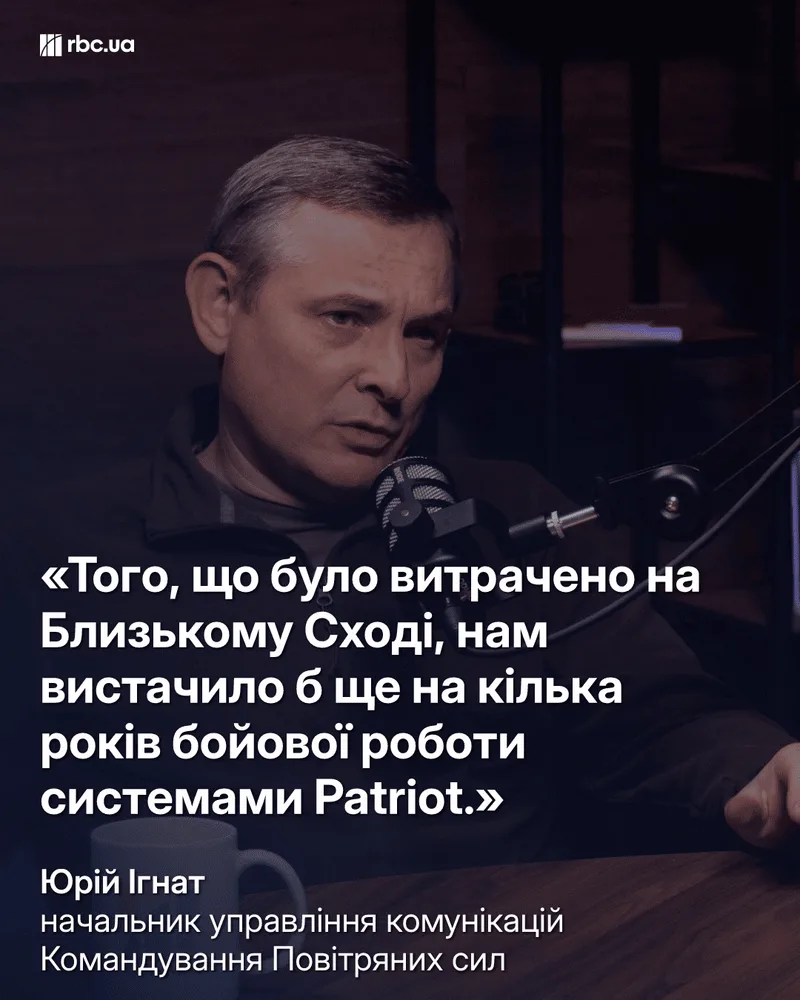
That is why we are now facing the crisis we find ourselves in: the missiles expended in the Middle East would have been enough to keep our Patriot systems operating in combat for several more years.
Ukrainian Air Force Aircraft Fleet
– How realistic is it to scale up production of Patriot interceptor missiles? US officials have promised to increase production.
– The President and the country’s top military leadership – the Minister of Defence, the Commander-in-Chief, and the Commander of the Air Force – have met with representatives of Lockheed Martin. We really do need to work with this company. We have a lot of weapons manufactured by them. Moreover, the Gripen fighters, which we very much hope to receive as soon as possible, could help us gradually address the problem of guided aerial bombs to some extent.
In addition, we have F-16 fighter jets. During the President’s talks with company representatives, they discussed how these aircraft could be made more effective. After all, we did not receive the latest F-16 variant, but the Block 15, which had already been in service before we got them, and their service life is not unlimited. We operate them very intensively, especially over the past three months, when we have had to intercept thousands of Shahed drones. Last month, for example, there were around 3,500 jet-powered targets.
Accordingly, Lockheed Martin could improve the capabilities of the aircraft we already have, as well as carry out repairs or upgrades.
Our pilots’ dream when it comes to the F-16 is to receive the latest variants, the Block 70/72. These would allow them to take on Russian Su-35s with a fair degree of confidence.
Many of our pilots discuss the Gripen because it is a relatively low-maintenance aircraft and one of the least expensive to operate. Initially, we could receive aircraft that have already been in service, in the C/D versions – Charlie and Delta. However, the Swedish company Saab is already working on a newer variant, the E – Echo, which has very impressive capabilities.
We already need to be thinking about a strategy for developing the Air Force after the war. A strategy has already been drawn up through 2035, outlining what the Air Force will look like, what types of weapons we will have, and what its organizational structure will be. As far as aviation is concerned, this involves creating aviation units known as “wings.” For example, yesterday we launched a Facebook page for the 107th F-16 Air Wing, which may publish materials about its work.
Many of the operational airfields across Ukraine that we have been using throughout this war will serve as the basis for new air bases. These bases will be capable of accommodating any type of aircraft. For example, there is currently an airfield in Ivano-Frankivsk where the main aircraft type is the MiG-29, and all the infrastructure there is designed to maintain and support that aircraft. Future air bases across Ukraine, however, will need to be able to accommodate any type of aircraft. This is in line with NATO standards, and that is precisely the direction we are moving in.
– As of today, and looking specifically at this year, has the Air Force increased the number of aircraft it has, or are we simply wearing out our existing fleet?
– We are receiving new equipment gradually. Last year, it was announced that several Mirage and F-16 aircraft, as well as MiGs, had been delivered. Unfortunately, however, we are also suffering losses, including the loss of pilots. These are extremely painful moments. We also lose equipment on the ground – even if an aircraft has not been destroyed, it may still need to be restored.
– Is this the result of Russian strikes on our airfields?
– The Russians carry out drone strikes virtually around the clock. Take the very app we discussed: you can see that Shahed drones are constantly in the air, and airfields are among their priority targets. A helicopter can still land somewhere on a separate pad and be more or less hidden. An aircraft, however, needs a runway and suitable shelter.
As foreign partners tell us, it is already a miracle that we are still able to keep these aircraft, conceal them, and deploy them – both to strike targets on enemy territory and to defend our own.
– So they have to keep taking off, given that Shahed drones are constantly flying toward airfields?
– Either take off, or come up with something, find a workaround, outsmart the enemy. That is the art of war – deceiving the enemy. Information and psychological operations are also part of non-kinetic operations. As the saying goes, if you want to survive, you have to learn to improvise. That is why our anti-aircraft gunners, radio-technical troops, logistics personnel, and unmanned systems operators are making unconventional decisions on the ground today.
How Ukraine Is Countering Jet-Powered Drones
– How has the effectiveness of shooting down jet-powered Shahed drones changed since August, when Russia began deploying them on a large scale? We can see that the interception rate seems to have increased, but that doesn’t mean Ukraine has definitively found an answer to the challenge posed by Geran-5 drones, does it?
– Of course, everyone wants to see a higher interception rate – ideally, 100%. Unfortunately, with so many drones being launched, that is impossible.
The attacks continue around the clock, our supply of missiles is limited, and then there are the vagaries of the weather – dense fog, clouds, and precipitation. Most of our systems today require visual tracking of the target. That means either an operator’s eyes, optical targeting cameras, or a laser. This applies to both ground-based systems and airborne platforms.
– So cloud cover works in Russia’s favor in this case?
– In some ways, yes. But on the other hand, it also makes things harder for them. If a drone is controlled via communication links or mesh networks, the Russian operator would also want to see what is happening. So they probably have to fly the drone at a lower altitude. And when visibility is poor, even that does not help much.
However, they can launch drones using coordinates or control them directly through an operator, using various communication links. Naturally, this makes things more difficult for us, so the interception rate drops in such weather. Overall, though, it is still increasing.
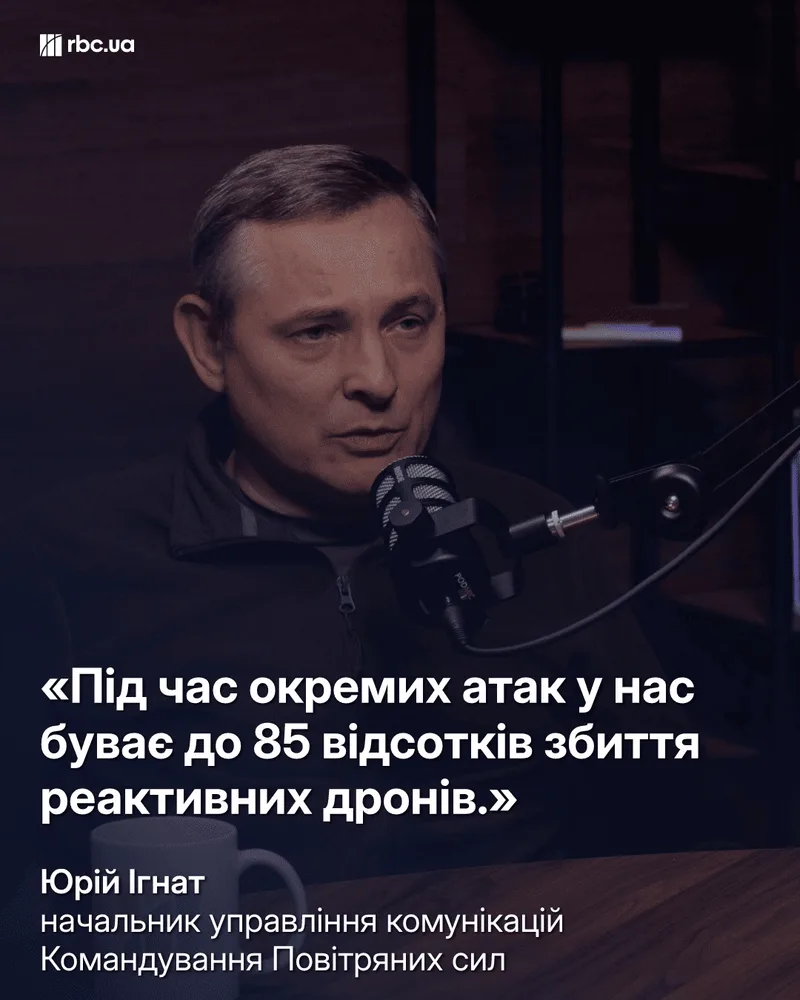
During some attacks, we manage to shoot down as many as 85% of jet-powered drones. That is a very high rate. But if 100 drones were launched in a nighttime attack and we shot down 85 of them, did we do a good job? Of course we did.
– But 15 got through.
– Yes. And those 15 could hit a 110 kV substation, a 330 kV substation, some other facility, or even an Epicentr store – causing a huge warehouse to burn down or disrupting railway traffic.
However, given our current level of resources, particularly our missile supplies, the interception rate is quite high. We are counting heavily on the aviation component. Helicopters have performed very well against conventional Shahed drones powered by internal combustion engines. Fighter aircraft, meanwhile, have the highest interception rate specifically against jet-powered drones.
– Not interceptor drones?
– Jet-powered interceptor drones are still undergoing combat testing. Of course, Starlink is used for this purpose. We really need this type of connectivity, primarily because operating interceptor drones requires high-speed internet access.
There are promising models that the President and the Minister of Defence have already spoken about. Certain technical issues still need to be resolved, and manufacturers are working on them together with our crews. Our best crews are testing these systems directly in combat conditions, with manufacturer representatives and technical specialists present.
Thanks to intelligence, we identify locations where enemy drones are likely to fly through. We need to be in the right place at the right time, precisely when a drone passes over the area where a crew is operating. After all, interceptor drones also have a limited range.
Jet-powered interceptor drones need to fly faster than the jet-powered drones attacking us. If the latter fly at around 400 kilometers per hour, an interceptor needs to reach a speed of, say, 800 kilometers per hour or even more.
Ukraine needs to accelerate this process as much as possible to find a solution, because our interceptor drones are significantly cheaper than jet-powered Shaheds.
– So for now, the Air Force is doing most of the work against jet-powered drones, and that comes at a high cost?
– We use every means at our disposal. The Air Force covers the areas where it can operate, but it cannot operate simultaneously with ground-based air defence systems, to avoid friendly fire.
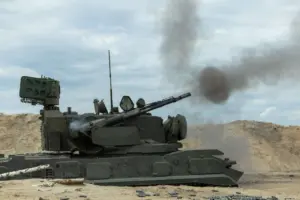
Closer to cities or certain facilities, our personnel use MANPADS and surface-to-air missile systems. We have various systems, including the FrankenSAM project and vehicles equipped with laser-guided Hellfire missiles.
Electronic warfare systems are also in operation. They disrupt many of the enemy’s systems, too. Not all of their systems are equally well protected or equipped with the relevant 32 elements on their antennas.
We have even had cases where drones were shot down with assault rifles, although, of course, that happens rarely.
In other words, each system is deployed where it is most effective. We forecast enemy attacks based on intelligence about where an attack is expected to come from, which targets the enemy intends to strike, and which critical infrastructure facilities are its priorities. Air defence lines are then established accordingly.
Mobile fire groups, which some have already begun to write off, are still operating and achieving a certain level of effectiveness within their own echelon, engaging targets within their reach.
Quadcopter-type interceptor drones are also delivering results. These are conventional, standard models that we have scaled up and which work well against conventional Shahed drones.
There are also turrets, which have been the subject of much discussion lately.
– Are turrets automated machine-gun systems that essentially operate on their own, without human involvement?
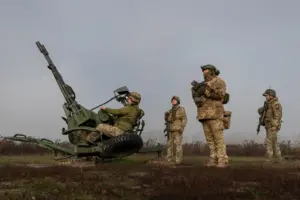
– Yes, they use artificial intelligence. There is an automated system that can lock onto a target at a long distance and track it. However, the machine gun itself has a limited range – around one kilometre, perhaps a little more. The turret also needs to be in the right place at the right time, possibly on elevated ground.
In any case, such a system is not fully autonomous; human intervention is still necessary. We cannot simply position a loaded machine gun and let it fire wherever it wants. In addition, our air defence provides both area and point defence, protecting specific zones and facilities. Accordingly, turrets can also protect a particular defensive line.
You can watch a feature on short-range air defence on the Ukrainian Air Force’s YouTube channel. It already includes examples of turrets shooting down even jet-powered drones – apparently, even a Geran-5. But all the conditions were right in that instance: the target entered the engagement zone, visibility was good, the turret locked onto it, rotated, fired several bursts, and the drone was shot down. To be honest, I didn’t believe it was possible myself until I saw it with my own eyes.
– And the target had to be within roughly one kilometre, no farther away?
– It was flying at low altitude. When a target flies low, that layer is covered by mobile fire groups, turrets, and other systems. If it flies higher – at around 4.5 kilometres or above – aircraft and surface-to-air missile systems engage it.
– Why have jet-powered drones started reaching Rivne, Volyn, Khmelnytskyi, and Lviv regions – the western regions of Ukraine in general?
– In terms of its tactical and technical characteristics, a jet-powered UAV is already closer to a cruise missile. Cruise missiles can reach Lviv.
It depends on the specifications of a particular drone, how much fuel it carries, and the size of its warhead. If the warhead is removed entirely or its size is reduced to a minimum, more fuel can be carried, thereby increasing the drone’s range.
The entire payload of Shahed drones consists of reconnaissance equipment, electronic warfare countermeasures, a warhead, and optical systems. The jet engine itself also adds weight, as does the fuel. If some of the payload is removed, including the warhead, the drone can fly farther and, for example, conduct reconnaissance over Ukraine’s western regions.
In this way, they are also testing these jet-powered drones to assess their range. We had not seen such cases before. The Geran-5 already looks more like a cruise missile, doesn’t it? In terms of its shape and wings, that is. That is why we call it a “missile-drone.”
The same applies to loitering munitions. For example, the S-8000 (“Banderol”) or the “Dan-T.” It is a missile-drone or a loitering munition – what matters less is what you call it. It is a dangerous weapon because it is launched from an airborne platform, although its range is not as great – approximately 600 kilometres.
Initially, these weapons were launched from the Orion strike-reconnaissance UAV, and later from helicopters. Perhaps they are now moving towards launching them from aircraft.
– Do the “Banderol” and “Dan-T” pose a greater threat to us now?
– There are far fewer of them. Last month, there were around 350. Their numbers are approximately ten times lower than those of jet-powered UAVs.
– So the Russians are unable to produce them in large quantities?
– For now, it seems they cannot scale up production to the same extent. But we do not know the full extent of their capabilities and resources. They began using “Banderol” drones about a year and a half ago. Initially, there were isolated cases over the Black Sea, heading towards the Kherson and Mykolaiv regions. Remember the reports about loitering munitions flying in circles?
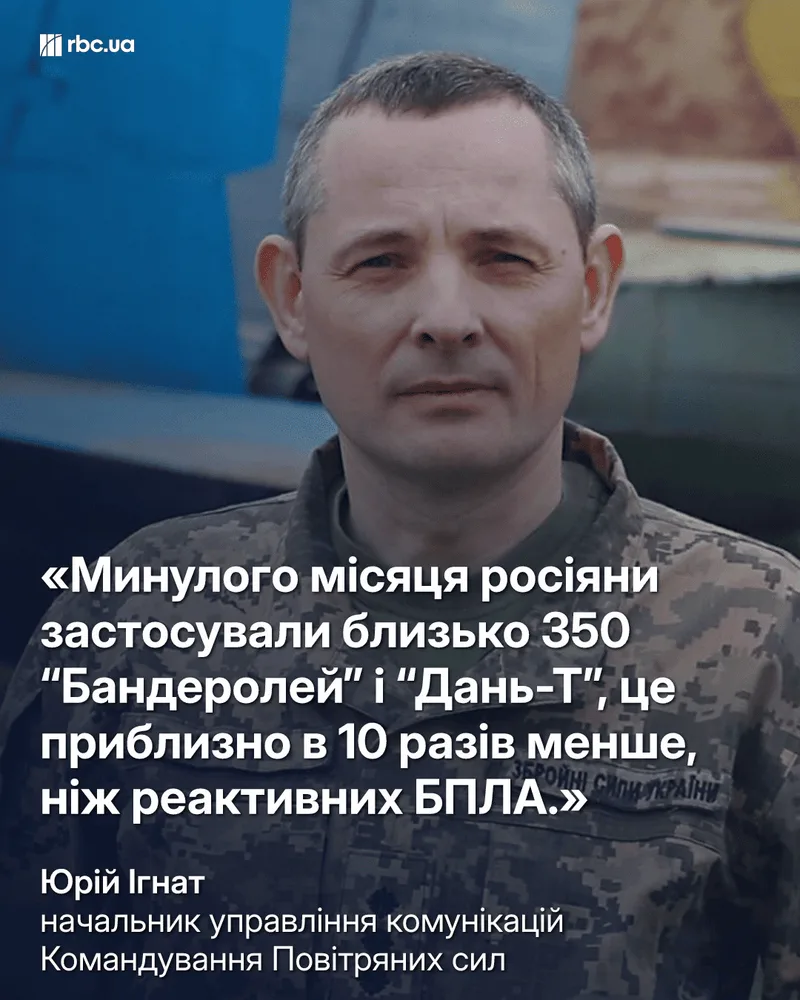
They have now ramped up production of these weapons to some extent, alongside jet-powered UAVs. However, the “Banderol” will eventually be replaced by a newer version, the “Dan-T.” We distinguish between the two.
– Are we doing anything to prepare for this threat?
– It is an aerial target just like a jet-powered Shahed or a cruise missile. It flies at a speed of around 600 kilometres per hour and at approximately the same altitude as a cruise missile. In terms of its characteristics, it is already very similar to one. Essentially, we have another aerial target to deal with, another weapon that we need to counter using both electronic warfare (EW) systems and the air defence assets we already have.
Starlink and Starshield
– In addition to missiles and intelligence, there has been a lot of talk in recent days about Starshield. There has been a lot of conspiracy theorising, uncertainty, and shifting of responsibility among the US leadership. I’d like to understand: if, hypothetically, we were left without Starshield, would we still be able to operate effectively in the skies?
– Of course we would. We used to operate without it. The question is how much our effectiveness would decline. Take aviation, for example, and the same helicopters that intercept drones. I was lucky enough to fly on a combat mission with helicopter crews once. We shot down several Shaheds, and the emotions were intense. We even recorded it on video, although we haven’t published it yet.
The weather was difficult: it was cloudy, raining, and there was even lightning somewhere, but they kept flying and doing their job. One helicopter flying at a lower altitude shot down more drones because it had better conditions: it was operating below the clouds. We were higher up, above the clouds and partly inside them.
Our helicopter crews also use Starlink to better acquire targets and maintain a stable exchange of information with ground-based combat control officers, who guide the helicopter crew to its target.
A helicopter flies at approximately 300–350 kilometres per hour. If the speed restriction that has been discussed is introduced, it could become a problem. Tactical aviation may also use, or may already be using, Starlink – I don’t want to disclose all the details – for reliable communications, satellite internet, and so on.
Another promising area where Starlink is used is jet-powered interceptor drones. Therefore, if Starlink speeds are restricted, using it on jet-powered interceptor drones could also become impossible or significantly more difficult.
That is why we need Starshield and similar systems primarily to protect our skies from aerial threats.
– Our border guards have spoken extensively about repeaters in Belarus that the Russians could be using for drones. Is there any way we can eliminate this threat?
– I have repeatedly seen Russian drones flying practically along the border. In the same app we discussed earlier, you can clearly see them flying one after another along the border zone.
Could they be using repeaters? They could. But that still needs to be proven. Our Foreign Ministry is conducting certain efforts through diplomatic channels, including with regard to Belarus. Any contacts and dialogue are necessary, even in a situation like this. Belarus has stated that it does not use such equipment and does not allow it to be used. But this is more a matter for the intelligence services.
At the same time, even if drones are simply flying one after another, they can themselves act as repeaters for one another. They can relay signals from one drone to another, creating a mesh network. And it is not necessarily limited to a linear formation – they can establish an entire network. A Russian operator based, for example, in the Bryansk or Oryol region can use this network to control the drone flying at the front and even deploy it against aerial targets.
That is the danger posed by a mesh network. In addition, we cannot rule out the use of ground-based communication stations to support enemy drones, possibly even with the help of Russian agents operating inside Ukraine.
– As I understand it, the number of drones directly controlled by operators will increase, because this allows them to evade our air defence systems, unlike drones that simply follow preset coordinates?
– In reality, this will not help them evade our defences in the long run to any significant extent. The enemy has already come up with solutions such as fitting an ordinary Shahed with a rear-view camera and sensors like those used in cars when parking. These sensors would detect when something was approaching the drone, allowing it to veer left or right and cause our interceptor drone operator to miss.
There are already solutions involving computer vision and artificial intelligence. Military technology is also advancing extremely rapidly. Practically every month, something new emerges, and the technology continues to progress all the time.
– Ukrainians are being warned to prepare for an extremely difficult winter, primarily in terms of energy supplies. What advice would you give them? Perhaps you could reassure them, or, conversely, say that the situation will be very difficult. Give us as realistic a picture as possible.
– You know, whatever happens, I remain an optimist. We have already endured so many threats and winters. Ukrainians have adapted to some extent, buying generators, alternative energy sources, and so on. Some people may even move elsewhere.
I think that, overall, we need to spend less time fighting among ourselves, both on social media and in the broader information space. The infighting that certain politicians and populists often fuel today leads nowhere constructive. What the nation needs now is unity, like we had in 2022, when people volunteered to fight and we said, “We’ll even shoot them down with jars of pickles.” People were making Molotov cocktails and saying, “Let them just try to come.”
Then we saw the Russian columns destroyed near Kyiv. Do you remember the sense of inspiration we felt at the time? We saw Russian aircraft and helicopters being shot down and burning, and Russian pilots being taken prisoner. That was what gave people the spirit and strength to continue resisting.
We cannot surrender, and we have no right to do so. If we surrender, we will be wiped out. And then all or a significant part of Europe will be under threat.
We have powerful allies. I would like the United States, too, to honour the commitments it made to Ukraine following the Budapest Memorandum and all the subsequent agreements. I always tell foreign media, especially American outlets, that since 1991, Ukraine has consistently followed the path of fulfilling all its commitments. First, there was the Budapest Memorandum; second, Ukraine gave up its nuclear weapons. We chose the path towards NATO. Regardless of which president was in office, we generally continued along that path, with the exception of the Yanukovych period.
We reduced our stockpiles of Scud-type medium-range missiles – ballistic missiles that we could be using in large numbers today. I saw foreign representatives, including John Tefft, come over as these missiles were ceremoniously cut up for scrap metal in front of them, to the applause of the entire world.
We scrapped Tu-160 bombers and transferred them to Russia as payment for gas debts. The Tu-160s, Tu-22M3s, and Kh-22 missiles – all of these could have been extremely useful to us in the current confrontation.
We reduced the size of our army as we sought to join Euro-Atlantic alliances and embrace their institutions and values.
That is why we need to remember that Ukraine has always extended a hand to the West. And today, we need the support that was promised to us back then.