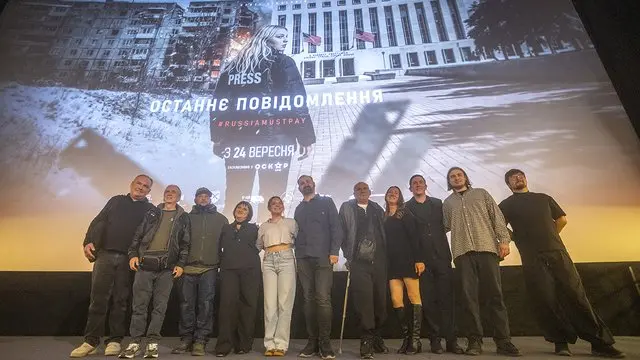
Ukrainian documentary The Last Message has built significant momentum on the international film-festival circuit, collecting 40+ awards and official selections since February 2026 as it enters the competition at the Oscars Academy Awards.
Director Andrii Voloshyn on the The Last Message documentary, and why everyone can take their own step.
How did the idea for the film “The Last Message” come about, and how did Ukrainian and American realities intersect in it?
The team that worked on this film was definitely not put together by chance.
Our acquaintance with Kelsie Kimberlin began back in 2016, when Andrii Samerkhanov, founder of EMPR.media – the first independent media outlet about Ukraine, and a producer of young talent, and Serhiy Krutsenko, a talented Ukrainian composer and director (who sadly passed away in 2023), introduced me and my friend and creative partner, co-director and excellent cinematographer Oleksii Liebiediev, to Kelsie Kimberlin. At the time we were making feature films and music videos.
When Kelsie came to Kyiv in 2023, we shot several music videos, one of which “Another chance to live again” received a prestigious UN award. On that project, my co-author and like-minded partner Oleksii Liebiediev and I were both directors, and Andrii Samerkhanov was the producer.
Then in 2024, when the question came up of Kelsie wanting to come to Ukraine again, I had an idea: not just to shoot music videos, because videos don’t convey much of what we want to tell the world about what’s happening. I learned that Kelsie’s cousin had been killed. She recorded a very emotional message on YouTube at the time (which, it’s said, prompted House Speaker Mike Johnson to actually bring the Ukraine aid bill to a vote). Seeing that message, the idea came to me that this had to be tied to something bigger. I understood that we needed to combine this personal experience, real pain, and the larger story of the struggle. That’s how the concept for The Last Message was born.
What did you see in the story of Kelsie Kimberlin and Andriy Rachok that made you want to make a film about them?
First of all, this is far from our first work about the war in Ukraine. Oleksii Liebiediev and I had already made the project “Extraordinary Fascism,” which was a kind of collection of evidence and reflections on what is happening with Russia and why it attacked Ukraine. But that’s fairly complex material to take in, and I wanted to make something more emotional and real.
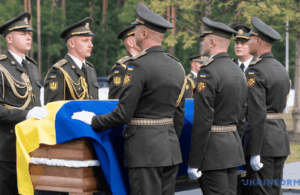
So, working on the concept together with Margarita Vlasova (she wrote the script), I proposed building the story around a personal journey – Kelsie Kimberlin’s return to Ukraine. Her visits to the grave of her cousin, Andriy Rachok, who, from the start of the full-scale war, went to defend Ukraine and died a hero. In search of an answer to what justice can mean for people whose lives the war has destroyed. That’s how the dramaturgy of “The Last Message” gradually took shape.
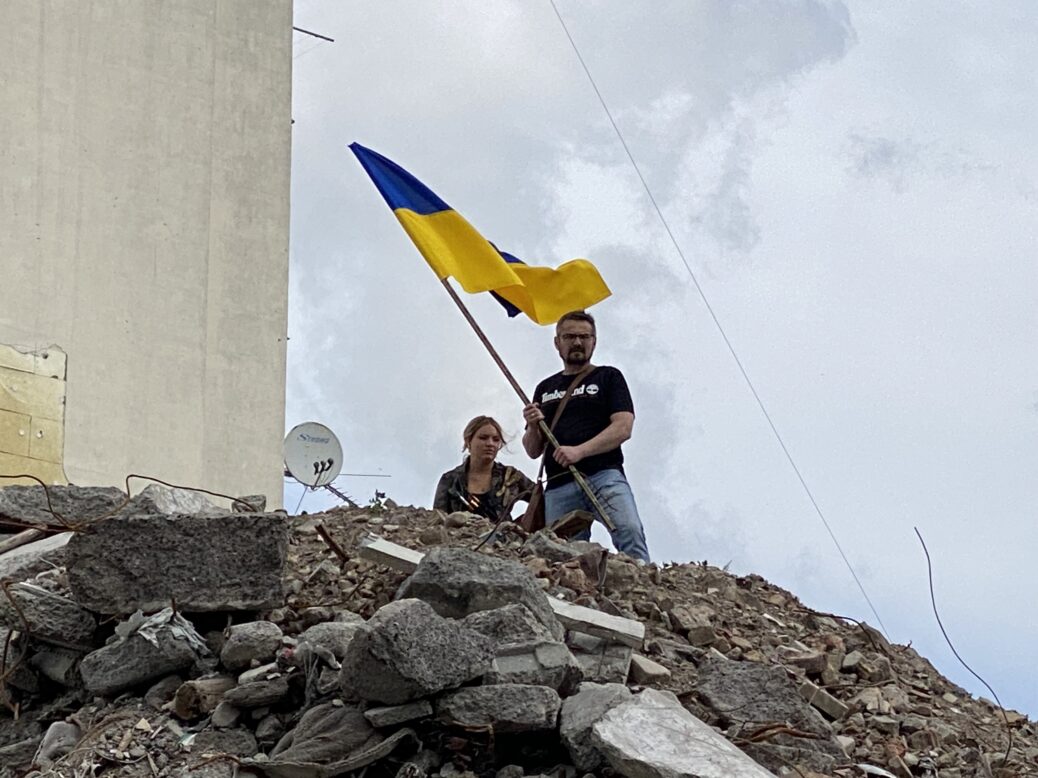
We also saw how Kelsie and the whole team traveling with her changed – before, during, and after their time in Ukraine. We wanted to show more of what’s actually happening, so the change at the end would really land. Kelsie’s story gave us a rare chance to trace that inner evolution: from someone lost, who doesn’t understand what to do or what’s happening in the world, to a person with a clear civic stance and a sense of what steps to take next.
Why is it so important to tell this story right now?
So that the world doesn’t grow used to the war and understands the true scale of the tragedy. Documentary film captures reality without embellishment, showing the transformation of people from other countries who have faced this pain personally. It’s a way to bring the truth to an international audience and to remind people of the need for real restitution and justice.
How did you handle the logistics of filming in a war zone? What was the biggest difficulty for you in making this film?
The route built for filming this movie ran along the front line. That means danger, unpredictability, and simply a threat to life for every member of the team – there are no sightseers there. But that’s only one side of it. The other had to do with whether we could make this story happen at all – I mean the permissions to film there. And thanks to the enormous, painstaking work of EMPR.media, which has been covering events since 2014, starting with the Maidan and the beginning of Russia’s war against Ukraine (in Crimea and in Donetsk), our project was able to earn the trust of the Government and the support of the General Staff of the Armed Forces of Ukraine.
And yes, our producer, Andrii Samerkhanov (founder and head of EMPR.media), did a brilliant job – not only making it possible to realize the idea, but also actively taking part in the trip himself.
For me personally, the biggest difficulty was being in the US, cut off from the filming of the Ukrainian part. I couldn’t be there, couldn’t personally direct the process on set. Part of the Ukrainian filming was handled by Oleksii Liebiediev. He was also a director on this project and was responsible for the entire filming process. Without that partnership, the film wouldn’t have turned out the way it did. But it was still an enormous trial for me.
Since I had bills to pay, I worked what’s called a survival job – twelve-hour shifts at a factory, and then I’d come home and edit the film. Physically juggling hard factory work with remote editing was incredibly hard.
What surprised you the most out of everything you managed to capture?
What surprised me most was the actual change in Kelsie – it really happened. What’s happening in Ukraine, all the horror and destruction, I’d already seen all of that, and it didn’t surprise me that much, because we live within that context. But watching a person who came from another world change, gain an understanding of the situation, and ultimately propose filing a lawsuit against the Russian Federation herself – that was the truly striking outcome.
What did you discuss in your first conversations about the music with Yurii Shepeta?
It was a difficult process. Yurii kept saying how hard it is to convey what’s happening through music. The war itself is extremely hard to convey through music, and I think he’s right. For about a year and a half, I personally couldn’t even listen to music. Even while working on “Extraordinary Fascism,” we ended up deciding to use not music but simply sound design running through the whole film.
Of course, Yurii still turned it into music in the end – he’s a composer, after all. But why couldn’t I take in music? Music is a powerful tool for affecting a person. It has rhythm, laws of harmony – even the most “wrong” music has its own beauty. But what was happening, and is happening, in Ukraine doesn’t obey any laws at all, and expressing that through music is incredibly hard. But it seems to me that Yurii pulled it off brilliantly in the end.
What main thought or feeling do you think audiences should take away after watching the film?
What I’d really like is for people, watching this small woman who risked everything, risked her life, came and simply did something – to understand the main thing: everyone can take their own step. You just have to look honestly and soberly at the situation we’re all in. So it doesn’t become too late.
And The Last Message isn’t just a film. It’s a film that can become the start of a real movement toward justice for Ukraine. Of course, we can’t bring people’s lives back. But we can do what’s within our power. Right now there’s a real question of compensating families for the deaths of their loved ones and for the destruction, and there’s a real resource for that – the frozen assets of the Russian Federation. I think it would be entirely just, if we truly mean it when we say we want to help Ukraine, to set such precedents and set in motion a process of restoring justice through the courts. Russia has to pay for all of it.
#RUSSIAMUSTPAY