
Investigation reveals how a shadow market has formed around Ukraine’s mobilization system, where deferments, medical decisions, and even border crossings are priced in the thousands of dollars.
“Buying Freedom”: how the system around Territorial Recruitment Centers monetizes fear of mobilization — Ekonomichna Pravda outlines the price list, reports Breaking News.
$300–$2,000 — removal from the wanted list;
$2,500 — “unhindered” update of military registration data;
$3,000 — removal from military registration on health grounds via documents and system changes;
$4,000 — to avoid being served a draft notice;
$5,000 — “exit” from a TRC building without a medical commission, combat summons, or administrative liability;
$6,000 — to avoid being taken to a TRC;
$6,000 — a fictitious job at a critical infrastructure facility;
$7,000 — deferment through a forged court decision on “guardianship”;
$9,000 — “lifetime” removal from registration;
$10,000 — “special flight,” i.e. a fake medical evacuation scheme: a person is promised to be taken out disguised as a patient in an ambulance with an oxygen mask and escort;
$12,000 — a “green corridor” via Moldova, Romania, Poland, or Hungary;
$16,000 — influence over the medical commission decision and a package of documents for crossing the border;
$18,000 — a fictitious diagnosis;
up to $20,000 — reservation (deferment from mobilization);
$25,000 — removal from military registration / declaration of unfitness in specific cases;
$50,000 — fake disability status, removal from registration, and departure abroad.
The full-scale war did not eliminate corruption — it only changed the rules of the game and raised the stakes. Why has the mobilization system turned into a marketplace with prices reaching thousands of dollars?
Gold, dollars, euros, jewelry. No, this is not the wealth of a jeweler, but of a serviceman from the Bucha District Territorial Recruitment and Social Support Center (TRC). In 2025, Oleh Kolomiiets declared gold bars worth 7.7 million UAH, as well as $43,500 and cash in euros. At the same time, his official annual income amounted to 366,000 UAH. This was reported by Ekonomichna Pravda.
The declaration does not explain the origin of these assets, but it shows that around a system that controls deferments, fitness for service, and access to freedom of movement, funds are somehow accumulating that are difficult to explain — and even harder to ignore.
After four years of full-scale war, corruption in the mobilization sphere has not disappeared. On the contrary, it appears to have adapted, despite law enforcement efforts to curb it.
At the intersection of Territorial Recruitment Centers (TRCs), military medical commissions (MMCs), medical assessments, registries, and fictitious deferments, a separate, large “market” has emerged — where time, status, documents, and the right to avoid being sent where the state can forcibly deploy you are effectively being sold. How does it work?
Bribing an employee of a TRC, MMC, or another official is punishable under Article 369 of the Criminal Code of Ukraine: from a fine to up to four years of imprisonment. If money is given to an intermediary “to influence” a decision, it falls under Article 369-2 of the Criminal Code: up to two years of imprisonment.
The Scale of the “Industry”
The potential market around Territorial Recruitment Centers (TRCs) involves a male audience of millions. In 2024, Ukrainska Pravda estimated the mobilization reserve at 4.4 million people. The state does not publish official data on the number of men aged 25–60.
Men aged 25 and older form the core demand on this “market.” In some cases, they are offered packages that include deferments, reservations (exemptions), removal from military registration, declarations of unfitness, “necessary” entries in the Oberih registry, and “required” medical documents.
Corruption schemes around mobilization are not limited to certain TRC employees. Public cases (discussed further below) also involve members of military medical commissions (MMCs), doctors issuing fictitious medical documents, individuals with access to registries, and intermediaries who bundle these “solutions” into a single “package” for the client. These schemes operate like a service infrastructure, where a person effectively buys a pathway from the status of “registered” to “unfit” or “reserved.”
In 2023, the National Police of Ukraine reported more than 250 cases involving TRCs, MMCs, and the Medical and Social Expert Commission (MSEC), along with 63 notices of suspicion. In September–October 2024, law enforcement reported 29 schemes and 39 individuals involved in just two waves of crackdowns. Since May 2025, Operation “Guardian” has been underway, within which, by the end of March 2026, 325 individuals and 115 indictments had been reported.
Separately, the National Police of Ukraine provided Ekonomichna Pravda with statistics on corruption cases involving TRC and MMC employees. The number of such investigations is declining: from 207 in the peak year of 2023 to 164 in 2025. This is not the full picture, as the fight against corruption in TRCs is not limited to the police. Overall, the data suggests that the market has not disappeared, and demand for “problem-solving” services remains.
Menu of Services
The cheapest option offered by some representatives of TRCs and numerous “intermediaries” is minor interference with records, including removal from the wanted list and updating data “without consequences.” More expensive options include deferment, reservation, and a military medical commission (MMC) decision resulting in removal from the register. The most expensive package includes medical documents, commission decisions, registry changes, and the ability to leave the country.
It is difficult to determine the average cost of such services, as no official statistics are collected. The only indicators of price levels come from official releases by the police, the State Bureau of Investigation of Ukraine, the prosecutor’s office, and the register of court decisions.
According to an analysis of public information on corruption investigations related to mobilization, the cost of services increases as a person approaches the status of a servicemember: the smallest bribes are typically required before any contact with a TRC, while the largest are paid at the stage of mobilization.
For example, according to court records, in the Sumy region in 2026, people paid $300 for removal from the wanted list, and $7,000 for deferment through a forged court decision on guardianship. In the Volyn region, $1,500 was requested for removal from the wanted list and $2,500 for “unhindered” updating of military registration data. In the Zhytomyr region, a TRC official, according to the investigation, asked for $3,000 to remove a person from military registration on health grounds through documents and system changes.
All these cases relate to the cheapest segment of corrupt services. They involve situations where a person has not yet come into contact with the TRC. In effect, for a bribe, they were “selling” a pause before contact with the system.
As soon as such contact occurs, the price increases. In Odesa in 2024, a TRC employee was detained for demanding $4,000. According to the investigation, for that money he promised not to issue a draft notice. According to the prosecutor’s office, in January 2026 in the same city, three employees of a district TRC and a member of a public organization demanded $6,000 to avoid taking a man to the TRC.
In Ternopil, a court considered a case in which a driver at the regional TRC demanded $5,000 for exiting the Territorial Recruitment Center building without undergoing a military medical commission, without receiving a combat summons, and without administrative liability.
Public reports also mention “package services” for which corrupt actors demanded tens of thousands of dollars. For example, in Kropyvnytskyi, the State Bureau of Investigation of Ukraine exposed an officer of the regional TRC who was selling reservations for $20,000 and demanded $6,000 for removal from the wanted list and release after forced delivery to the TRC.
In Kyiv, prosecutors described a case where, for $25,000, a lawyer promised to arrange removal from military registration. In 2025, the Kyiv City Prosecutor’s Office reported a case involving a $50,000 bribe for a fictitious disability status, removal from the register, and departure abroad.
A separate segment involves fictitious employment, where a job itself becomes the “product.” In Odesa in February 2026, a scheme was reported in which a job at a critical infrastructure facility cost $6,000.
The most expensive segment turned out to be the medical one. In the Kyiv region in 2026, police described a scheme involving $18,000 for a fictitious diagnosis alone. In Dnipro, court records documented a case involving $16,000 for influencing the decision of a military medical commission (MMC) and a package of documents for crossing the border. In Odesa in 2025, an intermediary promised to arrange documents certifying unfitness for service for $25,000.
The most high-profile medical case occurred in January 2026. The Office of the Prosecutor General of Ukraine reported that the head of a Military Medical Commission in the Dnipropetrovsk region orchestrated 20 episodes of selling “unfitness” for a total of $300,000. In the Khmelnytskyi region, investigators reported a large scheme involving $170,000, 301,000 UAH, and two cars in exchange for not conscripting employees of an enterprise.
The cost of this corruption runs into the millions. In 2023, Ukrainska Pravda uncovered that the family of Odesa military official Yevhen Borysov owned luxury real estate in Spain worth €4.5 million. In the case of former head of the Khmelnytskyi MSEC Tetiana Krupa and her family, searches uncovered over $5.2 million, €300,000, millions of hryvnias, and valuables.
How It Works
Ekonomichna Pravda contacted a man whose Telegram channel, containing various schemes for avoiding mobilization, was found by the editorial team through a thematic post on Threads. He presents himself as an intermediary in resolving issues with TRCs and arranging departures abroad. According to the story, a 24-year-old man from Kyiv, after encountering TRC officers on the street, decided to leave the country, looked for options for himself and his father, and contacted him.
The intermediary offered two scenarios. The first is to take a liable-to-service individual out of the country without removing them from the military register. The second is to arrange what is described in the correspondence as “lifetime removal from military registration,” allowing the person to live in Ukraine and “not fear the TRC.”
For leaving the country, there is a service with several pricing tiers. For $10,000, a “special flight” is offered; for $12,000, a “green corridor” through Moldova, Romania, Poland, or Hungary.
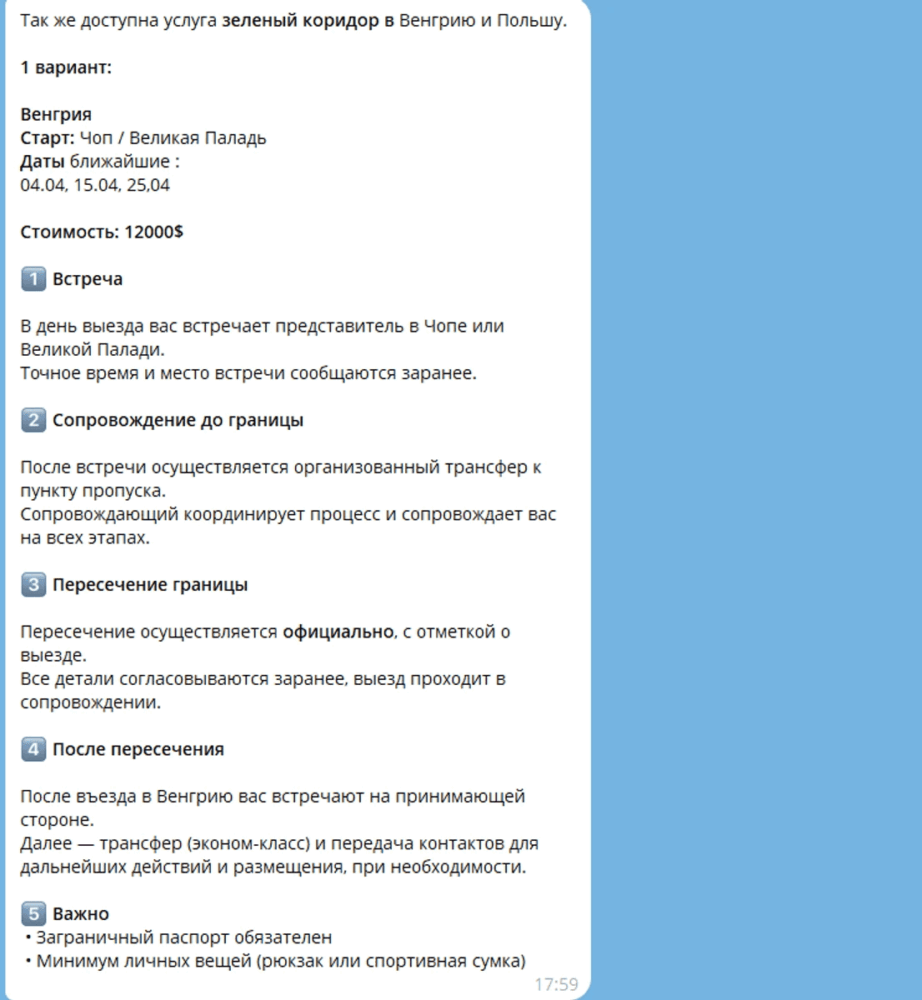
Under the “special flight,” a medical evacuation scheme is meant. The client is allegedly placed in an ambulance with foreign license plates, transported lying down with an oxygen mask (it is separately noted that smoking is not recommended), accompanied by paramedics and a “special representative.” At the end of the route is a hospital in Bucharest (Romania) and several days of paid accommodation after crossing the border. If the client is afraid of checkpoints, they are allegedly transported from their place of residence to the starting point. Dates are available to choose from.
The second option is “lifetime removal from military registration” for $9,000. According to the promise, this is done within 15 days. The service provider claims that the scheme does not follow a single template for everyone. For a young man from Kyiv, an “invalidity package” was offered, including tests, ultrasound, an endocrinologist’s report, an extract from a medical record, a certificate of disability or incapacity, and a ready-made application to the TRC and the military medical commission.
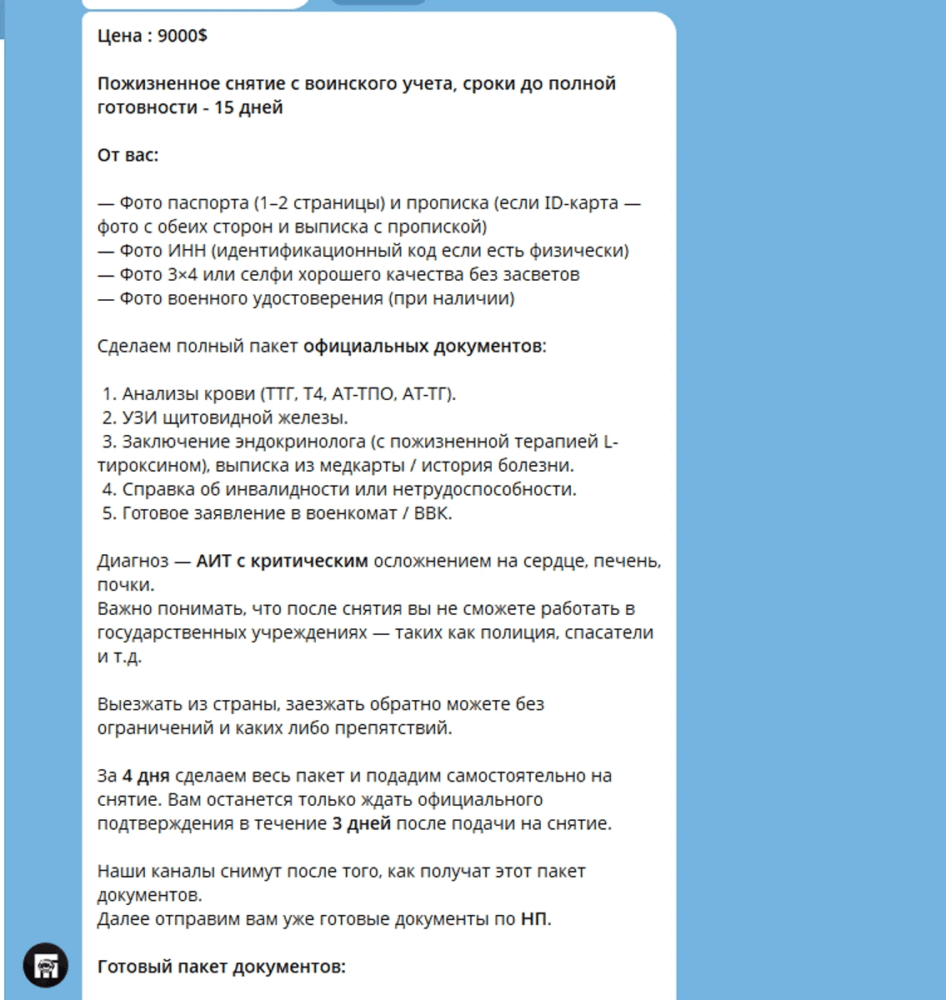
The basic “legend” is autoimmune thyroiditis with critical complications affecting the heart, liver, and kidneys, along with a lifelong need for hormone therapy. However, the diagnosis itself does not automatically result in removal from military registration, since a decision by the Military Medical Commission (MMC) is required to declare a person unfit, not just a doctor’s certificate.
The intermediary promised a full chain of services, including their own doctors, channels for submitting documents, an MMC decision, updates to the status in the “Oberih” system and the “Reserv+” app, a new military registration document, and a certificate for traveling abroad.
In the end, the person is allegedly granted the status of being unfit, with removal from the military register. All documents are promised to be sent via Nova Poshta. To proceed, they request a photo (a selfie is acceptable), a photo of the passport, a tax identification number, and a military document.
As for payment, a 50/50 scheme is used, with half the amount paid upfront. All payments are made in USDT cryptocurrency. In the correspondence, this is stated strictly, with no room for negotiation.
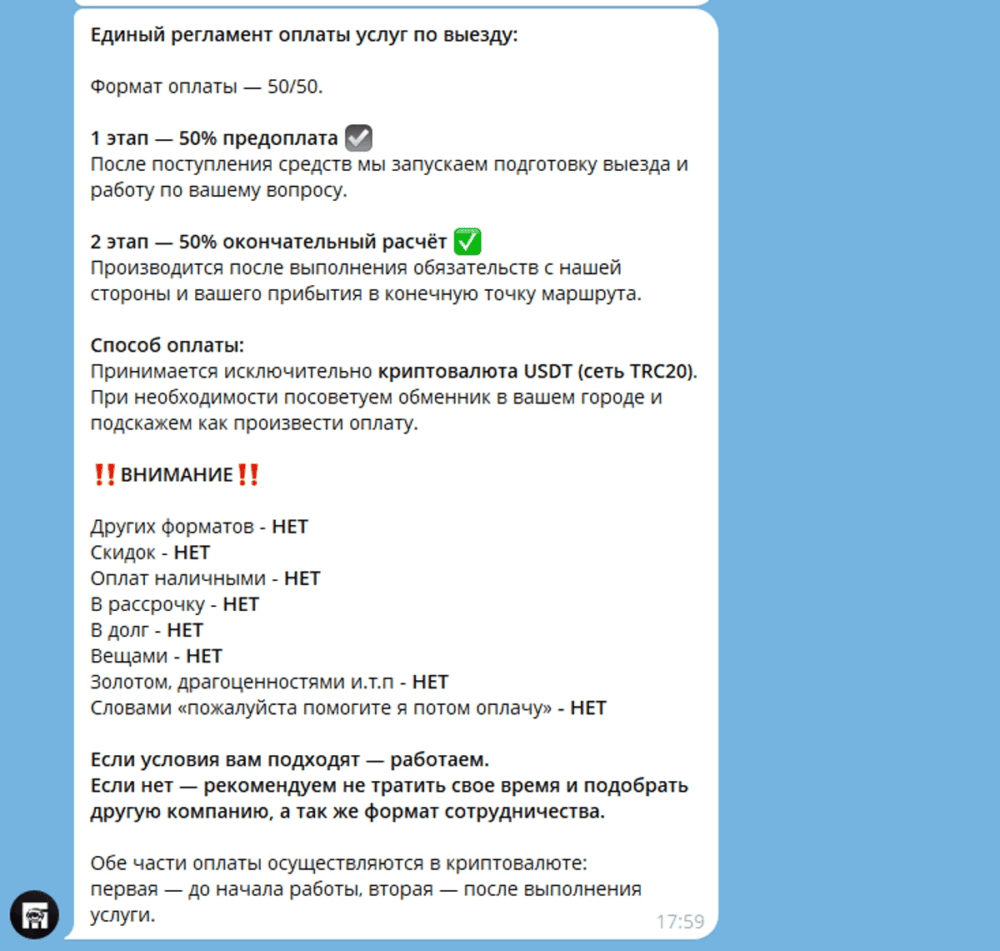
A notable aspect of this story is the tone of the conversation. To the journalist, it felt less like evasion of mobilization and more like a standard consultation before purchasing an expensive product. The correspondence includes phrases such as “lifetime,” “no right to undergo the MMC again,” and “full immunity.”
This level of “perfection” raises suspicions of possible fraud. The overly smooth description of the schemes, claims of having “insiders everywhere,” and promises of 100% guarantees do not prove that the client would actually receive the promised outcome after payment. The newsroom was unable to confirm that the interlocutor truly provides such services, as the journalistic experiment was stopped before crossing the line into criminal liability.
At the same time, the tone of the messages, the Telegram channel posts, and the confident explanations of internal procedures may create the impression of credibility for an average person.
Instead of a Conclusion
The exact scale of the corruption market around TRCs is unknown. Public estimates range from €800 million to €2.1 billion per year, but without a disclosed methodology. If one were to divide €2 billion by the cost of removal from the register in the Zhytomyr case ($3,000), it would imply that 666,000 men are removed from the register every year — a figure that appears highly implausible.
Importantly, this market also includes fraud, where “solutions” are sold based on claimed influence without clear evidence. In some cases, the origins of these “TRC problem-solving managers” lead back to Russia.
The problem lies elsewhere. As long as the state maintains a monopoly on coercion, it risks losing its monopoly on justice. Alongside the formal system, a shadow market exists — one that continues to operate and generate profit.
In such a system, the principle of equality is replaced by solvency: one person looks for an intermediary and a crypto wallet, while another goes to serve. The longer this market exists, the harder it becomes for the state to convince society that mobilization is a shared duty rather than an unequal burden from which the wealthier can escape through the back door.
Tags: Corruption investigation draft evasion EMPR media governance TCC system Ukraine Mobilization war in Ukraine