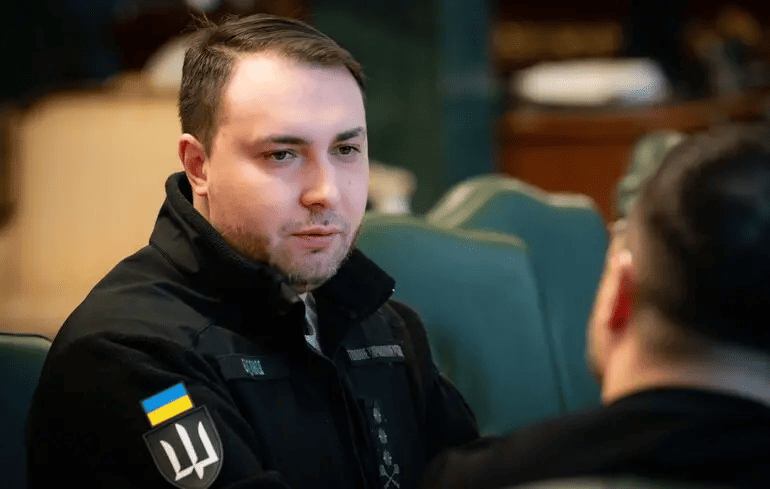
Zelenskyy appointed military intelligence chief Budanov to lead his office, signaling reform, managing rivals, and preparing negotiations, while balancing domestic politics, war, and potential succession.
Kyrylo Budanov had been in the pool of candidates for the post of head of the President’s Office from the very beginning. He was publicly “highlighted” by Volodymyr Zelenskyy himself in photo reports from meetings with other contenders: Deputy Prime Minister Mykhailo Fedorov, Deputy Foreign Minister Serhiy Kyslytsya, and Deputy Head of the President’s Office Pavlo Palisa. This was reported by ZN.ua.
However, the more time passed after the scandalous dismissal of Andriy Yermak (who, as we have already written in detail, never disappeared from Zelenskyy’s inner circle), the higher the likelihood grew that a technical candidate would be appointed — someone who would de facto act as the former head of the office’s hands on Bankova Street. One such option was sanctions policy commissioner Vladyslav Vlasiuk. Trusted sources continue to claim that it was he who topped the list when Zelenskyy set off to meet with Donald Trump.
However, after the president returned from Mar-a-Lago, everything changed. A turning point came. The information Zelenskyy brought back from the United States ultimately pushed him to make a different decision. Whether this happened after official talks, when it became clear that Trump would not be able to sway Putin on territorial issues, or as a result of a personal meeting focused on guarantees for the president, his family, and his closest circle — we can only speculate.
Let us repeat: Zelenskyy had no intention of appointing Budanov as head of his office. And for a month he did not do so. Budanov’s proposals, presented as a 12-point package, failed to impress him. Throughout this entire period, they — like Mykhailo Fedorov’s initiatives — gathered dust on the president’s desk.
So what changed? What guided Zelenskyy in making the unexpected move with Budanov? And why did Budanov himself agree to trade the chair of the legendary head of the Defence Intelligence of Ukraine for the “changing table” of the head of the presidential office, still overshadowed by Yermak’s lingering influence?
There may be several factors at play here.
Factor One: Diverting Attention from Yermak
“Yermak is finished!” — a tempting lure unexpectedly placed on the table by the president. The media and opinion leaders devoured it with pleasure. But people — presidents included — do not give away what they themselves feed on.
Yermak is still everywhere. Yermak at home. Yermak at the gym. Yermak makes sure food comes from “Sanahunt.” Even the masseur is under his watch. He is close. And he is one of their own.
However, the public toxicity of the former head of the President’s Office — both domestically and internationally — forced the president, at a crucial stage of his term, to throw down a trump ace. Not to abandon Yermak, but to shield himself. And to try to win the game.
A new trump card has been drawn from the deck.
Undoubtedly, the appointment of the military heavyweight Kyrylo Budanov — with no political experience but a high political approval rating (third after Valerii Zaluzhnyi and Volodymyr Zelenskyy) — will introduce changes to the system of power. Yermak’s influence will be curtailed, if only because sitting in the president’s ear and issuing commands from an office on Bankova Street are two very different things.
But let us remind those who may have forgotten once again: this is not Yermak’s system. It is Zelenskyy’s system. Every appointment and every individual was approved personally by the president. And it is he who will decide how far to change it — in substance, not just in form.
The only question is whether Kyrylo Budanov, now the former head of the Defence Intelligence of Ukraine, understands this. The Financial Times is seriously mistaken in claiming that Zelenskyy spent a month persuading Budanov to take over the President’s Office. That is not the case. Budanov wanted this status. And the same 12-point package he brought to the president is direct proof of that.
We will discuss Budanov’s motives below. For now, let us note that he made this decision believing he could change a great deal. What exactly he intends to change, and by what means, remains an open question. Until now, one of Budanov’s key tools has been his network of connections. There are very few people who do not hold “credentials” from the Defence Intelligence of Ukraine. Such a diaspora, however, can bring both advantages and serious drawbacks. At the very least, Budanov is placing his main bet not on support inside Ukraine, but abroad — meaning that those he can rely on are located beyond its borders.
Factor Two: Budanov’s Personal Ties with Americans and Russians
Budanov is the only person within Ukraine’s system of power who currently enjoys the trust and respect of the incumbent U.S. team. He has built a network of personal relationships not only with Keith Kellogg (who still has access to Donald Trump’s office), but also with J.D. Vance, Steve Witkoff, and a number of other figures from the U.S. president’s inner circle. The CIA, as a partner agency, and its director John Lee Ratcliffe likewise support Budanov. They see him not only as a hero of the war, but as someone with a realistic view of it — and as a figure untainted by the notorious “Mindich-gate” scandal or by classic corruption involving public funds. This is a fundamentally important point that automatically expands Budanov’s influence. (What is more, were it not for Budanov’s special relationship with the Americans, Zelenskyy and Yermak would have “taken him out” a year and a half ago.)
In addition, the former head of the Defence Intelligence of Ukraine has been in contact with the Russians throughout this entire period. For many years, it was he who — with no real alternative (Yermak served as an additional piece) — handled prisoner exchanges, and he now heads the relevant coordination headquarters. At the same time, it is clear that discussions around exchanges are never limited to the humanitarian track alone: such talks regularly extend far beyond it. As a result, Budanov has genuine, working communication channels with the Russians — and they are unique.
This is precisely why his elevation and appointment at this moment appear functionally justified. According to available information, at least two negotiating groups are expected to be formed going forward. One — on reconstruction — will most likely be led by Prime Minister Yuliia Svyrydenko. The second will focus on ending the war and the peace track. And it is here that Budanov’s role becomes crucial. In effect, this points to a potential head of the key negotiating delegation.
No matter how events unfold (whether peace is achieved or the war continues), Budanov appears entirely fitting in this position — both for the domestic audience, which believes in a system change, and for the international audience, which is fully satisfied with him.
Factor Three: Neutralizing a Rival
Formally, Budanov holds the third-highest political rating in the country. However, it is still difficult to claim that he had real chances of becoming the top figure in the state. It remains unclear how society — and especially international partners — would view a military figure under conditions of peaceful or transitional elections. This is not an obvious scenario.
Yet Zelenskyy sees this rating. And Budanov’s appointment to the President’s Office can be read as an attempt to accomplish two tasks at once. First — to separate him from his own power base, from the “root” from which his political weight had grown. Second — to disrupt his electoral trajectory. Experience shows that almost no one successfully launches a campaign for office from the position of head of the President’s Office. It is not a springboard; it is an anchor.
Although there is an alternative view: some believe that this very position could, on the contrary, strengthen Budanov’s standing.
However, another point is important here: the president broke the initial agreements immediately after Budanov’s office doors were closed behind him. It is no secret that, when leaving the Defence Intelligence of Ukraine, Budanov expected to retain influence within the “state within a state” he had built. That is why he asked the president to appoint his formal right-hand man, Vadym Skibitskyy, or someone from his team, as head of the Defence Intelligence.
However, the president’s next decree following Budanov’s appointment was to name Oleg Ivashchenko as head of the Defence Intelligence. The now-former head of the Foreign Intelligence Service, Ivashchenko, is not just a Yermak loyalist. He grew up within the Defence Intelligence, a classic career military officer, a professional, and a strong leader in military intelligence — but not of the structure Budanov had built. These are fundamentally different models. Ivashchenko is not the type of person who would act as a “surrogate leader.” He will not serve political or commercial interests, nor external projects that extend beyond the direct functions of military intelligence.
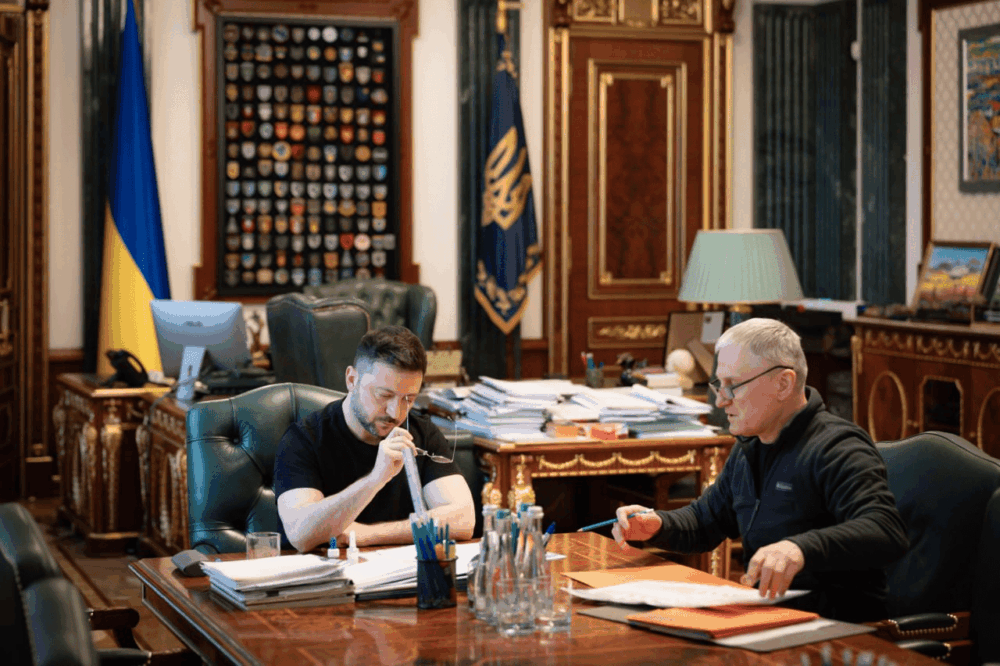
For Budanov, this means one thing: he will not be able to reach any agreement with Ivashchenko. He is incompatible with anything other than the strict, classical logic of the service — and it is precisely for this reason that his appointment is a serious blow to Budanov’s opportunities and to the system of influence he has been building for years.
In other words, by appointing Budanov while simultaneously making the personnel decision to place Ivashchenko in charge, the president did not simply “bring a rival closer” — he immediately removed his support. This is no longer an alliance; it is captivity.
In the same vein, another important personnel reshuffle should be considered — the replacement of Defense Minister Denys Shmyhal with Mykhailo Fedorov. Commentators are divided on this move. Some argue that only Fedorov is capable of shaking up the entrenched general-level bureaucracy and that he has a real war plan (meaning significant resignations in the army should be expected). Others are convinced that the systematic Shmyhal, who had only just familiarized himself with the ministry’s inner workings, should not have been touched, let alone “replaced by the creative Fedorov, who would not uncover the essence of the position even after five years.”
Military bureaucracy is not civilian. It is far harsher and more dangerous. It is a system that knows how to overwhelm with infographics, percentages, and reports, to click heels and nod perfectly, and to do exactly what it has always done — simulate management without changing the substance. That is why replacing Shmyhal with Mykhailo Fedorov appears extremely risky. Fedorov built his ministry in an almost sterile, non-competitive environment, where he alone set the rules and the pace. The Ministry of Defense is completely different. There, the system operates according to its own laws, and it will resist.
Moreover, it was Shmyhal whom someone from the older, rather than the new, military system — Budanov — could rely on, including politically. After all, it was Arahamia, Shmyhal, and Budanov (with Fedorov joining them only at the last moment) who organized the internal command revolt against Yermak.
Also, according to our sources in the President’s Office, a personnel reshuffle has been decided in the diplomatic bloc: the current Deputy Head of the President’s Office for International Policy, Ihor Zhovkva, is to move to the Ministry of Foreign Affairs. His position will be taken by the First Deputy Minister, Serhiy Kyslytsya (as the president announced at the time of writing). This appointment is highly symbolic. Kyslytsya is a figure extremely comfortable for Andriy Yermak. He is closely linked to the Ministry of Foreign Affairs and, over the past year, has served as the former head of the President’s Office’s key channel for communication on foreign policy issues. By contrast, the current foreign minister, Andriy Sybiga, irritated Yermak, who preferred to handle sensitive matters not with the minister but directly with Kyslytsya.
In short, by appointing Budanov — essentially an outsider — as head of his office, the president immediately put him in his place: a public carrot, a private stick.
We have already written that neither Trump nor Putin view Zelenskyy as a second-term figure. But we do not know how much this actually influences the president’s real decisions. What we do see is how Zaluzhnyi is being methodically taken apart today — everything is being thrown at him: the South, Kivalov, the Dominican Republic, even his discharge.
Perhaps Zelenskyy has now turned to a second potential rival. But not by attacking him — rather by following a different logic: to draw him closer and suffocate him in an embrace.
Factor Four: A Potential Successor
There is another risky and controversial interpretation: Budanov’s appointment is not about neutralizing a rival, but testing a successor. An attempt to pass on to him not only electoral potential, but also some administrative, managerial, and international capacities.
The problem, however, is that these two logics are mutually exclusive. You either “neutralize” a potential candidate by putting him in the position of head of the President’s Office, or you groom a successor. Doing both at the same time is impossible. Hence the duality in both Zelenskyy’s motivation and Budanov’s own decision.
So the key question, to which we still have no answer, is this: is Zelenskyy planning a second term?
If he is — then Budanov’s appointment clearly functions as neutralization: a position that rarely serves as a springboard to elections.
If he is not — then for Budanov, it may look like an opportunity. He gains a negotiating track, steps into the public sphere not as a military officer but as a state manager, and fills in the missing pieces of the presidential puzzle: experience, international contacts, participation in key decisions. A general with state-level experience is a completely different kind of candidate.
If Zelenskyy were definitely running for re-election, it would have made more sense to appoint Fedorov as head of the President’s Office. Hence, there is a theory that Zelenskyy is open to a deal.
Moreover, the mood within the elites has shifted significantly. Those who sincerely believe in Zelenskyy’s victory are becoming fewer — and he feels it. Budanov, apparently, does too. And perhaps he calculated that, under any scenario, a window of opportunity is opening for him.
Some well-informed sources even say outright: “We’ve never seen a second round of ‘Zaluzhnyi vs. Budanov.’ Do you understand? And we don’t know how, in this configuration, the negotiating track, international support, and the image of a person capable of making deals would play out.”
Could Budanov be the Americans’ bet? We do not know if they are betting at all. But Zaluzhnyi was certainly not forgiven for failing to pick up the phone when Vance called — at that critical moment when President Zelenskyy, after the Oval Office scandal, was flying to London.
Factor Five: Protection from the Military
As we have already noted, Budanov is to lead the negotiating team. In this sense, appointing a military officer as head of the President’s Office is not only an external move, but an internal one as well. Zelenskyy needs Budanov as a safeguard against the military itself — in case Ukraine is forced to sign a particularly difficult agreement. Only a military officer can hold the military in check.
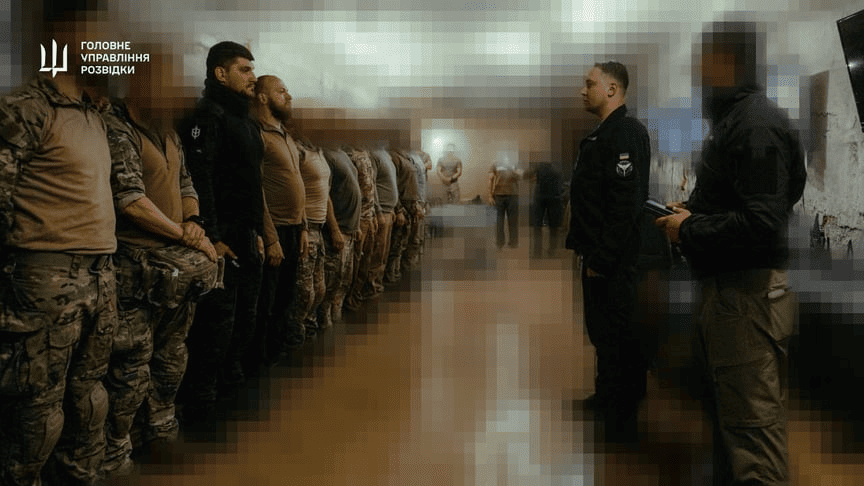
In effect, this is about an “honest conversation between the authorities and society” — something often talked about, but that no one wants to initiate. Budanov has already started it — first informally, then fragmentarily in comments, and later more explicitly. This includes discussions with the president — not now, but long before the current events. Budanov voices issues that are considered unpopular in the public sphere — and takes responsibility for them. He is not willing to cede territory, but he speaks directly about the need to end the war; that resources — especially human ones — are exhausted; and that the authorities have failed at mobilization.
This makes him inconvenient, but it is precisely for this reason that he is valuable to Zelenskyy, who avoids domestic political topics. Budanov is a person ready to take on significant burdens, and his methods can be multifaceted and far from comfortable for the system.
Factor Six: Trusted Relations with the Anti-Corruption Authorities
A separate and important motive concerns the anti-corruption bloc. Those around the president believe that Budanov can help reduce the level of confrontation with the NABU and SAP. Budanov does not have close or friendly ties with the anti-corruption authorities. But there is something else — mutual respect and trust on certain key issues. This is not an alliance or a partnership, but a working relationship that no one else in the president’s inner circle currently has.
At the same time, for the full picture, it is worth noting that Budanov’s arrival has shaken the position of SBU head Vasyl Malyuk. According to the former head of the Defence Intelligence, Malyuk did not represent the authorities’ line cleanly enough in the NABU and SAP cases. According to our information, the president did indeed speak with Malyuk and offered him the chance to head the Foreign Intelligence Service. Malyuk refused both the president’s proposal and a resignation statement, leaving the matter to parliament, where there will certainly be a problem with votes. Malyuk is associated not only among the military but also with deputies primarily with the “Spiderweb” operation, rather than with curbing the powers of the anti-corruption authorities.
…Thus, Budanov’s appointment is an urgent, multi-layered move by Zelenskyy, which, as we have already noted, has several motivations.
It is clear that each player is pursuing their own agenda.
Focusing on negotiations, Zelenskyy has brought the military Budanov into the schedule at a new level, signaling to society his readiness both to reboot the government and to continue the war if talks fail.
The military Budanov (simultaneously internally prepared for a truce), by agreeing to share responsibility with Zelenskyy, sees in this an opportunity for real power in the future. Yet he cannot fail to understand that literally on the very first day, the president clipped his wings, backing him up with his own people in the Defence Intelligence, the Ministry of Defense, and the President’s Office.
For now, however, this is only a proto-stage of the process — dual, unstructured, dependent on the course of the war, negotiations, and the positions of the U.S. and Russia. What happens next will depend on the key, still unresolved question: is Zelenskyy running for re-election?
It is clear that Budanov’s appointment is Zelenskyy’s signal to society that he senses a public demand for change.
However, in reality, this government will not fundamentally change. First, because all personnel reshuffles are happening within the same pool of officials — using people who are already in the system. This is neither new blood nor a new logic.
Second, the authorities simply no longer have the time for a full-scale transformation. Everything we see now is an attempt to soften public perception — especially in the United States. Real systemic changes can only be expected after new elections.
Tags: budanov EMPR.media government shake‑up presidential office Ukraine Politics Yermak ousted zelenskyy

![Austrian Foreign Minister Beate Meinl‑Reisinger and Ukraine’s Foreign Minister Andriy Sybiha meet in Kyiv to discuss humanitarian, energy and reconstruction support. :contentReference[oaicite:2]{index=2}](https://empr.media/wp-content/uploads/2026/02/beata-480x270.png)



![Visitors at the “Thank You With All My Heart” Ukrainian exhibition at the Council of Europe, featuring the Great Amber Heart and powerful war art. :contentReference[oaicite:2]{index=2}](https://empr.media/wp-content/uploads/2026/02/heart-300x171.png)