
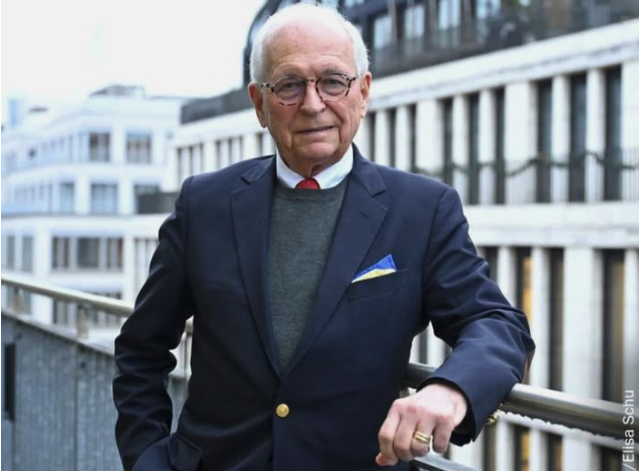
A scandal has erupted around the Chairman of the Munich Security Conference (MSC), Ambassador Wolfgang Ischinger, who publicly spoke out against a ceasefire in Ukraine.
Svitlana Melnyk reveals.
On the eve of this year’s Munich Security Conference, which opens next week, the long-standing head of the MSC gave a programmatic interview to Tagesspiegel under the telling headline: “A Ceasefire in Ukraine Would Increase the Threat to NATO.”
The interview caused genuine shock. What one of Germany’s most influential diplomats openly articulated, in fact, reflects — to a large extent — the real strategic line of the German government, though few are willing to say it out loud.
So what exactly did Ischinger say?
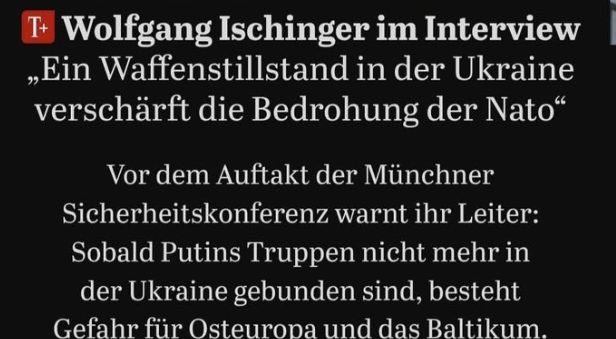
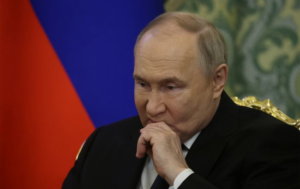
He argued bluntly that achieving a ceasefire in Ukraine would be bad news, because it would automatically increase the danger for NATO’s eastern flank. In his view, a pause in fighting would allow Putin to calmly rebuild and expand Russia’s military capabilities.
According to Ischinger, the military threat to Germany would rise if a future ceasefire were not accompanied by strict limitations on Russian troop numbers in the western military districts — something he believes is highly unlikely. Therefore, a ceasefire alone offers no grounds for reassurance: peace in Europe would not be guaranteed.
Ischinger went even further, stating that “as long as Ukraine is defending Europe, Russian forces remain tied down, and the level of threat is therefore lower.”
While he could not avoid expressing a conventional wish that “the deaths of Ukrainians should end as soon as possible,” his message should serve as a brutally honest warning to Kyiv about the prevailing mindset among European elites.
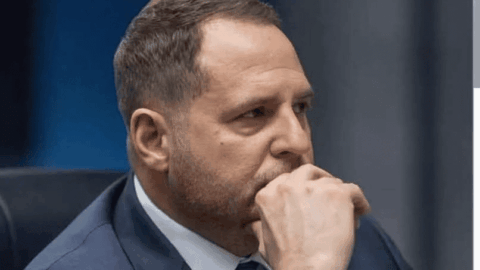
Unsurprisingly, Ukraine’s former ambassador to Germany, Andriy Melnyk, who knows Ischinger personally, could not remain silent and entered into a public debate with the MSC chairman on Twitter.
Instead of drawing the correct conclusions and publicly urging the German government and other European allies to dramatically increase military support for Ukraine at this critical stage of the war, what does one of Germany’s leading foreign-policy figures actually do?
Ambassador Ischinger places his bet on Ukrainians continuing to sacrifice themselves, holding back Russia’s advance toward Europe, tying down the Russian army, and buying Berlin additional time to better prepare its own defenses against a future Russian attack.
Unfortunately, this passive-cynical approach is exactly what we see from many European allies today — especially against the backdrop of the ongoing energy crisis.
Instead of transferring all available air-defense systems to Ukraine’s Air Force, Europe shares only symbolic amounts — just enough for appearances.
Behind the scenes, however, large-scale production and stockpiling of weapons is underway — not for Ukraine, but for the defense of Europe itself against the “inevitable” Russian threat.
If you believe that Mr. Ischinger offered a reasoned answer to Ambassador Melnyk’s rhetorical question about why he opposes an immediate ceasefire, you would be mistaken.
In his characteristic arrogance, Ambassador Ischinger accused Melnyk of “shamelessness” and demanded a public apology.
An apology — for what, exactly?
For being forced to speak the truth to partners who prioritize their own survival while leaving Ukraine to face Russia largely on its own?
Tags: ceasefire debate EMPR.media European security German foreign policy munich security conference NATO threat ukraine war Wolfgang Ischinger

![Austrian Foreign Minister Beate Meinl‑Reisinger and Ukraine’s Foreign Minister Andriy Sybiha meet in Kyiv to discuss humanitarian, energy and reconstruction support. :contentReference[oaicite:2]{index=2}](https://empr.media/wp-content/uploads/2026/02/beata-480x270.png)





![Visitors at the “Thank You With All My Heart” Ukrainian exhibition at the Council of Europe, featuring the Great Amber Heart and powerful war art. :contentReference[oaicite:2]{index=2}](https://empr.media/wp-content/uploads/2026/02/heart-300x171.png)



![Ukrainian Roboneers and Latvian partners at the signing of a defence robotics and underwater technology cooperation memorandum. :contentReference[oaicite:2]{index=2}](https://empr.media/wp-content/uploads/2026/02/oboronka-300x168.png)