Kraken deputy commander Danylo Polozhukhno discusses Ukraine’s evolving drone warfare, Russian infiltration tactics, Operation Vivaldi, military reform, and defending his native Luhansk region.
Russian forces are trying to infiltrate Ukrainian defences in small groups, but technology, drones and the speed of decision-making are playing an increasingly decisive role on the battlefield. As the war evolves, military units must adapt alongside it to stay ahead of the enemy.
Danylo Polozhukhno, deputy commander of the Kraken Unmanned Systems Regiment of the Third Army Corps, told 24 Kanal in an exclusive interview how the legendary unit has transformed, what Operation Vivaldi has revealed, and why Russia’s infiltration tactics are becoming less effective. He also explained how Ukraine can counter the enemy’s numerical advantage through asymmetric solutions and new technologies.
How Did Kraken Transform into an Unmanned Systems Regiment?
Danylo, the legendary Kraken — without exaggeration, a legendary reconnaissance and sabotage unit that was subordinate to Ukraine’s Defence Intelligence — was a household name in 2022–2023, during the first counteroffensive. Since then, the unit has undergone a transformation and restructuring. Tell us, what is Kraken today?
Today, Kraken is an unmanned systems regiment within the Third Army Corps. We have been operating in this format for a year and a half. We have completed our staffing and are now awaiting an expansion of our personnel. Our focus is now on unmanned systems.
The war is changing very rapidly. At a certain point, we realised that new conditions were emerging on the battlefield and that technology was beginning to play a much greater role. Drones were taking over a significant share of military tasks. So we made the corresponding decision.
Andrii Biletskyi, who was brigade commander at the time and later became corps commander, supported us in this move. We joined the Third Army Corps and established an unmanned systems regiment. The name has changed a little, too.
As for the composition of your unmanned systems unit, are most of your personnel still from Kharkiv, as before, or is it now a completely different mix of people?
People come from different cities. Today, they come from all over Ukraine and beyond. The unit now also includes more people from a wider range of professional backgrounds.
When we first started out, our core was primarily made up of football ultras. Today, the unmanned systems regiment is built on the foundation of Kraken, personnel from the anti-tank battalion of the Third Assault Brigade, and a battalion from the Presidential Brigade.
All three units were strong in their respective areas and recognised the potential for developing the unmanned component. So we merged into a single unit, and today we carry out missions at both the tactical and operational levels. In other words, we cover the frontline using reconnaissance and strike capabilities, including FPV drones and Mavic drones, while also operating in the operational depth through reconnaissance and strikes using Middle Strike systems.
Speaking about you personally, Kraken was a reconnaissance and sabotage unit, and you carried out different tasks back then. From your own perspective, which role was easier, and which did you find more interesting? How would you assess your own transformation?
Today, my position is primarily focused on management. We build systems, develop standards and, rather than managing personnel at the tactical level from an infantryman’s perspective, we focus on carrying out the corps commander’s operational concept.
He has a specific plan and his own vision. As an unmanned systems regiment, we strive to achieve the results set out in that plan and create all the conditions necessary for the infantry to advance afterwards.
To put it in very simple terms for our viewers: you used to be out in the field, in a tree line, holding a rifle and looking at the enemy through a gunsight. Now you look at the enemy through a screen.
I can say that psychologically, it is easier now. You have to understand that the level of losses and the scale of our impact on the battlefield were very different then compared with today. Losses are significantly lower because an unmanned systems regiment does not have as many direct encounters with the enemy.
Although the enemy is trying to counter unmanned systems, our losses remain minimal, while the impact we achieve on the battlefield is significant.
The war has changed. Objectively, we have to understand that what we did as Kraken at the beginning of the war is simply no longer possible. No unit can operate the way it did back then, because unmanned systems have fundamentally changed the rules of the battlefield. The cost of capturing every square kilometre becomes much higher if you do not invest in technology.
At the tactical level, our enemy is not investing enough in unmanned systems. That is precisely why every square kilometre it gains through its “human-wave assaults” comes at an enormous cost.
How Russian Forces Are Fighting Today and How Ukraine’s Armed Forces Counter Infiltration
How are Russian forces fighting today? Looking at the bigger picture, what does their approach look like?
At the tactical level, they have not abandoned their infiltration tactics. They believe these tactics are still effective. But in reality, there are ways to counter them.
Take our sector and our corps as an example. We have established a unified intelligence centre specifically tasked with countering infiltration. It brings together all reconnaissance units: the brigades’ reconnaissance companies, Defence Intelligence of Ukraine (DIU) units operating in our sector, and Special Operations Forces (SOF) units.
They coordinate their work in one place. Their primary task is to counter enemy infiltration, because no one is better suited to locating and then eliminating the enemy than specialised units.
The purpose of the enemy’s infiltration tactics is to advance as far as possible without being detected. Russian troops can remain hidden for a very long time, sometimes for months, in a dugout, basement, beneath a floor or even inside buildings. They may stay there for months until they receive an order that enough such groups have accumulated in a particular settlement or tree line to begin operations.
These operations may involve disrupting logistics, laying mines and so on. This creates chaos along supply routes, putting frontline positions under pressure. The enemy then advances with its main forces.
But you’re saying that this tactic is no longer as effective as it used to be.
Today, we have a clear understanding of how to counter this tactic. The experience gained by the Third Corps and other units is now being shared across the Armed Forces of Ukraine. I think that other Ukrainian units will adopt this experience in the near future, making this type of tactic almost impossible to carry out.
And how do you counter it in practice?
As the unmanned component, we support units conducting reconnaissance and search operations. Often, all that is needed is to destroy an enemy position that has already been identified.
It is better to send in a bomber drone to destroy the enemy first, and then have reconnaissance personnel approach and check whether anyone has survived.
Today, the main goal is to protect our personnel as much as possible. Losing a drone is not a big deal. There are commanders who are still afraid of losing drones. I believe it is better to lose a drone and save the lives of our personnel.
Operation Vivaldi and the Transformation of the Third Army Corps
If we look back at the original Kraken, the unit rose to prominence during the Kharkiv counteroffensive and the battles for Bakhmut, Soledar and Chasiv Yar. Am I right in understanding that Operation Vivaldi is now your main focus?
Yes, at this point, it is. Operation Vivaldi is the result of the efforts of the entire corps.
To put things into perspective, a little over a year ago, the Third Army Corps was only beginning to take shape. What had been established by then? The Third Assault Brigade, which had extensive combat experience and its own standards. It had become something of an icebreaker in its sector.
When the corps was formed, the brigade was assigned units that were already operating in that sector. Crisis managers were appointed to various positions and began implementing the Third Assault Brigade’s standards. These have now become the standards of the Third Army Corps.
This involves establishing a strong NCO corps, fostering a shared organisational culture and ensuring that everyone understands their role. It also includes an ideological component — the khorunzha service, which focuses on the meaning behind the work and helps personnel understand what they are fighting for.
We have also introduced battle captains — officers who direct the fighting while the commander focuses on planning.
In your opinion, is the Ukrainian army undergoing successful or unsuccessful reform?
Today, I can say that it is transforming successfully. In recent months, we have seen a noticeable acceleration in the pace of reforms. This also applies to unmanned systems. I can see the changes, and we are moving in the right direction — towards NATO standards adapted to the realities of the war we are fighting today.
So these standards are not simply being copied blindly…
Exactly. I can also see a growing emphasis on the concept of a people-centred approach. With the emergence of new technologies, the intensity of combat is increasing, and every kilometre comes at a much higher cost. That is why commanders must always keep their personnel in mind. The changes are definitely happening, and they are positive.
Let’s talk about Operation Vivaldi. Why were you able to catch the enemy off guard?
I believe that, years from now, Operation Vivaldi will be studied as one of the major operations in military history. The corps carried it out using the same forces it had when it was first established.
We understood that the enemy’s officer corps was deteriorating and that inaccurate information was being reported to the higher command. In the first stage, we stopped the enemy’s infiltration. We then prepared the battlefield by destroying its mechanised equipment and firepower.
General Biletskyi understood that the entire war came down to energy. To command troops, you need a generator and fuel. We focused on destroying the enemy’s logistics — fuel tankers and fuel and lubricant storage facilities. This created a tactical shortage.
The enemy could no longer protect its troops with electronic warfare (EW) systems or maintain a complete picture of the battlefield because its drones were running out of charge.
When the crisis reached its peak, the ground operation began. We applied the principle of mission command, delegating authority without micromanagement. The enemy was unable to respond effectively because its commanders continued to receive false information and make the wrong decisions.
What can robots do today, and what tasks still require a human?
The primary role of a human is to make decisions. The final decision must remain in human hands, despite advances in technology.
Not artificial intelligence?
We need to distinguish between artificial intelligence and machine intelligence. Artificial intelligence, in a sense, refers to systems for target acquisition and guidance. Machine intelligence is more concerned with analytics. We use systems that allow us to analyse information within a timeframe that would previously have required five to ten people to do the same work. But these are still just tools for decision-making.
So humans still have to make the decisions, while robots can do everything else?
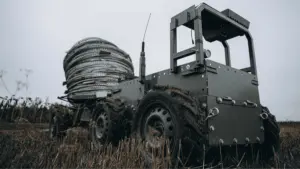
Yes. Today, robots carry out reconnaissance missions, strike targets (Middle Strike and Deep Strike), and deliver supplies by air. As for ground-based systems, their primary role is logistics. Hundreds of tonnes of cargo are already being transported without a person behind the wheel, using unmanned ground vehicles (UGVs).
The second area involves kamikaze ground robotic systems and platforms equipped with turrets. All these systems require only ground support teams and a pilot, who can be located anywhere in Ukraine.
What are Russian forces good at today?
Any technological advantage lasts only until the enemy adapts. Once they adapt, the question becomes one of scaling up. And this is where the Russians are strong. We lag behind the enemy specifically when it comes to scaling up technology.
We have many manufacturers and high-quality technologies. But we cannot scale all of them up sufficiently.
Take jet-powered Shahed drones, for example. Their first use was reported a year and a half ago. Many predicted that they would account for 8–10% of the total, but today that figure has exceeded 50%. And only now are we looking for effective countermeasures.
The same applies to the Bandеrol drone-missile, which is made entirely of civilian components and which the enemy is now scaling up.
So, is the future of warfare asymmetric warfare?
Absolutely. And this is not the warfare of the future — it is the warfare of today. Conventional warfare, in which victory goes to the side with greater resources, has taken a back seat. Today, it is about striking the right targets and choosing them precisely.
You have gone from serving in an assault unit to working with unmanned systems. How has this changed your understanding of what it means to be an effective military commander?
First, trust. You cannot be effective if your personnel do not trust you. If people understand that you treat them as an asset worth investing in for the sake of a shared goal, that investment will pay off.
Second, building systems. At the beginning of the war, you could get by with minimal leadership and rely on past experience. But today, the war has been going on for a long time, and personnel come from diverse backgrounds. You need to keep investing in people and raising their level of competence.
Kraken was formed largely from football ultras. Does that football hooligan background still help in the unmanned systems regiment, or do those principles no longer work?
I wouldn’t say they no longer work, but that feels like a previous life now. At the beginning of the war, having the right character was enough to achieve significant results. You simply had to be willing to make decisions without fear.
Today, however, the war has dragged on, and everything depends on systems. It is about building systems and working consistently. I tell my team that we are organising our work as if we were going to be at war for another ten years. You are not a sprinter; you are a marathon runner.
Luhansk in 2014, Memories of Home and War on Native Soil
You are from Luhansk and were an active member of the Zorya football fan movement. Why do you think the passionate pro-Ukrainian minority in Luhansk failed to change the course of events in 2014 the way people did in Kyiv during the Maidan protests?
Perhaps there was not a sufficiently large critical mass of these passionate pro-Ukrainian activists. Most of the so-called pro-Russian activists were workers brought in from mining towns — people who were tired of life and dissatisfied with what was happening in the country.
It is clear that the core of the movement consisted of Russians who had arrived to direct the seizure of buildings, while the crowds simply followed their lead. Why did the Ukrainian side fail? There was a lack of leaders with ties to the state apparatus. No one in the administration or the police stepped up to provide leadership.
Leadership emerged only on the streets. One of the leaders in Luhansk was Tymur Yuldashev, who later went to war and was killed, becoming a Hero of Ukraine. But there were too few leaders like him to unite all that passion and mount resistance.
How did you perceive the atmosphere at the time? Did you think things would escalate into what they eventually became?
One of my relatives said at the very beginning, “This will last ten years.” At first, I thought, what do you mean, ten years? But when the National Guard began withdrawing from certain facilities, I realised that clearing one building was one thing, while taking back control of an entire city was much more difficult.
By the summer, after Ilovaisk, I realised this would last a very long time. I was eighteen at the time.
How did you resist back then? What did you do?
It was street activism and direct-action protests. We tried to protect the pro-Ukrainian population during clashes, using force and whatever we had at hand, including metal rebar.
I remember 9 March, Shevchenko’s birthday. There was a pro-Ukrainian rally where people read poetry. Pro-Russian activists gathered opposite us. Organised groups of people came out and advanced on our rally. I saw elderly men and women with opposing views beating one another with flagpoles. That image has stayed with me forever.
Today, drones from your regiment strike targets in the temporarily occupied part of Luhansk region — Starobilsk, Shchastia and Rubizhne. When places you have known since childhood appear on the screen, how does that make you feel?
The first Middle Strike flights over Luhansk region felt as though I had visited those places for the first time in more than ten years. You get to see what is actually happening there now.
Today, it is painful for me to look at destroyed cities. I understand that every family is facing a tragedy — some people have nowhere left to return to. But a commander cannot dwell on this all the time, because it would affect decision-making.
When our drones fly into Luhansk or Starobilsk, they strike enemy logistics, depots and command posts. I wouldn’t say I feel any particular emotion beyond whether the mission has been successfully completed or not.
The last time you were in Luhansk was in 2014. Have you ever seen something through a drone camera that immediately brought back memories?
There are certain landmarks you recognise. I remember when we flew over the railway station — I immediately recognised the monument to Voroshilov. You realise: “Oh, right, we used to meet there.” So, yes, certain memories come back.
Kraken has become part of wartime folklore. What would you say are the key elements of this cultural phenomenon today?
The story of Kraken as a kind of mythical monster continues to evolve. All those quotes like “Release the Kraken!” are still around — you keep hearing them and seeing them on T-shirts.
It is good that people in Kharkiv recognise Kraken’s contribution to defending the city in the first days and months of the war. They say, “Kraken are our defenders,” and that feels really good.
Almost three years ago, you said that 30,000 well-trained soldiers were better than 100,000 untrained ones. Do you still believe that?
Yes. The Third Army Corps was defending its positions against three Russian armies whose combined strength was well over 100,000 troops. Our corps was not far off 30,000 in size.
We can see the results: the enemy is retreating. So I would refine my view: 30,000 well-trained, technologically equipped soldiers using technology intelligently are stronger even than 200,000.