The Russian “special operation” to seize Crimea began three days before the end of the Winter Olympics in Sochi, which took place from February 7 to 23, 2014.
February 20, 2014: From Kozacha Bay in Sevastopol, where the 810th Marine Brigade of the Russian Black Sea Fleet (BSF RF) is based, a column of armored vehicles left Sevastopol. Russian authorities explained that the Black Sea Fleet was putting its units in Crimea on high alert due to the tense political situation in Ukraine.The marines were tasked with reinforcing security at other BSF bases in Crimea, including garrisons near Simferopol (airbase in the settlement of Hvardiyske) and in Feodosia.
February 20–23, 2014: A separate GRU Spetsnaz brigade from Tolyatti was deployed to Crimea “to guard one of the strategic objects.”
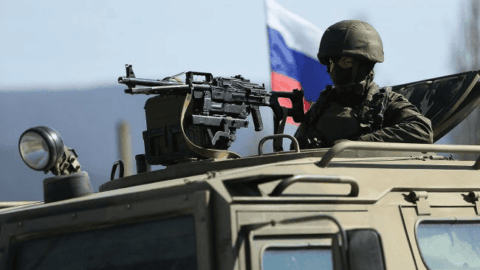
February 23, 2014: Sevastopol effectively came under Russian control. A “people’s mayor” was elected at a local rally, and “self-defense units” were formed. Russian troops in unmarked uniforms, later dubbed “little green men,” operated together with these units.The Winter Olympics in Sochi concluded on February 23, 2014. The Russian Black Sea Fleet ships that had secured the Olympics returned to Novorossiysk.
February 24, 2014: Russian armored personnel carriers (APCs) completely blocked access to Sevastopol.
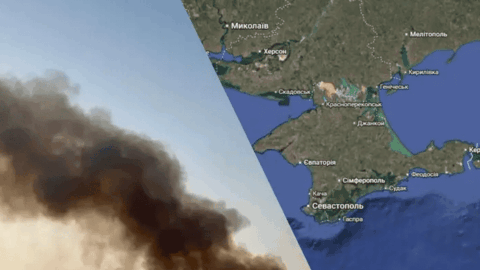
Sevastopol became the initial point of the Crimea occupation, as it hosted the Black Sea Fleet HQ, the main ship units, and the marine brigade.On the same day, the “Olympic” squadron of the Black Sea Fleet embarked airborne and marine special forces from Novorossiysk with combat equipment to occupy Crimea and set course for Sevastopol.
During the Winter Olympics period in the Black Sea (Sochi–Novorossiysk):
Missile cruiser Moskva – departed Sevastopol Feb 3, 2014
Patrol ship (frigate) Smetlivy – departed Sevastopol Feb 3, 2014
Small anti-submarine ship (corvette) Aleksandrovets – Feb 4, 2014
Small anti-submarine ship (corvette) Muromets – Feb 4, 2014
Minehunter Kovrovets – Feb 4, 2014
Minehunter Turbinist – Feb 4, 2014
Medium reconnaissance ship Priazovye – Feb 4, 2014
In addition, the Russian fleet in the Black Sea included large landing ships (BDK) from the Black Sea, Northern, and Baltic Fleets, which regularly supplied Russian forces stationed at the naval base in Tartus, Syria, and delivered military equipment to Bashar al-Assad’s regime from Novorossiysk.
February 20 – March 25, 2014: During the Crimea occupation, 9 large landing ships operated in the Black Sea:
5 Black Sea Fleet ships: Saratov (150), Nikolay Filchenkov (152), Novocherkassk (142), Yamal (156), Azov (151)
2 Baltic Fleet ships: Kaliningrad (102), Minsk (127)
2 Northern Fleet ships: Olenegorsky Gornyak (112), Georgiy Pobedonosets (016)
Additionally, at least 9 Black Sea Fleet ships based in Novorossiysk and 8 Russian FSB coastal guard ships operated in the Black Sea.
February 25, 2014: The Black Sea Fleet squadron returned to Sevastopol after the Olympics, bringing several thousand troops and equipment. Russian marines were placed on high alert, and family lists were prepared for possible evacuation.
February 25, 2014: A GRU special forces unit from Ulyanovsk arrived in Crimea.
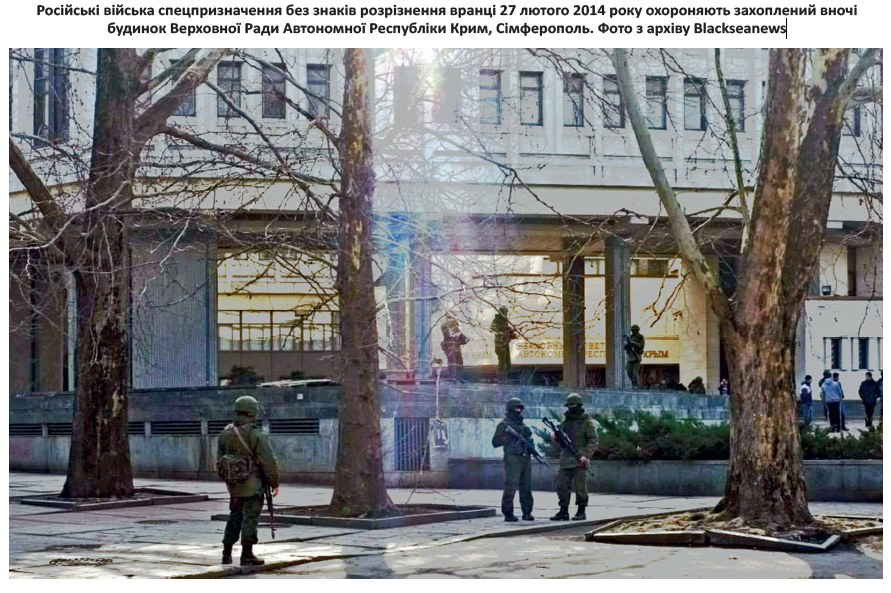
February 27, 2014: An airborne VDV Spetsnaz reconnaissance–sabotage group, arriving from Sevastopol in unmarked uniforms, captured the buildings of the Supreme Council and Council of Ministers of the Autonomous Republic of Crimea in Simferopol.
February 28, 2014:
The exit from Balaklava Bay (Sevastopol), where Ukrainian naval border guard ships were stationed, was blocked by the missile boat Ivanovets (954) of the Black Sea Fleet.The Ukrainian border guard unit in Balaklava was surrounded by Russian Spetsnaz.Columns of Russian armored vehicles, including Tigr vehicles and other previously unseen weaponry, advanced toward Simferopol and captured Simferopol and Belbek airports.
March 1, 2014:
The President of Russia requested the Federation Council’s approval to deploy troops “to stabilize the socio-political situation in Ukraine,” which was granted.
Two large landing ships from the Baltic Fleet, Kaliningrad (102) and Minsk (127), arrived in Sevastopol with troops and equipment from Novorossiysk.
Feodosia Bay and Port were blocked by air-cushion missile ships Bora and Samum of the Black Sea Fleet.
March 2, 2014:
Two Northern Fleet landing ships, Olenegorsky Gornyak (112) and Georgiy Pobedonosets (016), arrived in Sevastopol with troops and equipment.
Russian forces captured the Presidential Administration building in Crimea, blockaded Ukrainian marine battalions in Feodosia and Kerch, the coastal defense brigade in Perevalne, and headquarters of the Azov-Black Sea regional administration and Simferopol border detachment.
March 3, 2014:
Russian ships blocked the Sevastopol Bay exit to prevent Ukrainian Navy vessels from leaving or the flagship frigate Hetman Sahaydachny (U130) from entering.All Ukrainian military units in Crimea were blockaded until March 25, 2014.
Black Sea Fleet commander Admiral Aleksandr Vitko issued an ultimatum: Ukrainian forces must surrender by 5 a.m., March 4, 2014, or assaults on Ukrainian units would begin.Russian Spetsnaz captured the Kerch ferry crossing and the Kerch maritime border detachment.
March 5, 2014:
Five Russian landing ships arrived again from Novorossiysk, unloading at least 300 troops and 20 vehicles per ship.
From the BDK Azov, seven BTR-80 armored vehicles and Sturm anti-tank complexes were deployed.
March 6, 2014:
In Donuzlav Lake near Yevpatoria, old Ukrainian ships were scuttled by Russia to block the exit and prevent Ukrainian ships from reaching Odesa.
March 7, 2014:
Russian troops had captured all administrative buildings, blocked access to the peninsula, and controlled all Ukrainian Navy points and military garrisons.
Approximately 10,000 Russian troops and equipment were deployed, including mobile coastal anti-ship missile systems.Troop redeployments occurred via the Kerch ferry crossing.
18 Russian military trucks landed at Cape Chauda, Feodosia Bay, setting up a field camp to receive reinforcements from landing ships.
March 14, 2014:
A rail convoy of 14 S-300 PMU anti-aircraft missile systems moved from the Kerch ferry crossing into Crimea.
To be continued.
Tags: 2014 Ukraine war Black Sea Fleet Crimea occupation GRU operations military timeline russian invasion Sevastopol takeover